B2B Sales
AI-Driven Coaching for Better Sales Collaboration
Mar 16, 2026
AI sales coaching delivers real-time call feedback, automates CRM tasks, enforces playbooks, and boosts win rates, conversions, and quota attainment.
AI coaching is transforming sales collaboration by addressing common team challenges and boosting performance.
Here’s why it matters:
67% of sellers missed quotas in 2024, with only 24% of their week spent selling.
Managers review less than 10% of calls, leaving 90% of interactions without feedback.
Teams using AI coaching are 1.3x more likely to grow revenue, with some seeing a 30% increase in deal conversions.
Key Benefits of AI Coaching:
Real-Time Feedback: AI analyzes 100% of calls, offering live guidance to improve outcomes immediately.
Streamlined Processes: Automates CRM updates, saving reps 19.5 hours per week.
Improved Training: Reinforces skills daily, helping reps retain knowledge and close more deals.
Team Alignment: Standardizes practices across teams, ensuring consistent execution.
Results:
Companies like Bureau saw a 30% boost in conversions, while others cut coaching time by half and improved quota attainment by 39%.
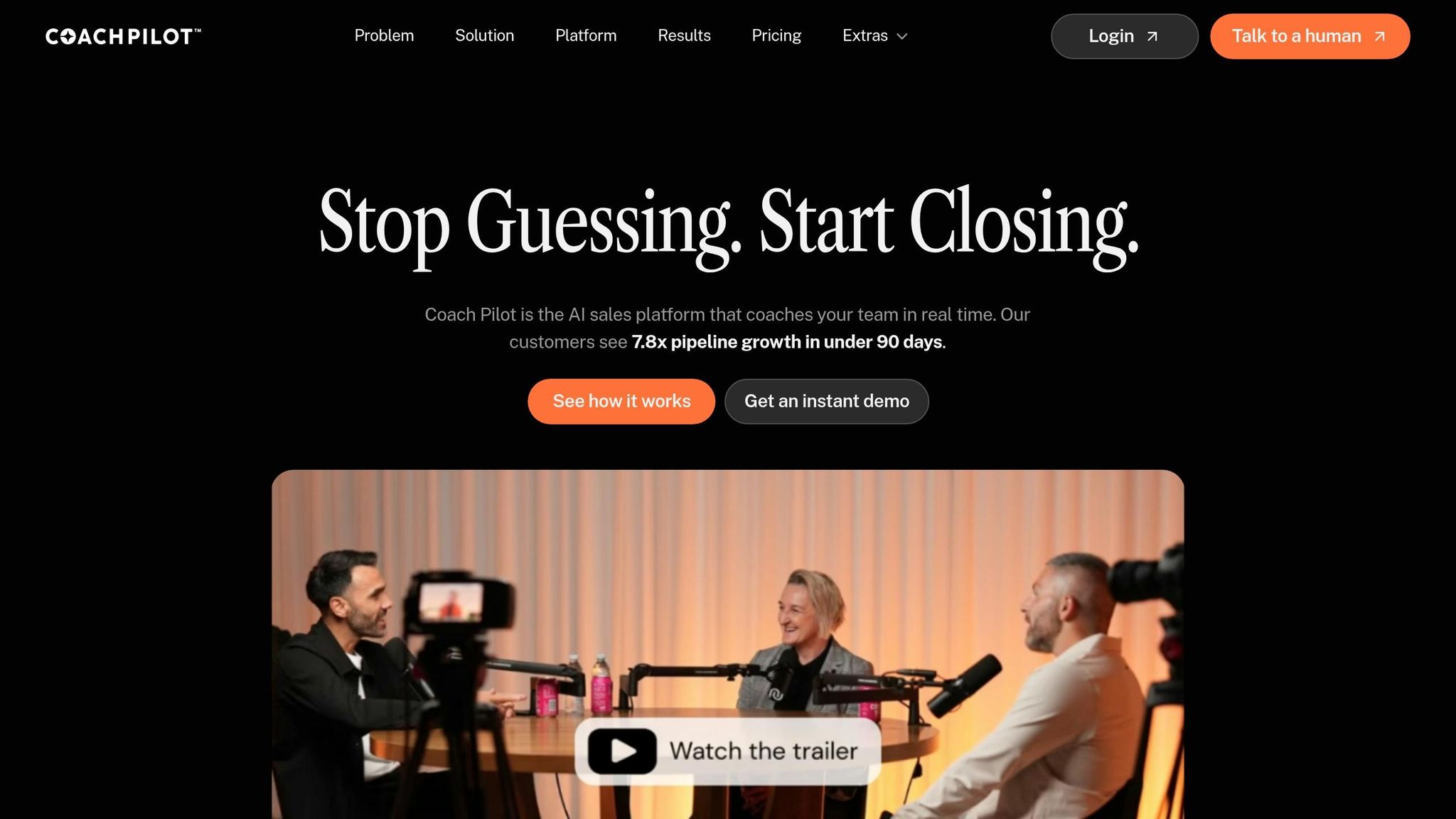
If your sales team struggles with inconsistent messaging, poor follow-ups, or delayed feedback, AI-driven coaching could be the solution. Platforms like Coach Pilot integrate directly into workflows, providing structured playbooks, real-time guidance, and actionable analytics to drive measurable improvements.
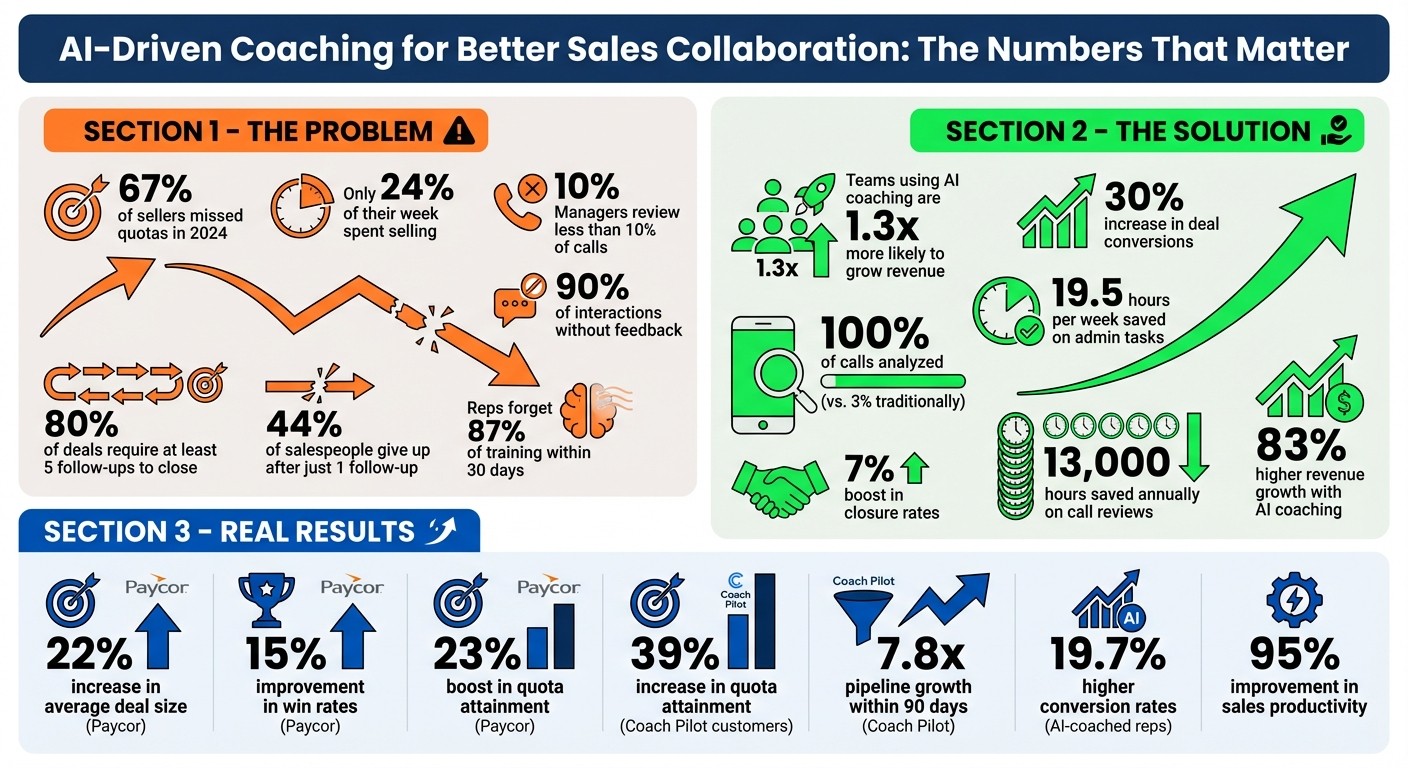
AI-Driven Sales Coaching Impact: Key Statistics and Results
Main Collaboration Challenges in Sales Teams
Inconsistent Use of Sales Playbooks
Sales playbooks often end up as static PDFs that gather dust, ignored by reps during live deals. Instead of sticking to proven strategies, many salespeople improvise, leading to what's called "messaging drift." This happens when reps stray from established value propositions, leaving prospects confused and weakening your market position. Here's a telling statistic: only 19% of sales teams maintain a regular coaching schedule, while 81% of reps say they don't get personalized coaching tailored to their needs [10][12]. Companies with structured coaching processes, however, see a 91% quota attainment rate compared to 85% for those without structured approaches [10]. Poor communication only worsens the issue, making it harder to maintain a unified sales strategy.
Poor Communication and Objection Handling
Weak communication can derail the entire sales process. Without clear frameworks, reps may skip important discovery questions or fail to address customer pain points effectively. This often leads to poorly executed demos [12]. The lack of real-time coaching compounds the problem, as most interactions with prospects occur without immediate guidance. Even when coaching happens, feedback is often delayed by days or even weeks, making it harder for reps to fix their mistakes quickly [4][3].
"The fact that only 12% of teams are using AI for coaching... means the majority of the market is still using AI to go faster, not to get better" [13].
AI-driven coaching offers a solution by delivering instant feedback during live interactions, allowing reps to adjust their approach on the spot.
Missing Next Steps in the Sales Process
Far too many sales calls end without clear next steps, leaving deals to stall and prospects to slip away. This lack of follow-through not only affects forecasting accuracy but also wastes valuable time and effort [2][8]. The numbers back this up: 80% of deals require at least five follow-ups to close, yet 44% of salespeople give up after just one [6]. On top of that, sales reps can forget as much as 87% of what they learn in training within 30 days if those lessons aren't reinforced in their daily workflow [14]. AI tools can help by automating structured follow-ups, ensuring reps stay on track and avoid these common pitfalls. Many organizations are already using ChatGPT for teams to streamline these administrative tasks and improve overall efficiency.
Summary of Challenges
These issues collectively hinder sales effectiveness, as outlined below:
Barrier | Impact on Sales Outcome |
|---|---|
Inconsistent Playbook Use | Slower sales cycles and lost opportunities due to off-brand messaging [6] |
Poor Objection Handling | Lower win rates and increased friction in the buyer journey [7][8] |
Missing Next Steps | Stalled deals, "ghosting" by prospects, and inaccurate forecasting [2][8] |
Delayed Feedback | Extended ramp time for new hires and repetition of costly mistakes [2][7] |
Knowledge Silos | Critical expertise "walks out the door" when top performers leave [7] |
How AI-Driven Coaching Solves Collaboration Problems
Real-Time Feedback and Performance Insights
AI tools are changing the game for sales teams by offering real-time feedback during video calls on platforms like Zoom, Teams, and Google Meet. These tools capture audio, transcribe conversations almost instantly, and provide live suggestions while the conversation is still happening [16]. This means sales reps can adjust on the spot - whether they’re talking too much, missing shifts in buyer sentiment, or skipping over key discovery questions like budget or decision-making authority [15]. Tools such as Spiky and SalesGhost even track calls against frameworks like MEDDPICC or BANT in real time, flagging gaps before the call ends [15].
Traditional coaching methods typically review only a small fraction of calls - about 3% - but AI analyzes every second of every interaction. This comprehensive approach delivers objective, data-backed insights for 100% of calls [17]. The results? Teams see an average 7% boost in closure rates and save up to 13,000 hours annually on call reviews and CRM updates [15]. Plus, AI automatically syncs insights and next steps into the CRM, keeping everyone aligned on deal progress [15]. These real-time insights help create a cycle of continuous training and alignment, driving long-term performance improvements.
Better Training and Knowledge Retention
Here’s a challenge: people forget about 70% of new information within a day [18]. AI-driven coaching tackles this "forgetting curve" by offering daily micro-coaching and ongoing reinforcement. Instead of generic training sessions, AI pinpoints individual skill gaps - whether it’s in discovery or closing - and tailors development plans to each rep [18].
AI also captures the strategies of top performers by identifying patterns like ideal talk-to-listen ratios or effective messaging. It then shares these insights with the entire team, scaling success [7]. The impact is hard to ignore: teams using AI have achieved 83% higher revenue growth compared to those that don’t [6]. For example, Precina, a healthcare company, used Salesforce Agentforce to train clinicians for patient intake calls. The AI provided real-time feedback on essential skills like accuracy, compliance, and empathy [9].
"The winning formula is a hybrid model combining AI for data-driven consistency and scale with human coaches who provide empathy, strategic deal coaching, and mentorship." - Hyperbound [7]
Improved Team Alignment
AI doesn’t just improve individual performance; it also brings teams together by standardizing processes. It translates abstract sales methodologies like MEDDICC or Challenger into specific, measurable behaviors. Every rep gets evaluated using the same criteria, ensuring consistency [2]. Live guidance and battle cards further support reps during calls by surfacing the right messaging or technical details exactly when objections arise [16]. AI even automates CRM updates based on call transcripts, eliminating the need for manual data entry [17].
Take Paycor, for instance. They used AI-powered coaching to standardize key selling skills, and the results were impressive: a 22% increase in average deal size, a 15% improvement in win rates, and a 23% boost in quota attainment [11]. Since AI reviews every interaction - not just a small sample - it ensures no deviations from the playbook go unnoticed, closing the visibility gap that often challenges managers [17].
How Coach Pilot Improves Sales Collaboration
Custom Sales Playbooks and Training
Coach Pilot transforms static sales playbooks into "Living Playbooks" that integrate seamlessly into daily sales workflows [19][3]. These playbooks serve as active, practical tools, guiding sales reps through every stage of the deal. Acting as a standardization engine, the platform ensures that teams - whether based in New York or working remotely - adhere to consistent sales methodologies like MEDDIC or Challenger [2].
For instance, in June 2024, Connor Bell, a Business Development Manager at HubSpot, used Coach Pilot over an 11-week period to achieve impressive results: a 50% increase in net new opportunities, 12 closed deals, and a 38% boost in quarterly sales revenue. Similarly, Rebecca Veksler, Co-Founder of Four Rooms, reported tripling her company’s monthly sales within just 8 weeks in May 2024, closing 14 deals during that time [19]. These living playbooks lay the foundation for integrating AI coaching into sales enablement practices.
AI-Driven Coaching Built Into Workflows
Coach Pilot takes these playbooks a step further by embedding AI-driven coaching directly into existing workflows. This eliminates the need for reps to switch between tools, allowing them to stay focused on selling. By automatically capturing deal data during conversations, the platform saves sales reps an average of 19.5 hours per week on administrative tasks [19].
In May 2024, Naum Sekulovski, a Business Development Manager at Food By Us, used Coach Pilot’s integrated training to secure 13 contracts in just 9 weeks, driving a 45% increase in sales revenue [19]. Unlike traditional one-off training sessions, Coach Pilot offers continuous coaching, reinforcing skills and ensuring that teams stay aligned on best practices [19].
Sales Performance Analytics for Collaboration Tracking
Coach Pilot’s analytics go beyond coaching by turning team behaviors into actionable insights. By correlating behavioral data with revenue metrics, managers can pinpoint whether stalled deals are due to market challenges or execution gaps within the team [3]. The platform also identifies successful strategies used by top performers, such as when to involve executives or how to handle procurement, and shares these insights across the team [19].
The results speak for themselves: customers have reported 7.8x pipeline growth within the first 90 days and a 39% increase in quota attainment [19]. In May 2024, Ash Bent, Founder & CEO of Sketch & Etch, exceeded his quarterly sales goals by 43% after using Coach Pilot to align his sales team [19].
"We've significantly increased our pipeline and boosted our bottom line. The investment in this program has paid for itself many times over." - Costa Vasili, CEO, Ethnolink [19]
Measuring the Impact of AI on Sales Collaboration
Key Metrics for Measuring Collaboration Success
When it comes to improving sales collaboration, tracking the right metrics is crucial. Metrics can be broken down into two categories: leading indicators and lagging indicators. Leading indicators include factors like call adherence, how objections are handled, and whether next steps are clearly defined. On the other hand, lagging indicators focus on outcomes, such as win rates and revenue growth. AI tools bring an added advantage by analyzing conversational data, such as talk-to-listen ratios, the frequency of questions, and how well discussions cover key topics like pain points, budgets, and timelines [20][2].
Pipeline metrics also play a significant role in understanding the health of the sales process. These include stage conversion rates, time spent in each stage, and deal slip rates - when forecasted deals are delayed to the next period. Lagging indicators, such as average selling price, sales cycle length, and overall revenue growth, help measure the broader impact of improved collaboration [20][21]. Teams that integrate AI into their processes have reported 83% revenue growth, compared to 66% for those without AI [23]. Additionally, sales productivity can improve by 95% when AI is used for coaching activities [22].
Before rolling out any AI-driven coaching platform, it's essential to establish baseline metrics. Record current close rates, average deal sizes, ramp-up times, and the hours managers spend manually coaching their teams [21]. These benchmarks will help you measure the impact of AI later. Initially, focusing on high-impact behaviors - like conducting deeper discovery and clarifying next steps - can lead to faster pipeline movement [2]. These metrics provide a solid foundation for assessing how AI transforms sales performance.
Before and After AI Coaching Comparisons
Once these metrics are in place, compare performance outcomes before and after implementing AI-driven coaching. One of AI's standout advantages is its ability to review every interaction, addressing a significant gap in traditional coaching. For instance, while 90% of sales leaders claim to provide regular coaching, only 38% of reps say they actually receive it [23].
Consider this example: In September 2025, a mid-sized B2B services company introduced PathfinderAI's Sales Coaching Platform to tackle inconsistent performance. During a 60-day pilot, their close rate jumped from 17% to 35%, an impressive 18-point increase. Weekly performance volatility also stabilized, shifting from erratic 7–25% swings to a consistent 33–37% range [1]. Similarly, a 2025 study of 938 B2B teams found that AI-coached reps achieved 19.7% higher conversion rates compared to those receiving traditional coaching alone. Managers also saw their coaching time reduced from 8.3 hours per week to 4.7 hours [24].
To maximize results, a 30-60-90 day pilot framework can be highly effective. Start with the first 30 days to define objectives and gather baseline data, use the next 60 days to roll out playbooks, and evaluate improvements in win rates and sales cycle times by the 90-day mark [20][1]. To further validate the results, compare a group receiving AI coaching against a control group without it [20]. The best outcomes often come from blending AI's consistency with tailored human coaching [23].
Conclusion
Key Takeaways from AI-Driven Coaching
Sales collaboration thrives when teams stay aligned during live deals, and AI-driven coaching bridges the gap between strategy and execution. Instead of letting a B2B sales playbook sit unused in shared drives, AI integrates them directly into daily workflows. This turns theoretical methodologies into actionable behaviors that every sales rep can easily follow [2][19].
The results speak for themselves. Teams leveraging AI coaching are 1.3 times more likely to achieve revenue growth, while win rates see a 36% boost through AI-guided strategies [3][5]. On top of that, reps save an average of 19.5 hours per week by automating CRM updates and administrative tasks. This frees managers to focus on high-level deal strategies and team development [19]. Recent implementations have also led to measurable increases in new opportunities and quarterly revenue [19].
AI transforms sales teams by shifting from reactive analysis to real-time intervention. It acts as a consistency engine, ensuring uniform execution across distributed teams. With context-aware prompts and spaced learning, AI helps reps develop lasting habits that drive performance [2][3]. These results highlight why integrating real-time AI coaching into sales processes is a game-changer.
Next Steps for Sales Teams
If your team faces challenges like inconsistent playbook use, communication breakdowns, or unclear action plans, AI-driven coaching offers a clear solution. Start by documenting your top-performing discovery calls and defining key behaviors that lead to success [17].
For example, Coach Pilot customers have reported 7.8x pipeline growth within 90 days by embedding custom playbooks into workflows, delivering hands-on training, and integrating AI-driven coaching directly into their existing tools [19]. The platform combines tailored playbook creation, live workshops, and real-time AI guidance to close execution gaps and deliver predictable growth. By embedding AI into your daily sales routine, you align strategy with execution seamlessly.
To see how Coach Pilot can elevate your sales performance, visit https://coachpilot.com.
Sales Coaching Reimagined with Agentic AI
FAQs
What sales calls should AI coach first?
AI coaching shines when applied to sales calls that involve intricate interactions, handling objections, or navigating negotiations. These moments are pivotal, and real-time guidance can make all the difference in steering conversations toward success. It’s particularly useful during onboarding calls, where new sales reps benefit from support as they learn the ropes and familiarize themselves with the sales playbook. Additionally, AI coaching proves invaluable in calls with high-value prospects, ensuring that best practices are consistently followed. By focusing on these scenarios, sales teams can adapt more effectively and see improved outcomes.
How is ROI from AI coaching measured?
ROI from AI coaching can be tracked by looking at several key factors: broader coaching coverage, reduced time spent by managers, quicker onboarding for sales reps, and better overall sales performance. The results speak for themselves - AI coaching has been linked to higher conversion rates and shorter sales cycles. Specifically, data reveals a 19.7% boost in conversion rates and a 32.6% reduction in sales cycle duration when AI-driven recommendations are utilized.
Will AI coaching replace sales managers?
AI coaching has become a game-changer for boosting sales performance, but it’s not here to completely take over the role of sales managers. Sure, AI shines when it comes to handling large-scale tasks, offering instant feedback, and automating repetitive processes. But human managers bring something AI can’t replicate - emotional intelligence, trust, and the ability to provide deeply personalized coaching. The sweet spot? Using AI as a partner to sales managers. It frees them up to focus on strategic and relationship-building aspects of their work, rather than replacing their role altogether.
Related Blog Posts

Remove the guesswork from winning more deals.