B2B Sales
AI Feedback for Shorter Sales Cycles
Mar 16, 2026
Real-time AI feedback and coaching speed up sales cycles, improve conversion rates, boost revenue, and cut admin time for sales teams.

AI is transforming sales by making cycles faster and more efficient.
Here’s the key takeaway: AI tools analyze sales data in real time, offering instant feedback and actionable insights. This helps sales teams close deals faster, improve conversion rates, and generate more revenue without adding extra work.
Key Findings:
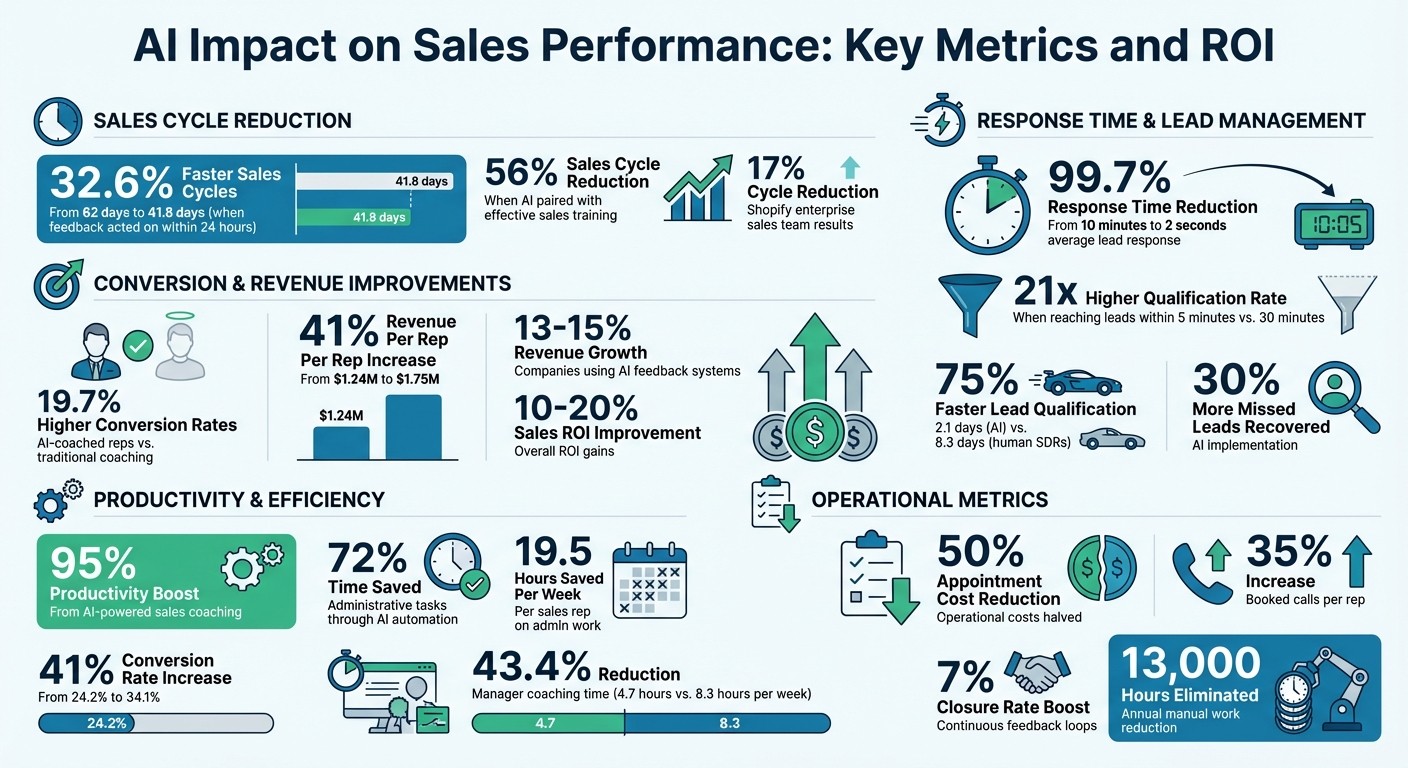
32.6% Faster Sales Cycles: AI reduces average sales cycles from 62 days to 41.8 days when feedback is acted on within 24 hours.
19.7% Higher Conversion Rates: AI-coached reps outperform those with traditional coaching.
13-15% Revenue Growth: Companies using AI see measurable increases in revenue and ROI.
95% Productivity Boost: AI eliminates time spent on admin tasks, allowing reps to focus on selling.
AI tools also enhance response times, improve lead prioritization, and provide real-time coaching during calls. These systems are reshaping sales by automating repetitive tasks, offering precise recommendations, and helping teams focus on high-impact activities.
If you’re looking to close deals faster and improve team performance, AI-driven feedback is the way forward.
AI Impact on Sales Performance: Key Metrics and ROI Statistics
What Great Looks Like in AI Sales Coaching Agents: 2025 Benchmark Report
Research Findings on AI's Impact on Sales Cycles
Recent studies continue to emphasize how AI is reshaping sales cycles, delivering faster results and improved outcomes. When paired with effective sales training, some organizations have reported cutting their sales cycles by up to 56% [9].
But it’s not just about speed. AI-assisted sales reps are outperforming their peers in key areas. For instance, AI-coached representatives achieved 19.7% higher conversion rates compared to those coached solely by managers [6]. Another study revealed that AI-enhanced reps boosted their conversion rates from 24.2% to 34.1%, a 41% increase. Alongside this, revenue per rep surged by 41%, climbing from $1.24 million to $1.75 million [7]. These improvements translate into quicker deal closures and more revenue in less time.
Response time is another area where AI shines. AI-powered systems have reduced average lead response times from 10 minutes to just 2 seconds [10]. This is crucial, as reaching out to a lead within five minutes instead of 30 minutes increases the likelihood of qualification by 21 times [8]. Additionally, while human sales development representatives (SDRs) take an average of 8.3 days to qualify a lead, AI agents can accomplish the same task in just 2.1 days [8].
The productivity gains are striking. Companies using AI for sales coaching report a 95% increase in productivity [9]. AI automation also saves sales teams from spending 72% of their time on administrative tasks, allowing them to focus on activities that drive revenue [5].
Performance Metrics Before and After AI Implementation
AI's impact extends beyond cycle time reductions, improving key performance metrics like costs, response times, and efficiency. For example, AI implementation has halved operational appointment costs and increased booked calls per rep by 35% [10]. Response times dropped by an astounding 99.7%, while companies managed to recover 30% more missed leads [10].
A hybrid approach - combining AI tools with human coaching - has proven particularly effective. Teams using this model reported the highest satisfaction scores (8.4 out of 10) and a long-term retention rate of 89% [6]. This setup not only accelerates sales cycles but also fosters better team morale and retention. Additionally, AI-only coaching required significantly less manager involvement, with just 4.7 hours per week compared to 8.3 hours for traditional human-only coaching - a 43.4% reduction [6].
AI's benefits vary across different sales stages. For instance, AI saves 8.7 days during the proposal stage by identifying missing stakeholders, 5.2 days in negotiations by flagging stalled legal reviews, and 5.0 days in the final stages by tracking contract approvals [6]. However, its impact is smaller during the discovery phase, saving only 1.3 days by addressing pre-qualifying questions [6].
How AI-Driven Feedback Mechanisms Work
AI feedback systems work through a streamlined process that analyzes sales conversations at lightning speed. Modern tools can process audio, transcribe speech, and identify intent in just 700 milliseconds[12]. This near-instant response turns coaching into an in-the-moment activity, making it possible to adjust strategies during live calls and potentially save deals on the brink. These advancements are the backbone of the efficiencies discussed earlier.
To ensure accuracy, these systems use dual-stream transcription, separating the sales rep's voice from the prospect's. This guarantees precise speaker identification and provides a clear view of conversational dynamics[12]. Natural Language Processing (NLP) takes things further by interpreting subtle cues, intent, and the overall flow of the conversation. This allows reps to address objections or answer complex questions immediately by tapping into the company’s knowledge base - eliminating delays that could disrupt deal progression[12][5].
One of the standout capabilities of these systems is their ability to pinpoint execution gaps in real time. AI flags missing qualification criteria (like MEDDIC or BANT), identifies single-threaded deals, and highlights weak business cases - all while the conversation is still happening[13][2]. It also tracks behavioral metrics, such as talk-to-listen ratios and speaking speed, nudging reps to pause for discovery or refine their delivery mid-call[13][15]. This blend of human insight and AI-driven data provides a level of support that would be impossible to achieve manually.
Real-Time Data and Continuous Feedback Loops
The move from reactive to proactive coaching has reshaped sales operations. Traditional coaching often relied on reviewing call recordings days or weeks later - a process some experts liken to "archaeology"[12][1]. By then, the window for meaningful intervention had often closed. Real-time AI coaching changes the game by analyzing conversations as they happen or immediately after, allowing for adjustments that can still influence the outcome[12][15].
These continuous feedback loops take unstructured conversations and turn them into structured data. This data automatically updates CRM fields, ensuring pipeline reviews are based on actual interactions rather than subjective memory[11][1]. For example, Versa Networks used AI-powered pipeline reviews to cut coaching time in half while improving consistency across their global sales team[1]. The system examined 100% of their calls, a sharp contrast to the random sampling typical of manual reviews[15][2].
Organizations leveraging these feedback loops have seen a 7% boost in closure rates and eliminated up to 13,000 hours of manual work annually[13].
Predictive Analytics and Sentiment Analysis
AI’s real-time insights pave the way for predictive analytics, which shifts the focus from analyzing past actions to anticipating future outcomes. Machine learning models evaluate historical data, online behavior, and past interactions to score leads, helping reps prioritize those most likely to convert[5]. These systems go beyond basic activity tracking, identifying risks like single-threaded deals or low executive engagement before they derail opportunities[1].
Sentiment analysis adds another layer by interpreting the emotional undertones of customer conversations. NLP picks up on subtle cues - changes in tone, hesitation, or buying signals - that might go unnoticed during a fast-paced call[12][5]. For example, Bureau used AI-driven automation paired with coaching to refine its discovery process, resulting in a 30% increase in deal conversions[1]. Instead of just instructing reps on what to say, the system guided them on when to say it, based on real-time sentiment cues.
Personalization plays a critical role here. AI evaluates calls against established sales frameworks like MEDDIC, Challenger, or GAP Selling to provide tailored feedback on areas like discovery or objection handling[14][2]. By aligning coaching with each rep’s skill level and deal specifics, organizations ensure that feedback is both relevant and actionable. Companies using AI systems have reported a 50% increase in leads and appointments[5], as well as revenue growth ranging from 3% to 15% and sales ROI improvements of 10% to 20%[5][16].
"The tool's AI-driven coaching feedback also gives managers tremendous insight and direction on their team's performance, giving them the ability to have greater impact across their teams."
This combination of predictive analytics and sentiment analysis delivers what some call "atomic insights" - concise, actionable feedback that eliminates the need for hours of manual review[16]. By automating administrative tasks, these tools help sellers reclaim time, allowing them to focus more on high-value conversations. Currently, sellers spend only 24% of their week actively selling[1], but AI is helping shift that balance toward activities that actually close deals.
Case Studies: AI Feedback Success Stories
B2B Companies Using AI Feedback
When theory meets practice, the results can be game-changing. Take TechForge Industrial, for example. This precision parts manufacturer, under the leadership of VP Sarah Martinez, embraced an AI-driven system in January 2024. By July, they had cut their sales cycle almost in half - from 52 days to just 28. That’s not all: revenue jumped by 20% (adding $1.7M), and automated lead scoring slashed the time spent on manual prioritization by a staggering 95% [17].
Another standout is TechVantage, a B2B SaaS company with a 50-person sales team. Before AI, they struggled with an 18% win rate and a lengthy 60-day deal cycle. But after integrating AI-powered predictive lead scoring and automated playbooks in July 2024, the transformation was dramatic. Within six months, their win rate doubled to 36%, the deal cycle shortened by 22% (down to 47 days), and they added $3.2M in incremental ARR [18].
"We spent $89K and got back $1.27M in 6 months. But the real value isn't the math - it's that my team is happy again. They're not grinding through junk leads anymore." - Rebecca Martinez, VP of Sales, TechVantage [18]
Even Shopify's enterprise sales team saw impressive gains. By automating MEDDIC qualification and CRM data entry with AI agents, they reduced their sales cycle by 17% and significantly lightened administrative workloads [20]. These examples highlight how AI feedback can revolutionize B2B operations, setting the stage for similar breakthroughs in other sectors.
Retail Applications: Feedback and Customer Experience
AI feedback isn’t just reshaping B2B - it’s making waves in retail too. Taylor Morrison, for instance, introduced AI coaching for its sales reps during model-home visits. According to Community Sales Manager Austin Lanford, this led to faster results: the time from first visit to contract dropped by 4.5 days, appointment-to-contract rates climbed by 16%, and average project values saw a 10% boost [21]. These improvements translate directly into quicker revenue generation, reinforcing earlier research findings.
DJ & Lindsey Real Estate, a brokerage with 79 agents, offers another compelling example. Between January and April 2025, AI call coaching analyzed every sales conversation. The result? Outbound call activity skyrocketed by 119%, and the team closed 119 deals in just four months, generating an additional $120,000 in revenue [19].
Even in the competitive world of retail, AI tools are proving their worth. Mattress Firm rolled out SleepExpert.AI to assist sales associates with instant answers about product specs, promotions, and financing options, allowing them to focus fully on customer interactions. They also introduced Drill Mode, an interactive AI roleplay system that lets staff practice sales techniques during downtime, turning quiet moments into valuable coaching opportunities [22].
These examples showcase how AI feedback is not only boosting efficiency but also enhancing the overall customer experience in retail.
Coach Pilot: AI-Driven Coaching for Shorter Sales Cycles
The examples above showcase the potential of AI feedback, but putting it into practice is where many teams hit roadblocks. That’s where Coach Pilot steps in. By embedding AI-driven coaching directly into sales workflows, it transforms insights into action. Instead of simply reporting what happened, it tells sales reps exactly what to do next. Coach Pilot bridges the gap between strategy and real-time execution, making it a game-changer for sales teams.
Custom Playbooks and Training
Coach Pilot takes your tried-and-true sales process and turns it into dynamic, real-time coaching. Forget those static PDF playbooks - this platform integrates your winning strategies into daily workflows through AI-powered guidance [23]. The result? Every team member follows the same proven methodology, cutting out inconsistencies that often drag out sales cycles.
Take the success stories from May 2024, for instance. Rebecca Veksler, Co-Founder of Four Rooms, shared how her team tripled monthly sales and closed 14 new deals in just 8 weeks thanks to Coach Pilot's tailored support [23]. Similarly, Naum Sekulovski, BDM at Food By Us, achieved 13 new contracts in 9 weeks, driving a 45% boost in sales revenue. He credited this success to the foundational skills and strategies provided by the platform, which completely transformed his approach to the role [23].
These customized playbooks set the stage for precise, real-time coaching, which is explored further below.
AI-Driven Real-Time Coaching
Unlike tools that merely summarize past performance, Coach Pilot delivers actionable next steps during live deals. By automatically capturing deal specifics and suggesting immediate adjustments, it not only improves results but also saves sales reps an average of 19.5 hours per week on admin tasks [23][4]. This focus on real-time guidance ensures that reps can make corrections during active interactions, rather than after the fact [4].
The impact is clear. In June 2024, Connor Bell, a BDM at HubSpot, used Coach Pilot to create 50% more net new opportunities. Over an 11-week period, he closed 12 new deals, leading to a 38% increase in quarterly sales revenue [23]. The platform’s in-the-moment prompts - like adjusting talk-to-listen ratios during calls - played a key role in this rapid improvement.
"Coach Pilot has helped me generate 50% more net new opportunities. Over an 11-week period, I was able to secure 12 new deals, resulting in a 38% increase in our quarterly sales revenue." - Connor Bell, BDM, HubSpot [23]
The results speak for themselves. Customers report a 7.8x increase in pipeline growth within the first 90 days of using Coach Pilot, with teams achieving a 39% boost in quota attainment by replacing generic outreach with tailored, value-driven messaging [23]. Another example comes from December 2024, when Stephen Luxmoore, Founder & CEO of Your HR Team, saw a 32% rise in new client acquisitions, signing 8 contracts in just 9 weeks. He attributed this success to the platform’s actionable strategies and personalized advice, which helped improve his company’s market position [23].
Conclusion
Research indicates that AI-driven feedback mechanisms can cut sales cycle times by 10–30% by removing obstacles during the discovery and qualification phases[8]. Sales reps who act on AI recommendations within 24 hours see sales cycles shrink by 32.6%, alongside a 19.7% boost in conversion rates compared to traditional coaching methods[6].
Beyond speeding up processes, AI integration delivers measurable improvements in performance. Metrics consistently show reduced sales cycle durations and enhanced productivity, alongside better conversion rates[9][1]. AI-driven coaching adapts to provide tailored guidance for every sales rep, ensuring no one is left behind[3][4].
To truly maximize its impact, AI technology must become part of daily workflows. The most effective platforms integrate coaching tools directly into sales activities, transforming insights into actionable strategies. For example, Coach Pilot seamlessly embeds AI coaching into tailored sales playbooks and training programs. This approach bridges the gap between strategic insights and everyday execution, ensuring that reps can act on recommendations without delay.
Incorporating AI-driven feedback doesn't just make sales faster - it makes them smarter. By automating routine tasks and delivering real-time coaching, these tools allow managers to focus on bigger-picture strategies while empowering reps to perform better. The result? Shorter sales cycles and quicker revenue generation. For sales leaders aiming to streamline processes and achieve lasting results, AI-powered solutions are no longer optional - they’re a game changer.
FAQs
How do I start using AI feedback without changing our whole sales process?
You can bring AI-powered coaching tools into your workflow without overhauling your existing systems. For example, AI roleplay coaching can help sales reps practice their conversations and fine-tune their messaging. Additionally, call analysis tools can deliver real-time feedback, making it easier to spot areas for improvement on the spot. The key is to start with tools that align with your current processes. Once your team gets the hang of it, you can gradually expand their use to boost performance and speed up sales cycles.
What sales data does AI need to provide accurate coaching and next steps?
AI thrives on analyzing sales interactions in real time. This includes breaking down speech patterns, understanding the context of conversations, identifying objections, gauging buyer sentiment, and tracking engagement trends. By processing these insights, AI provides targeted coaching and actionable recommendations, empowering sales teams to work more efficiently and close deals faster.
How can managers ensure reps act on AI recommendations within 24 hours?
Managers can encourage sales reps to act on AI recommendations within 24 hours by integrating AI-driven coaching directly into their daily routines and leveraging real-time feedback tools. Research indicates that quick action can noticeably shorten sales cycles, making a fast response culture essential. Tools like automated alerts and tailored coaching prompts ensure reps can quickly review and apply suggestions, helping them get the most out of AI insights.
Related Blog Posts

Remove the guesswork from winning more deals.