B2B Sales
AI Coaching for Data-Driven Sales Leadership
Mar 7, 2026
AI coaching analyzes every call, email, and meeting to deliver real-time feedback, scale coaching across teams, improve win rates, and accelerate onboarding.
Sales coaching is changing. With longer B2B sales cycles, more decision-makers, and only 5% of managers’ time spent on coaching, traditional methods fall short. AI coaching tools are stepping in to analyze 100% of sales interactions - calls, emails, meetings - delivering real-time feedback and insights that managers can use to guide their teams effectively.
Key Takeaways:
AI coaching analyzes every interaction: Unlike manual reviews that cover only 3% of calls, AI tools provide visibility into all customer conversations.
Real-time feedback: AI delivers actionable insights during or immediately after calls, helping reps improve on the spot.
Scalable coaching: AI enables one manager to oversee and coach 20+ reps, compared to the typical 6–8.
Improved metrics: Teams using AI coaching see win rates rise by up to 32% and revenue forecasting becomes more accurate.
The shift to AI coaching isn’t just about saving time - it’s about making every sales interaction count. By automating data collection and delivering actionable insights, AI empowers leaders to focus on driving results.
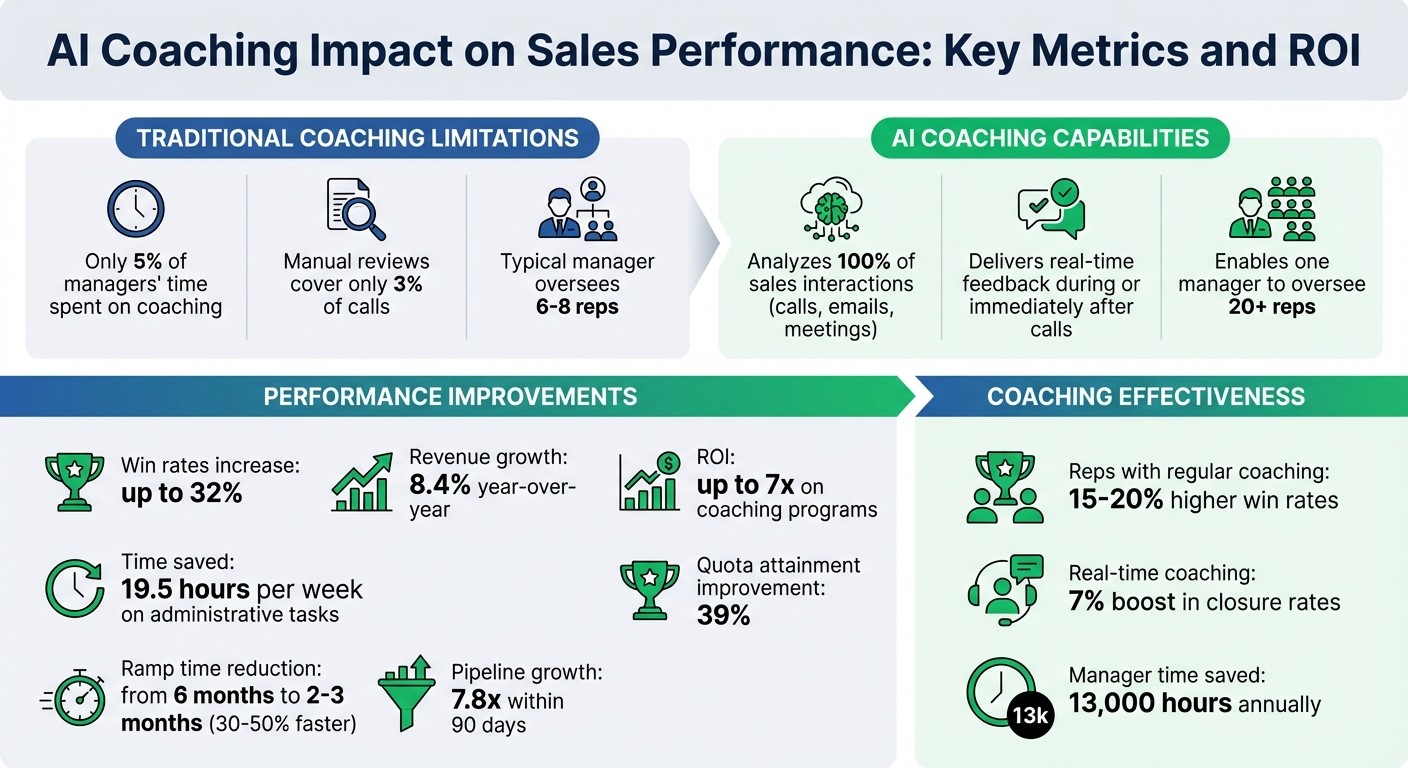
AI Coaching Impact on Sales Performance: Key Metrics and ROI
I Built an AI Sales Coach That Analyzes Your Calls (n8n tutorial)
Core Principles of Data-Driven Sales Leadership
Data-driven sales leadership thrives on tracking the right metrics and building a solid foundation of reliable data. This approach replaces guesswork with informed strategies. Even the most advanced AI coaching tools are ineffective without accurate metrics and structured data. Let’s dive into the key metrics and data practices that make this approach successful.
Key Metrics That Define Sales Leadership Success
Sales leaders need to monitor two types of metrics: lagging indicators and leading indicators. Lagging indicators, such as quota attainment, revenue, average selling price (ASP), and win rate, reflect past performance. Leading indicators, like pipeline velocity, stage conversion rates, talk-to-listen ratios, and next-step hygiene, offer insights into future outcomes [9][11].
Pipeline metrics, including coverage ratio, slip rate, and deal velocity, are essential for accurate forecasting [9][11]. Additionally, evaluating the impact of coaching is critical. Sales representatives who receive regular, high-quality coaching experience win rates that are 15–20% higher than those who don’t [11]. Teams with data-driven coaching programs can see win rates improve by as much as 32%, with structured coaching initiatives yielding an ROI of up to 7× [8].
Building a Reliable Data Infrastructure
AI coaching tools can only deliver meaningful insights if they’re fed with accurate, comprehensive data. Automated and standardized data capture is crucial for ensuring every interaction - emails, calls, meetings - is recorded in the CRM without requiring manual input. This streamlined process saves sales reps an average of 19.5 hours per week on administrative tasks [13].
To ensure fairness and consistency, organizations need to adopt standardized metrics and playbooks. This includes using uniform field names, consistent scoring rubrics (e.g., a 1–5 scale for discovery skills), and a unified sales methodology [3][10][11][12].
"Sales leaders should drive alignment across the organization by ensuring that each manager has access to the same data and playbook to lead their teams."
– Jill Brown, North American VP of Sales, People.ai [3]
A strong data system lays the groundwork for an AI workspace for smarter selling to provide real-time coaching and accurate insights. Companies that implement these practices often report significant gains in both revenue and efficiency [13].
Start by identifying and addressing existing data challenges - such as manually updated account plans or missing performance data - before rolling out AI solutions [14]. Set clear success benchmarks, like the percentage of accounts with AI-driven plans or improvements in conversion rates, and establish regular reporting schedules to monitor progress [14]. Finally, ensure that AI systems have access to at least two years of historical data to uncover actionable patterns [3][6].
How AI Coaching Transforms Sales Leadership
AI coaching is reshaping sales leadership by turning raw data into actionable insights that can be used immediately. Unlike traditional methods that often overlook the majority of customer interactions, AI dives deep - analyzing every call, email, and CRM activity to deliver a full view of a team’s performance [1]. This level of analysis helps transform overwhelming data into targeted, real-time coaching opportunities.
From Data to Insights: How AI Analyzes Sales Performance
AI tools work by capturing audio from platforms like Zoom or Microsoft Teams and converting speech to text in under 700 milliseconds [16]. These systems dig into behavioral patterns, examining talk-to-listen ratios, filler words, and sentiment changes in both sales reps and prospects [1, 24]. They also align these insights with established frameworks like MEDDICC or SPICED to ensure key deal components - such as identifying the economic buyer - are addressed [2].
The technology doesn’t stop there. It generates smart call summaries, highlights coachable moments, and flags stalled deals or missing stakeholders for leadership attention [3, 23]. These insights are seamlessly integrated into CRMs like Salesforce or HubSpot, turning unstructured conversations into structured, actionable data that supports accurate pipeline forecasting [24, 25]. For instance, Bureau implemented AI coaching in 2025 to improve discovery calls, which led to a 30% increase in deal conversions [17].
Real-Time and Asynchronous Coaching for Leaders
AI coaching operates in two powerful ways: live during interactions and asynchronously afterward. Real-time coaching delivers critical information - like battle cards or technical details - exactly when a prospect asks a question, processing data almost instantly [16]. Meanwhile, asynchronous coaching focuses on post-call analysis, allowing sales reps to refine their skills with AI training bots that mimic real customer scenarios [6, 25].
This dual approach is highly effective. Real-time coaching has been shown to boost closure rates by 7% and save managers up to 13,000 hours annually [20]. A great example is Versa Networks, which used behavior-driven AI coaching to cut coaching time for managers in half while ensuring consistency across their global teams.
"AI provides the diagnostics; the manager provides the cure." - Jonathan M Kvarfordt, Momentum [1]
Improving Forecast Accuracy and Planning
AI also improves sales forecasting by analyzing behavioral signals like multi-threading, executive involvement, and agreed-upon next steps, while identifying risks such as delayed responses or stagnant sentiment [23, 26]. It evaluates critical deal elements - such as the presence of a mutual close plan or identifying the economic buyer - to provide an objective health score for each deal [3, 9].
This shifts pipeline reviews from backward-looking assessments to forward-thinking strategies.
"AI presents the potential to serve as a second brain, helping bridge the gap between a sea of data to having effective coaching conversations." - Jason Creane, Sales Leadership Enablement at Zscaler [6]
With AI-driven insights, sales teams are 1.3 times more likely to achieve revenue growth [17]. These tools empower leaders to move beyond reactive problem-solving, enabling them to execute strategic plans that drive their teams toward success.
Practical Use Cases for AI Coaching in Sales Leadership
AI coaching is transforming sales leadership by ensuring consistent practices, speeding up new hire readiness, and freeing up leaders to focus on strategic tasks.
Standardizing Coaching Across Teams
One of AI's biggest advantages is its ability to remove inconsistencies in coaching. Unlike traditional methods, where feedback often depends on subjective impressions, AI uses uniform evaluation criteria for every interaction. This ensures fairness and accuracy. For example, Paycor saw impressive results with this approach, including a 22% jump in average deal size, a 15% increase in win rate, and a 23% boost in quota attainment in 2025 [22]. By standardizing coaching, they ensured that every team member practiced essential skills, creating a unified performance baseline. This prevents the common issue of the unused sales playbook by embedding guidance directly into the workflow.
Versa Networks experienced similar benefits, cutting coaching time in half while maintaining consistent feedback across their global sales teams [17]. AI's ability to benchmark reps against top performers eliminated the need for guesswork. These "performance fingerprints" allowed managers to focus on measurable behaviors rather than relying on gut instincts [21][17]. In 2025, Visa used this method to maintain consistency during frequent product launches, helping their sales teams refine pitches in as little as 30 minutes [22].
"AI can reduce many human biases like favorite rep syndrome and recency bias. When every call gets scored against the same rubric regardless of who made it, reps gain confidence in the fairness of feedback." - Frederick Meiners [21]
"AI provides the diagnostics; the manager provides the cure." - Jonathan M. Kvarfordt, Momentum [1]
Accelerating Onboarding and Ramp Times
AI coaching also plays a key role in getting new hires up to speed faster. By enabling reps to engage in over 100 practice conversations before their first real call, AI can reduce onboarding times from six months to just 2–3 months [23]. For instance, Precina, a healthcare company, used Salesforce Agentforce in 2025 to train clinicians for patient intake calls. AI offered a 24/7 practice environment, providing real-time feedback on tone, compliance, and empathy. This allowed the company to scale training without depending on manager availability [18].
AI also identifies weak spots early - like rushing through discovery or mishandling objections - and provides instant feedback on areas like tone and clarity [23][24]. Traditional training often leads to 70% of new information being forgotten within a day without reinforcement [23]. But AI closes this gap by creating daily practice routines that build long-term skills through short, focused sessions [23][5].
This approach makes onboarding faster and more effective, ensuring new hires are ready to contribute much sooner.
Optimizing Time Allocation for Sales Leaders
AI doesn't just benefit reps - it also gives sales leaders more time to focus on high-value activities. Reps currently spend only 24% of their week actively selling, with the rest taken up by tasks like meetings, research, and CRM updates [17]. AI automates many of these tasks, including CRM data entry, call summaries, and follow-up emails. It also analyzes interactions to highlight the top three coachable moments, making 1:1 meetings more efficient [2][17].
The average manager's span of control is increasing - from 10.9 reports in 2024 to 12.1 in 2025 - making manual coaching harder to scale [25]. Traditional methods only provide visibility into about 3% of team interactions, leaving most customer conversations unexamined [1]. AI changes that by analyzing 100% of calls, surfacing insights like stalled deals or emotional tone shifts [19][2].
On top of that, frontline managers often spend 30–60% of their time on administrative tasks, leaving just 10–40% for team management [25]. By automating these routine processes, AI allows leaders to focus on strategic coaching and closing complex deals, instead of getting bogged down in micromanagement [7].
Implementing AI Coaching in Your Sales Organization
Implementing AI coaching requires careful planning, smooth integration, and team support. The stakes are high: around 70% of digital and AI transformation efforts fail to meet their goals due to poor strategies focused on people [29]. However, organizations that execute effectively enjoy growth in both revenue and efficiency.
Assessing Readiness and Defining Success Metrics
Before diving into AI coaching, take a hard look at your current data quality. If your CRM is cluttered or inconsistent, AI won’t be able to provide meaningful insights [8]. Ensure your team regularly updates deal stages, logs calls, and records customer interactions - without this foundation, AI coaching becomes guesswork.
Define clear, measurable goals. Use SMART goals to set both predictive (leading) and outcome (lagging) metrics. For example, instead of saying, "improve performance", aim for something specific like "increase average deal size by 15% by Q2 2026" or "shorten the sales cycle from 45 days to 35 days by June 30, 2026" [27][28]. Start by documenting metrics like win rates, pipeline value, quota attainment, and talk-to-listen ratios. These benchmarks will help you measure ROI later [24].
AI coaching also shines in tracking behavioral shifts that are harder to measure through traditional methods. For instance, it can evaluate "soft" skills using metrics like objection-handling success, discovery depth, or even a "Coachability Score" - calculated as (Recommendations Implemented / Total Recommendations) × 100% [8]. This score helps identify reps who adapt quickly and those who may need extra guidance.
A structured 90-day roadmap can streamline your rollout:
Days 1–30: Define KPIs, review historical data, and train managers on interpreting AI-driven insights.
Days 31–60: Run AI in "shadow mode", where it analyzes calls while managers provide manual feedback to fine-tune recommendations [2][8].
Days 61–90: Fully deploy AI, automate insights, and track results using tools like pipeline risk analysis [8].
Once you’ve established clear metrics and confirmed readiness, the next step is embedding AI into your team’s daily operations.
Integrating AI Coaching into Daily Sales Operations
For AI coaching to succeed, it has to fit seamlessly into your team’s routine. Avoid overwhelming your team with too many platforms. Instead, embed AI into tools they already use, such as your CRM, Slack, or ChatGPT for Teams [24]. When AI highlights the top three coachable moments for each rep within these familiar systems, adoption becomes much easier [2].
Start small by focusing on "Minimum Viable Outcomes" - identify two or three high-impact use cases before scaling up [29][24]. For example, Versa Networks concentrated on cutting coaching time while maintaining consistency across global teams, ultimately reducing coaching time by half [17]. This approach shows the value of addressing targeted challenges without overhauling everything at once.
Standardize your 1:1 coaching sessions around AI insights. Structure these meetings with a clear agenda: spend five minutes celebrating wins, 15 minutes on skill development using AI scorecards, and 10 minutes reviewing the pipeline [5]. This keeps conversations focused and data-driven.
Another helpful strategy is creating a "coaching queue" where AI automatically compiles a weekly list of the top three coachable moments for each rep [2]. This ensures managers focus on the most impactful areas without burning out. For example, if AI identifies that a rep consistently rushes through discovery or struggles with pricing objections, these issues can be prioritized during their next coaching session.
Change Management and Team Adoption
Even with seamless integration, successful AI adoption depends on thoughtful change management. Resistance is common - 38% of employees fear job displacement, and 41% express mistrust during AI rollouts [29]. Leaders must address these concerns by emphasizing that AI is a tool to enhance, not replace, their roles. When trust in AI grows, organizations are twice as likely to achieve revenue increases of 10% or more [29].
The ADKAR model - Awareness (why change is necessary), Desire (willingness to participate), Knowledge (how to use the tools), Ability (applying the tools), and Reinforcement (sustaining change) - is a proven framework for managing this transition [29]. Leaders play a key role here; they should model AI use themselves and include adoption metrics in performance reviews [29].
Identify Gen AI Ambassadors, or early adopters, to champion AI from within the team [29][24]. When peers share real-world successes, adoption tends to spread naturally. For example, Precina, a healthcare company, used Salesforce Agentforce coaching to onboard clinicians for patient intake calls in 2024/2025. The AI provided real-time feedback on empathy, compliance, and accuracy, enabling the company to scale without heavy training demands [18].
"Building trust in AI adoption doubles the likelihood of 10%+ revenue growth." – McKinsey [29]
Shift away from traditional classroom-style training to a "learning while doing" approach. With real-time AI prompts and feedback during sales cycles, reps can develop skills organically [29]. Update incentive structures to reward behaviors AI is designed to improve, further encouraging adoption [29].
Finally, avoid over-automation. AI should support coaching, not replace the human element. As Mike Montague, Global Head of Content at Sandler Training, puts it:
"There are no bad salespeople, only bad coaches. It's the coach's job to understand what a rep needs in order to be successful - and deliver it." [26]
Managers must still provide context, nuance, and personalized support, ensuring coaching remains a balanced mix of data and human insight [2].
Organizations that involve 21–30% of employees in transformations are twice as likely to see positive shareholder returns compared to those involving only 2% [29]. By preparing your team, embedding AI into daily operations, and managing change carefully, you can unlock the full potential of AI coaching in your sales organization.
How Coach Pilot Enables Data-Driven Sales Leadership
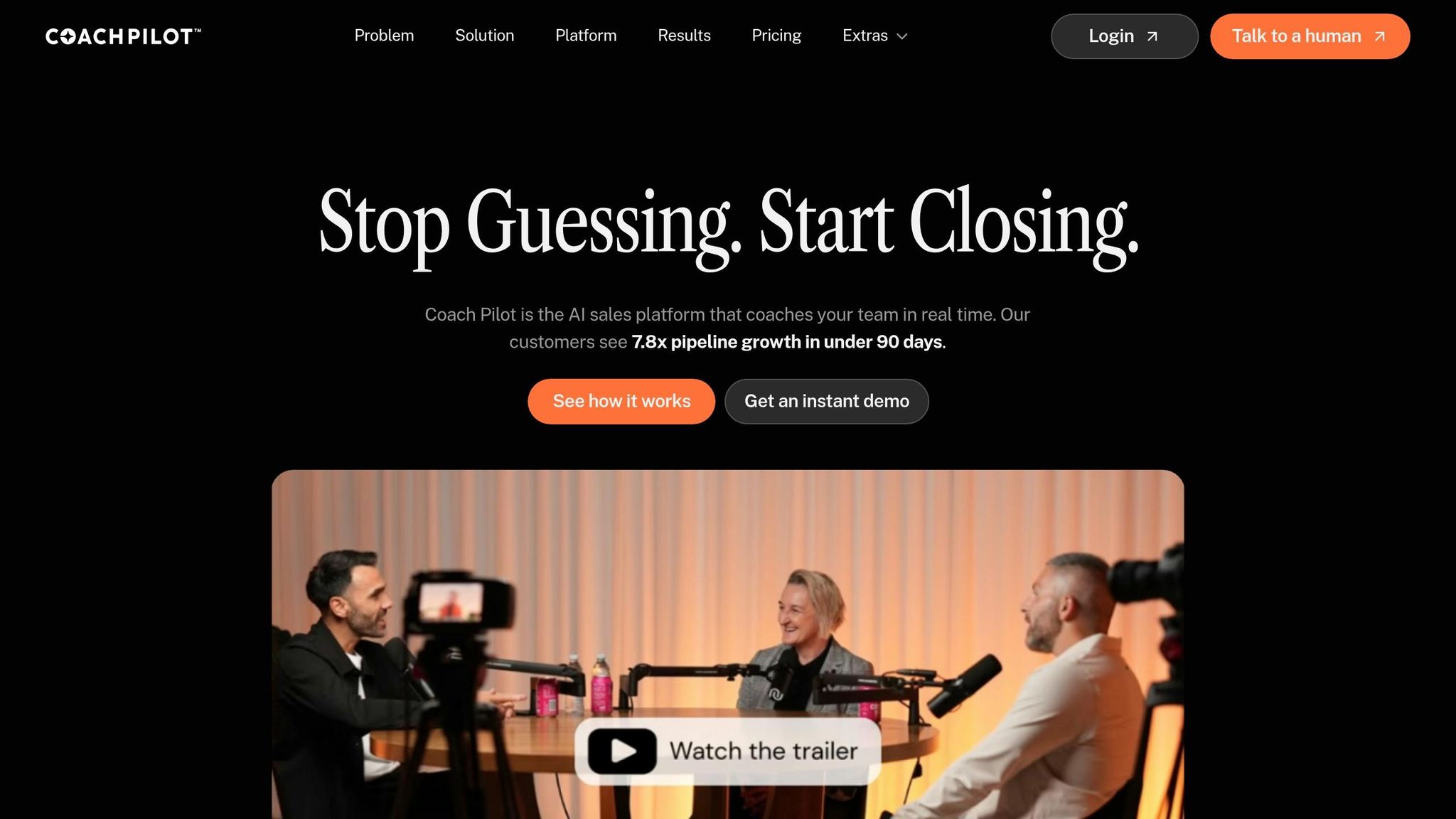
Coach Pilot bridges the gap between sales strategy and everyday execution by turning static playbooks into dynamic, AI-powered systems. Instead of leaving methodologies buried in documents, it integrates coaching directly into the tools sales reps already rely on - like Microsoft Teams, Outlook, and CRM platforms. This seamless integration connects playbook insights to daily sales actions, allowing leaders to scale the best practices of top performers across their teams without adding extra hours to their day.
Custom Sales Playbooks for Structured Coaching
Using AI-driven insights, Coach Pilot builds structured playbooks tailored to data-driven sales strategies. These playbooks are based on real deal data, pinpointing what sets top performers apart. For complex sales, the platform identifies advanced patterns - like the best times to involve executives or how to navigate procurement - and makes these insights accessible to every team member [30]. It also continuously refines playbooks with updated deal data [30].
In May 2024, Rebecca Veksler, Co-Founder of Four Rooms, shared how Coach Pilot transformed their sales process, tripling monthly sales and closing 14 new deals in just 8 weeks [31]. Similarly, Naum Sekulovski, BDM at Food By Us, secured 13 new contracts and contributed to a 45% increase in sales revenue over 9 weeks [31]. Companies leveraging Coach Pilot's AI-powered playbooks report 7.8x pipeline growth within 90 days and a 39% improvement in quota attainment [30].
"Creating a playbook, the information that has gone into it, and the evolution of the playbook has been hugely insightful... it's helped me not only make my target but exceed my target." – Craig Cant, Head of Sales, Industry Best [31]
Embedding AI Coaching into Sales Workflows
Coach Pilot goes beyond analyzing past performance - it delivers actionable next steps, like who to email, when to call, and which talking points to prioritize [30]. This eliminates execution bottlenecks that can slow down even skilled teams. Additionally, the platform automates deal documentation, capturing the "deal truth" without manual input [30].
In June 2024, Connor Bell, BDM at HubSpot, leveraged Coach Pilot to generate 50% more net new opportunities and close 12 new deals in 11 weeks, boosting quarterly revenue by 38% [31]. By embedding AI coaching into daily workflows, sales leaders ensure consistent execution across their teams without constant monitoring.
Improving Key Metrics with AI-Driven Insights
Coach Pilot's AI-driven insights also enhance critical sales metrics, including win rates, sales cycle times, and forecast accuracy. By analyzing behavioral data - tracking what reps are actually doing - it identifies gaps in execution [17]. This approach not only stabilizes team performance but also replaces guesswork in revenue forecasting by automatically logging key deal data [30].
In December 2024, Stephen Luxmoore, CEO of Your HR Team, reported a 32% increase in new client acquisitions within nine weeks of using Coach Pilot, securing eight new contracts with tailored strategies [32]. Companies with dynamic, data-informed coaching programs like Coach Pilot have seen win rates improve by as much as 32% [33], while real-time, deal-specific coaching has boosted year-over-year revenue by 8.4% [15].
"We've significantly increased our pipeline and boosted our bottom line. The investment in this program has paid for itself many times over." – Costa Vasili, CEO, Ethnolink [32]
Conclusion
Traditional sales coaching methods, relying on delayed and limited feedback, struggle to meet the demands of today’s complex B2B sales environment. With sales managers dedicating less than 5% of their time to coaching, the challenge is clear [15]. AI coaching offers a solution by analyzing 100% of interactions [4], providing real-time feedback, and allowing leaders to concentrate on strategic deal-making instead of routine administrative tasks.
The impact of AI coaching is hard to ignore. It can increase win rates by up to 32%, deliver an ROI of up to 7x [8], and drive an annual revenue growth of 8.4% [15]. These results stem from shifting coaching from reactive reviews to proactive, real-time interventions that shape behaviors before deals are finalized.
By moving away from sporadic evaluations to continuous, in-the-moment feedback, AI coaching reshapes the coaching process. It creates a seamless feedback loop embedded directly into daily workflows. For example, it might prompt a rep to ask more insightful discovery questions during a live call or automatically flag low-performing interactions for managerial review. This approach not only standardizes high performance across teams but also cuts ramp-up time for new hires by 30% to 50% [4], ensuring that the best practices of top performers are replicated throughout the organization.
For leaders looking to embed strategic coaching into their daily operations, platforms like Coach Pilot provide a clear path forward. With integrated playbooks and AI-driven insights, tools like these make it possible to scale coaching efforts without increasing the workload. The real question isn’t whether to adopt AI coaching - it’s how quickly you can implement it to maintain a competitive edge in today’s data-driven sales world.
FAQs
What data is needed before implementing AI sales coaching?
To make AI sales coaching work well, start by collecting the right data - things like performance stats, call recordings, and sales behaviors. Here’s what to focus on:
Call logs and recordings: These help analyze conversations and pinpoint areas where skills can improve.
Performance data: Metrics like quotas, lead types, and deal stages allow for tailored coaching that fits individual needs.
CRM activity logs and engagement metrics: These track progress and provide insights into how reps are improving over time.
By using this data, AI coaching can deliver precise feedback that leads to noticeable improvements in sales performance.
How do you measure ROI from AI coaching?
Organizations assess ROI from AI coaching by focusing on critical metrics like expanded coaching coverage, time efficiency, quicker onboarding, and revenue growth. For instance, AI tools can significantly enhance coaching coverage, save managers more than 10 hours per week, and increase close rates from 17% to 35%. Additional metrics such as pipeline progress, shorter sales cycles, and seamless CRM integration further demonstrate ROI through greater efficiency and tangible financial results.
How can you get reps to trust and use AI coaching?
Building trust starts with being upfront about AI's role - it's here to support, not monitor. Position AI as a helpful tool designed to provide real-time, actionable feedback that sales reps can use right away in their daily tasks. By weaving AI coaching seamlessly into everyday workflows, you create opportunities for skill-building on the spot.
To encourage a mindset focused on growth, demonstrate how AI amplifies coaching efforts, making it easier to scale personalized guidance and development across the team. Emphasize that AI complements human coaching, acting as an enabler rather than a replacement, to reinforce its positive impact.
Related Blog Posts

Remove the guesswork from winning more deals.