B2B Sales
AI Sales Coaching vs Traditional Training: What Works Better
Feb 4, 2026
AI sales coaching scales with real-time, data-driven feedback and lowers costs; human coaches add emotional nuance. A hybrid model often delivers the best results.

AI sales coaching outperforms traditional training when it comes to scalability, speed, and consistency. It provides instant, data-driven feedback by analyzing 100% of sales interactions, while traditional methods rely on limited call reviews and manager availability. AI reduces training costs by 15%, improves productivity by 40%, and shortens onboarding time by up to 42%. However, human-led coaching excels in emotional intelligence and trust-building, making it better for nuanced, interpersonal scenarios.
Key Insights:
AI Coaching: 24/7 availability, unbiased insights, and real-time feedback. Boosts quota attainment by 3.3x and improves win rates by 36%.
Human Coaching: Personalized guidance, emotional understanding, and trust-building. Effective for complex customer relationships but harder to scale.
Quick Comparison:
Factor | AI Sales Coaching | Human-Led Coaching |
|---|---|---|
Scalability | Unlimited, 24/7 availability | Limited by manager time |
Feedback Speed | Instant | Delayed |
Cost | Long-term savings (15% reduction) | High; ongoing travel and facilitation |
Personalization | Data-driven insights | Emotional intelligence |
Coverage | Analyzes 100% of calls | Reviews a small sample |
For the best results, combine both approaches. AI handles repetitive tasks and scales efficiently, while human managers focus on emotional and strategic coaching. Teams using a hybrid model see 37% higher win rates compared to either method alone.
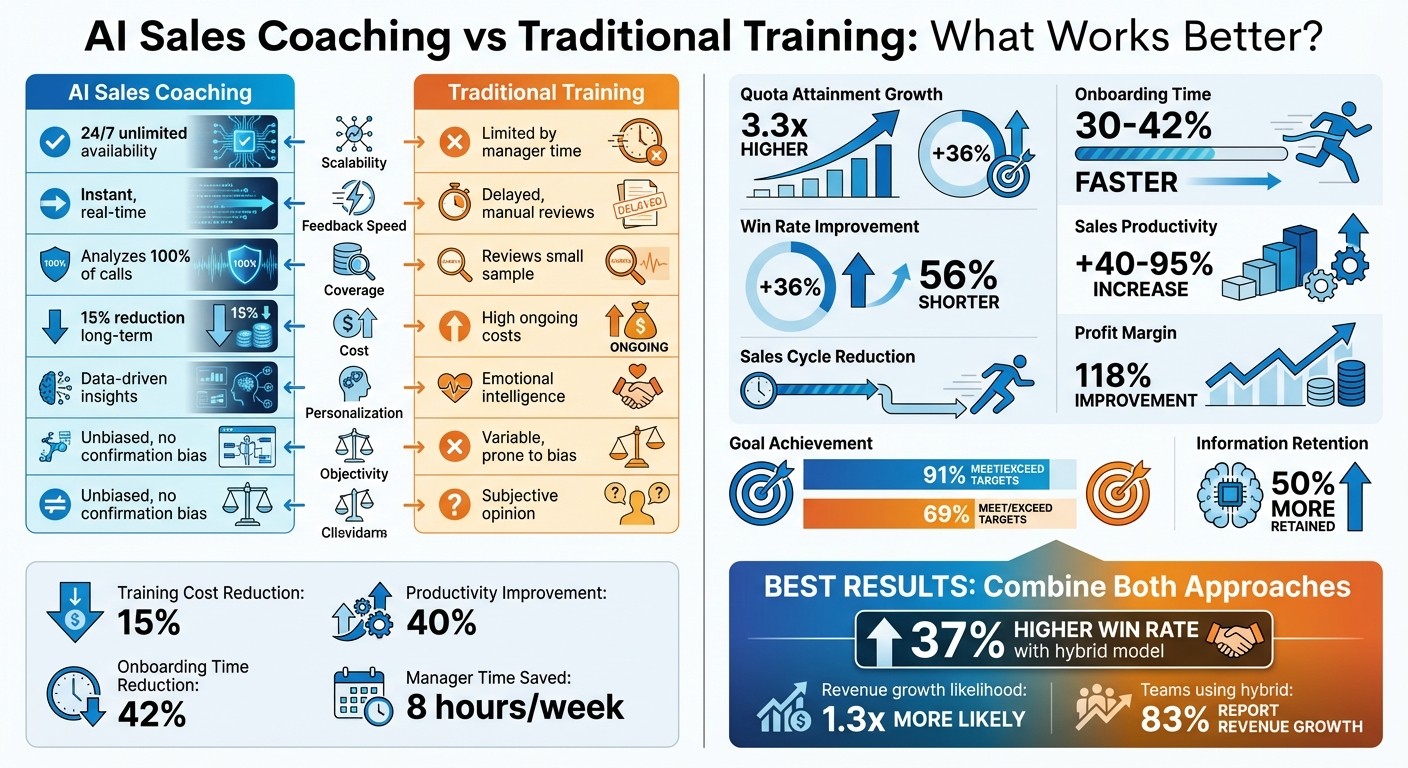
AI Sales Coaching vs Traditional Training: Performance Metrics and Key Differences Comparison
What Great Looks Like in AI Sales Coaching Agents: 2025 Benchmark Report
Key Differences Between AI Sales Coaching and Traditional Training
AI sales coaching transforms how sales teams learn by providing constant, scalable feedback. It analyzes every interaction and delivers insights instantly, turning each call into an opportunity for improvement. In comparison, traditional training depends on scheduled sessions and limited call reviews, which often delay feedback. This comparison highlights the unique advantages of AI-driven coaching.
Comparison Table: AI Sales Coaching vs Traditional Training
Here's a quick look at how these two approaches stack up:
Factor | AI Sales Coaching | Traditional Sales Training |
|---|---|---|
Scalability | ||
Feedback Speed | Delayed due to manual reviews [4] | |
Cost-Efficiency | Lower long-term; cuts training costs by 15% [1] | |
Personalization | Relies on emotional intelligence and experience | |
Objectivity | Variable; prone to manager bias [3] | |
Coverage | Analyzes 100% of calls and interactions [9] | Limited to small samples of calls [9] |
Environment | May cause anxiety during observed sessions [4] |
By understanding these differences, it's easier to see how each approach impacts sales teams in practice.
Pros and Cons of Each Method
AI sales coaching stands out for its ability to deliver consistent, unbiased feedback. It reduces training time by 42% and improves productivity by 40% [4]. With AI, there’s no room for confirmation bias, and it provides a non-judgmental environment for practice.
On the other hand, traditional training excels in offering nuanced insights, thanks to human interpretation and emotional intelligence. However, delayed feedback and the heavy resource demands of this method can slow down progress.
Cost-wise, AI coaching offers long-term savings, reducing expenses by around 15% [1]. Traditional methods, however, require ongoing investment in facilitator time, travel, and materials. The choice ultimately depends on which trade-offs your team can handle and which benefits align best with your sales goals.
Strengths of Traditional Sales Training
Personalized Coaching and Emotional Insight
Human managers bring an irreplaceable ability to interpret subtle cues. When a sales rep struggles during calls, a manager can often discern whether the issue stems from a lack of confidence or a gap in knowledge. This understanding shapes how coaching is delivered and helps build trust within the team [13][5].
Traditional training fosters psychological safety, encouraging reps to openly share their challenges without fear [5]. Managers tailor their coaching based on each individual's personality - whether they're more analytical or relationship-driven - and their career stage [5]. This tailored approach is especially effective in managing complex customer relationships that require emotional sensitivity [5].
"The human element allows us to understand not just what happened, but why it happened." - Marcel, Head of Product, Demodesk [5]
The impact is clear: 69% of salespeople in organizations using traditional coaching methods meet or exceed their goals [12]. Human-led role-playing exercises and one-on-one coaching sessions drive meaningful behavior changes by offering realistic practice and immediate, personalized feedback [11].
However, while this approach excels in emotional depth and customization, it faces hurdles when applied at scale.
Scalability and Cost Limitations
Despite its strengths, traditional coaching encounters significant challenges as they consider the future of sales enablement and how to scale. Managers can only review a limited number of calls, leaving many sales interactions unanalyzed and creating blind spots in performance evaluation [5]. As teams expand, the costs of maintaining this approach become prohibitive [11].
Another issue is that coaching often takes a backseat to immediate sales demands [4][7]. Only 19% of managers consistently provide high-quality coaching [4]. Resource limitations further exacerbate the problem, leading to uneven coaching experiences - some reps receive excellent guidance, while others are left with minimal support.
Strengths of AI Sales Coaching
Real-Time Feedback and Continuous Reinforcement
One of the biggest challenges with traditional sales coaching is the delay in feedback. Managers often need hours to review call recordings, making it harder for reps to act on their mistakes quickly. AI flips this script by delivering instant, contextual feedback during live calls or right after interactions. It processes call transcripts in seconds, identifying patterns in speech, tone, and strategy [8].
This speed creates judgment-free practice environments, where sales reps can rehearse high-pressure scenarios like handling objections or negotiating deals. AI-powered roleplay tools allow them to practice repeatedly until they reach "unconscious competence" - the ability to perform skills naturally without overthinking [10]. And the results speak for themselves: 91% of organizations using AI coaching saw reps meet or exceed their targets, compared to 69% with traditional methods [12].
"AI sales coaching, when executed well, delivers three outcomes: Time recovered, behavior reinforced, and outcomes measured." - Sanchit Garg, Cofounder & CEO, Zime [10]
AI also addresses a common pitfall of traditional coaching: inconsistency. With 55% of managers admitting they lack effective coaching skills [8], AI ensures every rep gets the same high-quality feedback, regardless of their manager's expertise or availability. By embedding coaching into daily workflows, AI moves away from one-off workshops that often fail to stick. Instead, it provides actionable, consistent feedback that drives long-term performance improvements.
Scalability and Cost-Effectiveness
AI coaching runs 24/7, giving sales reps access to training and support whenever they need it. Unlike managers, who can only review a limited number of calls, AI analyzes every interaction without adding to staffing costs.
The financial benefits are clear. Companies using AI sales coaching report a 15% reduction in sales costs [1] and cut onboarding times by up to 42% [4]. AI also boosts productivity by 40% [4], largely by automating repetitive tasks like CRM updates and call evaluations. This frees up valuable time for reps to focus on selling.
"AI doesn't replace the manager's role; it enhances it. It handles the repetition, speeds up analysis and provides a consistent baseline." - Julie Thomas, President and CEO, ValueSelling Associates [8]
Even as teams grow, AI maintains quality. Every rep, no matter where they are, receives feedback aligned with company standards. Managers can shift their focus from micromanaging basic skills to providing strategic guidance on complex deals. This creates what many call a "force multiplier" - delivering more coaching without increasing management workload.
Performance Metrics: AI vs Traditional Training
The difference in outcomes between AI-enhanced coaching and traditional methods is stark. Teams using AI in their sales training achieved 3.3x year-over-year growth in quota attainment compared to those relying on AI without structured training [3]. Win rates jumped by 36% [6], and sales cycles became 56% shorter [3].
Here’s how key metrics compare:
Metric | Traditional Training | AI-Enhanced Coaching |
|---|---|---|
Quota Attainment Growth | Baseline | 3.3x higher [3] |
Win Rate Improvement | Baseline | +36% [6] |
Sales Cycle Length | Baseline | 56% reduction [3] |
Onboarding Time | Baseline | |
Sales Productivity | Baseline | |
Average Profit Margin | Baseline | 118% improvement [3] |
Real-world examples underline these gains. Bureau implemented AI coaching to refine discovery calls, achieving a 30% increase in deal conversions between 2024 and 2025 [10]. A Fortune 500 company improved objection handling by 35% using AI-powered roleplay simulations [4]. Another global sales team reported a 28% rise in customer satisfaction and a 15% boost in average deal size after adopting real-time AI feedback [4].
Neuroscience backs these results. Sellers retain 50% more information with AI coaching compared to human coaching alone [15]. This better retention translates to stronger performance: businesses using AI are 1.3 times more likely to achieve revenue growth [10] and 20% more likely to hit higher revenue targets [6].
When to Choose AI Sales Coaching Over Traditional Training
Scaling Training for Large Teams
As sales teams grow, traditional coaching often struggles to keep up. Managers can only review a limited number of calls each week, creating a "visibility gap" that leaves leadership uncertain about whether reps are applying their training effectively [4]. This challenge becomes even more pronounced in large organizations with dozens or even thousands of reps spread across regions. Limited time and availability make it nearly impossible for managers to scale personalized coaching effectively.
AI steps in to bridge this gap by analyzing every interaction, no matter how many reps are involved, without requiring additional staff. For instance, a large enterprise with over 2,000 sellers introduced an AI roleplay simulation in September 2025. The result? A 98% engagement rate across the entire sales team [4]. Achieving this level of participation with traditional methods would demand a much larger training staff and significant logistical effort.
"Most sales managers simply don't have enough time to give personalized training and feedback to every single rep who needs it." - Salesforce [9]
Cost is another critical factor. Businesses leveraging AI coaching report a 15% cut in sales costs [1], avoiding expenses tied to travel, venues, or hiring external trainers. Additionally, 75% of companies have increased their investment in digital sales training, with 60% reducing budgets for in-person programs [1]. By automating transcript analysis and other repetitive tasks, AI frees managers to focus on strategy and complex deals. These cost and scalability benefits make AI a game-changer for modern sales organizations.
Data-Driven Insights for Skill Gap Analysis
Beyond scalability, AI transforms training by delivering precise, actionable insights. Traditional coaching often relies on subjective feedback from a handful of call reviews, leaving gaps in understanding team-wide performance. AI, on the other hand, processes call transcripts, CRM data, and buyer engagement patterns in seconds [6]. This allows it to identify which reps struggle with specific skills, like objection handling or refining value propositions, and highlights top performers whose strategies can be scaled across the team.
The results speak for themselves. Companies using AI in their training programs report 3.3x year-over-year growth in quota attainment compared to those sticking with traditional methods [3]. For example, a Fortune 500 company that adopted AI-powered sales enablement in September 2025 saw a 35% improvement in objection handling across its sales force [4]. These gains stem from AI’s ability to deliver targeted, data-driven coaching that directly impacts performance.
"Traditional coaching methods leave reps feeling unsupported, resulting in stalled performance, lower win rates, and costly turnover." - Highspot [6]
AI also removes human bias, offering objective benchmarks for the entire team [8]. It provides real-time guidance during active sales opportunities, allowing reps to adjust their approach immediately rather than waiting for feedback after a call. This immediacy is crucial in today’s fast-paced sales environment. In fact, 91% of organizations using AI coaching report their salespeople meeting or exceeding goals, compared to just 69% with traditional training methods [12].
The Hybrid Approach: Combining AI and Traditional Training
AI for Scalability, Humans for Nuance
Blending AI's precision with human intuition creates a powerful coaching strategy. AI takes care of repetitive tasks like analyzing calls, tracking adherence to sales playbooks, and spotting trends across hundreds of conversations. Meanwhile, human coaches excel in areas machines can’t, such as interpreting emotional cues, managing intricate organizational dynamics, and guiding teams during high-stakes negotiations [16][5].
AI ensures comprehensive coverage of interactions, giving managers back 8 hours a week by eliminating the need for manual call reviews. This reclaimed time can then be used for focused, data-driven coaching sessions [5].
"The winning formula is a hybrid model combining AI for data-driven consistency and scale with human coaches who provide empathy, strategic deal coaching, and mentorship." – Hyperbound [16]
The numbers back this up: sales teams that integrate AI-powered coaching with human management see a 37% higher win rate compared to those using just one method [5]. Additionally, sellers retain 50% more information when coached by AI than through human coaching alone [15]. The hybrid model also addresses psychological challenges: top performers often distrust automated feedback ("AI aversion"), while struggling reps can feel overwhelmed by excessive data. Human managers bridge this gap by contextualizing AI insights and delivering them with encouragement [13].
This combination of AI's efficiency and human empathy is further illustrated through real-world success stories.
Case Study: Hybrid Success with Coach Pilot
The hybrid approach’s effectiveness shines in real-world applications. For example, in 2025, Treatwell - a beauty software company - introduced an AI coaching program that boosted pitch quality by 10% and led to an 800% increase in recorded meetings. This surge in data allowed managers to conduct more targeted development sessions [5]. By automating basic skill assessments, managers could focus their 1:1 time on complex, judgment-heavy scenarios.
Another success story comes from a global technology company that implemented a 12-week hybrid enablement program in 2025. This initiative combined AI-simulated buyer conversations with human-led coaching, resulting in a 22% increase in average order value in one region and a 15% improvement in deal velocity [14]. The AI provided a risk-free environment for practicing sales techniques, while human coaches addressed nuanced objections and relationship-building strategies.
Coach Pilot exemplifies this hybrid model by integrating AI-driven tools with expert human guidance. The platform customizes sales playbooks, offers immersive training workshops, and embeds AI coaching into daily workflows. AI continually evaluates rep performance, highlighting areas for improvement, while weekly live coaching sessions with human experts provide mentorship and accountability. This dual approach ensures reps not only master the basics through scalable, data-informed feedback but also gain the personalized coaching needed to navigate complex deals effectively.
Conclusion: Choosing the Right Solution for Your Sales Team
Key Takeaways
AI stands out when scale and data accuracy are critical. It evaluates 100% of sales calls, operates around the clock, and delivers unbiased feedback, improving retention by 50% within 48 hours [2]. AI also eliminates confirmation bias, shortens onboarding by up to 30%, and lowers sales costs by 15% [1]. It’s highly effective for building foundational skills, ensuring playbook adherence, and providing consistent training across dispersed teams.
However, traditional coaching offers something AI cannot: human connection and emotional intelligence. Human coaches excel at navigating complex organizational dynamics, fostering trust in high-stakes negotiations, and offering the empathy and motivation that machines lack [1][16]. They shine in areas like strategic deal coaching, career mentorship, and interpreting subtle emotional nuances that AI might overlook.
The ideal solution combines the strengths of both. A hybrid approach delivers the best results. Sales teams that blend AI coaching with human guidance see 37% higher win rates than those relying on just one method [5]. Companies using AI alongside traditional training achieve 3.3x year-over-year growth in quota attainment compared to those using AI alone [3]. This strategy leverages AI for scalable and consistent insights while relying on human expertise for strategic and emotional intelligence.
Next Steps for Implementing AI Sales Coaching
Looking to align strategy with execution? Coach Pilot offers the hybrid model your team needs. The platform integrates custom sales playbooks, immersive training workshops, and AI-driven coaching directly into your workflows. AI monitors performance, identifies skill gaps, and automates repetitive tasks, while weekly live coaching sessions with human experts provide mentorship and accountability.
Start by automating foundational tasks like product knowledge, call evaluations, and roleplay exercises, saving managers up to 8 hours per week [5]. Then, focus human coaching on high-impact areas like complex deals and relationship-building. With 83% of sales teams using AI reporting revenue growth, compared to just 66% of non-AI teams [16], adopting AI coaching now can deliver fast, measurable improvements for your sales team.
FAQs
How does AI sales coaching boost productivity compared to traditional training?
AI sales coaching transforms productivity by offering real-time, tailored feedback that helps sales reps sharpen their skills more quickly and effectively. Traditional training often falls short with delayed feedback and generalized insights. In contrast, AI-powered coaching relies on data to deliver immediate, actionable advice. This means reps can adjust their strategies on the fly, accelerating skill development and improving overall performance.
Another advantage is scalability. AI coaching can support large teams without requiring additional management resources, ensuring everyone receives consistent training. It’s also incredibly precise at spotting skill gaps and tracking progress, allowing managers to provide focused support where it’s needed most. The outcome? Higher win rates, smoother customer interactions, and significant time savings - all driving measurable productivity improvements.
What are the cost advantages of using AI sales coaching compared to traditional training?
AI sales coaching brings budget-friendly advantages compared to traditional training methods. One of its standout features is scalability. It enables organizations to deliver tailored, consistent coaching to large teams without the hefty price tag of in-person sessions or hiring additional trainers. This approach minimizes the need for costly one-on-one coaching while still achieving meaningful results.
Another key benefit is the ability to offer real-time feedback and ongoing learning. With AI tools, there’s no need for repeated, expensive in-person training sessions. Many companies that adopt AI-driven sales coaching report significant returns on investment, thanks to improved sales performance and higher quota attainment. By blending cost savings with measurable improvements, AI sales coaching proves to be a practical and efficient alternative to traditional methods.
Can AI sales coaching match the emotional intelligence of human coaches?
AI sales coaching shines in areas like data-driven insights, real-time feedback, and scalability, making it an excellent resource for boosting sales performance, especially in larger teams. But there’s a catch: AI struggles with emotional intelligence - it can’t read or respond to emotions or build meaningful personal connections the way humans can.
On the other hand, human coaches excel where AI falls short. They bring empathy, the ability to form strong relationships, and the skill to navigate complex emotional situations. These traits are especially important for leadership development and personalized coaching. While AI can handle routine tasks like feedback and data analysis, it can’t replace the emotional depth and strategic thinking that human coaches provide.
The best results often come from combining both. AI offers efficiency and objective insights, while human coaches supply emotional support and nuanced decision-making. Together, they create a balanced approach that maximizes both technology and human connection for sales teams.
Related Blog Posts

Remove the guesswork from winning more deals.