B2B Sales
AI-Driven Coaching for Sales Talent Development
Mar 9, 2026
AI analyzes 100% of sales calls to deliver real-time coaching, speed onboarding, and improve win rates and manager efficiency.
AI-driven coaching uses artificial intelligence to analyze sales conversations and provide real-time feedback to enhance sales reps' skills. By automatically reviewing 100% of calls, it identifies improvement areas like objection handling, discovery questions, and next-step clarity. This saves managers time, improves team performance and revenue execution, and accelerates onboarding.
Key Benefits:
Real-time Feedback: AI offers live suggestions during calls, improving outcomes instantly.
Performance Insights: Analyzes top performer behaviors to create benchmarks for all reps.
Faster Onboarding: Reduces ramp time by up to 50% with unlimited practice opportunities.
Manager Efficiency: Automates call reviews, freeing managers to focus on strategic coaching.
Improved Metrics: Teams using AI report up to 36% higher win rates and faster revenue growth.
How It Works:
Call Analysis: Transcribes and evaluates calls for key skills.
Workflow Integration: Embeds into tools like Salesforce and Teams for seamless use.
Personalized Training: Creates tailored learning paths based on each rep's performance data.
AI coaching isn’t just about automation - it combines data-driven insights with human expertise to improve sales outcomes and create scalable, high-quality coaching systems.
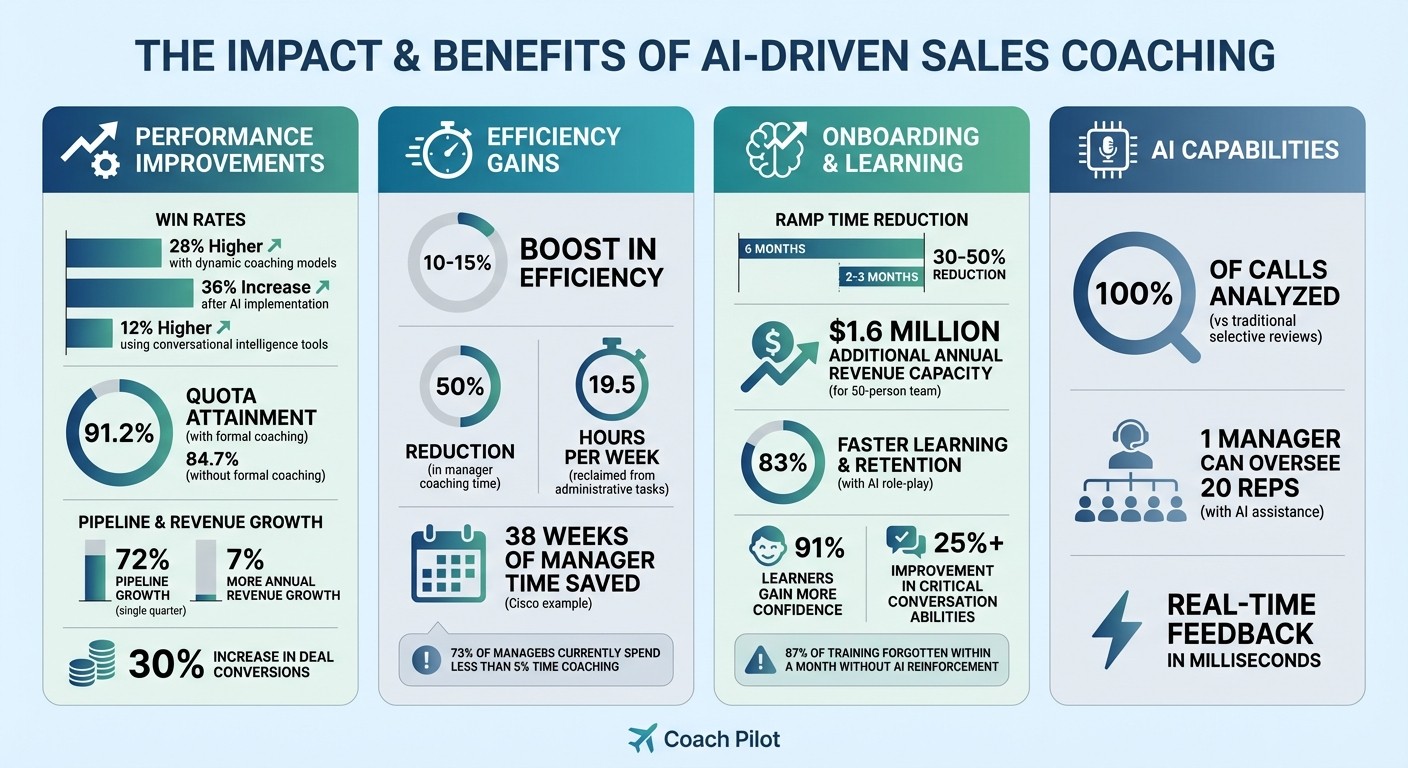
AI-Driven Sales Coaching Impact: Key Performance Metrics and ROI
Benefits of AI-Driven Coaching for Sales Teams
Better Performance and Consistency
AI tools analyze what sets top-performing sales reps apart - things like their talk-to-listen ratios, how many discovery questions they ask, and the strategies they use to handle objections. This data allows managers to benchmark every rep against proven success patterns. By relying on objective metrics, such as detailed transcripts and sentiment analysis, AI removes the guesswork (and bias) from coaching. Every rep gets actionable, data-driven feedback instead of feedback based on selective call reviews [6].
Real-time AI prompts during live calls are another game-changer. They help reps handle objections or reference relevant case studies on the spot, making it easier to close deals in the moment [6].
The results? Organizations that use dynamic coaching models see 28% higher win rates and achieve 7% more annual revenue growth [9]. Companies with formal coaching processes also outperform those with informal ones - 91.2% quota attainment compared to 84.7% [9]. For instance, in August 2025, an SMB manager at an EdTech SaaS company used AI insights to focus coaching on specific behavioral gaps. The result? His team saw 72% pipeline growth in a single quarter, compared to just 25% growth for less consistent managers [8].
This kind of insight doesn’t just improve performance - it also speeds up the onboarding process.
Faster Onboarding and Upskilling
Getting new sales reps up to speed is a time-intensive process. Typically, new hires need over 100 practice conversations to build confidence and proficiency, but managers often only have time for 3–5 role-plays [10]. AI-driven coaching bridges this gap by offering unlimited, on-demand practice opportunities, allowing reps to experiment and learn without the pressure of performing in front of peers.
This approach can dramatically reduce ramp time for new reps - by 30% to 50%, cutting the onboarding period from six months to just 2–3 months [10]. For a 50-person sales team, shaving off just two months of ramp time could generate an additional $1.6 million in annual revenue capacity [10]. Beyond onboarding, AI also combats the "forgetting curve", a phenomenon where reps lose up to 87% of what they learn within a month without reinforcement [8].
"Reps shouldn't be practicing in the game." - Sriharsha Guduguntla, Founder, Hyperbound [8]
By accelerating skill development, AI not only benefits reps but also makes life easier for managers.
Improved Metrics and Manager Efficiency
Even though coaching has a huge impact on sales performance, 73% of managers spend less than 5% of their time actively coaching their teams [9]. AI changes that by automating tasks like call scoring and flagging conversations that need human attention. This allows managers to oversee larger teams without sacrificing coaching quality [6].
The efficiency gains are hard to ignore. Companies using AI-driven sales coaching report a 10–15% boost in efficiency, with some teams experiencing a 36% increase in win rates soon after implementation [4][11]. Reps who receive consistent, high-quality coaching are also 50% more likely to hit their individual quotas [9].
Tools like Coach Pilot make it easy to integrate AI coaching into daily workflows. These platforms help teams improve win rates, shorten sales cycles, and enhance forecast accuracy, all while freeing managers to focus on high-value tasks like strategic deal navigation instead of administrative work.
How to Use AI as Your Personal Sales Coach
Key Features of AI Coaching Tools
Advanced AI coaching tools are reshaping how sales teams learn and perform, thanks to a few standout features. These tools bridge the gap between strategic planning and effective execution during real-world calls, creating a more seamless and impactful coaching experience.
Custom Sales Playbook Creation
Traditional sales playbooks often end up as static PDFs that gather dust, rarely used in the heat of a deal. Tools like Coach Pilot change the game by transforming your sales strategy - messaging, deal stages, objection handling, and proof points - into a dynamic, interactive "Living Playbook." This playbook is embedded directly into a rep's workflow, offering guidance exactly when it’s needed during live conversations.
The results speak for themselves: companies have seen a 7.8x increase in pipeline growth within 90 days, a 39% boost in quota attainment through playbook-aligned messaging, and a 19.5-hour weekly reduction in administrative tasks [12]. Once the playbook is integrated, AI simulation tools further strengthen reps' readiness to perform.
Training Simulations and Workshops
AI-powered simulations take training to the next level, offering reps the chance to practice with human-like avatars and realistic, adaptive scenarios [13][14]. These simulations create a safe space for reps to fine-tune their skills for high-pressure situations, whether it’s closing a six-figure deal or addressing complex pricing objections.
The impact is clear: companies using AI-driven role-play report an 83% faster learning and retention rate compared to traditional methods, and 91% of learners gain more confidence in handling critical conversations [13]. These simulations not only prepare reps but also set the stage for the real-time coaching they’ll receive during actual calls.
Real-Time Feedback and Workflow Integration
The final piece of the puzzle is real-time feedback, which integrates AI insights directly into a rep's daily workflow. Modern AI coaching tools process call audio in milliseconds, delivering actionable suggestions - like objection handling tips or technical answers - while the conversation is still in progress [3]. This "whisper coaching" feature provides prompts such as "Ask about budget" or "Slow down", empowering reps to adjust on the fly [3][7].
"The math of traditional sales coaching is broken... 90% of prospect interactions happen without any guidance" [7].
AI tools also monitor calls continuously, notifying managers via Slack or Teams only when something goes off track - like a competitor being mentioned or a drop in sentiment. This "invisible shadowing" allows managers to oversee and coach more reps at once, with reported efficiency gains of 10% to 15% [4].
These features combine to create a coaching system that’s as dynamic as the sales environment itself, ensuring reps are always prepared and supported.
How to Implement AI-Driven Coaching
Getting started with AI-driven coaching doesn’t have to be overwhelming. By focusing on data, integrating tools into your team’s workflow, and customizing learning paths for each sales rep, you can make the process seamless and effective.
Step 1: Identify Talent Gaps with Call Analysis
Effective coaching begins with understanding where each rep needs help. AI can analyze 100% of sales calls, scoring metrics like talk-to-listen ratio, pacing, and filler words, alongside core skills such as discovery depth, objection handling, and call-to-action clarity [1][7]. This level of analysis pinpoints areas that traditional methods often miss.
By compiling data from hundreds of calls, AI creates a detailed competency profile for each rep, highlighting their strengths and weaknesses compared to team benchmarks [1]. For instance, AI might reveal that a mid-level performer only asks two discovery questions per call, while top performers average six. With this insight, you can zero in on behaviors that yield the greatest results, such as improving discovery techniques or refining next-step planning [4].
A quick 5-minute scan of your dashboard each morning can help you spot and address significant drops in key metrics [1]. Teams using conversational intelligence tools have reported 12% higher win rates compared to those relying solely on traditional coaching [16].
Once you’ve identified the talent gaps, the next step is to integrate AI into your team’s daily operations.
Step 2: Integrate AI into Daily Operations
For AI coaching tools to succeed, they must fit effortlessly into your team’s existing systems. Seamless integration with platforms like Salesforce, Pipedrive, Slack, Teams, and dialers ensures that the tools are used consistently [15][2]. For example, Coach Pilot integrates directly into sales workflows, delivering real-time guidance during live calls.
During the first 2–4 weeks, operate AI in "shadow mode." This means the system generates feedback while managers review and fine-tune it before sharing with reps. This approach builds trust and ensures that the feedback is both accurate and actionable [4][18]. With AI handling much of the analysis, one manager can oversee up to 20 reps without compromising on quality.
Using AI to automate call reviews can save managers significant time, allowing them to focus on strategic sales enablement coaching. Research shows that sales reps spend only 29% of their time selling, with the rest devoted to administrative tasks [16]. AI helps reclaim this lost time, boosting team efficiency by 10–15% [4].
Once AI is fully integrated, the focus shifts to creating personalized learning paths for each rep.
Step 3: Personalize Learning Paths and Track Progress
Generic training programs don’t work for everyone. AI links CRM outcomes - like low closing rates - to specific call behaviors, such as difficulty handling pricing objections. Based on this data, it assigns training modules tailored to each rep’s needs [15][4]. This adaptive learning ensures that training is both relevant and effective [19].
AI can also compile "best practice" playlists by capturing standout moments from top performers. These clips can then be shared with reps who need improvement in specific areas. For example, if your best closer has a winning technique for addressing budget objections, AI can save and share that moment with others [17]. Companies using AI sales coaching report being 20% more likely to achieve higher revenue outcomes [11].
When it’s time for 1:1 coaching sessions, rely on AI data instead of subjective opinions. Spend 10 minutes reviewing an AI-generated rep profile to ensure your 30-minute session focuses on measurable skill development [1]. Track whether reps are applying what they’ve learned, rather than just completing training modules. Teams that consistently follow through with AI-guided coaching have seen win rates increase by 36% soon after implementation [11].
Best Practices for Continuous Learning and Upskilling
Combine AI Insights with Human Coaching
AI and human coaching bring different strengths to the table. While AI handles tasks like automating call scoring and spotting behavioral trends across teams, human coaches shine in areas like guiding strategic deals, fostering empathy, and mentoring careers [20][16].
When paired with AI, human coaching becomes even more impactful. AI provides a comprehensive view of team performance - far beyond the 3% of customer interactions typically seen by managers - while human coaches turn this data into actionable strategies [6].
"AI provides the diagnostics; the manager provides the cure" - Jonathan M. Kvarfordt, Momentum [6]
For example, reviewing AI-generated scorecards before one-on-one sessions allows managers to focus on specific skill gaps. This approach has led to revenue growth improvements ranging from 66% to 83% [20].
"We still want managers coaching, but AI is providing additional tools to leverage their time and improve the quality of coaching" - Michelle Richardson, Vice President, The Brooks Group [20]
From here, practical role-play scenarios can help solidify these strategies.
Use Realistic Role-Play Scenarios
AI-powered role-play is a fast and effective way to build critical sales skills. It allows reps to practice, get instant feedback, and refine their approach through repetition [22]. This continuous cycle of practice is essential, especially since 87% of traditional sales training is forgotten within a month [21][8].
For the best results, role-play scenarios should adapt dynamically to a rep's input rather than sticking to rigid scripts [14][22]. Companies like Precina and Cisco have already seen success with this approach. For instance, during a July 2025 pitch contest, Cisco used Mindtickle's Copilot to train 3,500 sellers, saving 38 weeks of manager time and boosting both deal size and booked deal value [21].
Encouraging reps to dedicate just 15–20 minutes daily to AI role-play can significantly improve skills like objection handling and pricing negotiations [1]. In fact, learners using AI conversation simulators have shown over a 25% improvement in critical conversation abilities [13].
"Reps shouldn't be practicing in the game" - Sriharsha Guduguntla, Co-Founder, Hyperbound [8]
These realistic exercises translate directly into measurable performance gains.
Measure and Optimize ROI
To truly gauge the effectiveness of your learning strategies, focus on metrics that impact revenue and reduce ramp-up time, rather than simply tracking activity metrics like platform usage [16][14]. Research shows that organizations using conversational intelligence see win rates improve by 12% [16].
Start by establishing a baseline with metrics like win rates by stage, average deal cycles, and talk-to-listen ratios [14]. A key indicator of success is whether mid-performing reps are adopting the techniques used by top performers [16].
Tools like Coach Pilot can help track these metrics and refine strategies over time. By incorporating AI-generated insights into dynamic sales playbooks and training modules, you can ensure that your learning content stays aligned with shifting market demands [16][14].
"The issue is not information scarcity. It is that feedback arrives too late and coaching struggles to keep pace with the velocity of the sales cycle" - Sanchit Garg, CEO, Zime [5]
Conclusion: Transforming Sales Talent Development with AI
AI-powered coaching is turning static sales playbooks into dynamic, real-time tools. Traditional playbooks, often buried in PDFs, fail to provide actionable guidance during most sales interactions, leaving reps unsupported for a majority of their work [7]. AI flips the script by embedding coaching directly into daily workflows, offering 24/7 guidance on what to say and do in the moment [12].
The results speak for themselves. Companies like Versa Networks and Bureau have seen dramatic improvements. Versa Networks, for example, reduced manager coaching time by 50% while ensuring consistent execution across global teams [5]. Bureau, on the other hand, achieved a 30% increase in deal conversions by using AI to refine their discovery process [5]. Overall, AI coaching has been shown to boost win rates by 12% and improve quota attainment by more than threefold [5][16].
Platforms like Coach Pilot are leading this transformation. By creating dynamic sales playbooks, offering immersive training, and embedding AI-driven coaching into existing workflows, Coach Pilot has helped teams achieve outcomes like 7.8x pipeline growth in just 90 days [12]. The platform analyzes 100% of sales interactions, delivering evidence-based feedback that helps reps close deals faster, improve win rates, and consistently meet their quotas.
AI’s role goes beyond efficiency; it’s about scalability and consistency. By automatically scoring every call, AI eliminates the bottleneck of manual reviews, allowing managers to focus on strategic coaching [16]. Sales reps also reclaim an average of 19.5 hours per week, previously spent on administrative tasks [12]. This shift is creating a new coaching paradigm that balances automation with human expertise.
The future of sales talent development lies in combining the strengths of AI and human coaching. AI provides the diagnostics and real-time insights, while managers offer the strategic, personalized guidance that drives growth. Siemens, for instance, has embraced this approach with its AI-powered Seller Action Hub, supporting over 30,000 sellers [16]. With tools like these, organizations can create a continuous learning environment where every sales rep is empowered to perform at their peak.
FAQs
Will AI coaching feel intrusive for reps on live calls?
AI coaching during live calls is built to seamlessly support representatives, boosting their performance without interrupting the conversation's rhythm. It works in real time, offering gentle prompts or guidance precisely when needed. Using subtle notifications and being transparent about its purpose ensures that reps view it as a helpful resource rather than a distraction.
What data and permissions are needed to analyze 100% of calls?
To thoroughly analyze all calls, you’ll need access to recorded sales calls and customer conversation data. It’s also crucial to secure explicit consent or permissions for recording and analyzing these interactions. This step ensures compliance with privacy laws and regulations, allowing the data to be used ethically and legally for AI-powered coaching and insights.
How can ROI be demonstrated beyond higher win rates?
AI-driven sales coaching delivers measurable returns that extend far beyond just boosting win rates. It enables broader coaching coverage, allowing managers to analyze all sales calls instead of just a small sample. This comprehensive approach helps identify patterns and areas for improvement across the board.
Other key benefits include accelerating rep ramp-up times and shortening sales cycles, which directly impact productivity and revenue. Managers also save a significant amount of time, as AI tools streamline the coaching process while ensuring consistent adherence to playbooks. This consistency not only strengthens coaching delivery but also improves overall team performance and development. Together, these advantages drive greater sales efficiency and contribute to stronger revenue growth.
Related Blog Posts

Remove the guesswork from winning more deals.