B2B Sales
AI-Driven Sales Coaching: Key Benefits
Mar 7, 2026
AI analyzes every sales interaction to provide real-time coaching, personalized feedback, and predictive insights that boost win rates, shorten cycles, and speed ramp.

AI-driven sales coaching is transforming how sales teams improve performance by analyzing 100% of interactions and delivering instant, data-backed feedback. Traditional methods often miss 97% of team activities and rely on delayed, subjective reviews. AI tools close this gap by offering real-time insights, personalized coaching, and predictive analytics that boost revenue, shorten sales cycles, and enhance skill development.
Key Takeaways:
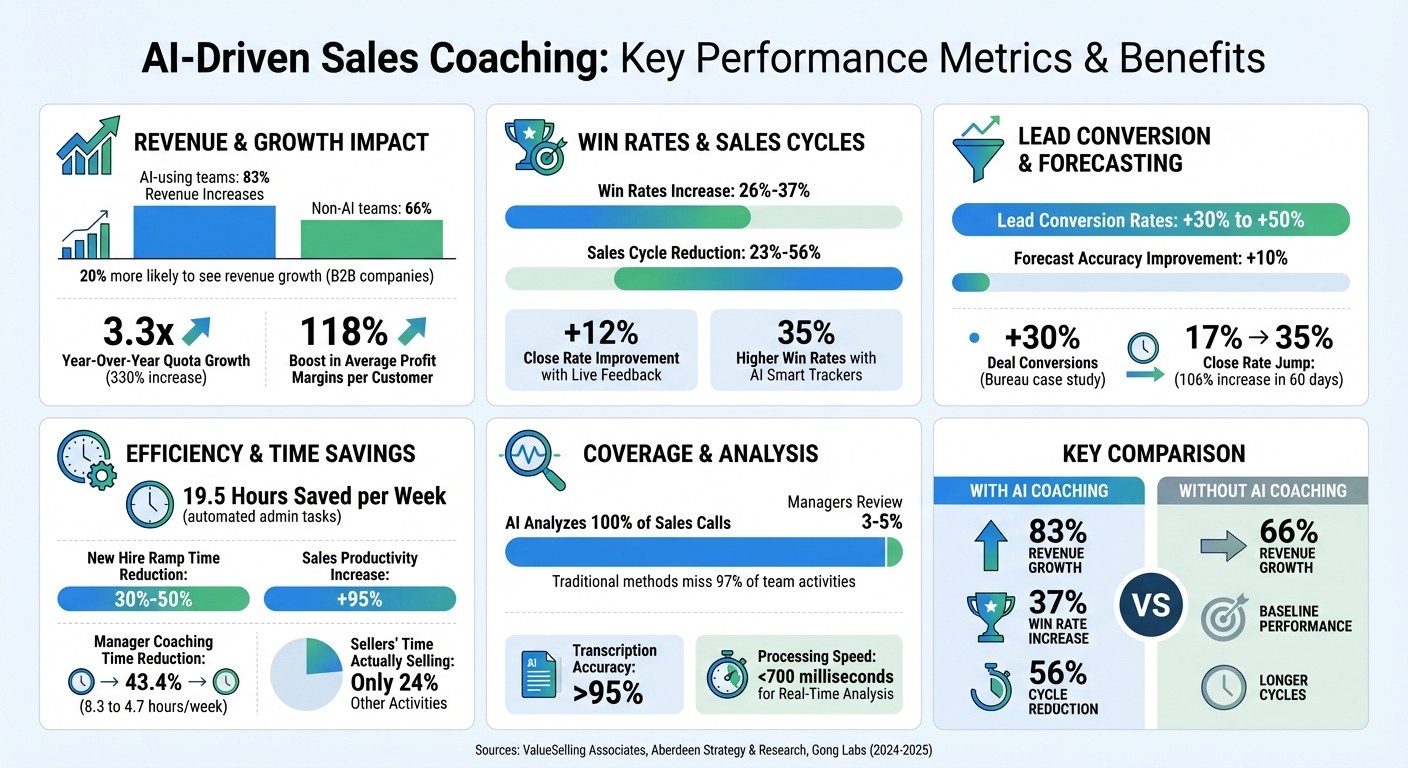
Revenue Growth: 83% of AI-using teams report revenue increases, compared to 66% for others.
Improved Win Rates: AI boosts win rates by 26%-37% and reduces sales cycles by up to 56%.
Personalized Feedback: AI identifies skill gaps, provides targeted training, and offers real-time call guidance.
Efficiency Gains: Automates admin tasks as part of the future of sales enablement, saving reps up to 19.5 hours weekly and cutting new hire ramp time by 30%-50%.
Predictive Insights: Flags at-risk deals and suggests next steps to improve outcomes.
AI-driven tools like Coach Pilot integrate seamlessly into workflows, providing actionable recommendations, automating repetitive tasks, and enabling scalable coaching. Sales teams leveraging AI achieve faster results, better customer engagement, and consistent quota attainment.
AI-Driven Sales Coaching Performance Metrics and ROI Statistics
What Great Looks Like in AI Sales Coaching Agents: 2025 Benchmark Report
Personalized Coaching with AI
AI is transforming the coaching landscape by analyzing every interaction - calls, emails, and CRM activities - to create a detailed performance profile for each sales rep [1]. Using Natural Language Processing, AI evaluates metrics like talk-to-listen ratios, question quality, script adherence, and mentions of competitors. It then compares these findings against patterns from top performers to identify specific areas for improvement, such as handling objections, conducting discovery calls, or securing next steps [13, 14, 16]. This level of analysis goes far beyond what traditional coaching methods can achieve.
Take the example of a mid-sized B2B services company that adopted PathfinderAI's Sales Coaching Platform in September 2025. During a 60-day pilot, their close rate jumped from 17% to 35% - a 106% increase. The AI identified unique challenges for individual reps, such as one struggling with discovery objections and another with closing deals [10]. Achieving this level of precision manually would be nearly impossible.
Automated Performance Analysis
AI seamlessly integrates with tools like Salesforce, HubSpot, and various communication platforms, capturing every interaction and analyzing it in detail. By examining factors like sentiment, vocal pitch, volume, and word choice, AI assesses both how engaged prospects are and how confident reps appear [13, 14, 15]. It then creates objective scorecards based on set criteria, eliminating the risk of manager bias [16, 20]. Instead of waiting for quarterly reviews, reps receive immediate feedback after calls, complete with specific clips that highlight areas for improvement [20, 2]. Companies using conversation analytics are 8.5 times more likely to experience revenue growth exceeding 20% [6].
Skill Gap Identification and Feedback
Building on its performance analysis, AI takes coaching a step further by pinpointing specific skill gaps for each rep. These insights shape personalized coaching plans, ensuring that development efforts are targeted and effective. For instance, if a rep consistently struggles with budget discovery, the AI assigns tailored role-play exercises to help them practice in a low-pressure environment before their next call [13, 16, 17].
"AI takes sales coaching to the next level by diving deep into each rep's unique data... It's like having a personal coach who knows exactly where each rep shines and where they need a little extra help."
Peter Kyranakis, VP of Solution Consulting and Sales Enablement, Allego [2]
Bureau, a company that adopted Zime's AI coaching tools, saw a 30% boost in deal conversions by using automated coaching strategies and playbooks to improve their discovery calls [3]. Considering that 81% of salespeople currently lack coaching tailored to their individual needs [10], AI makes it possible to scale personalized development across entire teams effectively.
Real-Time Sales Call Analysis and Insights
AI has taken sales call analysis to the next level by offering real-time intervention. Instead of waiting for post-call reviews, AI now analyzes conversations as they unfold. With transcription accuracies exceeding 95% [13], it uses Automatic Speech Recognition (ASR) to capture every word and Natural Language Processing (NLP) to interpret the conversation’s meaning. This includes identifying key details like competitor mentions or product features while maintaining the overall context [13]. Some systems are so fast they process and deliver analysis in under 700 milliseconds - quick enough to provide actionable suggestions while the prospect is still speaking [16].
But AI doesn’t stop at transcription. It evaluates vocal patterns and sentiment, picking up on emotions such as confusion, interest, or hesitation in real time [12][13]. It also monitors conversational metrics like talk-to-listen ratios, speaking speed, and the length of monologues. This helps sales reps strike the right balance in their interactions. Research even shows that successful sales reps speak only 43% of the time, leaving 57% for the buyer [14].
Immediate Feedback During or After Calls
The standout feature of real-time AI is its ability to identify "coaching moments" during live calls. By matching conversation triggers to company playbooks like MEDDIC or BANT [11][13], the AI provides instant, actionable feedback. For example, if a prospect mentions a competitor, the system might display a battle card highlighting key differentiators. Or, if the rep skips an important discovery question about budget, the AI prompts them to revisit it before moving forward. These insights appear as quick, glanceable visual alerts that keep the conversation on track [13].
Some platforms go a step further with "whisper coaching." This feature delivers discreet audio prompts directly into the rep’s headset, ensuring the prospect remains unaware [13]. By combining visual and auditory guidance, the system minimizes disruptions while maximizing effectiveness. Gartner reports that live feedback like this can boost close rates by over 12% [17]. Other studies show an average 7% improvement, particularly in objection handling and qualification consistency [11]. This real-time guidance not only improves performance in the moment but also strengthens overall customer interactions.
Improving Customer Engagement
Real-time AI doesn’t just correct mistakes - it helps reps connect with customers on a deeper level. For instance, if the system detects hesitation or confusion in the prospect’s tone, it might suggest a clarifying question or a more empathetic approach to address concerns [12][13]. By identifying these subtle cues, AI ensures that important buying signals aren’t missed and that the conversation flows at a pace that feels natural for the prospect.
"The tool's AI-driven coaching feedback also gives managers tremendous insight and direction on their team's performance, giving them the ability to have greater impact across their teams" - Susan Hopper, VP of Sales Enablement at HireRight [7]
This combination of real-time insights and emotional intelligence allows sales reps to engage prospects more effectively, creating a smoother and more productive sales process.
Predictive Analytics for Sales Coaching
AI-driven predictive analytics is reshaping sales coaching by shifting the focus from reactive problem-solving to proactive performance management. Instead of just analyzing past performance, managers can now access real-time guidance based on behavioral signals like multi-threading, executive engagement, and sentiment changes. By analyzing data from hundreds of calls, these systems create detailed profiles for sales reps, helping identify issues such as funnel leaks or distinguishing between problems like low connect rates (low engagement) and poor conversion rates (skill deficiencies) [19].
This technology also evaluates deals to identify those with a high likelihood of success and those at risk. For example, AI can flag "stuck" deals - those with no activity for over a week or stalled during the proposal stage due to missing stakeholders. It can also highlight patterns like deals involving CFO engagement before the proposal stage, which have a 3.2x higher win rate [18].
Forecasting Individual and Team Outcomes
Predictive systems use behavioral data to forecast performance with impressive precision. Moving beyond subjective manager notes or simple activity metrics, these tools assess factors like the depth of discovery calls, the presence of economic buyers, and the quality of outlined next steps [3][9]. Benchmarking tools further enhance insights by comparing middle-performers to top-performers, identifying key differences such as the number of discovery questions asked or the talk-to-listen ratio [19][15].
The results are tangible. B2B companies integrating AI into their sales coaching processes are 20% more likely to see revenue growth, with win rates increasing by 36% shortly after implementation [5]. Acting on AI recommendations within 24 hours further accelerates sales cycles, reducing them by 32.6% - from an average of 62.0 days to 41.8 days. The most significant improvements occur during the proposal stage (cut by 8.7 days) and negotiation stage (cut by 5.2 days) [18].
"Traditional reviews surface forecasts and subjective judgments. By contrast, [AI] Pipeline Review elevates behavior data alongside deal data, allowing managers to identify which risks stem from execution gaps rather than market dynamics." - Zime [3]
Early Intervention Coaching Strategies
Predictive analytics equips managers with tools to catch potential issues early, such as scorecards that highlight the top three coaching opportunities for each sales rep [9]. The system also flags missing key personas - like an Economic Buyer or CFO - in deals, prompting timely intervention from managers.
This approach allows managers to dedicate more time to strategic, high-value tasks. For instance, managers using predictive analytics have reduced their direct coaching time by 43.4% (from 8.3 to 4.7 hours per week). This freed-up time is then redirected toward deal strategy (a 256% increase) and team development (a 200% increase) [18]. Teams that combine AI-automated nudges for routine tasks with human oversight for complex negotiations report a satisfaction score of 8.4 out of 10 [18].
"AI doesn't replace the manager. It solves the bandwidth problem so the manager can actually do the high-value work: interpreting insights, having meaningful conversations, and making judgment calls about development priorities." - Salesfinity [19]
These predictive tools not only improve coaching effectiveness but also pave the way for integrated solutions that better align strategy with execution.
Efficiency Gains in Sales Training and Process Optimization
AI isn't just about crunching numbers - it’s reshaping how sales teams train and optimize their processes, delivering measurable improvements in both areas.
Automated Training and Feedback
AI takes over repetitive tasks like creating quizzes, tracking progress, and offering personalized feedback. It handles call reviews, develops training materials, and manages administrative duties, saving teams hours every week [21][23].
Here’s the reality: sellers spend only 24% of their week actively selling. The rest of their time is swallowed by meetings, research, and CRM updates [3]. AI steps in to reclaim those hours by automating CRM updates, summarizing calls, and drafting follow-up emails - tasks that used to drain significant time [3][1].
Take Precina, a healthcare company, as an example. In 2025, they used AI coaching to simplify clinician onboarding. Their always-on learning system provided real-time feedback during intake calls, making it easier to scale training efforts that were previously resource-intensive. CEO John Oberg highlighted the benefits:
"I've asked my team to practice once a day. They're warming up every day for professional calls. We want our providers to be warming up every day before they talk to patients" [21].
These changes deliver real results. AI-assisted coaching can cut new hire ramp time by 30% to 50%, helping sellers close their first deals sooner [8]. Sales teams leveraging automation report consistent efficiency gains of 10–15%, and those using AI are 1.3 times more likely to achieve revenue growth [3][9].
Process Optimization with AI Insights
AI doesn’t just streamline individual tasks - it analyzes every sales interaction to identify bottlenecks and patterns. For instance, it can uncover team-wide issues like rushing through discovery calls or struggling to handle specific objections [1]. Unlike traditional coaching, which often focuses on surface-level activity metrics (e.g., "calls made"), AI digs deeper to evaluate behaviors like discovery depth, value articulation, and objection handling.
Consider Bureau, a company that used automated documentation and coaching reinforcement to improve their discovery process. The result? A 30% increase in deal conversions [3]. Similarly, Versa Networks implemented Zime's Pipeline Review, cutting manager coaching time in half while improving consistency across their global sales team [3].
By automating routine evaluations and diagnostics, AI allows managers to dedicate more time to strategic coaching and team development. As Mamta Tainwala from Sybill puts it:
"A rep who spends 90 minutes a day on admin is a rep who has 90 fewer minutes to practice, prospect, and close. Freeing up that time is training by subtraction" [22].
These efficiency gains don’t just save time - they create space for meaningful skill development and revenue growth. AI’s ability to align process improvements with training goals is transforming how sales teams operate.
Research-Backed Benefits of AI-Driven Sales Coaching
AI-driven sales coaching is proving to be a game-changer, delivering measurable improvements across critical sales metrics. It enhances win rates, helps sales teams achieve quotas more effectively, improves forecast accuracy, and even shortens sales cycles. These results highlight how AI bridges the gap between strategy and tactical execution in sales coaching.
Key Metrics and Measured Improvements
A survey conducted in November 2024 by ValueSelling Associates and Aberdeen Strategy & Research, which involved 610 sales leaders, revealed some eye-opening statistics. Sales teams combining AI with structured training achieved over three times the year-over-year quota growth compared to teams using AI without training [4]. The same research also found a 56% reduction in sales cycle length and a 118% boost in average profit margins per customer [4]. Julie Thomas, CEO of ValueSelling Associates, emphasized the balance between technology and human connection, stating:
"AI can help to build and reinforce desired selling behaviors in a very human-centric way" [27].
Further supporting these findings, Gong Labs analyzed over one million sales opportunities across 1,418 organizations in February 2024. Their study revealed that teams using AI-powered Smart Trackers to identify deal characteristics saw 35% higher win rates, while those utilizing the "Ask Anything" AI feature experienced a 26% increase in win rates [24]. Eilon Reshef, Gong's Co-founder and Chief Product Officer, noted:
"Our research shows that targeted AI solutions are delivering significant value for revenue teams and helping them close deals more quickly, and more often" [24].
Other data paint a clear picture of the revenue potential AI offers. Sales teams leveraging AI report 83% revenue growth, compared to 66% for non-AI teams. Forecast accuracy improves by 10%, and lead conversion rates jump by 30% to 50% [20][26].
Here’s a snapshot of key performance boosts achieved through AI-driven coaching:
These results demonstrate how AI-driven coaching aligns sales strategies with practical, actionable insights, leading to consistent performance improvements.
AI also addresses scaling challenges that traditional coaching methods struggle to overcome. As the average manager’s span of control grows from 10.9 in 2024 to 12.1 in 2025, one-on-one coaching is becoming increasingly unrealistic [20]. While human managers typically review less than 5% of sales conversations, AI platforms can analyze 100% of calls [26]. This comprehensive approach ensures no coaching opportunity is missed. Additionally, high-performing organizations are 3.5 times more likely to use AI for forecasting compared to underperforming ones [26].
Integrating AI Coaching with Solutions like Coach Pilot
AI-driven coaching has already proven its value, but putting it into practice can be tricky for many organizations. That’s where tools like Coach Pilot step in. Instead of being a standalone tool, Coach Pilot weaves AI coaching directly into daily workflows. It transforms static playbooks into dynamic, interactive systems that guide sales reps through every phase of a deal. With immersive training and ongoing AI support, it ensures that coaching becomes a natural part of every sales interaction.
Custom Sales Playbooks and Training
Coach Pilot doesn’t just hand your team another PDF to ignore. Instead, it delivers customized sales playbooks that integrate with the tools your team already uses. These playbooks provide real-time, relevant guidance - whether it’s drafting an email, preparing for a call, or reviewing a deal. The platform pairs this with immersive training workshops designed to create lasting habits, not just surface-level memorization [28][29]. This combination turns strategy into action, ensuring measurable success in every interaction.
For example, in May 2024, Rebecca Veksler, Co-Founder of Four Rooms, shared that her team tripled monthly sales and closed 14 new deals within just 8 weeks of using Coach Pilot [29]. Similarly, Connor Bell, a BDM at HubSpot, reported a 50% increase in net new opportunities and 12 new deals over 11 weeks, which boosted quarterly sales revenue by 38% [29]. On average, companies experience 7.8x pipeline growth in under 90 days, with a 39% boost in quota attainment thanks to value-driven, playbook-aligned messaging [28].
Real-Time AI Coaching and Analytics
Coach Pilot doesn’t just review past calls - it provides real-time, actionable advice. Instead of generic metrics, the AI offers specific next steps like:
"Email the CFO by Thursday with this message. Call the economic buyer Friday at 9am. Use these talking points that closed three similar deals" [28].
It also saves reps time by automating admin tasks. By capturing the "deal truth" and updating CRM records automatically, it frees up an average of 19.5 hours per week that would otherwise be spent on manual data entry. This efficiency translates into tangible results. For instance, in December 2024, Stephen Luxmoore, Founder & CEO of Your HR Team, saw a 32% increase in client acquisitions, signing 8 new contracts in just 9 weeks with the help of tailored advice and strategies [30].
"The AI is insane, and the weekly live coaching is even more helpful. We can bring in real-life problems and have the coaches give specific examples and solutions to help guide us and remove any roadblocks."
Linh Podetti, CEO of Virtual Outsourced Angels[30]
Conclusion
AI-driven sales coaching is reshaping how sales teams perform. Studies reveal that 83% of teams using AI report revenue growth, compared to 66% of teams without it. Companies leveraging AI for coaching also see impressive results: 3.3x year-over-year quota growth, 56% shorter sales cycles, and 118% higher profit margins per customer [2][4][27][31]. These numbers underscore how AI directly impacts profitability.
One of AI's biggest advantages is its ability to analyze 100% of sales calls, while managers typically review only about 3% [1]. Additionally, with sales reps spending just 24% of their week actively selling, AI steps in to reclaim valuable time by automating tasks like CRM updates, call summaries, and follow-ups [3]. These tools don’t just save time - they enhance daily efficiency in meaningful ways.
AI coaching also bridges the gap between subjective feedback and actionable insights. It combines hard data with tailored guidance, offering reps clear, measurable recommendations instead of opinion-based critiques. As Julie Thomas, CEO of ValueSelling Associates, explains:
"AI can help to build and reinforce desired selling behaviors in a very human-centric way" [27].
Solutions like Coach Pilot’s AI workspace seamlessly integrate AI coaching into everyday workflows, pairing it with custom playbooks and immersive training. This approach transforms coaching from reactive to proactive, empowering teams with data-driven strategies to close more deals, faster. The research speaks for itself - AI-driven coaching is a game-changer for sales teams ready to elevate their performance.
FAQs
What data does AI sales coaching analyze?
AI sales coaching analyzes a wide range of data, including real-time conversations, engagement patterns, buyer interactions, call summaries, CRM updates, and performance metrics. It provides insights into areas like talk-to-listen ratios, the effectiveness of discovery questions, strategies for handling objections, shifts in buyer sentiment, and deal progression signals. By breaking down these elements, sales teams can fine-tune their approaches and achieve better results.
How fast can AI coaching improve win rates?
AI coaching has the potential to transform sales performance in just 60 days. It can drive measurable outcomes, like increasing close rates from 17% to 35%, which directly translates to higher revenue. These changes enable sales teams to achieve stronger results while streamlining their processes.
How does Coach Pilot fit into our current workflow?
Coach Pilot fits right into your sales process, offering an AI-powered platform designed to improve coaching, training, and execution. It generates tailored sales playbooks, delivers hands-on training experiences, and offers real-time, personalized coaching. This means you can scale your efforts without needing to grow your team. The result? Better win rates, shorter sales cycles, and consistent execution of sales strategies across your entire team.
Related Blog Posts

Remove the guesswork from winning more deals.