B2B Sales
AI Sales Coaching: Boosting Workflow Productivity
Mar 17, 2026
AI sales coaching transforms reps' workflows—boosting revenue, shortening sales cycles, automating admin, and shifting reps to 80% customer-facing time.

AI sales coaching is transforming sales processes by analyzing 100% of interactions, offering real-time feedback, and automating administrative tasks. Sales reps using AI tools generate 41% more revenue ($1.75M vs. $1.24M), while reducing activities by 18%. Companies report shorter sales cycles (32.6% faster), higher conversion rates (19.7% increase), and a 353% ROI in the first year.
Key benefits:
Increased productivity: Reps spend 80% of their time on customer interactions (up from 48%).
Shorter sales cycles: Deals close in 41.8 days (vs. 62.0 days with human-only coaching).
Improved lead targeting: ICP precision rises from 52% to 78%.
Time savings: CRM logging time drops by 75%, saving 6.7 hours weekly per rep.
Case studies highlight real-world success:
DJ & Lindsey Real Estate saw a 119% increase in outbound calls and added $120,000 revenue in 4 months.
JPMorgan Chase achieved 20% sales growth by cutting research time using AI tools.
AI also supports managers by reducing coaching time by 43.4%, enabling focus on team development. With automated alerts, performance issues are identified 2–3 days earlier with 84% accuracy, improving recovery rates to 86%. AI reshapes workflows, freeing up reps to focus on high-value tasks and driving better sales outcomes.
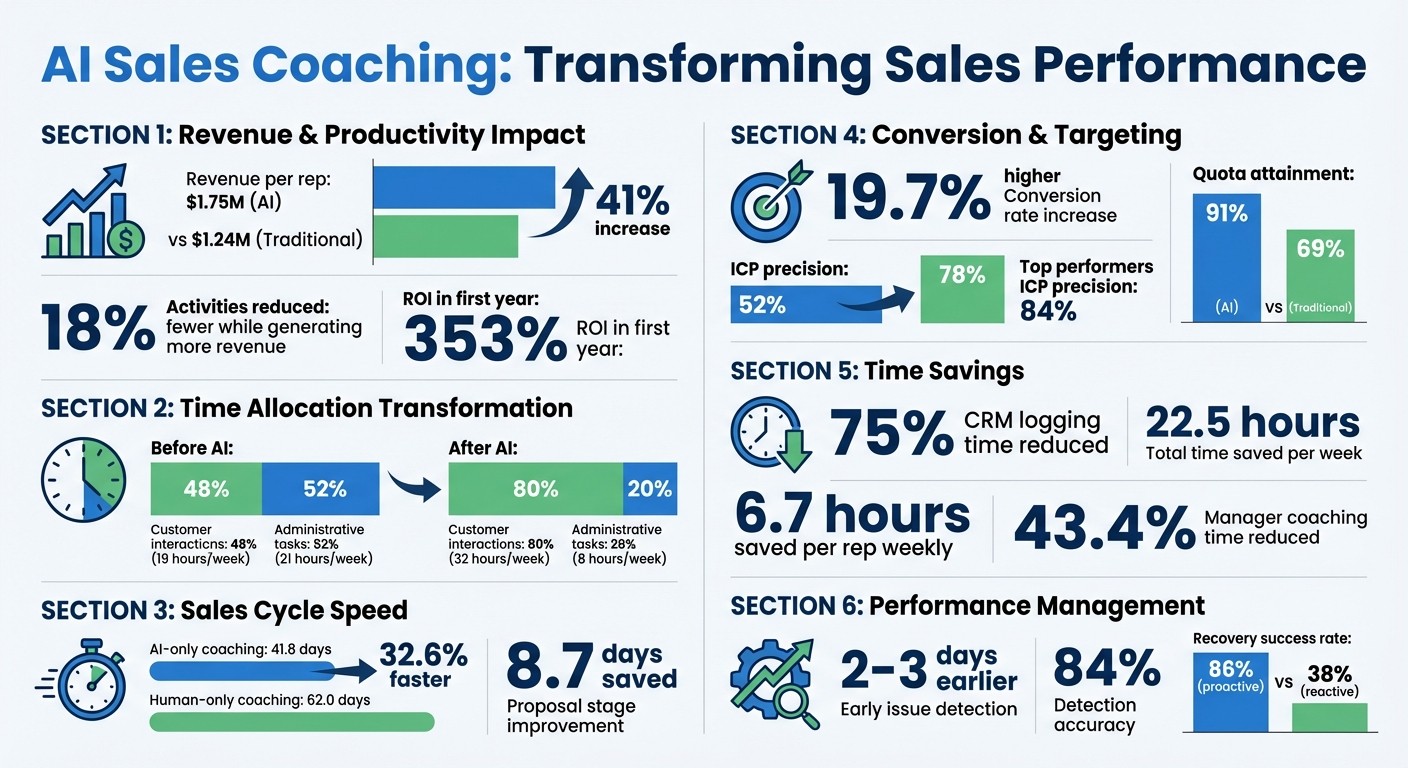
AI Sales Coaching Impact: Key Performance Metrics and ROI Statistics
What Research Shows About AI Sales Coaching and Productivity
Faster Sales Cycles
Teams coached exclusively by AI close deals in an average of 41.8 days, which is 32% faster than the 62.0 days typically seen with human-only coaching [5].
A hybrid approach - blending AI with human coaching - delivers sales cycles of 47.7 days, while achieving a team satisfaction score of 8.4 out of 10 [5]. This method strikes a balance between speed and the human connection that keeps teams motivated. Not only does AI coaching accelerate deal closures, but it also drives a noticeable boost in overall team productivity.
Higher Team Productivity
AI coaching doesn’t just speed up sales - it also shifts how time is spent, allowing reps to focus more on customers. Traditionally, sales reps spend 48% of their week (19 hours) on customer-facing activities and the remaining 52% (21 hours) handling administrative tasks [2]. With AI support, this dynamic flips. AI-augmented reps spend 80% of their week (32 hours) directly engaging with customers, leaving just 20% (8 hours) for manual tasks [2].
These changes lead to tangible results. For instance, AI-coached reps see 19.7% higher conversion rates compared to those relying solely on traditional manager coaching [5]. Teams that combine AI coaching with structured sales training experience an impressive 3.3x year-over-year growth in quota attainment [4]. Even more striking, 91% of salespeople using AI coaching meet or exceed their goals, compared to just 69% of those using traditional methods [7].
Enterprise Implementation Results
For enterprises, the benefits of AI coaching go beyond individual performance. Companies report a 353% ROI within the first year of adopting AI coaching technology [8]. Sales managers using AI tools have reduced their direct coaching time by 43.4%, allowing them to focus on strategic priorities like deal coaching and team development instead of repetitive tasks like pipeline reviews [5].
AI tools also enable proactive performance management. For example, AI-powered alerts can identify performance declines 2–3 days before they become apparent to managers, with an 84% accuracy rate [2]. When managers act on these early warnings, they achieve an 86% success rate in helping underperforming reps recover - more than double the 38% success rate of reactive approaches [2].
Sales Coaching Reimagined with Agentic AI
How AI Affects Sales Performance Metrics
AI continues to reshape sales strategies, delivering measurable improvements across key performance indicators.
Sales Productivity Increases
Sales reps using AI tools generate $1.75 million in revenue per rep, compared to $1.24 million for those relying on traditional methods - a 41% jump. And they achieve this while performing 18% fewer activities [2]. This demonstrates a shift from prioritizing sheer activity volume to focusing on meaningful, high-quality interactions that drive results.
AI also sharpens targeting precision. By utilizing AI-powered Ideal Customer Profile (ICP) analysis, precision rates improve from 52% to 78% [2]. Top-performing reps take this further, maintaining an impressive 84% ICP precision rate, compared to the average of 52% [2]. This level of accuracy allows teams to disqualify weak leads earlier and focus on prospects most likely to convert.
Time Saved Through Automation
AI dramatically reduces time spent on administrative tasks, freeing up 22.5 hours per week per rep [2]. The percentage of time dedicated to manual work drops from 52% to just 20% - a 62% reduction [2]. Additionally, CRM logging time is slashed by 75%, saving about 6.7 hours weekly per rep [2]. For larger teams, these savings add up, enabling sales managers to focus more on strategic coaching and improving overall team performance.
With these efficiencies, sales reps can manage deals more dynamically, leading to shorter sales cycles and better outcomes.
Reduced Sales Cycle Length
AI-guided coaching significantly shortens sales cycles, cutting the average length by 32.6% - from 62.0 days to 41.8 days - when reps act on AI recommendations within 24 hours [5]. The proposal stage sees the most dramatic improvement, with an average reduction of 8.7 days [5]. By identifying bottlenecks in real time, AI empowers reps to take quick, decisive actions during negotiations.
A real-world example comes from JPMorgan Chase. Between 2023 and 2024, the company introduced an AI-driven tool called "Coach AI" for its private client teams. This platform delivered real-time market insights during meetings, cutting research time from hours to seconds and contributing to a 20% gross sales growth in its Asset & Wealth Management division [10].
How AI Reduces Sales Workflow Inefficiencies
AI doesn't just improve sales performance and revenue execution - it also simplifies workflows by cutting down on time-consuming administrative tasks. Right now, sales reps spend only 24% of their week actively selling, with the rest eaten up by meetings, research, and CRM data entry [6]. AI tackles this issue by minimizing task-switching and streamlining the behind-the-scenes work that often disrupts productivity.
Less Time Switching Between Tasks
AI brings multiple tools together, automating processes like updating Salesforce fields when reps follow specific playbooks (e.g., MEDDIC) and sending summary notes straight to Slack [1]. This eliminates the need for manual data entry, letting reps focus on what they do best - selling.
Real-time AI playbooks take it a step further by offering context-specific prompts, so reps don’t have to stop mid-task to consult training manuals [6]. AI also handles repetitive tasks like creating call summaries and updating records automatically, ensuring reps stay engaged with their sales activities rather than getting bogged down by administrative work [6].
Managers benefit too. AI pre-analyzes calls and compiles key coaching moments into weekly agendas, freeing managers from reviewing every detail and allowing them to focus on improving team performance [3]. With tools like "invisible shadowing", AI monitors all live calls and only alerts managers when something needs attention - such as a drop in sentiment or a competitor being mentioned. This allows one manager to effectively oversee up to 20 reps [11]. By reducing distractions for both reps and managers, AI creates a more focused, efficient sales process.
Better Lead Qualification
AI also improves lead qualification, a critical factor in shortening sales cycles. Automated scorecards evaluate every call based on criteria like discovery depth and value articulation, helping to identify gaps in the qualification process [3][12].
In real time, AI flags risks that could derail deals. For example, it can spot if a key decision-maker, like a CFO, hasn’t been engaged by a certain point - say, "day 14" - or if a deal is single-threaded and needs additional stakeholder involvement [3][5]. This automated stakeholder mapping ensures reps focus their energy on the most impactful activities.
Organizations leveraging AI report being 1.3 times more likely to achieve revenue growth, thanks to the time saved on administrative tasks [6]. By automating CRM upkeep and follow-ups, AI allows reps to spend more time on high-value activities that move deals forward [1].
How Coach Pilot Delivers These Productivity Benefits
Coach Pilot turns AI sales coaching research into practical results by moving beyond static playbooks and aligning with the dynamic nature of live sales deals. Instead of relying on documents that sales reps often overlook, it integrates your company’s workflows, messaging, deal stages, and objection-handling strategies into a Living Playbook. This playbook stays active across every stage of the sales process, making it an integral part of daily operations [13]. Let’s explore how this approach, along with real-time coaching and smarter forecasting, drives real results.
Custom Sales Playbooks
Coach Pilot captures and shares the strategies of top-performing sales reps - like knowing the right time to bring in executives or how to navigate procurement hurdles. This expertise is embedded into your existing tools, giving reps access to actionable advice without forcing them to switch between platforms [13][9].
The results speak for themselves. In May 2024, Rebecca Veksler, Co-Founder of Four Rooms, reported tripling monthly sales and closing 14 deals in just eight weeks [13]. Similarly, Naum Sekulovski, a Business Development Manager at Food By Us, achieved 13 new contracts in nine weeks, driving a 45% increase in sales revenue [13].
Training and Real-Time Coaching
By combining hands-on training workshops with AI-powered real-time coaching, Coach Pilot ensures reps stick to proven best practices during live interactions. The platform also automates key deal insights, saving sales reps an average of 19.5 hours per week by reducing time spent on CRM updates and admin work [13].
For example, in June 2024, Connor Bell, a BDM at HubSpot, used Coach Pilot to generate 50% more new opportunities. Over an 11-week period, he closed 12 deals, leading to a 38% increase in quarterly sales revenue [13]. Teams using Coach Pilot also see a 39% improvement in quota attainment by replacing generic outreach with targeted, playbook-aligned messaging [13].
And it doesn’t stop at coaching. The platform’s forecasting tools take it a step further, turning raw data into actionable insights that drive better outcomes.
Better Forecasting and Win Rates
Coach Pilot improves forecasting accuracy by automatically gathering deal data, cutting down on the need for subjective updates from reps. The AI analyzes patterns from real-world deals and shares successful tactics across the team. This approach has helped customers achieve pipeline growth of 7.8× within the first 90 days [13].
In December 2024, Stephen Luxmoore, Founder & CEO of Your HR Team, reported a 32% increase in new client acquisitions, signing eight contracts in nine weeks [13]. Costa Vasili, CEO of Ethnolink, shared his experience:
"We've significantly increased our pipeline and boosted our bottom line. The investment in this program has paid for itself many times over" [13].
Conclusion
Studies reveal that incorporating AI into sales coaching leads to productivity improvements that traditional methods simply can't match. Teams leveraging AI experience a 95% boost in productivity, 118% better profit margins, and sales cycles that are 32.6% to 56% shorter, depending on the circumstances [4][5]. On top of that, revenue per sales rep increases by 41%, climbing from $1.24 million to $1.75 million, while reps reduce their workload by 18%, focusing more on high-value prospects [2].
These results are driven by the expansive capabilities of AI. Unlike traditional coaching, which covers just 3% of sales interactions, AI provides 100% coverage, giving managers the tools to cut coaching time by 43.4% - saving them 3.6 hours weekly for strategic deal planning [1][5]. AI also transforms onboarding, reducing first-year rep attrition by 39%, dropping from 32% to 19.5% [14].
Another game-changer is how AI shifts reps' focus from administrative tasks to customer engagement. By automating much of the busywork, AI reduces administrative duties from 52% to just 20% of a rep's schedule, allowing them to spend 80% of their time directly interacting with customers [2]. Julie Thomas, CEO of ValueSelling Associates, highlights this shift by stating:
"AI can help to build and reinforce desired selling behaviors in a very human-centric way" [4].
FAQs
What data does AI sales coaching analyze from calls and emails?
AI sales coaching analyzes all sales interactions, from calls to emails. By identifying keywords, tracking sentiment, and spotting buyer objections, it provides personalized coaching tips tailored to each salesperson's unique call patterns. This approach helps sales teams tackle challenges head-on and boost their overall performance.
How long does it take to see ROI after adopting AI sales coaching?
ROI from AI sales coaching often becomes evident within just 1–2 weeks. This quick turnaround stems from several factors: expanded coaching coverage, saving managers over 10 hours per week, and speeding up the onboarding process for sales reps - particularly when there's a well-defined methodology and playbook guiding the process.
How does AI coaching fit into existing CRM and sales workflows?
AI coaching fits naturally into CRM and sales processes, delivering real-time, data-based feedback and customized guidance with little manual input. It evaluates sales interactions to pinpoint skill gaps, recommend next actions, and deliver personalized coaching automatically. By taking over tasks such as call reviews and creating scorecards, AI can save managers up to 43% of their time. This allows for consistent, proactive coaching that boosts team performance and speeds up sales cycles.
Related Blog Posts

Remove the guesswork from winning more deals.