B2B Sales
Scaling Account-Based Selling: AI Solutions
Mar 8, 2026
AI automates research, ranks accounts in real time, and creates personalized outreach to scale account-based selling and accelerate pipeline growth.

Account-based selling (ABS) delivers bigger deals and higher revenue by focusing on personalized strategies for high-value accounts. However, scaling ABS is challenging due to time-consuming manual tasks, siloed teams, and slow account prioritization. AI solves these problems by automating research, creating tailored content, and ranking accounts in real-time.
Key Insights:
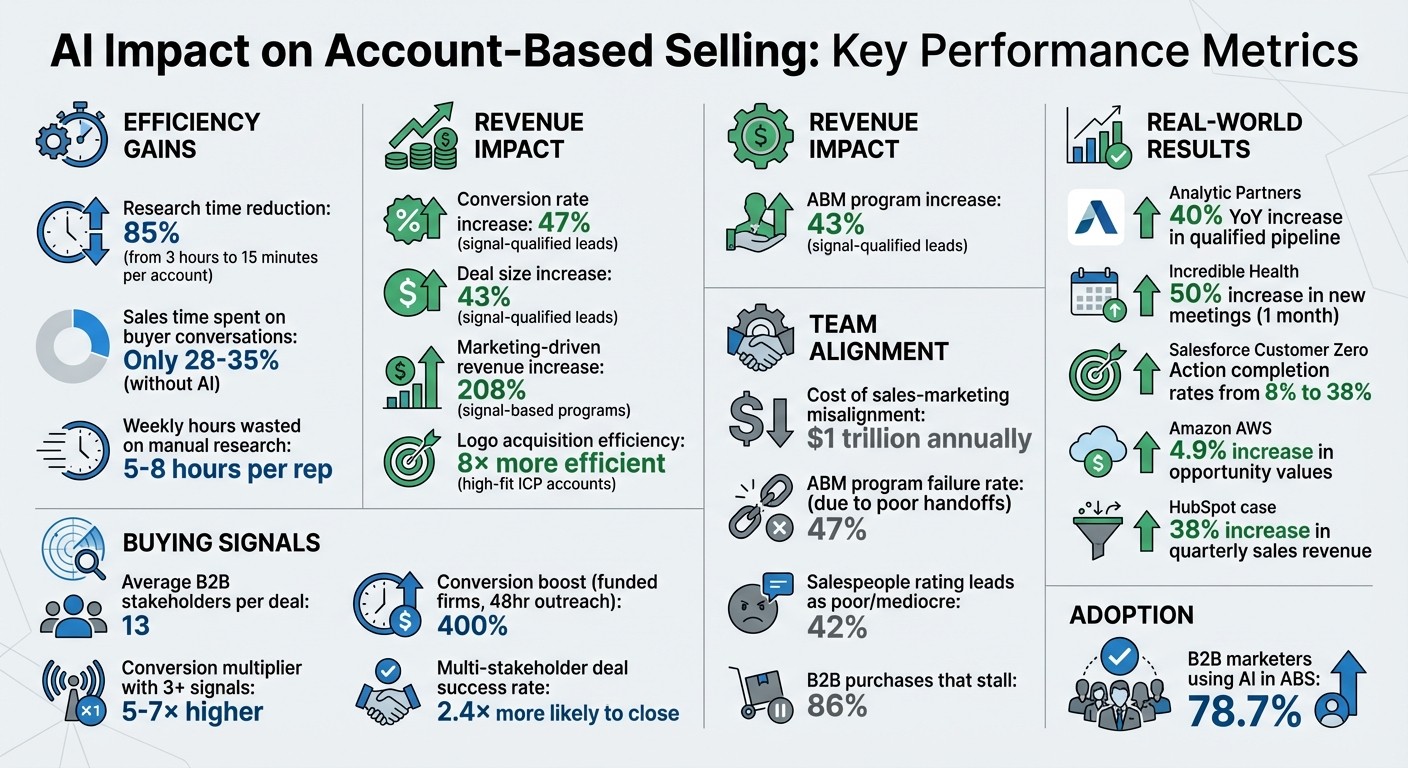
AI reduces research time by up to 85%, allowing sales teams to focus on selling.
Signal-based targeting increases conversion rates by 47% and deal sizes by 43%.
AI improves collaboration between sales and marketing by centralizing data and enabling real-time updates.
Companies using AI in ABS report faster pipeline growth, better account engagement, and higher revenue - all while reducing operational inefficiencies caused by static, unused playbooks. If scaling ABS feels overwhelming, AI might be the answer.
AI Impact on Account-Based Selling: Key Performance Metrics and ROI
How to Use AI for Sales Prospecting and Account Planning | The Sales Gravy Podcast
Common Problems When Scaling Account-Based Selling
When Account-Based Selling (ABS) starts to scale, the initial benefits often give way to operational hurdles. These aren't small annoyances - they're core challenges that can stall growth and sap resources. Here are three major obstacles that teams face when expanding ABS.
Personalization Consumes Too Many Resources
Personalization is the backbone of ABS success, but it’s also incredibly resource-intensive. To have a meaningful conversation with just one enterprise account, sales reps need to spend 2–3 hours combing through LinkedIn profiles, SEC filings, earnings transcripts, and news updates [2]. Now, imagine scaling that effort across dozens - or even hundreds - of accounts. The workload quickly becomes overwhelming.
Here’s the math: researching 10 accounts can take up to 10 hours per rep. Multiply that by the number of accounts in a growing portfolio, and it’s easy to see why teams struggle [9]. And it doesn’t stop there. On average, a B2B deal involves 13 stakeholders, each with their own concerns and priorities [9]. Crafting personalized outreach for every stakeholder becomes virtually impossible without automation. This dilemma is what experts call the "personalization paradox" - teams must choose between impersonal mass outreach (which doesn’t work) and genuine personalization (which is unsustainable) [8].
To make matters worse, account intelligence doesn’t last forever. A few weeks after completing research, new leadership hires, earnings reports, or strategic changes can render that information outdated. Teams are left scrambling to re-research accounts they thought they had already covered [2].
And personalization isn’t the only issue. Operational inefficiencies between teams make scaling even harder.
Sales and Marketing Operate in Silos
The disconnect between sales and marketing teams is more than just an inconvenience - it’s a massive financial drain. Sales-marketing misalignment costs companies over $1 trillion each year [10]. The core issue? These teams work on different timelines and prioritize different metrics. Marketing looks at long-term goals like brand awareness (6–12 months out), while Sales is laser-focused on hitting short-term quotas [10].
This misalignment shows up in almost every aspect of their work. Marketing measures success with metrics like MQLs or impressions, while Sales only cares about closed deals. The result? Constant arguments over lead quality and follow-up responsibilities [10]. In fact, 42% of salespeople rate marketing-generated leads as mediocre or poor [10], and 47% of ABM programs fail due to poor handoffs between teams [11].
The problem deepens when account selection becomes a battleground. Sales often pushes for high-profile “named logos,” while Marketing prioritizes accounts based on fit and intent data. RevOps, meanwhile, pushes for accounts that align with trackable metrics. These debates can drag on for weeks, leading to static quarterly account lists that are outdated almost as soon as they’re finalized [1][6]. Meanwhile, critical signals - like web visits, intent data, CRM notes, and call transcripts - are scattered across disconnected systems, making it nearly impossible to get a full picture of an account [6][2].
This lack of coordination slows down account prioritization, creating another major bottleneck.
Account Prioritization Takes Too Long
Manually prioritizing accounts is a time sink for sales teams [2]. Reps often spend 5–8 hours per week gathering data instead of engaging with buyers [2]. While this process might work for managing 25 accounts, it completely breaks down when scaling to 250. Without automation, scaling requires a proportional increase in headcount, which isn’t sustainable [6].
Traditional prioritization methods rely on outdated firmographics or gut instincts, which often lead to what’s known as "pilot purgatory." This is where ABM programs run but fail to evolve into a repeatable growth strategy [12][3]. High-value team members get bogged down synthesizing fragmented data sources instead of focusing on building strategic relationships [2][3]. And with 86% of B2B purchases stalling [4], timing becomes critical. Unfortunately, manual processes often can’t move fast enough to catch buying opportunities before they disappear.
These delays underscore the need for smarter, faster ways to manage and scale ABS effectively.
How AI Solves ABS Scaling Problems
Account-based selling (ABS) often struggles with balancing personalization, siloed operations, and slow account prioritization. AI steps in to tackle these challenges head-on, making it possible to achieve both personalization and efficiency at the same time.
AI Identifies and Ranks Accounts Automatically
Manual research and outdated data often lead to inefficiencies in account prioritization. AI changes the game by analyzing thousands of data points in real time, removing guesswork from the process. Instead of relying on static quarterly lists or gut feelings, predictive models rank accounts based on factors like conversion likelihood and lifetime value. These rankings continuously update with new information, shifting the focus from outdated "fit" criteria to real-time "readiness" driven by market events[13][14][16].
The results are impressive. Targeting high-fit Ideal Customer Profile (ICP) accounts leads to logo acquisitions that are 8× more efficient[13][15]. Additionally, organizations using signal-qualified leads report 47% better conversion rates and 43% larger deal sizes[16]. AI doesn’t just flag individual signals - it identifies compound signals, such as a combination of a funding round, leadership changes, and hiring surges. Accounts showing three or more of these signals convert at rates 5–7× higher than those with only one signal[16].
For example, Analytic Partners adopted signal-based AI under Andrew Giordano, their VP of Global Commercial Operations, in 2025. The company slashed research time per account from 3 hours to just 15 minutes - a reduction of 85% - and saw a 40% year-over-year increase in qualified pipeline[2]. Similarly, Incredible Health saw a 50% jump in new meetings booked within just one month of using signal-based intelligence[2].
"The Business Development team gets 80 to 90 percent of what they need in 15 minutes. That is a complete shift in how our reps work."
Andrew Giordano, VP of Global Commercial Operations, Analytic Partners[2]
AI also offers transparency. With tools like SHAP values, it explains why certain accounts are flagged as high-priority, giving sales teams the confidence to act on these insights[14].
Once accounts are prioritized, AI shifts its focus to scaling personalized outreach.
AI Creates Personalized Content at Scale
Personalization no longer requires hours of manual effort. AI compiles data from sources like LinkedIn, news, SEC filings, and earnings transcripts to create concise account briefs. It also generates role-specific messaging, tailoring the same product benefits differently for a CFO versus a CIO by addressing their unique pain points and goals[6][3][2]. The system monitors external triggers, such as leadership changes or earnings calls, and drafts timely, relevant outreach content[2][7].
To ensure accuracy and consistency, AI tools connect to a repository of approved messaging, product documentation, and brand guidelines. This "grounding" ensures that all generated content aligns with the company’s voice and standards. While AI handles the heavy lifting, humans step in for final strategic reviews, maintaining a balance between efficiency and quality[6][1].
AI Provides Real-Time Data for Team Alignment
AI doesn’t just refine account targeting - it also helps align sales and marketing teams by centralizing critical data. Disjointed operations can be costly, but AI-powered platforms unify data from CRMs, marketing automation tools, and third-party intent providers into a single source of truth[18][20]. This ensures both teams operate with the same insights.
Real-time intent alerts are particularly powerful. AI tracks behavioral signals like website visits, competitor research, and content engagement, triggering alerts for both sales and marketing teams. This enables immediate, coordinated responses[17][20]. Bi-directional CRM syncing further reduces manual data entry, keeping everyone on the same page and eliminating silos[20].
Platforms like Coach Pilot take this a step further by embedding AI-driven coaching directly into sales workflows. By offering shared intelligence and real-time guidance, these tools help sales teams bridge the gap between strategy and execution, improving win rates and shortening sales cycles.
Between February and May 2025, Salesforce’s internal "Customer Zero" team used an AI system to generate 24,000 personalized recommendations for sellers. This initiative boosted action completion rates from 8% to 38%, contributing $28 million to the pipeline and $9 million in closed ACV[5].
"AI will help align sales and marketing if all agree they can trust the data. It can cut out a lot of finger pointing."
Steven Wright, Chief Analyst, Vendor Neutral[19]
AI also standardizes methodologies by scoring sales interactions against frameworks like MEDDICC or Challenger. This shared approach reduces disagreements over lead quality and follow-up responsibilities, fostering better collaboration between teams.
How to Measure AI's Impact on ABS Scaling
Tracking the right metrics is essential to understand AI's influence on account-based selling (ABS). As teams transition from manual processes to AI-powered systems, focusing on results rather than just activities becomes critical.
Key Metrics to Track
Pipeline velocity is a standout metric, offering a comprehensive view by combining four variables: (Qualified Leads × Win Rate × Average Deal Size) ÷ Sales Cycle Length [24]. AI significantly enhances each of these factors. For instance, it shortens sales cycles by 28% and improves lead scoring accuracy by 43% [24].
Research time reclaimed directly reflects efficiency improvements. By automating tasks like account research, sales teams can shift their focus to high-value activities. For example, Amazon Web Services leveraged Generative AI to create over 100,000 account summaries, slashing preparation time and increasing opportunity values by 4.9% [24].
Multi-threading depth measures the quality of account engagement by tracking the number of unique stakeholders involved per account. AI strategies should aim for at least three engaged stakeholders in Tier 1 accounts before sales handoff. Research shows deals with multiple stakeholders are 2.4× more likely to close [21][16]. Another critical metric, next step reliability, evaluates how often sales interactions lead to clear, buyer-agreed next steps, serving as a key predictor for forecast accuracy [22].
Using control groups helps isolate AI’s incremental impact. Also, monitor the time between AI-detected signals and sales outreach - reaching out to funded firms within 48 hours can boost conversions by 400% [21][26][16].
These metrics offer a solid starting point for optimizing AI-driven ABS strategies.
How to Improve Results with AI Over Time
To sustain and enhance AI’s effectiveness, continuous monitoring and refinement are essential. One key metric is decision accuracy, which measures how often AI recommendations lead to successful outcomes. If human overrides consistently yield better results, the AI model may need retraining. On the other hand, if overrides reduce success rates, the team might need further training on how to use AI insights [23].
Signal density analysis is another valuable tool. Accounts showing three or more concurrent buying signals - like funding rounds, leadership changes, or hiring surges - convert at rates 5–7× higher than those with only one signal [16]. Regularly reviewing these signals helps prioritize the ones that drive deals forward while deprioritizing less effective ones.
In a practical example, Connor Bell, a Business Development Manager at HubSpot, achieved a 38% increase in quarterly sales revenue by adopting AI-powered strategies through Coach Pilot. Over an 11-week period in mid-2024, he generated 50% more net new opportunities and closed 12 new deals. His success came from following a 90-day optimization framework: focusing on data hygiene in the first 30 days, implementing predictive scoring in the next 30, and layering automated workflows in the final phase [24].
To calculate ROI effectively, use this formula: (Incremental Gross Profit + Cost Savings − Total AI Cost) ÷ Total AI Cost [26]. Most signal-based AI platforms deliver measurable results within 30–90 days, with reclaimed research time often offsetting platform costs within 60 days [2]. The focus should shift from cutting costs through automation to driving better outcomes and increasing revenue through improved execution.
Conclusion
Sales teams spend 5–8 hours each week on manual research, leaving only 28–35% of their time for buyer conversations [2]. AI steps in to eliminate this time drain by automating research, generating personalized content at scale, and pinpointing high-intent accounts through real-time signal tracking.
The results speak for themselves: signal-qualified leads drive a 47% increase in conversion rates and a 43% jump in deal sizes [16]. Programs that harness these signals generate 208% more marketing-driven revenue [16]. This represents a shift from labor-intensive processes to streamlined, scalable revenue strategies.
One of the biggest challenges sales teams face is the execution gap. Static PDFs and outdated playbooks can’t keep up with the dynamic nature of live deals. Coach Pilot addresses this by embedding AI-powered coaching directly into sales workflows, offering real-time guidance on the next steps - whether it’s choosing the right talking points or knowing when to engage a key stakeholder. For example, in May 2024, Rebecca Veksler, Co-Founder of Four Rooms, tripled her monthly sales and closed 14 new deals in just eight weeks using Coach Pilot’s actionable strategies and support [27]. This kind of real-time coaching transforms strategy into execution, giving businesses a competitive advantage.
"We've significantly increased our pipeline and boosted our bottom line. I highly recommend Coach Pilot to any business owner looking to drive sales fast."
– Costa Vasili, CEO, Ethnolink [27]
With 78.7% of B2B marketers already leveraging AI in ABS [7][25], the real question isn’t whether to adopt AI - it’s how quickly you can implement it to seize buying opportunities that open and close in weeks, not months.
FAQs
What data sources does AI use to rank accounts in real time?
AI processes data from various sources like websites, social media platforms, financial reports, news outlets, CRM systems, and market trends. By working with both structured and unstructured data, it pinpoints high-potential prospects and ranks accounts instantly, helping businesses fine-tune their account-based selling strategies.
How do you ensure AI-generated outreach stays accurate and on-brand?
Maintaining accurate and consistent AI-driven outreach means blending AI capabilities with human oversight and reliable data management. AI can help tailor messages using prospect data while staying true to your brand's tone and personality. To keep everything on track, review samples regularly to ensure they align with your standards. Plus, integrating AI workflows with your CRM allows you to monitor and fine-tune messaging over time. This approach keeps your outreach precise, engaging, and in harmony with your brand identity.
Which KPIs best show AI is improving ABS ROI?
When it comes to measuring AI's impact on account-based selling (ABS), a few key performance indicators (KPIs) stand out. Metrics like revenue growth, sales efficiency, and pipeline performance clearly reflect how AI contributes to ROI.
For instance, AI has been associated with higher quota attainment and shorter deal cycles, both of which are critical for sales success. Additionally, KPIs such as pipeline value and deal velocity emphasize AI's ability to boost sales productivity and drive revenue. These metrics provide a tangible way to evaluate how AI enhances ABS strategies and delivers measurable returns.
Related Blog Posts

Remove the guesswork from winning more deals.