B2B Sales
How to Improve Win Rates in B2B Sales
Feb 7, 2026
Practical methods to raise B2B win rates: accurate tracking, AI-driven coaching, custom playbooks, win-loss analysis, and real-time call guidance.

Want to close more deals in B2B sales? Start by improving your win rate.
Win rate measures how many opportunities turn into closed-won deals. The formula is simple:
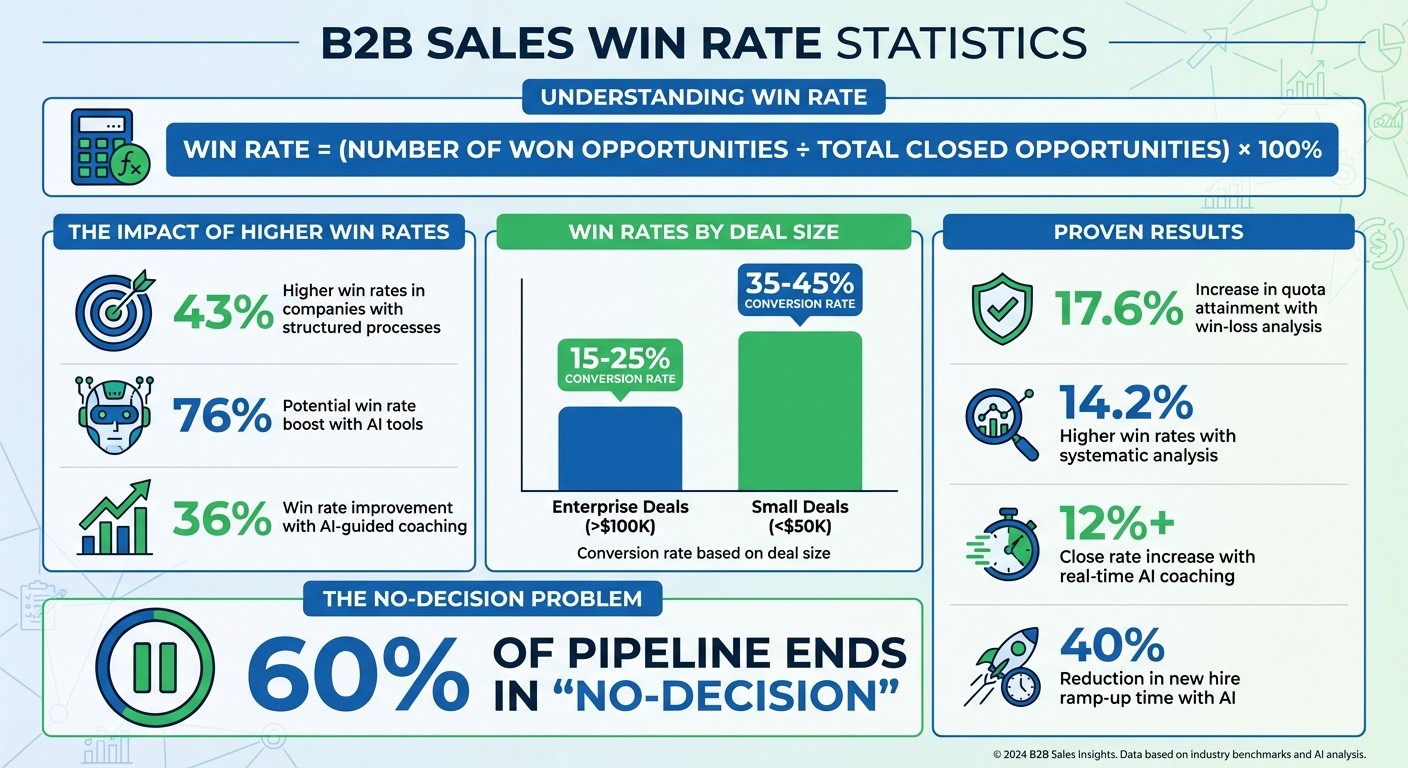
Win Rate = (Number of Won Opportunities ÷ Total Closed Opportunities) × 100%
Here’s why it matters:
Higher win rates = fewer leads needed to hit revenue goals
Companies with structured processes see 43% higher win rates
AI tools can boost win rates by up to 76%
But most sales teams struggle because they don’t analyze why deals are lost or fail to address skill gaps. This guide breaks down:
How to calculate win rates accurately
Using AI sales coaching to identify and fix weaknesses
Building tailored playbooks aligned with buyer needs
Leveraging real-time coaching to improve performance
Key B2B Sales Win Rate Statistics and Impact Metrics
How to Calculate and Track Win Rates Correctly
What Win Rates Mean in B2B Sales
Win rate is a key metric in B2B sales, showing how many qualified opportunities turn into closed deals. The formula is simple: (Number of Won Opportunities ÷ Total Closed Opportunities) × 100%. To keep your metrics accurate, only include deals with final outcomes - this avoids distorting your performance data [5].
It’s also important to define what counts as a loss. For example, decide whether “No Decision” or “Abandoned” deals should be included. This clarity helps you better understand how you’re performing against competitors [8].
If your business handles deals of varying sizes, a value-weighted win rate can provide a better perspective on revenue impact. Use this formula: (Total $ Won ÷ Total $ Closed) × 100%. This approach ensures that larger, high-value deals carry more weight in your analysis, giving you a more precise view of your sales performance [5].
Using CRM Tools to Track Sales Data
CRM tools like Salesforce can simplify tracking by automatically recording opportunity outcomes. However, clean data is essential. Sales reps should be required to select a specific reason for a loss - such as Price, Timing, Competition, or No Decision - before marking a deal as closed-lost [6].
Segmenting your data can uncover trends and bottlenecks. Break it down by sales rep, deal size, region, and lead source to identify where problems might be hiding. For instance, enterprise deals worth over $100,000 may have a conversion rate of 15–25%, while smaller deals under $50,000 might close at a higher rate of 35–45% [2]. Without such segmentation, you risk missing critical insights into your team’s challenges.
Consistency in reporting is another must. Use a rolling 90-day or 180-day window to ensure your data remains timely and statistically relevant [5]. Many teams now use tools like Coefficient to sync live CRM data with Google Sheets, allowing for automated dashboards that update hourly - no manual exports needed [7].
"Win rate isn't just a scorecard - it's a diagnostic tool. It tells you where your sales process is excelling and, more importantly, where it's breaking down." - Semir Jahic, Founder, Salesmotion [5]
Explore our sales strategy blog for more expert advice. Next, we’ll dive into how AI analytics can help identify and address skill gaps in your sales process.
Using AI Tools to Find and Fix Skill Gaps
AI Analytics for Sales Performance
AI tools are reshaping how sales teams identify and address skill gaps. By analyzing every sales interaction, these tools uncover areas where reps face challenges - using objective data instead of relying on a manager's intuition. Metrics like talk-to-listen ratios, the depth of questions asked, and objection-handling patterns are tracked to provide actionable insights. For instance, research shows that sales calls featuring 11–14 questions close 74% more deals compared to those with fewer questions [4]. AI can also flag when reps aren’t asking enough discovery questions or are dominating conversations.
These platforms align rep behaviors with established sales frameworks like MEDDIC or GAP Selling, while also benchmarking individual performance against top sellers. This helps pinpoint successful habits, such as confidence in pricing discussions or effective handling of competitor objections [4].
Real-time sentiment analysis takes it a step further by evaluating tone, tempo, and confidence during calls, offering insights into how a rep’s delivery affects buyer trust. AI-generated scorecards tie these conversational behaviors directly to revenue outcomes, replacing guesswork with solid data. Companies leveraging AI sales coaching programs are 20% more likely to achieve higher revenue outcomes, and teams using AI-guided coaching report win rate improvements of 36% [10]. With these insights, managers can create tailored coaching strategies that address specific needs.
Turning Insights into Coaching Plans
Once AI tools identify skill gaps, the next step is transforming those insights into focused coaching strategies. Define clear coaching themes - whether it’s improving discovery calls, shortening deal cycles, or handling pricing objections more effectively [10]. Instead of generic group training sessions, use AI findings to activate targeted training modules or role-playing exercises.
Platforms like Coach Pilot make this process seamless by turning AI insights into actionable coaching. Custom playbooks can be created to align with a team’s sales methodology, embedding AI-driven feedback into daily workflows. This allows managers to shift from broad deal reviews to focused "coaching sprints" that address specific skills, such as refining value positioning or asking better qualifying questions [12].
AI also accelerates onboarding for new hires, reducing ramp-up time by as much as 40% [9]. Additionally, 91% of organizations using AI coaching report that their salespeople meet or exceed goals, compared to 69% relying on traditional coaching methods [9][11].
"The tool's AI-driven coaching feedback also gives managers tremendous insight and direction on their team's performance, giving them the ability to have greater impact across their teams." - Susan Hopper, VP Sales Enablement, HireRight [9]
Automated triggers further enhance coaching by alerting managers to at-risk behaviors - like calls ending without a next step or deals stalling for weeks. This enables real-time micro-coaching, where personalized tips are delivered immediately after a trigger, rather than waiting for a weekly review [13]. By addressing skill gaps in the moment, sales teams can directly improve win rates and overall performance.
Building Custom Sales Playbooks for Better Results
Creating Playbooks with Coach Pilot
A sales playbook isn’t just a document - it’s a system for turning your best strategies into repeatable success across your team. But here’s the catch: many playbooks fail because they’re disconnected from daily workflows, often ending up as dusty PDFs instead of practical tools [28,29].
Coach Pilot tackles this problem head-on with a structured, four-step process:
Weeks 1–2: Audit your current processes, interview top-performing reps, and analyze successful deals. The goal? Pinpoint the tactics that consistently lead to wins, like knowing when to involve executives or navigating tricky procurement processes.
Weeks 3–4: Conduct hands-on training workshops to build habits that ensure consistent execution.
Weeks 5–6: Integrate AI tools (like Microsoft Teams) to provide 24/7 guidance directly tied to your playbook.
Weeks 7–8: Put the playbook into action with real deals. Weekly live coaching calls help tackle roadblocks and refine strategies based on actual results [28,36].
This process doesn’t just create a playbook - it builds a system for success. Using AI-driven insights to identify skill gaps, Coach Pilot turns raw data into actionable strategies. The results speak for themselves: companies have reported tripling monthly sales, achieving up to 45% revenue growth, and increasing quarterly sales revenue by 38% in just weeks [15].
The foundation of Coach Pilot’s approach is the "Know/Show/Do/Say" framework. This framework outlines exactly what sales reps need to know about buyer personas and challenges, the evidence they should present, the actions to take, and the messaging to use at every stage. Instead of relying on vague follow-ups, reps get specific, data-backed prompts. This method has led to a 27%+ boost in win rates and a 35% reduction in sales cycles [28,29,36].
Once your custom playbook is in place, the next step is aligning it with the buyer’s journey to ensure every interaction moves the deal forward.
Aligning Playbooks with Buyer Journeys
Traditional playbooks often focus on what salespeople should do. Modern playbooks, however, shift the focus to what buyers need to agree on. By structuring the playbook around buyer agreements - such as Problem, Priority, Evaluation, Value, and Commercial Agreements - deals progress based on clear, verifiable commitments rather than wishful thinking [16].
For example, top-performing organizations are 2.5 times more likely to use data-driven insights to guide seller actions. This means setting clear exit criteria for each stage of the buyer’s journey. Before moving forward, sales reps need proof that the buyer has quantified the business impact and committed to a timeline [16].
"What does the buyer need to agree on to move forward?" – Mark Kosoglow, former SVP of Outreach [16]
AI takes this alignment to the next level by monitoring market trends and win/loss data to suggest updates to your playbook. This reduces the time spent on manual updates from 20–30 hours to just 1–3 hours. Teams using AI-powered Smart Trackers have reported win rate improvements of up to 35%, ensuring their playbooks stay relevant and reps receive real-time guidance based on proven patterns [28,33,37].
Take Stephen Luxmoore, Founder & CEO of Your HR Team, for example. In December 2024, he saw a 32% increase in new client acquisitions, signing 8 contracts in just 9 weeks after implementing tailored strategies from Coach Pilot. By replacing generic outreach with messages that delivered specific business insights, his team improved win rates by 30% or more [28,32].
Using Real-Time AI Coaching During Sales Calls
Getting Instant Feedback During Sales Calls
When it comes to closing deals, what happens during the call can make or break the outcome. Real-time AI coaching steps in to provide instant feedback, analyzing live conversations and identifying areas where reps might falter. For example, if a prospect brings up "budget", the AI can immediately suggest an ROI-focused response. Or, if the rep dominates the conversation, the system might prompt them to pause and ask an open-ended question to re-engage the prospect.
The results speak for themselves. Sales teams that use live feedback during calls see close rates increase by over 12% [17], while AI-driven coaching tools contribute to a 10–15% boost in overall close rates [9]. These tools don’t just help individual reps - they give managers a clearer view of team performance, enabling them to guide their teams more effectively.
What makes these tools even more powerful is their ability to track both spoken words and subtle soft skills, like talk-to-listen ratios, filler words, and speaking pace. This allows for personalized, in-the-moment coaching. For instance, when objections arise, the system categorizes them - whether it's about price, timing, authority, or ROI - and suggests proven responses to keep the conversation on track. These tailored prompts can improve objection handling by an impressive 45% [18].
Adding Coaching Tools to Your Workflow
To turn these immediate wins into long-term success, it’s essential to integrate AI coaching tools into your existing workflow. Many of these tools, like Coach Pilot, work seamlessly with platforms such as Zoom, Microsoft Teams, and Google Meet. They provide guidance through a sidebar overlay, offering on-demand tips that align with your team’s strategies.
Start by introducing these tools to a pilot group of top-performing reps. Their feedback can help fine-tune the prompts and triggers before rolling out the solution across your organization. To avoid overwhelming reps, configure prompts to appear only when they’re most relevant - like suggesting next steps at the end of a call or surfacing competitive battle cards when a rival company is mentioned. Allowing reps to adjust the visibility and tone of these prompts ensures the tool enhances their performance without becoming a distraction.
The benefits of dynamic, ongoing coaching are clear. Teams that embrace these practices see win rates improve by more than six percentage points [14]. AI coaching also shortens new hire ramp-up time by as much as 40% [9]. Notably, teams using AI are 1.3 times more likely to achieve revenue growth [14]. Despite this, 43% of sales leaders are unaware that their reps are actively seeking more coaching [4]. By integrating real-time AI coaching, organizations can bridge this gap and unlock their teams’ full potential.
Analyzing Win-Loss Data to Keep Improving
Running Detailed Win-Loss Reviews
To truly improve, you need to understand why deals close or fall apart. Surprisingly, many teams overlook a thorough analysis of win-loss data, missing out on key insights. The best approach combines quantitative CRM data - like deal value, lead sources, and stage progression - with qualitative feedback from buyer interviews and AI-driven conversation analysis. This mix helps uncover patterns you might not notice otherwise. For example, you could find that deals closing within 45 days have much higher success rates compared to those dragging beyond 90 days [19][20][1].
Timing is everything when gathering buyer feedback. Conduct interviews 2 to 4 weeks after the decision - this window ensures their memories are fresh but not overshadowed by the challenges of implementation [24]. Teams that systematically analyze win-loss data report a 17.6% increase in quota attainment and 14.2% higher win rates, with some seeing win rates climb by as much as 50% [19][24].
Don’t ignore "no-decision" deals, which now make up nearly 60% of the pipeline [21][24]. These stalled opportunities often reveal issues like low urgency or poor qualification. Organize your findings into key categories: Product/Solution Fit, Pricing & Value, Sales Experience, Competitive Positioning, Timing & Urgency, Decision Process, and Relationship/Trust [24]. Focus on themes that appear in at least 30% of interviews before making any major adjustments [24].
Keep in mind that 85% of CRM closed-lost data is incomplete or inaccurate [25]. Sales reps might blame pricing when the real problem is value perception or bad timing. AI tools can help by analyzing all call transcripts and emails, providing an unbiased view of what’s happening [19][23]. Companies using continuous win-loss programs - triggered immediately after deal closure - gather intelligence 73% faster than teams relying on quarterly reviews. These programs also report 22% higher win rates within 18 months [22].
Insights from this analysis directly shape coaching strategies and playbook updates, ensuring every lesson learned translates into better approaches and ongoing improvement.
Updating Playbooks Based on Analytics
Win-loss insights are only valuable if you act on them. Updating your playbooks regularly ensures your strategies evolve alongside the data. The most effective teams treat playbooks as living documents, revising them weekly or monthly based on AI-driven insights rather than waiting for an annual overhaul [20][22]. This is especially crucial since 58% of competitive positioning shifts occur mid-quarter [22].
Here’s how to put your insights into action: when recurring patterns surface, update battlecards, demo scripts, or objection-handling strategies immediately. For example, if pricing objections consistently appear within a specific industry or deal size, tweak your ROI calculators and messaging to address those concerns. Assign responsibility for each insight - product gaps go to the Product Team, sales process issues to Sales Enablement, and pricing challenges to Revenue Operations [24].
Speed makes all the difference. Teams that update competitive content monthly achieve 31% higher win rates against primary competitors compared to those making quarterly updates [22]. Continuous feedback loops, delivering insights within 7 to 14 days of a deal decision, outpace project-based approaches that might take 60 to 90 days [22].
Platforms like Coach Pilot simplify this process. The tool automatically tags win, loss, and no-decision drivers from calls and emails, highlighting the most effective talk tracks from top performers [20]. Instead of guessing what works, you can compare average reps to top performers, pinpointing skill gaps and feeding those insights into coaching plans and playbook updates. This creates a continuous improvement cycle that keeps your team agile and ready to adapt to market changes.
Doubling your Win Rate by Exercising Deal Control | B2B Sales | Venkataraman Subramanyan
Conclusion
To boost B2B win rates, focus on creating a system driven by data: track win rates accurately, leverage AI to identify skill gaps, implement focused coaching, and align custom playbooks with buyer journeys for real-time adjustments. This combination of precise data and AI-powered coaching bridges the gap between insights and actionable results.
The key lies in continuous improvement. Companies with structured opportunity management processes see 43% higher win rates compared to their peers [1]. Organizations using AI-guided coaching have seen win rates climb by 36% [10]. However, despite 89% of revenue organizations adopting AI-powered sales tools, only about 40% achieve their ROI goals [26]. These numbers underscore the importance of translating AI insights into practical applications.
"AI won't replace your sellers. But sellers who know how to leverage AI will replace the ones who don't." - SalesHive [27]
Start by ensuring your CRM data is accurate - flawed data undermines decision-making [26][27]. Then, focus on turning AI insights into clear, actionable steps. For instance, if a lead scores above 80, set a follow-up within two hours [26]. This transforms analytics into a tool for decisive action.
Consider this: a recent pilot program increased conversion rates from 1.8% to 3.0% over 12 weeks, unlocking a potential $120 million in annual revenue [3]. Your team can achieve similar outcomes by committing to regular win-loss reviews, updating playbooks with real-world data, and embedding AI coaching into daily workflows. The difference between average and high-performing teams isn’t access to data - it’s the ability to turn that data into daily, repeatable decisions that fuel pipeline growth [26].
FAQs
How do AI tools help boost win rates in B2B sales?
AI tools can play a game-changing role in boosting win rates in B2B sales by fine-tuning critical parts of the sales process. By diving into buyer data, engagement trends, and the context of opportunities, AI can suggest personalized content and messaging tailored to a prospect's specific needs. This leads to more relevant and well-timed interactions, which naturally improves the chances of closing deals.
On top of that, AI-powered predictive models help sales teams zero in on high-potential leads. This means sales reps can focus their energy where it counts the most. These tools also offer real-time coaching and feedback, helping reps sharpen their skills and enhance their performance. And by automating repetitive tasks like CRM updates, AI gives sales professionals more time to focus on what really matters - building stronger relationships with clients and driving meaningful results. Together, these features make the sales process more streamlined, precise, and impactful.
What makes value-weighted win rates more effective than standard win rates?
Value-weighted win rates offer a more accurate view of how each deal impacts overall revenue by assigning greater importance to higher-value deals. Unlike standard win rates, which treat all deals the same regardless of size, this approach highlights the financial significance of each opportunity.
By concentrating on deal value, sales teams can align their strategies more effectively with revenue targets. This method helps pinpoint high-priority opportunities and supports better decision-making, ensuring efforts are directed where they can make the biggest financial impact.
How can AI coaching tools improve the effectiveness of sales calls in real time?
Real-time AI coaching tools are transforming sales calls by analyzing conversations as they unfold and delivering instant, tailored feedback. These tools identify what’s working in the moment and flag areas that need improvement, enabling sales reps to adjust their approach during the call itself. This kind of immediate guidance ensures reps stay aligned with buyer needs, avoid losing opportunities, and focus on driving deals to the finish line.
Another big advantage? These tools automate specific, role-focused suggestions, cutting down on the need for time-consuming post-call reviews. This means sales teams can quickly reinforce successful strategies and tackle skill gaps without delay. The result? Faster skill development and higher win rates. In fact, research shows that incorporating real-time AI coaching can lead to noticeable improvements in close rates and overall sales success.
Related Blog Posts

Remove the guesswork from winning more deals.