B2B Sales
5 Challenges Solved by AI Role-Play Tools
Mar 8, 2026
AI role-play tools speed onboarding, provide instant objective feedback, scale training, reduce practice anxiety, and strengthen objection handling for sales teams.

Sales teams face five common challenges: slow onboarding, inconsistent coaching, limited practice, scaling training for large teams, and weak objection handling. AI role-play tools address these issues by providing unlimited practice, instant feedback, and standardized evaluations. They reduce onboarding time by up to 60%, improve skill retention, and help reps confidently handle objections. Companies using these tools report higher quota attainment, faster ramp times, and increased productivity.
Key benefits include:
Faster Onboarding: Cuts ramp time by up to 60%.
Consistent Feedback: Objective, immediate, and actionable evaluations.
Scalable Training: Supports large teams without overburdening managers.
Confidence Building: Private, low-pressure practice environments.
Improved Objection Handling: Realistic buyer personas and dynamic scenarios.
AI role-play tools like Coach Pilot are transforming sales training, saving time, and driving results.
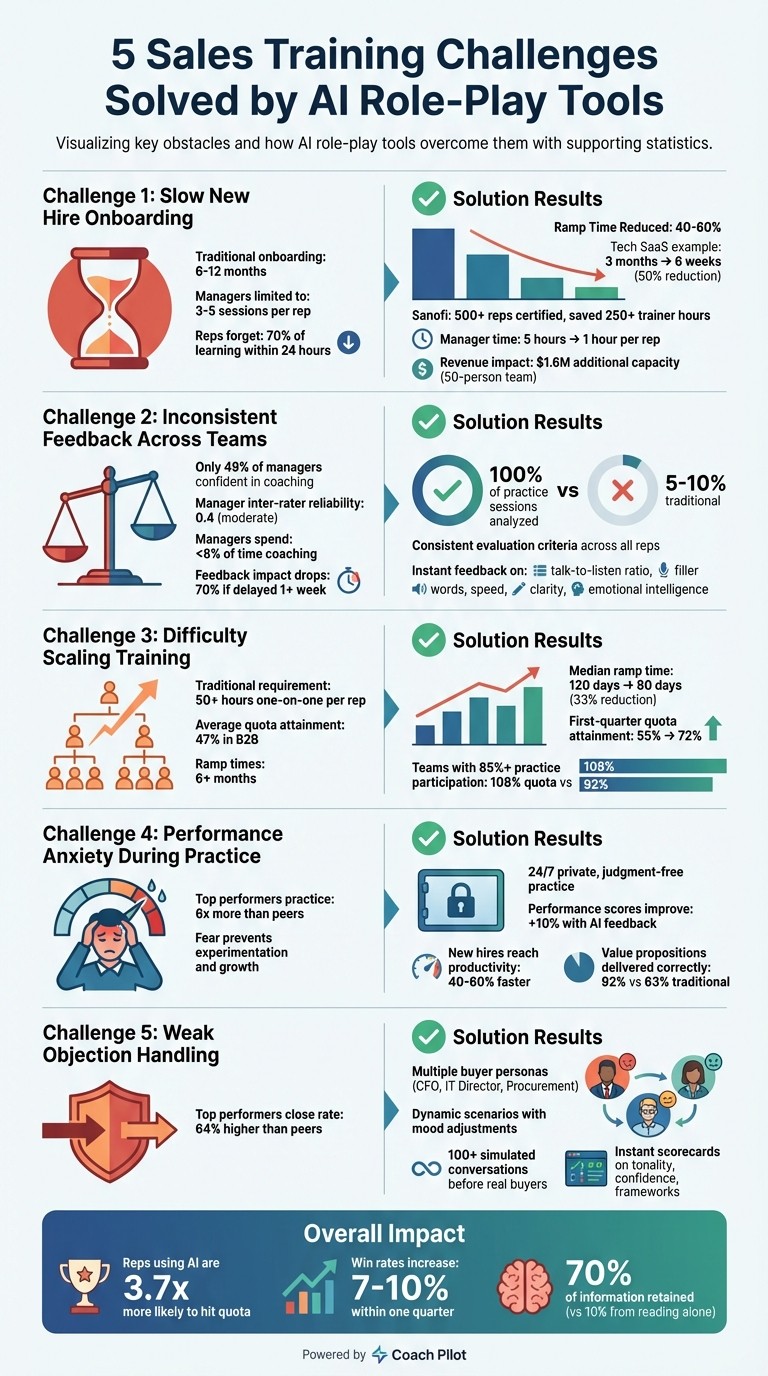
5 Sales Training Challenges Solved by AI Role-Play Tools: Key Statistics and Benefits
AI in Sales Training: From Pitch Practice to Real Roleplay | Jesse Rome from ASLAN
Slow New Hire Onboarding
Getting new hires up to speed quickly is critical for bridging the gap between training and actual performance. Traditional sales onboarding often drags on for 6–12 months, mainly because managers are stretched too thin. Most managers can only manage 3 to 5 sessions per rep [3], forcing new hires into live calls before they’re fully prepared. AI role-play tools tackle this problem by offering unlimited, on-demand practice sessions - no human partner required. This approach not only speeds up skill development but also eases the workload on managers.
The results speak for themselves. In May 2025, a tech SaaS company with a 75-person sales team adopted AI role-play training and cut SDR ramp time from 3 months to just 6 weeks - a 50% reduction [10]. Later that year, in October 2025, Sanofi used AI simulations to certify over 500 sales reps ahead of a national meeting, saving more than 250 trainer hours while ensuring reps were fully prepared [9]. In another example, a new hire named Abby at Yoodli completed her onboarding certification independently in January 2026 and closed her first deal just two weeks after her initial live call [11].
The key to this transformation is repetition and retention. Without immediate application, reps can forget up to 70% of what they learn within 24 hours [3][11]. AI role-play tools allow for frequent, bite-sized practice sessions that help build muscle memory and prevent skills from fading.
Aaron Marks, CEO of FullyRamped, highlights the value of these tools: "AI role-play is an invaluable asset in reducing the ramp time for new hires. It allows representatives to log hours of practice with AI-generated prospects, speeding up their readiness and freeing up managerial time for more focused developmental work" [8].
Faster Skill Development
AI simulations provide hands-on practice for critical sales scenarios, including discovery calls, handling objections, and closing deals. New hires can start with supportive AI prospects and gradually progress to more challenging situations as their confidence and skills improve. Real-time feedback from AI replaces the delays of traditional manager reviews by analyzing call metrics instantly [3][10].
This "learning by doing" method significantly boosts retention, with reps retaining 75% to 90% of knowledge compared to just 10% from reading alone [12]. It’s a safe environment for reps to make mistakes, learn from them, and refine their approach before facing real customers.
As one sales rep from Sellible.ai shared, "I used to be terrified of pricing objections. After practicing them 20+ times with AI... I know exactly what to say and feel confident" [3].
Less Manager Time Required
AI tools take over the repetitive foundational drills, cutting the time managers spend on basic skill-building from 5 hours per rep to just 1 hour [3][12]. Managers can then focus on higher-value coaching, such as deal strategy and account planning, instead of going over the same discovery call script repeatedly.
This reduction in training time not only accelerates readiness but also translates to measurable revenue gains. For example, a 50-person sales team that reduces ramp time by 2 months could unlock an estimated $1.6 million in additional revenue capacity annually [3]. Platforms like Coach Pilot ensure that training doesn’t stop at onboarding by embedding AI-driven coaching into everyday sales workflows. This creates a scalable system that maintains quality across the team, even as the pace of hiring increases.
Inconsistent Feedback Across Teams
When managers each have their own coaching style, sales reps often face inconsistent feedback. One manager might label a rep as "too aggressive" during discovery, while another might praise the same approach as "effective questioning." This lack of alignment creates confusion and slows down skill development across the team. The stats back this up: only 49% of average sales managers feel confident in their coaching abilities [13], and manager inter-rater reliability sits at just 0.4, showing only moderate consistency [16].
The issue compounds when managers spend less than 8% of their time on coaching [13]. This results in feedback that's often delayed, subjective, or incomplete. Some reps might receive detailed notes about their talk-to-listen ratio, while others only hear vague comments like, "You seemed off." AI role-play tools solve this by using a consistent evaluation rubric for every rep, every time. Whether it’s their first session or their hundredth, this standardized approach ensures objective, immediate, and actionable feedback, laying the groundwork for faster improvements.
Immediate Performance Feedback
AI tools provide performance insights as soon as a practice session ends. They measure talk-to-listen ratios, filler word usage, speaking speed, clarity, and emotional intelligence markers [2]. Instead of waiting days - or even weeks - for a manager to review a recording, reps receive instant feedback they can act on right away. This matters because feedback loses its effectiveness the longer it’s delayed, with a 70% drop in impact if given more than a week later [16].
Chris Cavallino, Director of Revenue Enablement at Replicant, highlights this benefit: "The AI-powered feedback helps them improve messaging faster, making coaching easier to scale and more impactful" [5].
Reps can immediately pinpoint areas where they need improvement - whether it’s talking too much, skipping an essential discovery question, or failing to show empathy - and jump right back into practice to address those gaps. This instant feedback supports a fair and consistent development process.
Consistent Evaluation Criteria
AI ensures that everyone is assessed using the same criteria, regardless of location, manager, or timing. A rep in New York is held to the exact same standards as one in Tokyo [2]. This eliminates the biases that can creep into human evaluations, such as a manager’s mood, personal preferences, or stress during busy periods [6].
This level of objectivity is a game-changer. As Manish Nepal puts it, "AI compares apples to apples and gives consistent, objective feedback whether it's their first session or hundredth" [14]. While managers typically review 5–10% of interactions, AI can analyze 100% of practice sessions [16]. This not only ensures fairness but also accelerates skill-building, especially during onboarding. Tools like Coach Pilot integrate these standardized evaluations into everyday workflows, creating a transparent process where every rep knows exactly what "great" looks like.
Difficulty Scaling Training for Large Teams
As sales teams grow, scaling training becomes a real headache. Traditional coaching methods just don’t cut it when every rep needs more than 50 hours of one-on-one manager time [3]. It’s simply not feasible.
Alex Radulovic from PurpleOwl puts it bluntly: "The key role-players in sales cannot spare the time required for frequent role-plays... Take a 10-person sales team. If each rep wants just three hours of role-play per month, that's a full week of senior time" [17].
The problem only gets worse as teams expand. A manager who once had time to coach eight reps now has to juggle 20 or even 30. What happens then? Average quota attainment drops to 47% in B2B organizations [1], and ramp times stretch past six months [1]. AI role-play tools offer a way out, giving reps unlimited, on-demand practice without tying up their managers.
Personalized Learning Paths
AI doesn’t just scale training - it makes it smarter. By analyzing every practice session, these tools track details like talk-to-listen ratios, objection handling, the quality of discovery questions, and even the use of filler words [3][2]. This data helps pinpoint where each rep struggles. For instance, if someone struggles with pricing objections but nails technical questions, the system focuses on value articulation and negotiation, ramping up the difficulty as they improve [2].
Reps start with more forgiving virtual prospects and gradually move on to tougher personas - skeptical, aggressive, even combative - once they’ve built confidence [3][17]. The impact can be huge. Take an early-stage SaaS company, for example: by using this approach, they cut their median ramp time from 120 days to 80 days - a 33% reduction - and increased first-quarter quota attainment for new hires from 55% to 72% [18].
Progress Tracking and Analytics
AI-powered dashboards make it easy for managers to track progress without drowning in data. Instead of reviewing every practice session, managers get a high-level view of performance trends and team-wide issues [3]. For example, they can quickly identify if the whole team is struggling with a new competitor’s messaging or if individual reps need extra help with discovery questions.
The real game-changer is linking practice data to real-world results. By integrating with CRM and conversation intelligence tools, managers can compare AI practice metrics with actual call performance [3]. The results speak for themselves: teams with 85%+ practice participation hit 108% of their quota, compared to 92% for teams with lower participation [3]. Tools like Coach Pilot embed these insights into everyday workflows, making it simple to see who’s improving, who needs extra support, and which skills lead directly to closed deals. It’s a powerful way to ensure continuous improvement as teams grow.
Performance Anxiety During Practice
Creating a low-stress practice environment is just as important as addressing scaling challenges. When role-playing feels like a high-stakes test, people tend to shy away from practicing. This anxiety isn't limited to new hires - it's a universal experience in sales, often addressed in a comprehensive B2B sales playbook. New reps fear looking incompetent, mid-level reps worry about revealing gaps in their skills, and even seasoned account executives fret that struggling during practice could hurt their reputation as experts [19]. Because of this, many avoid practice altogether or stick to safe, rehearsed scripts, avoiding the experimentation needed for real growth. Reducing this anxiety is critical for reps to take full advantage of the efficiency benefits discussed earlier.
When practice shifts from a genuine learning opportunity to a performance meant to impress, skill development takes a back seat. In high-pressure role-plays, reps often focus on surviving the exercise instead of improving. Managers, trying to protect morale, may offer overly gentle feedback that fails to address deeper issues [7]. Interestingly, top-performing reps practice role-plays up to six times more than their peers [4], but only when they feel secure enough to take risks without judgment.
Private Practice Environment
AI role-play tools offer a judgment-free zone, removing the stress of performing in front of others. Without an audience, the fear of embarrassment disappears [19]. These tools let reps pause, restart, or even fail on purpose without worrying about professional consequences. Available 24/7 [14], AI serves as a neutral, tireless partner for practice. This privacy encourages reps to tackle challenging objections and experiment with new messaging, which has been shown to improve performance scores by an average of 10% when paired with AI feedback [4]. This kind of environment supports the repetitive practice that builds genuine confidence.
Building Confidence Through Repetition
Confidence doesn’t come from motivational speeches - it’s built through consistent, successful practice. Sanghamitra Sarate puts it perfectly:
"Confidence is not a pep talk. It is a pattern... mostly a memory of successful repetitions" [19].
For example, practicing responses to pricing objections more than 20 times with AI can make real-world conversations feel routine. This "stress inoculation" effect helps reps stay calm and focused during high-stakes interactions [19][20]. One sales rep explained:
"I used to be terrified of pricing objections. After practicing them 20+ times with AI, now when real prospects raise pricing concerns, I've literally had this conversation before. I know exactly what to say and feel confident" [3].
The impact is clear: companies using AI role-play tools report that new hires reach full productivity 40% to 60% faster [2][20]. Additionally, critical value propositions are delivered correctly 92% of the time, compared to just 63% with traditional methods [20].
Weak Objection Handling Skills
Building confidence through repetition is just the start - mastering objection handling is where sales reps truly stand out. This skill is a game-changer, with top performers achieving a 64% higher close rate compared to their peers [21]. Yet, many teams fall short because traditional role-playing often feels too staged. Peers rarely mimic the tough resistance of real buyers, and managers tend to soften their critiques [7]. The result? Reps step into real-world conversations unprepared for challenges like aggressive pushback on price, authority, or timing.
AI role-play tools step in to bridge this gap by creating scenarios that feel like actual buyer interactions. Dan Fisher, Founder of Menemsha Group, highlights this advantage:
"AI doesn't worry about hurting feelings, sounding too blunt, 'being liked,' or protecting egos. It responds the way buyers do" [7].
This allows reps to face tough objections in a safe, controlled environment, laying the groundwork for personalized training with diverse buyer personas and challenging negotiation scenarios.
Multiple Buyer Personas
To mirror the complexity of real sales situations, AI tools differentiate between Personas and Scenarios. For instance, a single persona like the "Grumpy Engineer" can be used in various sales contexts [17]. Managers can fine-tune the buyer's temperament using tools like Mood Sliders, adjusting levels of friendliness, skepticism, or combativeness [17]. Additionally, a Mood Matrix or Supervisor AI monitors the conversation in real time, tweaking the buyer's responses based on the rep's performance.
Some common AI personas include:
Skeptical CFO: Focused on ROI and financial justification.
Risk-Averse IT Director: Concerned about security and implementation risks.
Price-Conscious Procurement Officer: Relentlessly focused on cost savings [22].
Each persona presents unique challenges, pushing reps to adapt their strategies instead of relying on generic responses. This helps reps sharpen their ability to read buyer cues and tailor their messaging in real time.
Negotiation Practice Scenarios
AI also offers dynamic simulations designed to test a rep's agility in handling unpredictable shifts in buyer sentiment. These scenarios throw curveballs like the introduction of a new stakeholder, sudden budget cuts, or last-minute discount demands [4]. The goal? To prepare reps for the unexpected.
Reps receive objective scorecards with instant feedback on critical metrics like tonality, confidence, talk-to-listen ratios, and their use of frameworks such as LAER (Listen, Acknowledge, Explore, Respond) [21][3]. Managers can track performance trends across sessions, identifying areas where reps excel - like handling technical objections - and where they need improvement, such as pricing discussions or negotiating with C-level executives [3].
Training can start with more supportive AI personas and gradually ramp up the difficulty, helping reps build the resilience needed for high-pressure scenarios [3][22]. By integrating these realistic simulations, sales teams can fast-track their readiness for real buyer interactions, ensuring that practice directly translates into improved performance.
Conclusion
AI role-play tools are reshaping how sales teams approach their toughest training challenges. These tools can cut new hire ramp time by 40% to 60% and provide objective, data-driven feedback, removing the bias of subjective manager opinions [15]. Sales reps using AI are 3.7 times more likely to hit their quotas [6], and companies experience a 7–10% boost in win rates within just one quarter [23].
By replacing awkward, hard-to-schedule manager-led sessions with on-demand, 24/7 practice environments, reps can engage in over 100 simulated conversations before ever speaking to a real buyer [3]. This safe, controlled space allows them to build the confidence and muscle memory needed for high-stakes scenarios. While 70% of new information is typically forgotten within a day [3], targeted, consistent practice helps reinforce key skills. This repetition, powered by data, sets the stage for platforms like Coach Pilot to unlock greater sales potential.
Coach Pilot takes this approach further by integrating tailored sales playbooks, immersive training, and AI sales coaching directly into everyday sales workflows. It aligns training with real-world challenges, identifies skill gaps, and creates personalized learning paths tailored to Ideal Customer Profiles and actual objections from the field. With performance analytics tracking team progress, Coach Pilot ensures consistent messaging and execution - whether you're managing a team of 10 or 1,000 across multiple regions.
For example, a 50-person team with a $200,000 quota could see an additional $1.6 million in annual revenue capacity by reducing ramp time by just two months [3]. Spencer Wixom, CEO, sums it up best:
"Sales leaders struggle to bridge the gap between training and real-world application. AI role-playing takes sales coaching to the next level by providing instant feedback, allowing learners to practice and track their progress over time" [23].
AI role-play tools are delivering measurable results. Start leveraging them now to stay ahead in the competitive sales landscape [2].
FAQs
How do AI role-plays fit into our current sales onboarding process?
AI role-plays are transforming sales onboarding by tackling the challenges of traditional training methods. They offer endless, on-demand practice scenarios that mimic real customer interactions, giving new hires the chance to refine their skills in a realistic setting. What sets this approach apart is the personalized, instant feedback it provides, helping reps improve quickly and with greater confidence. This often leads to shorter ramp-up times.
By creating a scalable and stress-free environment, AI role-plays allow sales teams to prepare thoroughly for real-life conversations. The result? Better skill retention and a noticeable boost in overall sales performance.
What data does AI use to score and give feedback on role-plays?
AI role-play tools simulate real-world conversations between sales reps and virtual customers, analyzing interactions to understand buyer behavior, objections, and emotional cues. These tools go beyond just words - they assess verbal and non-verbal elements like tone, pacing, and clarity. By combining insights from behavior, language, and performance, they generate detailed analytics that spotlight skill gaps and track progress. The result? Sales reps get personalized feedback they can act on to sharpen their communication and boost their sales game.
How can managers use AI role-play results to coach without adding more meetings?
Managers can make the most of AI role-play results to coach more effectively without adding extra meetings to their schedules. By using insights generated from these tools, they can evaluate performance, pinpoint strengths and areas for improvement, and offer actionable feedback. This approach helps managers zero in on moments that truly matter, delivering tailored guidance that has a bigger impact. Meanwhile, team members gain the advantage of unlimited practice opportunities and immediate feedback, cutting down the need for constant one-on-one sessions while still supporting ongoing growth.
Related Blog Posts

Remove the guesswork from winning more deals.