B2B Sales
Strategic Prospecting: Common Challenges Solved by AI
Mar 14, 2026
How AI improves B2B prospecting: smarter lead scoring, precise timing, and scaled personalization to boost conversions and cut research time.

AI is transforming the future of sales enablement by helping teams prospect, qualify leads, and close deals. Here's why it matters:
Better Lead Qualification: AI analyzes real-time signals to identify leads most likely to convert, saving hours of manual research.
Perfect Timing: AI tracks buyer behavior and trigger events (e.g., leadership changes) to optimize follow-ups, increasing response rates by up to 50%.
Personalized Outreach: AI crafts messages tailored to a prospect's context, boosting email reply rates from 1–3% to 12–18%.
Key Stats:
Sales teams using AI report 83% revenue growth vs. 66% without it.
AI-powered lead scoring improves conversion rates by 25% and cuts research time by 85%.
Multi-channel strategies with AI increase engagement by 250%.
AI isn't just a tool - it’s a smarter way to focus on leads that matter, connect at the right time, and craft messages that resonate, all while saving time for what matters most: selling.
How AI Transformed This Sales Rep Enterprise Prospecting Strategy
Common Prospecting Challenges in B2B Sales
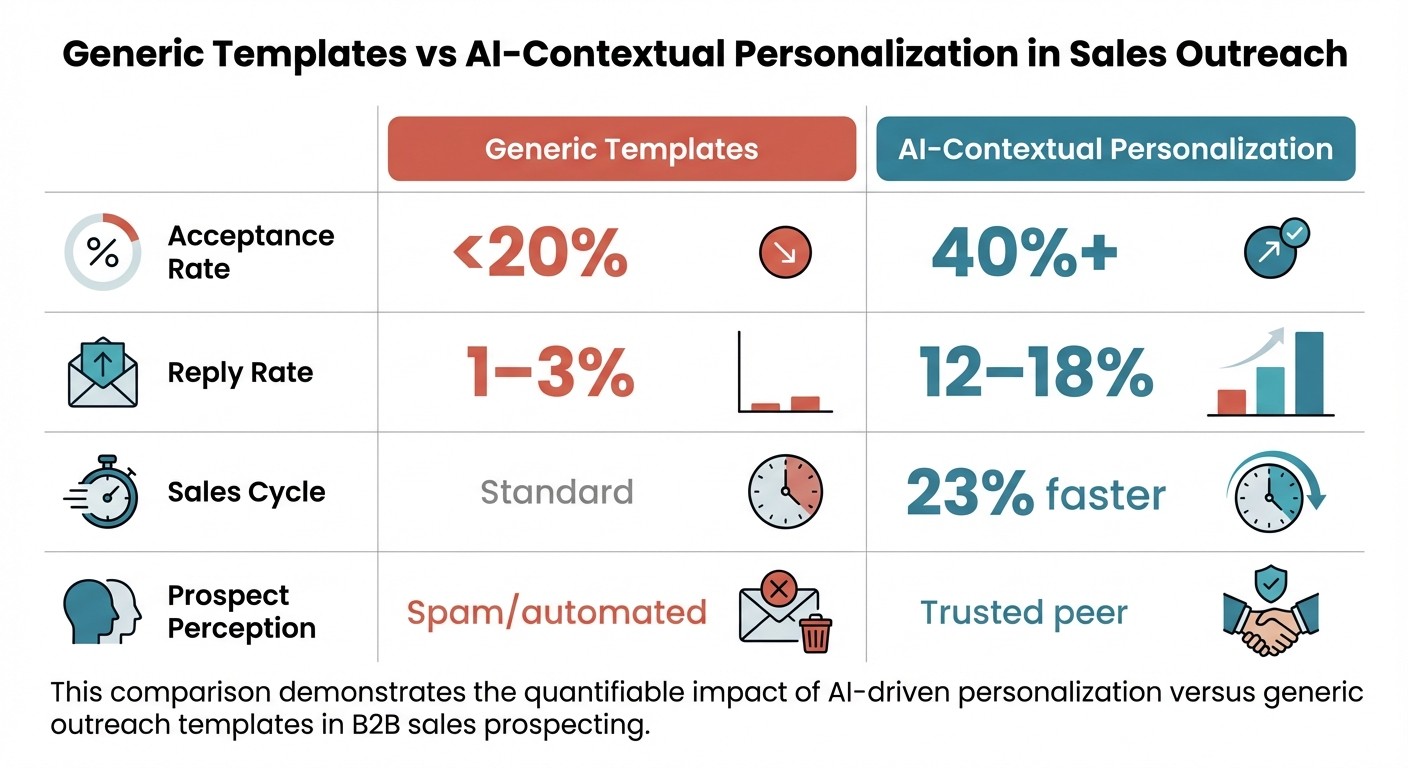
AI vs Traditional Prospecting: Performance Metrics Comparison
Even with the rise of data-driven prospecting, many B2B sales teams still face hurdles that sap productivity and limit their pipelines. These issues often stem from outdated methods that fail to align with a modern B2B sales playbook and how buyers in 2026 research and make decisions. Let’s break these challenges down into three key areas: lead qualification, follow-up timing, and outreach personalization.
Inefficient Lead Identification and Qualification
Sales reps spend a staggering 67% of their time chasing leads that never convert[8]. Why? Traditional frameworks like BANT (Budget, Authority, Need, Timeline) just don’t cut it anymore. These models were built for simpler sales cycles but struggle in today’s world, where purchasing decisions often involve 6 to 10 stakeholders across multiple departments[8].
On top of that, manual research eats up 2 to 3 hours per prospect on platforms like LinkedIn, company websites, and news sources[9]. That’s time that could be spent actually selling. And static lead scoring only makes things worse. Many teams still rely on outdated demographic filters like company size or location, ignoring critical real-time signals - like frequent visits to a pricing page versus a one-off whitepaper download. Unsurprisingly, manual qualification methods hit only about 15% accuracy[9].
Outdated or duplicate CRM data further complicates things. When unreliable information feeds into scoring models, it derails the entire qualification process[1][5]. Plus, focusing on individual contacts rather than the broader buying committee means teams often miss the bigger picture. For example, coordinated research efforts across departments like finance, IT, and operations can signal an account actively evaluating solutions[5]. This inefficiency clogs pipelines with unqualified leads while genuine opportunities slip through the cracks.
Poor Follow-Up Timing and Sequencing
Timing is everything in sales, and poor follow-up practices can tank even the best prospecting efforts. Studies show that the first company to respond to buying signals converts 50% more often than slower competitors[9]. Yet many teams rely on outdated methods, using weekly or monthly lead updates, rather than a living, breathing AI sales process. By the time a lead is flagged as "hot", the prospect may already have moved on[9].
This lag is especially damaging during trigger events - like new funding, leadership changes, or tech overhauls - that create short-lived buying windows, sometimes as brief as 90 days[5]. Without real-time behavioral tracking (e.g., website visits or pricing-page views), sales teams are left guessing. This is a big problem considering that 61% of the buying journey is already completed before a prospect even reaches out to a vendor[2]. Missing these moments can mean losing deals before they even start.
Lack of Personalization in Outreach
Generic outreach is a major turnoff for today’s savvy buyers. Phrases like "hope you're doing well" scream automation and fail to connect with prospects. Buyers can easily spot surface-level personalization, such as emails that only include their first name, and they’re quick to tune out[10][7]. Unsurprisingly, generic cold outreach typically sees reply rates of just 1% to 3%[10].
In contrast, AI-driven personalized messaging - rooted in specific business contexts like a recent funding round or an earnings report - can boost reply rates to 12% to 18%[10]. This shift aligns with the expectations of 74% of B2B buyers, who now demand personalized experiences similar to those they encounter as consumers[11].
Simply adding a custom sentence to a generic email isn’t enough. It creates a fragmented experience that feels automated, often triggering spam filters and damaging sender credibility[10][7].
Metric | Generic Templates | AI-Contextual Personalization |
|---|---|---|
Acceptance Rate | <20% [10] | 40%+ [10] |
Reply Rate | 1–3% [10] | 12–18% [10] |
Sales Cycle | Standard | 23% faster [11] |
Prospect Perception | "Spam/automated" [10] | "Trusted peer" [10] |
How AI Solves Prospecting Challenges
AI takes the guesswork out of prospecting, replacing outdated methods with precision. By analyzing live data - like website visits, email interactions, job changes, and company updates - AI pinpoints the leads most likely to convert. This approach shifts sales teams from rigid schedules to real-time, signal-driven outreach, allowing them to connect with prospects at just the right moment with highly relevant messages. Below, we explore how AI reshapes lead scoring, follow-up timing, and personalized outreach.
AI for Lead Scoring and Qualification
AI evaluates over 50 dynamic signals, including behavioral trends, company details, and intent indicators, all at once [9][5]. Unlike traditional models that assign arbitrary points based on static factors like job titles, AI learns from actual sales outcomes to detect patterns that drive a 65% higher conversion rate [15][9]. These are insights that would be nearly impossible for humans to uncover at scale.
For example, one company saw its lead-to-opportunity conversion rate jump from 9% to 27% within six months of implementing AI-powered qualification [8]. While manual qualification can take 2 to 3 hours per prospect, AI completes the same task in just 2 to 3 minutes [9]. Companies leveraging AI in sales report a 50%+ increase in leads and appointments, along with a 20% to 30% boost in conversion rates from AI-driven lead scoring [15][14].
"Traditional scoring operates on snapshots. AI operates on live data streams. The difference in response time directly impacts your win rate."
AI also excels at identifying negative signals, such as prospects who download whitepapers but avoid pricing pages. This helps sales teams disqualify unpromising leads early, saving 67% of the time typically spent chasing dead ends [8][9]. Scores are updated in real time, meaning a prospect's activity from this morning holds more weight than actions taken months ago [8].
AI for Optimizing Follow-Up Timing
AI addresses the delays of manual follow-ups by monitoring micro-behaviors like email opens, link clicks, and time spent on pages to detect when interest is at its peak [16]. Leads contacted within 5 minutes of an interaction are nine times more likely to engage [18], but many teams still rely on static schedules that overlook these real-time signals.
AI triggers outreach based on external events, such as leadership changes, funding announcements, or earnings reports [17][4]. In 2026, Cacheflow’s Head of Revenue, Adam Wainwright, implemented this approach, cutting meeting prep time by 60% (from 90 to 30 minutes) and tripling their average deal size from $5,000–$7,000 to $18,000–$20,000 [17].
"The moment we turned on Salesmotion, it became essential. No more hours on LinkedIn or Google to figure out who we're talking to. It's just there, served up to you, so it's always 'go time.'"
Adam Wainwright, Head of Revenue, Cacheflow [17]
AI also synchronizes outreach across multiple channels - email, LinkedIn, and phone - to create a natural, cohesive flow. Multi-channel strategies can improve engagement rates by up to 250% [18]. AI ensures each touchpoint builds on the last, rather than repeating the same message. For AI-prioritized leads, signal-to-meeting conversion rates range from 10% to 20%, compared to just 1% to 3% for traditional cold outreach [4].
AI for Personalized Outreach
Personalization is no longer about just inserting a first name into an email. AI enables deeper personalization by grounding outreach in real-time business priorities [12]. It can quickly analyze LinkedIn profiles, company websites, and news to craft outreach tailored to specific events - like a $25M funding round or a new VP hire - in seconds, a process that would take humans 10 to 15 minutes per prospect [19][13].
In 2025, Frontify’s growth team adopted signal-based outreach using Salesmotion, leading to a 400% increase in self-sourced meetings and a 42% year-over-year jump in sales velocity [2]. Similarly, Analytic Partners cut account research time by 85% (from 3 hours to 15 minutes) and saw a 40% increase in qualified pipeline year-over-year [2].
AI-driven personalization boosts cold email reply rates from the usual 0.5%–2% range to 6%–20%+ [19]. Emails with personalized subject lines see 26% higher open rates [19], while AI-personalized messages achieve 29% higher open rates and 41% higher click-through rates [2]. By reducing personalization time by 90%, AI-powered tools allow sales teams to improve response rates by 28% [2].
AI doesn’t replace human judgment - it enhances it. The most effective approaches combine AI’s speed and data analysis with human oversight for empathy, tone, and accuracy [19][12]. This partnership allows sales reps to focus on building relationships while AI handles research and drafting. Tools like Coach Pilot are paving the way for even more seamless integration of AI into sales workflows.
How Coach Pilot Improves Prospecting with AI
Coach Pilot takes AI's ability to analyze data and turns it into a system that scales your company's expertise. By codifying your winning strategies, it identifies patterns and transforms them into actionable, repeatable processes. This approach combines AI's strengths in lead scoring and timing with tailored sales strategies, creating dynamic playbooks that deliver measurable results.
Custom Sales Playbooks for Targeted Strategies
Unlike static traditional sales playbooks, Coach Pilot offers a dynamic, AI-supported strategy that evolves with your business. By analyzing successful deals, the platform identifies what drives conversions - whether it’s crafting role-specific messaging or pinpointing the best times to connect with decision-makers.
Take these examples: In May 2024, Naum Sekulovski at Food By Us closed 13 contracts in just 9 weeks, driving a 45% increase in sales revenue. Similarly, Connor Bell, a BDM at HubSpot, boosted net new opportunities by 50% between March and June 2024, closing 12 deals in 11 weeks and achieving a 38% increase in quarterly sales revenue. On average, companies using Coach Pilot see their pipelines grow 7.8× in under 90 days, with a 39% improvement in quota attainment [21].
AI-Driven Real-Time Coaching for Sales Teams
Coach Pilot doesn’t stop at strategy - it provides real-time coaching to optimize every interaction. From email templates to call timings and buyer persona-specific talking points, the platform ensures sales teams are always one step ahead.
For example, Rebecca Veksler, Co-Founder of Four Rooms, tripled her monthly sales and closed 14 new deals in just 8 weeks using Coach Pilot's strategies. Similarly, Stephen Luxmoore, Founder & CEO of Your HR Team, saw a 32% rise in new client acquisitions, signing 8 contracts within 9 weeks. On top of these results, sales reps save an average of 19.5 hours per week by automating tasks like deal capture and CRM updates [21].
"The team's passion, experience, and knowledge clearly show during our sessions. Thank you for motivating our team and sharing key learnings to accelerate growth."
Filippa Rusec, CCO, DB Schenker[21]
Integration with Existing Sales Workflows
Coach Pilot fits seamlessly into your existing tools, like CRMs and communication platforms, ensuring that insights are delivered right when and where they’re needed. Whether it’s Salesforce, Microsoft Teams, or live calls, the platform works within your daily workflows, eliminating the need for separate systems.
Given that 80% of deals require at least five follow-ups to close - but 44% of sellers quit after just one attempt - Coach Pilot automates and optimizes follow-up sequences to keep deals on track [22].
Steps to Implement AI-Driven Prospecting
Bringing AI into your sales process starts with laying a strong data foundation. Begin by auditing your CRM and aiming for at least 90% completeness in critical fields[23]. Clean data is non-negotiable - if your inputs are messy, the AI will only magnify those problems.
Start small by rolling out AI in phases. Test it with a group of 3–5 top-performing reps for 30–60 days in "shadow mode." This means running the AI alongside your existing process to see if AI-scored leads actually convert better[24]. This phased approach helps build confidence and provides time to smooth out any issues. For instance, Analytic Partners used this method in 2025 and managed to cut account research time from 3 hours to just 15 minutes per account, while boosting their qualified pipeline by 40% compared to the previous year[24]. Once you've validated the results during testing, you'll be ready to set specific goals and roll out AI sales coaching across your entire team.
Define Goals and Metrics for AI Integration
Before you dive into full-scale AI adoption, it's essential to define clear, outcome-driven goals. Focus on metrics that measure results, not just activity. Monitor key performance indicators like a 15–20% email response rate, a meeting-to-SQL conversion rate of at least 45%, and pipeline value per prospecting hour between $8,000 and $12,000[25].
Take The Organic Buzz as an example. They scaled to sending 1,500 emails daily, secured 1–2 meetings each day, and generated over $100,000 in pipeline value - all without increasing headcount[6].
To further refine your strategy, build a signal map with 3–5 high-intent triggers (such as leadership changes, funding announcements, or new job postings). Keep an eye on conversion rates, and if your AI-scored "hot" leads aren't converting 2–3 times better than "cold" ones, it’s a sign your model needs retraining[25].
"If your sales prospecting plan is built on flawed metrics, AI just helps you fail faster at scale." - Wajahat Ali, Smartlead[25]
Use AI Analytics for Continuous Improvement
AI can transform how you qualify and follow up with leads, but it’s not a "set it and forget it" tool. To keep your prospecting optimized, you need to commit to regular adjustments. Hold weekly 15-minute check-ins to review metrics, celebrate wins, and address any dips in conversion rates[25]. Create a feedback loop where sales reps can flag inaccurate AI scores or bad data, enabling your RevOps team to make necessary tweaks[24].
Every 90 days, conduct a full funnel analysis to identify bottlenecks and shift resources accordingly[25]. Adjust behavioral scores weekly by 15% to ensure the AI prioritizes fresh interest over outdated signals, and retrain your models quarterly to align with changing market trends[8].
In 2025, LivePerson saw a 35% increase in prospect engagement and cut manual research time by 60% by integrating AI analytics into their SDR workflows[20]. Their success came from treating AI as a dynamic system that improves with consistent attention, rather than a one-and-done solution.
Metric Category | Key KPI | Target Benchmark |
|---|---|---|
Engagement | Email Response Rate | 15–20%[25] |
Qualification | Meeting-to-SQL Conversion | 45–50%[25] |
Efficiency | Research Time per Account | Under 15 minutes[24] |
Speed | Time-to-First-Response | Under 24 hours[4] |
Impact | Pipeline Value per Hour | $8,000–$12,000[25] |
Conclusion
Prospecting has always been about playing the numbers, but AI is rewriting the playbook. Instead of relying on manual research and educated guesses, AI delivers real-time insights to uncover the right opportunities. For instance, companies using AI-driven lead scoring report 25% higher conversion rates and 15% lower cost per lead[3]. Meanwhile, teams adopting signal-based workflows save anywhere from 2 to 6 hours per rep each week on account research[2]. By combining predictive scoring with automated personalization and perfectly timed follow-ups, sales teams can work smarter and faster.
While these numbers underscore the efficiency gains, integrating AI isn't a "set it and forget it" solution. Success requires clean, reliable data, well-defined objectives, and ongoing fine-tuning. The best-performing teams treat AI as a dynamic partner - one that evolves alongside their strategies - while keeping human expertise front and center for building relationships and making critical decisions.
Looking ahead, the future of prospecting is about empowering sales teams, not replacing them. Tools like Coach Pilot bring AI-driven coaching into everyday workflows, pairing tailored sales playbooks with real-time guidance. This transforms prospecting from a tedious grind into a streamlined, scalable process that consistently drives revenue. AI’s real strength lies in equipping salespeople with the insights, timing, and context they need to connect with buyers who are ready to engage. That’s where its true potential shines.
FAQs
What data does AI need to score and qualify leads accurately?
AI uses a variety of data to evaluate and qualify leads with accuracy. This includes behavioral signals, such as how a lead interacts with your content, and engagement patterns, like email opens or website visits. It also considers firmographic and technographic details, which provide insights into a company’s size, industry, or technology stack. Additionally, historical data plays a key role, offering context from past interactions and outcomes. Together, these data points enable AI to assess lead quality and prioritize opportunities more effectively.
How do I know which buyer signals are worth acting on first?
Focusing on buyer signals that show high intent can make a big difference in your outreach efforts. These signals might include noticeable behavioral patterns, steady engagement over time, or even emotional cues that suggest genuine interest. The advantage? AI can process these signals in real time, helping you zero in on prospects who are most likely to take action. This way, you can channel your energy into the opportunities that truly count.
How can I keep AI-personalized outreach from sounding automated?
To create AI-personalized outreach that feels authentic, focus on using relevant, real-time data to craft messages that align with each buyer's specific priorities. Pair AI-generated content with a human touch - review and refine the tone to ensure it feels natural and reflects your brand's voice. Striking this balance keeps the communication personal while steering clear of sounding overly mechanical.
Related Blog Posts

Remove the guesswork from winning more deals.