B2B Sales
7 Ways to Shorten Your B2B Sales Cycle
Feb 1, 2026
Cut B2B deal timelines with AI-driven lead scoring, playbooks, automation, alignment, predictive analytics, and coaching to close deals faster.

B2B sales cycles are long, averaging 102 days, and deals over $250,000 often take over six months to close. This delays revenue, increases costs, and wastes time. But you can speed things up by addressing common roadblocks like unqualified leads, poor team alignment, and inefficient processes.
Here’s how you can shorten your sales cycle:
Use AI for faster lead qualification - AI prioritizes high-potential leads and automates admin tasks.
Build custom sales playbooks - AI-driven sales processes improve deal velocity and team collaboration.
Automate follow-ups - Multi-channel automation ensures timely and consistent prospect engagement.
Align sales and marketing - Shared goals and integrated tools reduce wasted time on low-quality leads.
Leverage AI-powered coaching - AI identifies successful strategies and helps reps focus on closing deals.
Apply predictive analytics - Intent data pinpoints ready-to-buy prospects, saving time and effort.
Track performance and train your team - Refining processes and monitoring metrics eliminate bottlenecks.
Key Stats:
43% of sales leaders say sales cycles are getting longer.
Aligning sales and marketing boosts deal closure rates by 67%.
AI tools save reps up to 2 hours daily on repetitive tasks.
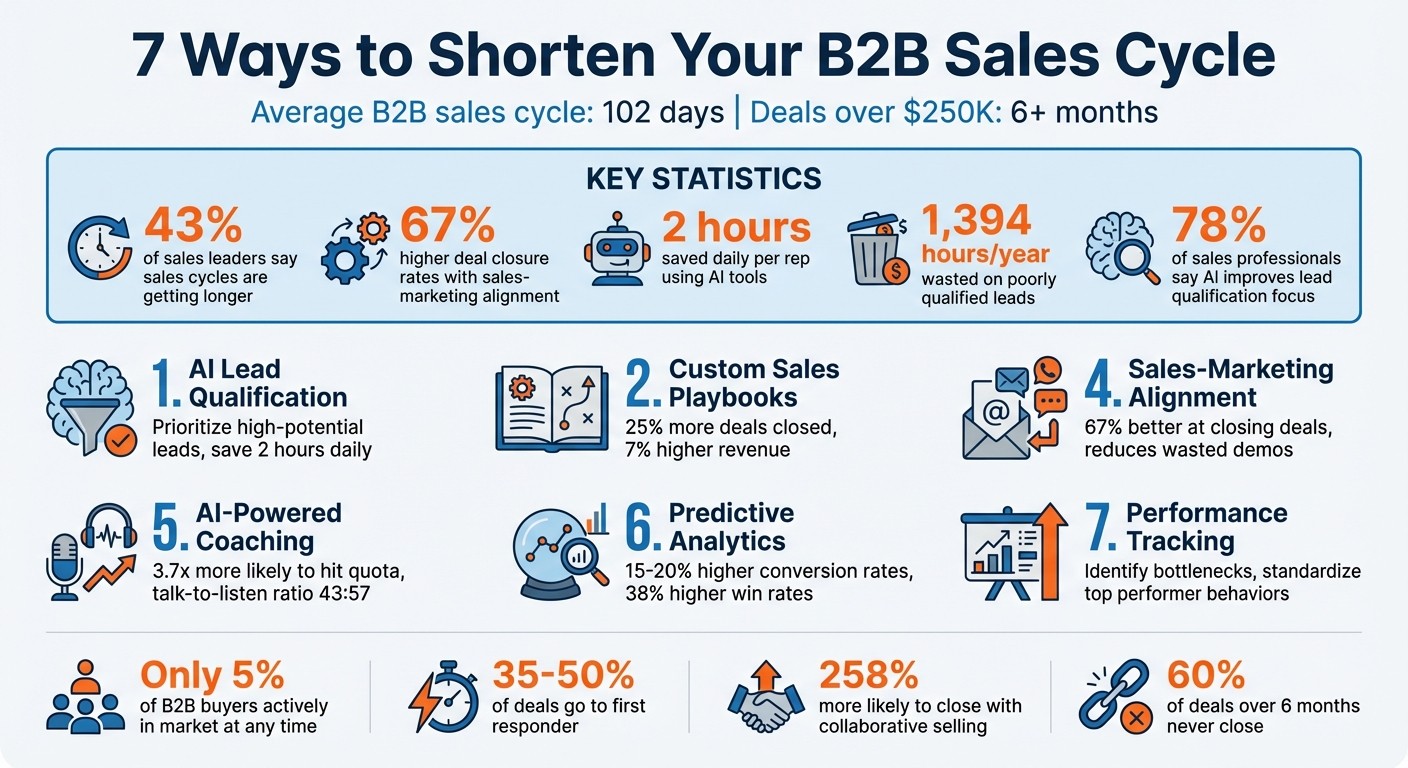
7 Strategies to Shorten Your B2B Sales Cycle: Key Stats and Methods
6 Winning Strategies to Shorten Your Sales Cycle in B2B
1. Use AI to Qualify Leads Faster
Speeding up lead qualification can dramatically shorten your sales cycle.
Cuts Down Time on Non-Viable Leads
Sales reps spend an astonishing 1,394 hours each year on poorly qualified leads, pulling their attention away from high-potential prospects [9]. AI steps in by analyzing digital behaviors like website visits and content engagement to gauge buying intent and prioritize leads that are ready to take action [9].
"Unqualified leads are the single biggest factor in elongating your sales cycle." - Sarah Taylor, Senior Content Marketing Manager, Qwilr [5]
With automated lead scoring, AI evaluates factors like company size, engagement levels, and previous interactions to pinpoint the prospects most likely to convert [10]. It also filters out low-quality leads, ensuring your team spends their time on opportunities that truly matter [9][10].
Automates and Simplifies Workflows
AI doesn’t just score leads - it takes care of tedious admin tasks, too. Tools powered by AI can update CRM records, enrich contact details, and trigger follow-ups within the critical five-minute window, when reps are 21 times more likely to qualify a prospect [5].
It also standardizes qualification methods like BANT and MEDDIC, creating a consistent, data-backed process [6]. In fact, 78% of sales professionals say AI helps them focus better on prospecting and lead qualification [6]. By automating repetitive tasks, sales reps can dedicate more time to building relationships and closing deals instead of drowning in spreadsheets.
Next, consider creating tailored sales playbooks to speed up your sales process even further.
2. Build Custom Sales Playbooks
Improves Deal Velocity Through Process Optimization
A well-structured sales playbook transforms the strategies of top-performing reps into a system that others can replicate. Start by analyzing your top 10–20% of sales reps. Document their methods - like their talk-to-listen ratios, the sequence of discovery questions they ask, and how they move step-by-step through the sales pipeline[7].
Incorporate qualification frameworks such as MEDDICC, BANT, or CHAMP to create a consistent process[11][6]. Add Mutual Action Plans (MAPs) to outline shared goals and responsibilities between your team and the buyer[5][4]. To keep deals moving, integrate incremental closes - small commitments like scheduling a follow-up with procurement can help maintain momentum[3]. Companies that align their sales strategies with the way modern buyers operate report 7% higher revenue and close 25% more deals[11].
"When you get a real sales process, it is so empowering. I use it with every single one of my clients." – Sarah Bedwell, Founder[11]
This structured approach doesn’t just speed up deal cycles - it also creates a foundation for better teamwork. By accelerating deal velocity and fostering collaboration, a custom playbook becomes a game-changer for your sales team.
Enhances Team Alignment and Collaboration
While improving processes speeds up sales cycles, team alignment ensures everything runs smoothly. Custom playbooks help eliminate miscommunication by standardizing messaging and clarifying lead handoffs[14][15]. Clear qualification criteria and seamless handoff protocols mean that marketing delivers leads sales teams can confidently close.
To maintain consistency, create modular templates for demos and proposals tailored to different buyer personas. This ensures every prospect receives a unified value narrative. Companies that implement this level of alignment can increase their ability to close deals by up to 67% within the typical sales cycle[6].
3. Automate Follow-Ups Across Multiple Channels
Save Time on Leads That Don’t Engage
Automated lead scoring helps you quickly pinpoint which prospects are worth your time. By tracking actions like email opens, website visits, and content downloads, automation can separate engaged leads from those who aren’t responding at all[10][6]. That way, your team can focus on prospects with real potential instead of wasting time on unresponsive ones.
Using multi-channel sequences - like email, phone, LinkedIn, and text - ensures consistent contact across platforms. These sequences also flag leads that show no interest, so you can avoid unnecessary follow-ups[12][10]. On top of that, automation tools streamline this process further by handling tasks like smart scheduling and CRM updates.
Leverage Technology to Simplify Workflows
Timing follow-ups can be tricky, but behavior-triggered sequences take care of that for you. For instance, if a prospect downloads a pricing sheet or repeatedly visits key product pages, an automated email can instantly deliver the next steps[16][10]. Considering that Sales Development Representatives spend 21% of their time on emails instead of closing deals, automation can make a huge difference[5][17].
AI-powered coaches can also step in to handle follow-ups. For example, conversation intelligence software can analyze your sales calls and draft personalized follow-up emails that address specific pain points mentioned during the meeting[10]. These tools automatically update your CRM with interaction data and notes, giving your team a clear, centralized record without the hassle of manual entry[10].
Automation doesn’t stop there. Lead routing tools can immediately assign new prospects to the right team member based on factors like location, availability, or lead score, ensuring no time is lost between lead capture and first contact[16]. And smart calendar links? They eliminate the back-and-forth of scheduling. If coordinating six meetings for a sales cycle takes half a day per meeting, that’s three full days wasted. Automation speeds things up, keeping your sales cycle on track[17].
4. Align Sales and Marketing Teams
Reduces Time Spent on Non-Viable Leads
When sales and marketing teams operate in silos, a lot of time gets wasted chasing leads that go nowhere. Did you know that roughly 35% of sales demos are conducted for leads that are either unqualified or underqualified? Each of these demos eats up 2–10 hours of sales engineering time[14]. That’s a lot of effort with little to show for it.
A better approach? Start by agreeing on an Ideal Customer Profile (ICP) and stick to qualification frameworks like BANT or CHAMP. This ensures that marketing passes on leads that sales can actually close. Beyond just qualifying leads, tools like integrated machine learning systems can help both teams stay aligned by offering real-time insights into prospect engagement. Automated interactive demos also play a big role - they can weed out unqualified prospects, leaving you with Demo Qualified Leads (DQLs) who are ready to move forward.
The result? Sales reps get to focus on high-intent opportunities, cutting down on wasted time and speeding up decision-making.
Enhances Team Alignment and Collaboration
"Sales and marketing alignment can help companies become 67% better at closing deals." – Docket[3]
To hit that kind of improvement, collaboration is key. Both teams need to work together to map out the buyer’s journey. This means creating buyer personas and identifying the pain points that come up during negotiations. When sales and marketing collaborate like this, marketing content becomes more targeted and addresses the objections that sales teams actually hear from prospects.
Here’s why this matters: Over 80% of B2B tech purchases now involve four or more decision-makers[1]. With so many stakeholders in the mix, even small inconsistencies between marketing materials and sales pitches can create doubt. For instance, imagine your website claims a 40% productivity boost, but a sales rep on a call says it’s 36%. That tiny mismatch can stall deals. Regular feedback between the two teams helps fine-tune messaging, ensuring a seamless buyer experience. Once that foundation is in place, automation can take over to smooth out manual handoffs.
Utilizes Technology to Automate and Streamline Workflows
Technology takes collaboration to the next level by simplifying workflows and creating a unified view of lead engagement. When you connect your CRM with marketing automation tools, you establish a single source of truth for tracking lead behavior and engagement. Features like automated lead routing can then assign prospects to the right sales rep based on priority and availability, ensuring that high-value leads get immediate attention.
Sales enablement platforms also keep everyone on the same page by ensuring that sales teams use marketing-approved materials that match current campaigns. One practical tactic? Require prospects to view a digital demo or complete a qualifying form before they can schedule a live meeting. This ensures they have both the intent and the budget before your team invests more time.
Here’s a staggering stat: misalignment between sales and marketing costs businesses an estimated $1 trillion annually in lost productivity and wasted marketing efforts[13]. Aligning these teams isn’t just a nice-to-have - it’s critical for speeding up your sales cycle and boosting overall efficiency.
5. Add AI-Powered Coaching to Your Sales Process
AI-powered coaching takes your sales strategy to the next level by fine-tuning every stage of the process, from identifying leads to closing deals.
Cuts Down Time Wasted on Unqualified Leads
Chasing leads that won’t convert eats up valuable time. AI-powered coaching addresses this by analyzing sales calls and emails to detect buying signals and gauge a prospect's readiness to make a purchase[9][10].
These tools assess engagement levels, intent, and firmographics in real-time to rank leads based on their likelihood to convert. They also flag at-risk deals early, identifying negative sentiment or stalled communication[10][11]. This gives managers the chance to step in or adjust strategies before resources are misallocated. Automated deal summaries provide instant updates on progress, eliminating the need for long pipeline meetings to determine which leads to prioritize[9]. It’s no surprise that 78% of sales professionals say AI allows them to focus on high-impact activities like prospecting and lead qualification[6].
Speeds Up Deal Closures with Smarter Processes
AI doesn’t just help pinpoint better leads - it also shortens the time it takes to close deals. Conversation intelligence tools record, transcribe, and analyze sales calls to uncover successful patterns from your top performers, which can then be applied across the team[7][11]. For instance, the most effective sales reps talk less than half the time, with an ideal talk-to-listen ratio of 43:57. In contrast, lower performers tend to dominate the conversation, talking 72% of the time[7].
AI assistants also streamline responses to prospect questions, cutting the time spent searching for answers from hours to seconds[9][3]. Reps who use AI effectively are 3.7 times more likely to hit their quotas[11]. By automating routine tasks like CRM updates and follow-ups, AI tools save sales professionals up to 2 hours per day - time that can be reinvested into closing deals[9]. This streamlined process naturally fosters better teamwork.
Boosts Team Coordination and Collaboration
AI-powered coaching gives managers a clear view of every sales interaction, making it easier to identify and replicate the habits of top-performing reps across the team[7]. Real-time updates delivered through platforms like Slack keep everyone informed about buyer intent and potential risks, without requiring manual input from reps[10][3]. This keeps sales, marketing, and customer success teams aligned without the need for constant status meetings.
By analyzing common objections and questions from prospects, AI also highlights areas where the team needs additional training, enabling leaders to address specific weaknesses[3]. Collaborative selling - having multiple team members join a sales call - can make a deal 258% more likely to close[7]. AI tools ensure consistent messaging by capturing and sharing knowledge across the team in seconds, so everyone has access to the same verified information[3].
Simplifies Workflows Through Automation
Platforms like Coach Pilot integrate AI-driven coaching directly into sales routines, creating tailored sales playbooks based on the behaviors of top-performing reps. These playbooks ensure that best practices are applied consistently across the team[11]. Centralized AI-powered deal rooms keep all essential deal details in one place, allowing cross-functional teams to collaborate seamlessly without falling into information silos[10].
6. Apply Predictive Analytics and Intent Data
Building on insights gained from AI-driven coaching, predictive analytics takes lead qualification and deal acceleration to the next level.
Reduces Time Spent on Non-Viable Leads
Predictive analytics helps pinpoint which prospects are genuinely ready to make a purchase. With only 5% of potential B2B buyers actively in the market at any given time[19], many sales teams waste effort targeting companies that aren't prepared to buy. Intent data changes the game by tracking digital behaviors - like content downloads, event attendance, peer reviews, and visits to pricing pages - to identify prospects entering an active buying phase[18].
Lead scoring systems blend demographic factors (such as industry or company size) with behavioral signals to prioritize leads based on their likelihood to convert[20]. For instance, a prospect from your ideal customer profile who visits your pricing page multiple times in a week is a much stronger lead than someone who downloaded a whitepaper months ago. This approach minimizes time spent on deals that are unlikely to close - especially since 60% of opportunities that drag on for more than six months never close[18]. By focusing on ready-to-buy prospects, sales teams can make better use of automation tools and eliminate wasted effort.
"Predictive analytics turns intent data into a competitive moat. It enables focus on the right accounts at the right time, reducing wasted effort and cycle length." - John Vargo, SEO Strategy & AI Optimization Expert, Webolutions[18]
Improves Deal Velocity Through Process Optimization
Intent data can reveal which companies are researching solutions before they even reach out. Since 74% of B2B buyers complete over half of their research online before contacting a sales rep[20], and 35–50% of deals go to the vendor that responds first[19], acting on these signals quickly can make all the difference. Tools like Bombora and ZoomInfo help sales teams identify accounts already exploring their category, allowing for timely and effective engagement[18].
Predictive analytics also evaluates deal health, identifying potential roadblocks. By analyzing past data, it can uncover patterns that indicate whether a deal is likely to close quickly or stall. AI platforms can suggest next steps for in-market accounts, like when to follow up or which resources to share, based on success with similar prospects[18]. Companies with aligned revenue teams that share intent and engagement data see 38% higher win rates[20], and predictive analytics can increase conversion rates by 15–20%[18].
Utilizes Technology to Automate and Streamline Workflows
Before implementing predictive models, it’s crucial to clean up your CRM data to avoid misdirecting your sales efforts[18]. Once your data is reliable, integrate third-party intent data providers to zero in on accounts already researching your offerings. Set up automated alerts for high-intent actions, like when a prospect views your demo request page[18][19].
Combine predictive insights with qualification frameworks like BANT or MEDDIC to ensure high-intent leads also meet purchasing criteria[6][1]. Leverage sales enablement tools to monitor how prospects engage with shared content - whether they view, download, or spend time on it - to assess their interest in real time[8]. This automation ensures your team focuses on the most promising accounts without wasting time on manual pipeline reviews.
7. Track Performance and Train Your Team
Once you've automated processes and gained predictive insights, the next step is keeping your strategy adaptable through performance tracking and consistent team training.
Your sales cycle won't get shorter unless your team knows what truly drives results. By monitoring key metrics, you can pinpoint where deals are stalling and identify the behaviors that help close them faster.
Speeds Up Deals by Refining Processes
Metrics like time spent in each stage of the sales cycle can highlight bottlenecks. For instance, if deals consistently slow down in one stage, it's a clear signal to investigate. Currently, closing deals over $250,000 takes more than six months, and 50% of sales leaders report that sales cycles have lengthened by 1–10% in 2024 [6]. Tracking conversion rates between stages helps you figure out where momentum is lost.
Conversation intelligence tools can also shed light on how your team interacts with prospects. For example, sellers who bring up pricing during the first call see a 10% higher win rate [3]. Plus, having more than one person from the buyer's organization on a call boosts the likelihood of closing a deal by 258% [7]. These insights can help your team refine their approach for better outcomes.
Boosts Team Alignment and Collaboration
Studying the habits of your top performers can help you create a playbook for success. For example, top sales reps use a customer's first name an average of 4.1 times per hour [7] and proactively address objections early in the conversation. Standardizing these practices across your team eliminates guesswork and leads to more predictable results.
Aligning sales and marketing is just as important. When these teams work together, deal closure rates can improve by up to 67% [3][6]. Shared dashboards that track metrics like lead quality, objection trends, and stakeholder engagement ensure everyone is working toward the same goals. If marketing-qualified leads aren't converting, CRM data can help identify whether the problem lies in targeting, messaging, or follow-up timing.
This focus on alignment naturally ties into leveraging technology for smoother workflows.
Leverages Technology for Efficiency
Automated tools can make onboarding quicker, helping new reps become productive faster.
"The faster they stop training and start working, the sooner they'll hit quota and earn for you", says Suchibaksmita Sahoo, Sr. Manager of Web Marketing at Gong.io [7].
AI-powered dashboards can track common questions and knowledge gaps, allowing you to create automated training modules to address them. Regularly cleaning up your CRM - like archiving inactive leads - improves email deliverability and helps focus on high-value opportunities [17].
Additionally, setting up mutual action plans (MAPs) with prospects ensures urgency and accountability throughout the sales process [5][21]. With 91% of sales, RevOps, and finance leaders missing their quota expectations in 2023 [21], tracking performance and investing in team training isn't just a good idea - it's a necessity.
Conclusion
Implementing these seven strategies can help your team simplify workflows and close deals more efficiently. The goal isn’t to rush potential buyers but to create a smoother, more efficient process that removes obstacles at every stage of the B2B sales cycle [1]. By combining these approaches, you’re not just saving time - you’re making better use of resources like salaries and CRM tools while increasing the number of deals closed within the same period [1].
The importance of urgency is clear. According to industry data, long sales cycles and poorly coordinated teams lead to billions in lost productivity.
AI-powered tools and automation can step in to handle repetitive tasks and reduce downtime, giving your team more time to focus on building relationships and closing deals faster [2][20]. But while automation speeds things up, it’s your team’s ability to work together seamlessly that ensures long-term success. In fact, aligning sales and marketing efforts can improve win rates by up to 67% [20][6]. When everyone operates with the same goals, definitions of qualified leads, and shared metrics, the entire sales process becomes easier to manage and more effective.
Keep an eye on critical metrics, refine your methods regularly, and invest in team training to eliminate bottlenecks and improve conversion rates. A well-organized, efficient process can dramatically shorten your sales cycle. Start applying these strategies now to revamp your sales process and achieve faster, more consistent outcomes.
FAQs
How can AI help streamline lead qualification in B2B sales?
AI takes the guesswork out of lead qualification by automating the process of identifying prospects with the highest potential. It sifts through massive amounts of data to find companies that align with your ideal customer profile, are actively seeking solutions, and are ready to engage. This means your sales team can zero in on leads that are most likely to convert, saving both time and effort.
By cutting down on manual tasks and reducing the chances of human error, AI ensures that only the most promising leads are pursued. The result? A faster qualification process and a shorter sales cycle, giving your team the ability to close deals more quickly and efficiently.
What are the advantages of aligning sales and marketing teams?
Aligning sales and marketing teams can make a big difference in speeding up the B2B sales process. When these teams work together, they gain a clearer picture of what customers want, craft messaging that hits the mark, and maintain consistent communication. This kind of collaboration helps move prospects through the decision-making process more quickly and keeps them engaged.
By joining forces, sales and marketing can also refine how leads are qualified and nurtured. This means sales teams spend less time chasing unqualified leads and can focus instead on high-potential prospects. It also helps them pinpoint decision-makers earlier, saving time and effort. Shared tools like CRM systems and automation platforms play a key role here, ensuring smoother workflows and helping teams address customer concerns more effectively.
The result? A unified team working toward common goals, leading to quicker deal closures, happier customers, and higher revenue.
How does predictive analytics help speed up the B2B sales process?
Predictive analytics plays a key role in speeding up the B2B sales process by helping sales teams zero in on the most promising leads. With AI-powered tools and data-driven insights, sales professionals can pinpoint prospects that are most likely to convert, saving valuable time and energy that might otherwise be spent on less qualified leads.
It also helps sales teams anticipate potential objections or recognize decision-making patterns early in the process. This means they can address concerns proactively, streamline communication, and eliminate unnecessary delays. The result? Faster deal closures and a shorter overall sales cycle.
Related Blog Posts

Remove the guesswork from winning more deals.