B2B Sales
How AI Detects Deal Risks in Sales Pipelines
Mar 14, 2026
How AI spots stalled deals, slow responses, competitor mentions, and stakeholder shifts—flagging risks early so teams can act fast.
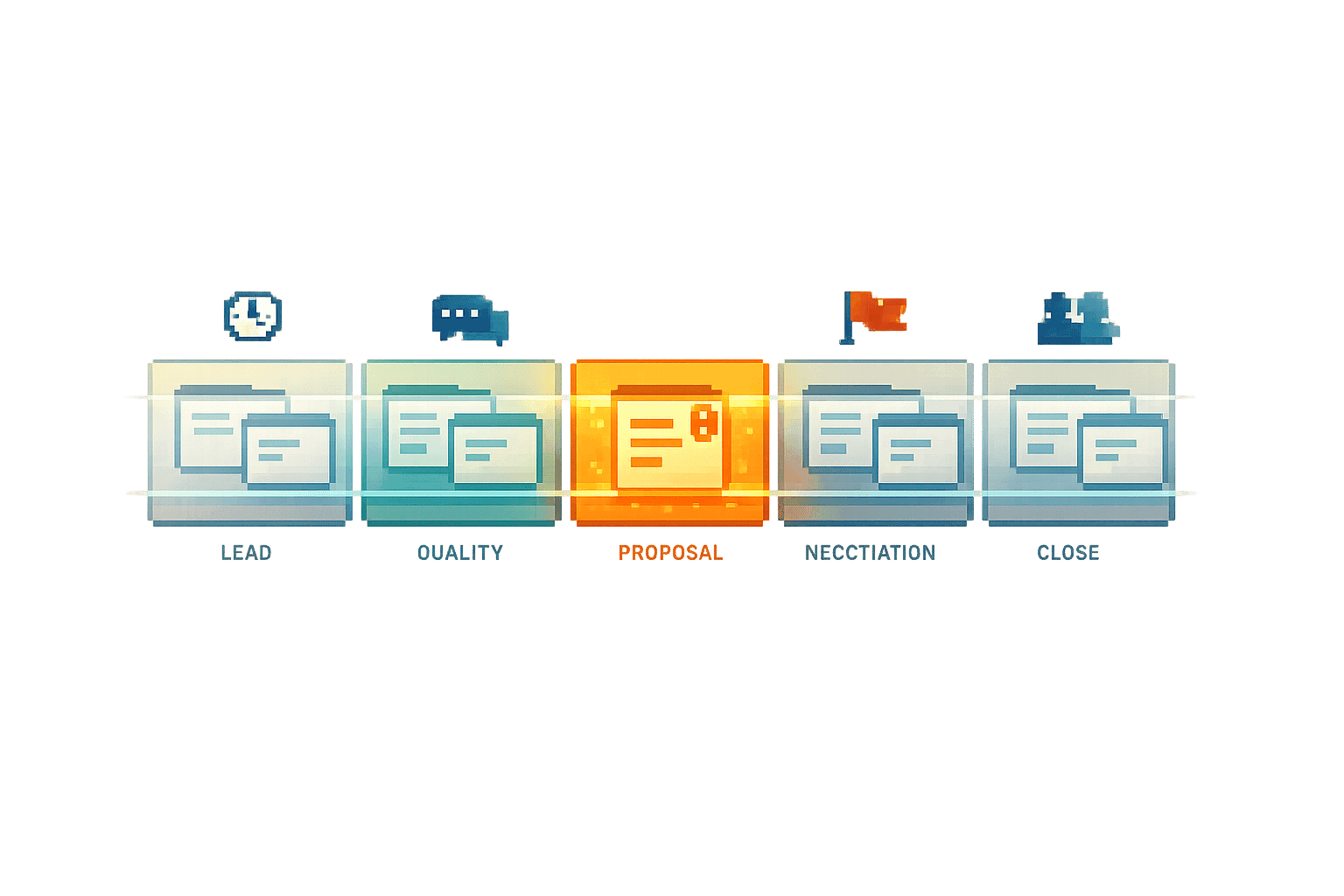
AI is transforming sales by helping teams identify deal risks early, reducing failure rates, and improving forecast accuracy. Traditional methods rely too much on subjective judgment and static playbooks, leading to overlooked risks like stalled timelines, communication gaps, and pricing concerns. AI tools analyze historical data, monitor real-time deal progression, and flag risks like delayed responses or reduced stakeholder engagement weeks before they derail a deal.
Key takeaways:
Stalled deals: Legal and budget delays are common blockers, with risks increasing if deals linger in a stage too long.
Communication gaps: Delayed responses (48+ hours) or fewer buyer-initiated interactions raise failure chances by 60%.
Competitive threats: Mentions of competitors or unclear budgets can push failure probabilities to 89%.
Real-time monitoring: AI tracks engagement, timelines, and stakeholder activity to flag risks within a critical 72-hour window.
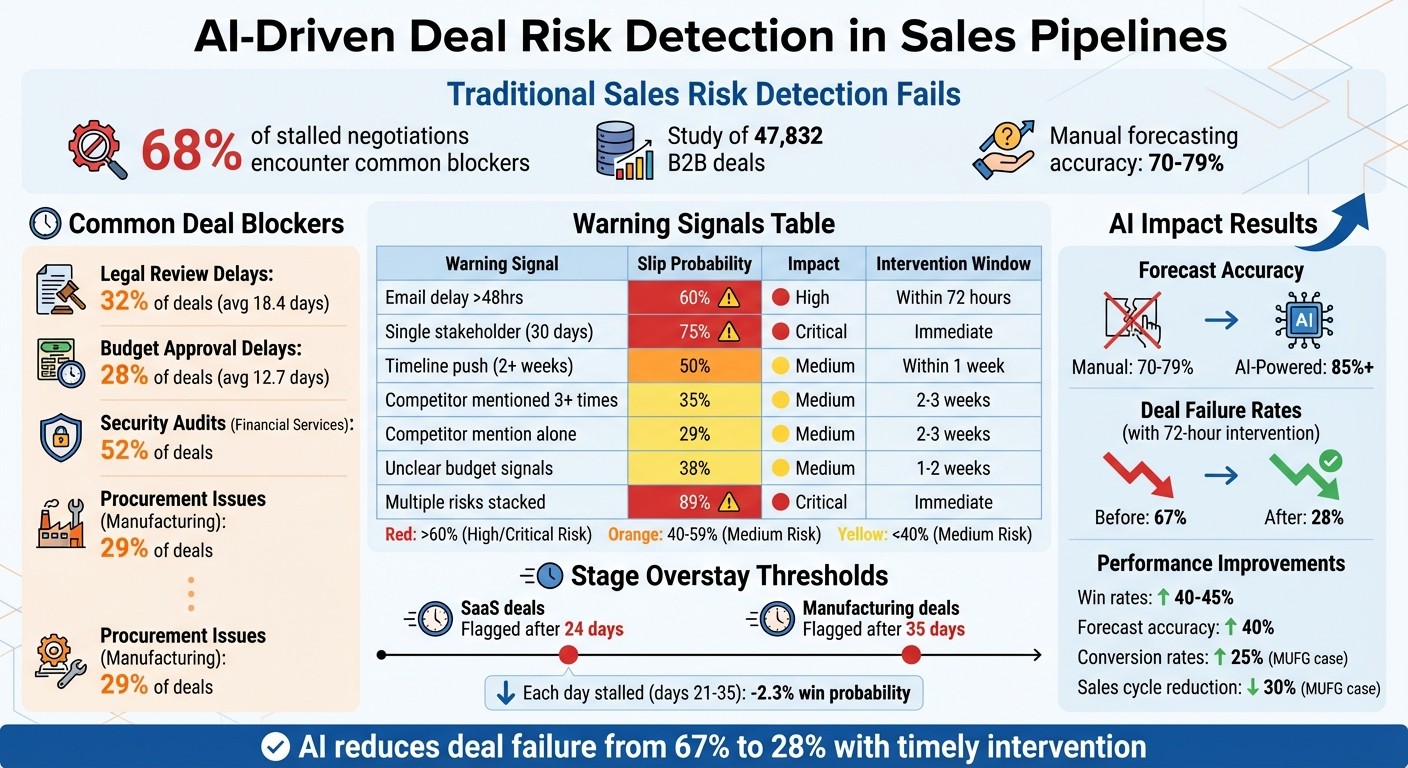
AI Deal Risk Detection: Key Warning Signals and Intervention Windows
How Sales Leaders Instantly Identify Deals at Risk | MIKI Agentic Chief of Staff Demo
Common Deal Risks in Sales Pipelines
Missed risk signals can derail deals, but understanding the common obstacles in sales pipelines can help prevent stagnation. A study of 47,832 B2B deals found that 68% of stalled negotiations encounter one of 12 common blockers [11]. These blockers often follow patterns that AI can identify before they even show up in your CRM.
Stalled Deal Progression
Deals rarely fall apart overnight - they tend to stall in one CRM stage for weeks. The most frequent culprit? Legal review delays, which impact 32% of deals and take an average of 18.4 days to resolve [11]. Right behind this are budget approval delays, which affect 28% of deals and add another 12.7 days to the sales cycle [11].
"The painful part isn't that deals stall - it's that they stall silently, while your team stays busy and your forecast stays optimistic." - Ameya Deshmukh, EverWorker [10]
When deals drag on for more than twice the team’s average cycle time, it’s often a sign of deeper issues. Administrative hurdles like security audits, procurement onboarding, and contract redlines are common culprits. In financial services, 52% of deals face delays from security audits, while manufacturing companies grapple with procurement challenges in 29% of deals [11].
Communication Gaps and Weak Signals
Communication breakdowns are often an early warning sign of trouble. When a key contact stops responding, fewer stakeholders join meetings, or the buying group shrinks, the risk of losing the deal increases. For instance, email response delays of more than 48 hours can raise the likelihood of deal failure by 60% [2].
But it’s not just about timing - how communication happens matters just as much. When clear next steps like "security review scheduled" are replaced by vague phrases like "follow up next week", deal momentum is already slipping [10]. In 2025, MUFG used AI to analyze prospect engagement patterns, boosting conversion rates by 25% and cutting sales cycles by 30% [4].
Competitive Threats and Pricing Sensitivity
The mention of a competitor can raise the risk of deal failure to 29%, while unclear budget signals push it up to 38%. When multiple risks stack up - like competitor mentions, pricing concerns, and vague timelines - the failure probability can skyrocket to 89% [1].
Take the example of a manufacturing company in 2025: an $89,000 deal stalled for 42 days, triggering multiple risk signals. AI flagged a 92% failure probability, prompting immediate action [1].
"Pricing or Terms Concerns: The buyer may oppose the proposed pricing, ask for 'better terms to justify the investment,' or say they're evaluating your competitors who have offered lower pricing." - Intersight [12]
AI tools can now predict these risks early, giving sales teams the chance to intervene before it’s too late.
How AI Detects Deal Risks with Predictive Analytics
AI doesn’t rely on guesswork to identify risky deals - it learns from your company’s past. By analyzing 12 to 18 months of CRM data from both closed-won and closed-lost deals, AI creates a baseline of what’s “normal” in your sales process [9]. This baseline becomes the foundation for real-time tracking, allowing predictive models to compare active deals against historical patterns and flag potential issues long before traditional reviews would catch them [9][2].
Analyzing Historical Deal Data
AI dives into your historical data, breaking it down by factors like deal size, industry, product line, region, and sales cycle length to build benchmarks tailored to specific contexts [10]. For example, the trajectory of a $50,000 SaaS deal in healthcare will likely differ from that of a $250,000 manufacturing deal.
By studying thousands of past deals, machine learning uncovers “success trajectories,” such as the ideal number of stakeholders, the best communication frequency, and how much time each stage typically takes for deals that close successfully [13]. Models like logistic regression or gradient boosting then score active deals, estimating their likelihood of success based on how closely they align with these patterns [3].
"AI agents spot patterns across thousands of deals that individual sellers miss, identifying critical engagement signals and relationship dynamics that often determine deal outcomes." - Nora Pantfoerder, Senior Product Marketing Manager, Outreach [9]
Companies using AI for pipeline analysis have seen up to a 40% improvement in forecast accuracy and an 18% boost in win rates [10]. While manual forecasting typically achieves accuracy rates of 70% to 79%, AI-powered platforms can push this to 85% or more [3][9].
Tracking Pipeline Velocity and Engagement Metrics
AI also keeps an eye on how quickly deals move through your pipeline, flagging any deviations from a healthy progression. One major red flag is stage overstay - when a deal lingers in a stage longer than the typical duration for successful deals [3][5].
In addition to time, AI examines engagement metrics like the ratio of buyer-initiated to seller-initiated interactions, response times, and meeting frequency [3][7]. For instance, a response delay of more than 48 hours increases deal risk by 60% [2]. Similarly, deals with just one engaged stakeholder after 30 days have a 75% chance of slipping [2].
Between 2024 and 2025, Omniplex Learning used Outreach’s AI forecasting tools to maintain high forecast accuracy while scaling their sales team from 10 to 30 reps. This shift reflects broader trends in the future of sales enablement, where AI-driven tools become central to growth. This enabled Sales Director Andrei Grayson to monitor deal health and velocity shifts in real time, avoiding the delays of month-end reviews [9].
These insights help create precise benchmarks, further improving the system’s ability to detect risks early.
Using Baseline Learning Models
AI establishes benchmarks for what “good” looks like in your pipeline and flags deviations from these standards. These baseline models adapt to your specific business context - a procurement-heavy manufacturing deal will naturally have a different pace than a SaaS expansion [10].
The system continuously monitors each deal’s “heartbeat,” comparing daily activity to established benchmarks to identify subtle momentum changes that could signal trouble [10]. It doesn’t just count emails or calls; it analyzes CRM notes to differentiate between concrete commitments (e.g., “security review scheduled for March 20”) and vague follow-ups (e.g., “touch base next week”) [7][10].
"Stalling isn't a single event; it's a drift. It looks like 'still in stage 3' while the internal clock keeps ticking." - Ameya Deshmukh, EverWorker [10]
Real-Time Risk Monitoring with AI
Once AI identifies what "normal" looks like in your sales pipeline, it transitions into continuous monitoring mode. Instead of relying on weekly pipeline reviews or month-end forecasts, the system keeps an eye on every active deal in real time. It compares current progress against established patterns and flags risks as soon as they arise. These real-time insights build on AI's predictive capabilities, allowing teams to act quickly. This shift turns deal management from reactive problem-solving into proactive intervention, enabling sales teams to respond within a critical 72-hour window - cutting deal failure rates from 67% to 28% [1].
Monitoring Delayed Timelines and Milestones
Using historical benchmarks, AI keeps tabs on deal progression, communication patterns, and stakeholder engagement. It tracks how long deals remain in each CRM stage and flags "stage overstays" when deals exceed industry-specific thresholds. For example, deals in SaaS industries are flagged after 24 days, while manufacturing deals are flagged after 35 days [1]. Every extra day a deal stalls between days 21 and 35 reduces its win probability by around 2.3% [1].
AI also monitors Mutual Action Plans (MAPs), ensuring milestones like security reviews or legal approvals stay on track [2][10]. If deadlines are missed or concrete commitments turn into vague placeholders, the system sends immediate alerts through automated CRM tasks or Slack notifications [10].
"Agentic AI is moving from insights to action - planning, integrating with applications, and executing tasks." - Gartner [3]
Analyzing Communication Frequency and Quality
AI doesn't stop at timelines - it also evaluates engagement patterns to catch early signs of lost interest. It monitors both the quality and frequency of buyer-seller interactions. Healthy engagement typically involves buyers initiating meetings or requesting technical reviews, while deals where reps do all the initiating raise red flags [7]. For instance, if meeting frequency drops by over 50% within two weeks, AI flags the deal for urgent review [2].
Natural Language Processing (NLP) adds another layer by analyzing conversation tone and content. It can detect shifts from positive sentiment to hesitation, pricing concerns, or mentions of competitors [12][2]. These insights help sales managers identify "silent stalls" weeks before a deal officially misses its close date, rather than uncovering issues during a forecast review.
Flagging Stakeholder Changes and Red Flags
Stakeholder engagement is another critical area AI monitors. It flags changes like reduced meeting attendance or shifts in decision-making authority [10]. Deals that are single-threaded - where only one contact remains actively engaged after 30 days - carry a 75% slip probability and trigger immediate alerts [2].
The system also checks if key players, such as economic buyers or executive sponsors, are actively involved. By cross-referencing CRM records with conversation transcripts, it identifies "No Power" situations or cases where prospects go from quick replies to complete silence [12][2]. When this happens, AI suggests specific actions, such as scheduling an executive alignment call or re-confirming decision criteria with new stakeholders [12][10]. Some advanced platforms even draft executive outreach emails or create re-validation tasks for stalled deals automatically [10][3].
These alerts, combined with earlier risk indicators, provide clear opportunities for intervention to prevent deal slippage.
Warning Signal | Slip Probability | Intervention Window |
|---|---|---|
Email response delay >48 hours | 60% | Within 72 hours |
Single stakeholder after 30 days | 75% | Immediate |
Timeline push (2+ weeks) | 50% | Within 1 week |
Competitor mentioned 3+ times | 35% | 2-3 weeks |
Source: Compiled from deal risk analysis data [2]
Coach Pilot Solutions: Reducing Deal Risks
Identifying risks early is just the beginning. The real challenge lies in taking swift, effective action - and that’s exactly what Coach Pilot delivers. By building on AI's ability to detect risks, Coach Pilot transforms alerts into actionable recovery strategies. Instead of static playbooks, it provides dynamic, AI-powered guides that embed winning processes, messaging strategies, and objection-handling techniques from top performers directly into sales workflows. This approach ensures the expertise of the best team members is shared across the entire organization. Teams using Coach Pilot have reported 7.8x pipeline growth in less than 90 days and a 39% boost in quota attainment by replacing generic outreach with tailored, value-driven messages guided by AI [14].
Real-Time Coaching and Tailored Playbooks
When a deal starts showing signs of trouble, Coach Pilot steps in with precise, actionable recommendations. Whether it’s knowing the right time to involve executives or strategies to handle procurement hurdles, the platform uses patterns from top performers to provide tailored guidance. For example, in May 2024, Four Rooms saw their monthly sales triple and secured 14 new deals in just eight weeks by implementing these targeted strategies [14]. These customized playbooks not only address immediate risks but also pave the way for deeper analytics to further strengthen deal outcomes.
Sales Analytics That Drive Action
Coach Pilot doesn’t stop at tactical advice - it also delivers powerful analytics to assess pipeline health and guide targeted actions. By automating the capture of "deal truth" and CRM updates, the platform ensures that pipeline data reflects real activity, saving sales reps an average of 19.5 hours per week on administrative tasks. Between March and June 2024, HubSpot BDM Connor Bell used these insights to generate 50% more net new opportunities, close 12 new deals in 11 weeks, and achieve a 38% increase in quarterly sales revenue [14].
Seamless Workflow Integration
To make risk detection and coaching even more effective, Coach Pilot integrates directly with tools like Microsoft Teams and ChatGPT, delivering timely alerts and recommendations right where sales reps are already working. This eliminates the need for context switching and ensures that coaching fits seamlessly into existing workflows. Weekly live coaching calls add an extra layer of support, helping teams address challenges in real time. Linh Podetti, CEO of Virtual Outsourced Angels, summed it up perfectly:
"The AI is insane, and the weekly live coaching is even more helpful. We can bring in real-life problems and have the coaches give specific examples and solutions to help guide us and remove any roadblocks" [14].
Strategies for Implementing AI-Driven Risk Alerts
AI can do more than just spot risks - it can help sales teams act quickly to address them. But detection alone isn’t enough. To save a deal, you need to act fast, and that requires alerts designed for speed and clarity. Here’s how to set up AI-powered risk alerts that drive immediate action.
Setting Real-Time Pipeline Velocity Alerts
Timing is everything in sales. Set up alerts that trigger when deals take significantly longer than usual to progress. For example, if moving from "Proposal Sent" to "Negotiation" typically takes 12 days, configure an alert to go off at day 24 [15]. Adjust these thresholds based on your industry - 24 days might make sense for SaaS, while Financial Services could require a longer buffer, like 42 days [1]. When deals stall without any milestone updates, reps need this information right away, not at the next pipeline review.
Using Engagement-Based Notifications
Engagement is often the first thing to falter when a deal is at risk. Set alerts for "ghosting" when a prospect goes silent - say, no response within 4 days for short sales cycles or 7 days for longer ones [15]. Another key metric to watch is stakeholder involvement. If no Director-level or higher contact is actively engaged as a deal nears closing, that’s a major warning sign [15].
"An alert that says 'Problem Detected' is noise. An alert that says 'Problem Detected. Here is the solution. Click to execute,' is orchestration" [6].
These engagement-based alerts can seamlessly feed into structured daily reviews, ensuring quick action where it’s needed most.
Conducting Daily At-Risk Deal Reviews
Real-time alerts are just the start - daily reviews help consolidate your risk management efforts. Dedicate 15 minutes each morning to review the top 10 at-risk deals flagged by AI [10]. Share this list automatically in a Slack or Teams channel so RevOps and managers can stay in the loop. The goal isn’t just to identify struggling deals but to understand the underlying issues and act within 72 hours. This rapid intervention can cut deal failure rates from 67% to 28% [1]. Use AI-generated briefs to uncover specific problems - whether it’s a missing decision-maker, a stalled timeline, or a communication breakdown - and assign recovery tasks on the spot.
Conclusion
AI is reshaping pipeline management by turning raw data into actionable insights. With AI-driven risk detection, subjective guesswork is replaced by objective behavioral data. Instead of relying on overly optimistic projections, AI tracks real buyer behavior - like response rates, meeting schedules, and stakeholder involvement - to flag deals at risk, often weeks earlier than traditional manual reviews [9][5].
The results speak for themselves. Companies using AI to prioritize deals report up to a 45% increase in win rates [8]. Forecasting accuracy has jumped to over 85%, compared to the 70–79% range seen with manual methods [9]. By narrowing forecast variance to within 10% [9], AI allows revenue leaders to allocate resources more effectively and make predictions with greater confidence. These advancements lay the groundwork for AI-powered sales coaching to thrive.
Coach Pilot ties all these features together, embedding AI-driven coaching directly into sales workflows. The platform integrates proactive alerts, custom playbooks, and performance analytics to help teams identify risks early and respond swiftly. With actionable notifications and easy-to-execute remediation steps, sales reps can focus less on admin work and more on closing deals.
FAQs
What data does AI need to spot deal risk accurately?
AI relies on various data points to function effectively in sales contexts. It analyzes information such as deal activity, behavioral patterns, unusual activity or inactivity, CRM entries, as well as calls, emails, buyer signals, and sales rep actions. These inputs enable it to pinpoint potential risks and offer actionable insights to tackle them efficiently.
How can teams act on risk alerts without overwhelming reps?
Teams can tackle risk alerts more effectively by zeroing in on high-priority deals and offering clear, actionable next steps. With the help of AI-powered tools, at-risk deals can be flagged early, along with tailored follow-up recommendations that go beyond generic alerts. These alerts can seamlessly fit into existing workflows, activating predefined playbooks or coaching prompts. This organized approach allows reps to address risks systematically, easing mental strain and avoiding alert fatigue, all while keeping their attention on the most critical tasks.
How do you set risk thresholds for different industries and deal sizes?
Risk thresholds are set by examining factors like early warning signals, the age of a deal, and pipeline health metrics. AI models analyze industry-specific data and historical trends to create predictive scores. These scores help pinpoint when a deal's risk level surpasses predefined limits. By tailoring thresholds to fit each industry and deal size, this method enhances precision in spotting and managing potential risks.
Related Blog Posts

Remove the guesswork from winning more deals.