B2B Sales
Ultimate Guide to AI Sales Skill Assessment
Mar 15, 2026
How AI analyzes every sales interaction to identify skill gaps, deliver real-time coaching, and boost quota attainment, productivity, and revenue.
AI is transforming how sales teams are assessed and coached. Instead of relying on limited, subjective reviews, AI evaluates 100% of sales interactions - calls, emails, and CRM updates - providing instant, data-backed insights. This shift helps managers save time, eliminate bias, and focus on high-impact AI sales coaching. Companies using AI report:
3.3× growth in quota attainment
95% boost in sales productivity
20% higher revenue outcomes
AI tools analyze communication patterns, sentiment, and behaviors like objection handling and discovery techniques. They also deliver real-time feedback during calls and predict skill gaps, enabling personalized coaching. For example, sales teams using AI-driven role-play tools increase deal sizes by 35% and ramp-up time for new hires drops by up to 40%.
Integrating AI into sales workflows ensures reps receive actionable insights without disrupting their routine. Combining AI's precision with human judgment creates a powerful system to improve performance and drive results.
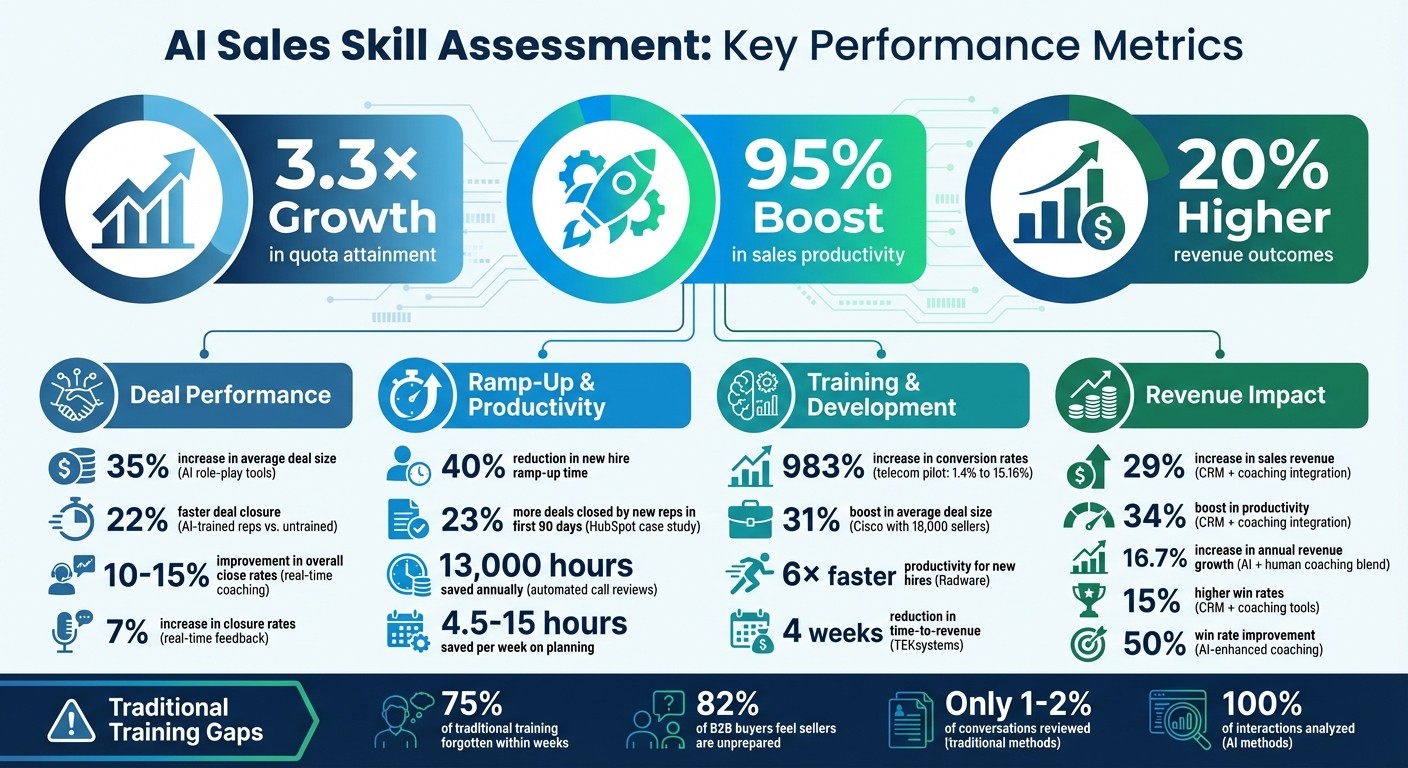
AI Sales Coaching Impact: Key Performance Metrics and ROI Statistics
I Built an AI Sales Coach That Analyzes Your Calls (n8n tutorial)
Core Capabilities of AI in Sales Skill Assessment
AI tools are transforming sales training by analyzing interactions and identifying where team members need support. Here's how they do it.
Conversation Intelligence and Behavioral Analytics
AI captures and analyzes every interaction - calls, video meetings, emails - to provide a detailed view of a sales rep's performance [9]. Using Natural Language Processing (NLP), these tools automatically flag key moments like pricing discussions, competitor mentions, or objections, saving managers from hours of manual review [10]. They also track behavioral metrics such as talk-to-listen ratios, speaking speed, interruptions, and the number of meaningful discovery questions asked. For example, research from over 500,000 B2B calls shows that the ideal talk-to-listen ratio is 43%, with only three meaningful discovery questions asked during a 30-minute call [10].
AI doesn't stop at tracking words - it also detects emotional cues by analyzing vocal tone, language patterns, and pacing. This helps gauge whether a prospect is engaged, frustrated, or hesitant [10]. The system then scores reps on competencies like opener effectiveness, discovery depth, and objection handling, comparing them to top performers to highlight specific skill gaps [8].
Take HubSpot in 2023 as an example: they used Gong.io for call coaching, and new reps who received AI-driven feedback closed 23% more deals in their first 90 days. Coaching specifically focused on objection handling doubled rep confidence [10]. Similarly, MongoDB used AI to identify a sharp rise in competitor mentions during Q2 2023, prompting a product repositioning that saved an estimated $1.2 million in at-risk deals [10].
"AI doesn't replace the manager. It solves the bandwidth problem so the manager can actually do the high-value work: interpreting insights and making judgment calls."
Salesfinity [11]
These insights not only improve post-call evaluations but also set the stage for real-time coaching.
Real-Time Feedback and Coaching
AI shifts coaching from being reactive to proactive by providing real-time guidance during live calls [12]. It processes audio in less than a second, using NLP to search knowledge bases in under 700 milliseconds [12]. During calls, AI monitors communication metrics and sentiment, offering instant feedback when a rep deviates from best practices [13]. For example, if a rep forgets to ask about budget or authority in a MEDDPICC or BANT framework, the system flags it immediately [13]. It can also surface critical information - like pricing details or competitive comparisons - on the spot, preventing missteps during high-stakes moments [12][13].
In 2025, Precina, a healthcare company, adopted Salesforce's Agentforce coaching for clinician onboarding. The AI provided real-time feedback during patient intake calls, measuring accuracy, compliance, and empathy. This allowed Precina to expand outreach to underserved communities while maintaining high-quality interactions [2].
The impact of real-time coaching is measurable: it can increase closure rates by 7% [13], improve overall close rates by 10–15% [14], and cut new hire ramp-up time by up to 40% [14]. Automating call reviews and CRM updates can also save teams up to 13,000 hours annually [13]. This instant feedback integrates seamlessly with ongoing assessments, refining strategies as they unfold.
Predictive Analytics for Skill Gap Identification
AI goes beyond analyzing past interactions; it predicts future challenges. By examining 100% of sales interactions, AI identifies patterns in tone, sentiment, and objection handling that might escape human managers [9]. It can even forecast which reps are likely to miss their quotas weeks in advance by analyzing speech habits, interaction frequency, and historical outcomes [9]. Comparing individual performance to top performers or industry benchmarks, it highlights specific areas for improvement [9].
The system connects behaviors directly to pipeline outcomes, identifying actions that most influence deal progression. For instance, focusing on improving discovery techniques through AI analysis can boost pipeline performance by 25%, while better objection handling can increase conversion rates by 20% [15].
"The future of selling isn't about dialing more prospects or writing better emails. It's about smarter coaching, faster learning, and delivering with precision, all powered by AI Sales Coaching."
Niharika Mogili, PowerDialer.ai[9]
Platforms like Coach Pilot embed these predictive insights into daily workflows. By combining custom playbooks with real-time guidance, they help teams close the gap between strategy and execution. This integration of predictive analytics with CRM data provides a full picture of rep readiness, enabling managers to focus on the most impactful coaching opportunities. With this approach, coaching becomes not just reactive but strategically proactive.
Key Skills and Competencies Assessed by AI
AI has evolved to evaluate the finer details of sales performance, going well beyond simple metrics like call frequency. It now examines the quality of communication, negotiation techniques, and even adaptability in real-time scenarios. By analyzing both the content and delivery of conversations, AI identifies the skills that distinguish top-performing sales reps from those who struggle to meet their targets.
Core Sales Skills Measured
AI dives deep into communication, evaluating factors like tone, confidence, empathy, clarity, talk-to-listen ratios, and speech pace [2][18]. It can detect signs of hesitation, which often point to a lack of preparation. When it comes to discovery, AI doesn’t just count the number of questions asked - it assesses their depth, focusing on whether reps use impactful probing questions that highlight the cost of inaction [4][18]. For objection handling, AI monitors how reps address pricing concerns, favoring value-based responses over quick discounts [4][18]. In negotiation, it looks for effective value positioning, anchoring strategies, and efforts to shift the conversation from price to broader outcomes [4][18].
Using natural language processing (NLP), AI captures the context and intent behind conversations [4]. It also employs behavioral analytics to compare individual performance against established benchmarks or sales frameworks like the ValueSelling Framework [1][4]. Sentiment analysis further enhances these evaluations by detecting emotional shifts during calls [1][7]. Some platforms even provide real-time assistance, offering "cue cards" with suggested talking points or reminders to ask key discovery questions during live interactions [16][17].
The results speak for themselves. Companies that integrate AI into coaching activities report a 3.3× year-over-year growth in quota attainment [4] and a 95% year-over-year boost in sales productivity [4]. These improvements are particularly striking given that traditional sales training often falls short - up to 75% of it is forgotten within weeks [18], and 82% of B2B buyers feel that sellers are unprepared to meet their needs [18].
Role-Specific and Team-Specific Assessments
AI doesn’t just evaluate general skills. It customizes its analysis based on specific roles and team dynamics. For instance:
SDRs are measured on discovery frequency and talk-to-listen ratios.
AEs are assessed on advanced negotiation techniques.
CSMs are evaluated for their message consistency during pricing updates [1][16][19].
AI also enables role-specific training through tailored scenarios. SDRs might practice handling challenging gatekeepers, AEs could rehearse complex negotiations, and CSMs might refine their approach to product launch announcements [19][21]. To make these simulations more realistic, AI adopts various buyer personas - ranging from "sassy" to "rude" to "supportive" - testing reps’ ability to adapt to different situations [20][21]. Currently, 18% of sales professionals use AI-powered role-play tools, and teams leveraging these tools are 35% more likely to see an increase in average deal size [19].
Role | Primary AI Focus | Key Metrics Tracked |
|---|---|---|
SDR/BDR | ||
Account Executive | ||
Customer Success Manager | Rehearsing launches & pricing updates [19] | Message consistency, positioning shifts [19] |
AI also identifies trends across entire teams. For example, it might reveal that discovery question quality declines at quarter-end or that multi-threading efforts drop during busy periods [18]. By benchmarking team performance against top performers, AI highlights behaviors that lead to successful deals versus lost opportunities [1][22]. These insights allow for targeted coaching, perfectly aligning with the goal of improving sales performance through AI-driven strategies.
From Assessment to Development: Closing the Skill Gap
Once assessments identify areas for improvement, the next step is turning those insights into practical development strategies. Modern AI platforms use an "Identify and Fix Framework" to analyze real-world interactions - like calls and emails - spotting specific challenges such as difficulty handling pricing objections. These platforms then assign tailored role-play simulations to help reps sharpen their skills in those areas [23].
This shift from simply diagnosing issues to offering tailored coaching changes the game for sales development. AI now creates personalized learning paths, including targeted modules, podcasts, and mentor suggestions, all aligned with individual skill levels [4][24]. The results speak for themselves: In January 2026, a telecommunications company ran a 90-day pilot with 75 associates using AI to pinpoint skill gaps and provide continuous micro-training. The outcome? Conversion rates skyrocketed from 1.4% to 15.16%, a 983% increase. AI-certified reps also converted 14.67% more customers and generated 21.04% more weekly sales [25].
Personalized Training Recommendations
AI eliminates the need for one-size-fits-all training. Instead, it tailors development to each rep's unique needs, comparing their current skills to the demands of their role and creating a custom path to bridge the gaps [24]. For example, a rep struggling with discovery might practice with an AI-powered buyer persona, while another who excels at discovery but struggles with negotiation would focus on strategies like value positioning and anchoring.
This approach tackles the "forgetting curve", where up to 90% of training is forgotten without reinforcement [23]. By embedding learning into daily workflows through tools like Slack or CRM systems, AI offers immediate feedback after every interaction, helping new skills stick over time [4][23]. TEKsystems used AI-driven onboarding to personalize development, cutting time-to-revenue by four weeks [24].
"AI coaching combats the well-known 'forgetting curve' by providing real-time practice and correction that makes skills stick and evolve beyond the initial training event." – ValueSelling Blog [4]
Cisco scaled its coaching efforts with AI role-play for 18,000 sellers in just six weeks, saving 6,000 manager hours and boosting average deal sizes by 31% [23]. Meanwhile, Radware saw new hires reach productivity six times faster compared to traditional onboarding methods [23].
Integration with Sales Workflows
For these personalized learning plans to succeed, they must integrate seamlessly into daily sales workflows. The best AI-powered training systems sync with tools sales teams already rely on - like Salesforce, HubSpot, Slack, and Microsoft Teams [17][26]. This prevents "tool fatigue" and ensures coaching happens naturally during work rather than feeling like an extra task.
Real-time integration means AI can provide live support during calls, offering cue cards with talking points or reminders to ask key questions [4][16]. After the call, AI logs insights and action items directly into the CRM, cutting down on administrative work [16][17]. For instance, in February 2026, Salesforce introduced its "Agentforce" AI, leading to a 10% increase in win rates for its own sales team [26].
Combining AI's precision with human managers' strategic input takes coaching even further. AI handles routine feedback and call scoring, freeing managers to focus on mentorship and complex strategies. Companies using this blended model have reported a 16.7% boost in annual revenue growth [27], while sales teams save an average of 4.5 hours per week on planning - some even reclaim up to 15 hours weekly [26].
"AI doesn't teach your methodology... AI provides another layer, ensuring reps apply the methodology consistently across every customer interaction by providing the reinforcement and practice that traditional training alone can't deliver at scale." – ValueSelling Blog [4]
Platforms like Coach Pilot go a step further, combining custom sales playbooks with AI-driven coaching embedded directly into workflows. This alignment ensures that development plans not only address individual skill gaps but also stay in sync with your business goals, creating a streamlined path from assessment to mastery.
Implementing AI-Powered Sales Skill Assessment
Deploying AI in sales skill assessment requires more than just understanding its potential. Success hinges on selecting the right platform, fostering team adoption, and tracking measurable outcomes. Let’s break it down.
Choosing the Right Platform
Transcription accuracy is critical. If the AI misinterprets what your sales reps say, the entire system collapses. Look for platforms boasting 90%–97% transcription accuracy. During demos, test the tool against your company’s specific product names, industry jargon, and competitor terms - areas where language models often stumble [29].
"The core of these tools is transcription accuracy, operating under the tenet: 'If the words are wrong, the outcomes are too'." – Outscale.ai [29]
Integration capabilities are equally important. The platform should sync seamlessly with your CRM, whether it’s Salesforce, HubSpot, or another system. This eliminates manual data entry and ensures coaching insights reflect the actual pipeline [29][22]. Teams that combine CRM tools with coaching report a 29% increase in sales revenue and a 34% boost in productivity [29].
Decide if your team needs real-time coaching, post-call analyses, or both. Real-time tools provide instant feedback, which can improve on-the-spot performance but may overwhelm newer reps. On the other hand, post-call reviews with transcripts and scorecards allow for deeper reflection but take longer to provide actionable insights [22][17][6].
Security and compliance cannot be overlooked, especially in regulated industries. Ensure the platform supports GDPR, HIPAA, and SOC 2 Type II certifications. Vendors should also demonstrate how their AI mitigates bias to avoid penalizing diverse sales styles unfairly [29].
Lastly, consider role-play and simulation features. AI avatars enable reps to practice discovery calls and objection handling in a judgment-free environment. Companies using AI-driven sales coaching tools have reported a 20–25% improvement in rep proficiency [22][17][30].
Platforms like Coach Pilot offer tailored solutions, combining AI-driven coaching with custom playbooks embedded into your workflows. Their flexibility ensures teams get exactly what they need, from live training to ongoing support.
Once you’ve chosen the right platform, the next step is ensuring your team adopts and uses it effectively.
Ensuring Rep Engagement and Adoption
Even the most advanced AI tools are useless if your team doesn’t embrace them. While 96% of sales and marketing professionals agree that coaching significantly impacts performance, only 26% of sales reps feel they receive quality coaching from their managers [27]. Bridging this gap requires thoughtful positioning.
Frame AI as a partner, not a watchdog. Leadership should emphasize that the tool is designed to help reps succeed and grow, not to monitor their every move [1]. For example, Precina’s CEO, John Oberg, implemented a “daily warmup” policy where clinicians practiced intake calls with AI before speaking to patients. This positioned AI as a training ally, making daily practice routines a natural part of professional development [5][2].
"I've asked my team to practice once a day. They're warming up every day for professional calls... We want our providers to be warming up every day before they talk to patients." – John Oberg, CEO and Founder, Precina [5]
Integrate AI into existing workflows. Embedding the tool into platforms like Slack, Microsoft Teams, or your CRM reduces friction and prevents tool fatigue. Reps are more likely to engage when they see immediate, actionable insights they can apply to their next call [29][5][2].
Involve your team in the selection process. Gather feedback during vendor evaluations to ensure the tool addresses their specific challenges, such as reducing ramp time or managing complex negotiations [5]. When reps feel included, they’re more likely to embrace the solution.
Encourage reps to treat AI role-play like an athlete’s warmup routine. Sales leaders should also regularly review AI-generated insights to ensure they align with company goals. When providing feedback, maintain a 3:1 ratio - three positive reinforcements for every constructive critique - to keep morale high [27].
"Adoption increases when reps see AI as an addition to the team, not a replacement. Encourage them to make practicing a habit." – Salesforce [5]
By implementing these strategies, you can position AI as a valuable tool that enhances performance and drives results.
Measuring Success and ROI
Traditional metrics like training completion rates don’t capture the real impact of AI tools. To measure success, focus on both leading indicators (behavioral changes) and lagging indicators (revenue outcomes) [29][15].
Start by establishing baselines. Track metrics like talk-to-listen ratios, win rates, and sales cycle lengths before implementing the tool. Behavioral changes, such as improved discovery techniques, can predict future revenue. For example, AI analysis of discovery calls has been shown to improve pipeline outcomes by 25% [15]. Teams integrating CRM tools with coaching have seen 15% higher win rates and 8% higher quarterly revenue growth [29].
Ramp time is another critical metric. Measure how quickly new hires reach 50% or 100% of their quota compared to traditional onboarding methods. Reps practicing with AI simulations close deals 22% faster than their untrained peers, and sales training delivers an average 353% ROI when applied to real-world scenarios [31].
Use AI for objective benchmarking to ensure consistent scoring across your team. AI can now assess soft skills like empathy and active listening by analyzing tone and sentiment [31][15].
Finally, implement a continuous feedback loop with a "train → apply → measure → reinforce" approach. AI tools can monitor how skills are applied in real-world scenarios and provide ongoing insights. Companies using AI-enhanced coaching have reported win rate improvements of up to 50% [29]. Sales teams that rely on data-driven strategies are 2.3 times more likely to hit their goals compared to those relying on intuition [29].
Blending AI’s precision with human managers’ strategic guidance creates a powerful combination. AI handles routine feedback and call scoring, freeing managers to focus on mentorship and high-level strategies - a model that has driven a 16.7% increase in annual revenue growth [27].
Conclusion
Traditional sales training typically reviewed just 1–2% of conversations. In contrast, AI evaluates 100% of interactions, offering objective, data-backed insights that can pinpoint which sales reps are at risk of missing their quotas - before it impacts revenue [4][32].
Sales management is shifting toward a "Moneyball" approach, where metrics like discovery depth and objection handling are meticulously tracked and benchmarked [7]. B2B companies using AI-driven sales coaching are 20% more likely to achieve stronger revenue outcomes [32]. The industry is evolving with AI tools that autonomously handle tasks like call scoring and proactive coaching workflows [3].
But technology alone isn’t the answer. The most successful teams marry AI’s precision with the emotional intelligence of human coaches. For instance, sales teams that integrate AI with traditional coaching methods have been shown to achieve 3.3× their quota attainment compared to those relying solely on AI [28]. By managing routine feedback and administrative tasks, AI allows managers to focus on high-value areas like deal strategy and mentorship. This hybrid model - where AI and human expertise work together - creates a powerful system for driving results.
Coach Pilot embodies this approach by embedding AI-powered coaching directly into sales workflows. With custom playbooks and live training, it supports everything from onboarding new hires to refining discovery techniques and scaling coaching for remote teams. The right AI solution transforms training from an occasional checkpoint into a continuous process for development.
The future of sales isn’t about replacing human judgment - it’s about enhancing it. By combining data-driven insights with human intuition, AI empowers sales reps to perform at their best every day. This seamless integration of assessment and development sets the stage for teams to consistently excel.
FAQs
How accurate does AI transcription need to be for coaching?
When it comes to analyzing sales conversations, accurate AI transcription is non-negotiable. Reliable transcripts form the foundation for identifying key moments, offering actionable feedback, and spotting areas where skills need improvement.
If the transcription misses the mark, it can lead to misunderstandings or flawed interpretations, which, in turn, can derail the coaching process. On the flip side, precise transcriptions ensure the insights generated are useful and directly contribute to improving sales performance. In short, accuracy isn't just a nice-to-have - it's the backbone of effective coaching analysis.
What sales skills can AI assess beyond basic call metrics?
AI goes beyond just tracking call metrics - it dives into evaluating a variety of sales skills. It can measure how well someone communicates, their ability to build rapport, and how effectively they listen. By analyzing tone, pace, and clarity, AI also provides insights into sales techniques, handling objections, and closing deals. On top of that, it examines soft skills like empathy and flexibility, offering personalized coaching to help salespeople grow and improve over time.
How do you prove ROI from AI sales coaching quickly?
To demonstrate ROI from AI sales coaching in a short amount of time, focus on tracking key performance metrics. These include:
Expanded coaching coverage: For example, the ability to analyze all sales calls rather than just a select few.
Time saved by managers: Measure how much administrative or coaching time is reduced.
Faster onboarding for new reps: Track how quickly new team members reach full productivity.
Improved close rates and shorter deal cycles: Monitor how AI-driven insights impact sales outcomes.
Start by establishing baseline metrics before rolling out the AI solution. Then, regularly monitor these KPIs to highlight tangible improvements in areas like revenue growth, team productivity, and operational efficiency. This approach ensures clear, measurable results within a short period.
Related Blog Posts

Remove the guesswork from winning more deals.