B2B Sales
AI Frameworks for Lead Qualification: A Complete Guide
Mar 3, 2026
Explore how AI enhances BANT, CHAMP, and MEDDIC with predictive scoring, automation, and real-time coaching to qualify leads faster and improve conversions.

AI is transforming how sales teams qualify leads, saving time and increasing accuracy.
Traditional lead qualification methods are slow and often waste resources. AI frameworks now allow sales teams to process leads in seconds, analyze over 10,000 data points per prospect, and deliver predictions with up to 90% greater accuracy. Companies using AI tools report faster sales cycles, higher conversion rates, and significant increases in qualified leads without adding headcount.
Key takeaways:
AI tools like Lift AI and Coach Pilot help prioritize high-intent leads, cutting qualification time from 15–30 minutes to 90 seconds.
Popular frameworks like BANT, CHAMP, and MEDDIC are enhanced by AI, automating tasks like identifying decision-makers and analyzing buyer intent.
Predictive scoring models evaluate leads based on fit, intent, and behavior, boosting lead-to-opportunity conversion rates by 20–40%.
Automated workflows, real-time insights, and feedback loops keep lead scoring accurate and efficient.
AI-powered lead qualification is now essential for sales teams aiming to stay competitive and hit quotas.
how I qualify leads with this AI in 27 Seconds (Make.com + Airtable)
Popular AI Lead Qualification Frameworks
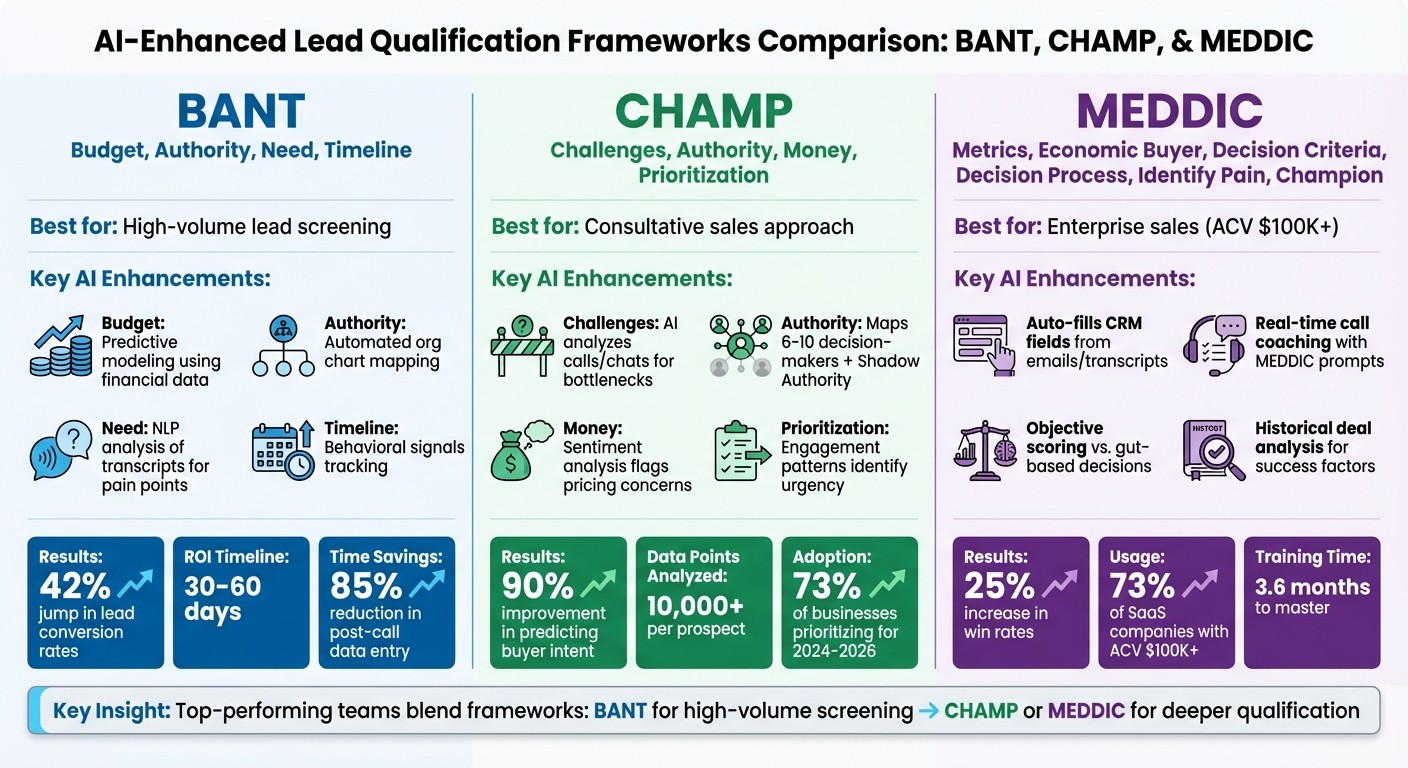
AI-Enhanced Lead Qualification Frameworks: BANT, CHAMP, and MEDDIC Comparison
Sales teams have relied on qualification frameworks for years, and AI is changing the game by turning these once-static methods into dynamic, data-driven systems. Three of the most commonly used frameworks - BANT, CHAMP, and MEDDIC - cater to different sales scenarios, and AI brings unique improvements to each.
BANT Framework with AI
The BANT framework (Budget, Authority, Need, Timeline) has been a cornerstone of sales strategies. With AI, its components are no longer reliant on manual effort but instead leverage predictive insights.
For instance, instead of directly asking prospects about their budget, AI analyzes historical financial data and market trends to estimate their spending capacity before any conversation happens. When it comes to identifying decision-makers, AI scrapes data from websites, company directories, and social media to map out organizational hierarchies automatically. During discovery, AI uses natural language processing (NLP) to pull key pain points and sentiment directly from call transcripts, emails, and chat logs, saving reps from tedious manual documentation.
The "Timeline" aspect gets a major upgrade, too. Rather than relying on a prospect's stated timeline, AI tracks behavioral signals - like visits to pricing pages or downloads of implementation guides - to predict when they’re likely to buy. Companies using AI-driven workflows report up to a 42% jump in lead conversion rates within the first quarter, with ROI typically achieved in 30–60 days [8].
AI also simplifies the process for managers by offering scorecards that track how well reps apply the BANT framework during calls. Automated CRM syncing cuts down on administrative tasks, reducing post-call data entry time by 85% [8].
CHAMP Framework and AI Integration
The CHAMP framework (Challenges, Authority, Money, Prioritization) shifts focus to understanding a prospect’s challenges first, aligning perfectly with today’s consultative sales approach.
AI takes the lead in the "Challenges" stage by analyzing sales calls and chat logs to uncover bottlenecks, pain points, and the cost of inaction [9][11]. Sentiment analysis flags emotional cues, like frustration with a competitor’s pricing or service, to identify "hot leads" ready for action [2].
In the "Authority" phase, AI maps out the often complex B2B buying process, which can involve 6 to 10 decision-makers [10][12]. It doesn’t just identify the person with the title but also finds "Shadow Authority" - influential users or stakeholders who play a key role in the decision.
For "Prioritization", AI examines engagement patterns and sentiment to determine when a challenge becomes a high-priority issue. Behavioral signals - such as urgent language ("need this by Friday") or repeated visits to implementation guides - are five times more predictive of intent than job titles alone [2]. Andrew Giordano, VP of Global Commercial Operations at Analytic Partners, highlights this shift:
"We're no longer fishing. We know who the right customers are, and we can qualify them quickly" [12].
With AI analyzing over 10,000 data points, companies see a 90% improvement in predicting buyer intent compared to traditional methods. It's no wonder 73% of businesses are prioritizing AI-driven lead scoring in their sales strategies for 2024–2026 [2].
MEDDIC Framework for Enterprise Sales
For enterprise-level deals, the MEDDIC framework (Metrics, Economic Buyer, Decision Criteria, Decision Process, Identify Pain, Champion) provides a structured, in-depth analysis. While 73% of SaaS companies with Annual Contract Values (ACV) over $100,000 use MEDDIC [14], only 15% of opportunities typically meet full qualification with all fields completed [14]. AI solves this by analyzing emails and transcripts to automatically fill in MEDDIC-specific CRM fields, keeping deal data accurate without manual input.
Real-time call coaching is another game-changer. AI listens to live sales calls, detecting MEDDIC signals as they arise and prompting reps to ask the right questions if they miss critical elements like the Economic Buyer or Decision Process. Ajay Singh, Co-founder & CEO of Pepsales, explains:
"AI MEDDIC transforms each step by monitoring calls in real time, detecting MEDDIC signals as they occur, and prompting sellers to ask clarifying questions" [13].
AI also replaces gut-based decisions with objective scoring, analyzing how well reps complete MEDDIC criteria and tracking buyer sentiment. Historical deal data reveals which factors - like securing a Champion early - most strongly correlate with success. Teams using the MEDDIC framework report a 25% increase in win rates [13][12][9], though it typically takes 3.6 months for reps to master the framework [14].
Nadeem Azam, Founder of Rep, stresses the importance of consistent application:
"The framework matters less than whether anyone actually uses it. Build enforcement into your systems. Make empty fields a pipeline blocker" [14].
Top-performing teams are increasingly blending these frameworks - starting with BANT for high-volume automated screening, then using CHAMP or MEDDIC for deeper exploration of qualified leads [9][12]. AI ensures that each framework delivers tailored insights, whether through rapid initial assessments or detailed enterprise discovery, paving the way for more effective lead qualification.
Building AI Lead Qualification Workflows
Setting up an AI-driven lead qualification workflow starts with defining your Ideal Customer Profile (ICP) and incorporating layered automation. Your ICP should be based on specific, measurable criteria like "Industry = SaaS" or "Company size = 11-50 employees", avoiding vague descriptions like "tech-savvy" [16]. This level of clarity ensures the AI operates with precision, eliminating guesswork.
The next step is integrating tools like your CRM, marketing automation platform, and enrichment services such as ZoomInfo or Clearbit [1][17]. A standard workflow typically follows this sequence: Lead capture trigger → Data enrichment → Initial scoring → Qualification check → Routing decision → Sales notification → CRM update [1]. This automation removes inefficiencies, saving up to 67% of sales time that would otherwise be wasted on unqualified leads [1][18].
Speed is critical in lead qualification. Teams that respond to leads within 5 minutes are 21 times more likely to qualify them compared to waiting 30 minutes [18]. High-performing teams often set a 5-minute SLA for high-intent leads, triggering immediate AI-driven engagement when a prospect interacts with key pages, like pricing or demo requests [18].
The workflow continuously adapts through feedback loops. By syncing closed-won data back into the AI model monthly, you allow it to recalibrate scoring weights based on real-time performance [1][15]. Sales and marketing teams should agree on a clear numerical threshold (e.g., 70+ points) to transition leads from Marketing Qualified Lead (MQL) to Sales Qualified Lead (SQL) [1][19]. This data-driven approach eliminates subjective decision-making and enhances long-term accuracy.
AI Lead Scoring Models
AI lead scoring evaluates lead quality through three main dimensions: Fit, Intent, and Behavioral.
Fit scoring assesses firmographics (e.g., industry, company size, revenue) alongside demographics like job title and seniority. For example, a decision-maker at a mid-market SaaS company might score 30-40 points in this category alone [1][4].
Intent scoring tracks high-value actions such as requesting demos, visiting pricing pages multiple times, or downloading implementation guides, each weighted at 30-40 points [1][5].
Behavioral scoring focuses on real-time engagement, like attending webinars or spending time on case study pages, typically worth 15-25 points [1][4].
AI scoring significantly boosts both speed and accuracy. Predictive scoring models are 40-60% more accurate than traditional rule-based systems [6], and companies using them report a 20-40% jump in lead-to-opportunity conversion rates [1]. Behavioral scoring, in particular, helps top-performing teams achieve MQL-to-SQL conversion rates of 39-40%, compared to the average of just 13% [18].
Modern AI systems also use temporal decay, assigning more weight to recent activities. For instance, a pricing page visit yesterday carries more significance than a whitepaper download from months ago [15].
To avoid overwhelming your system early on, start with 5-7 key qualification factors. Adding too much complexity too soon can lead to "MQL inflation", where unqualified leads clutter the pipeline [1][5]. Formstack experienced this firsthand but reversed course by focusing on high-intent website visitors using Lift AI's targeting model. Within 90 days, they saw an 88% increase in their sales pipeline [4].
Workflow Automation and Optimization
With accurate lead scoring in place, automation handles routine tasks and optimizes lead routing. Data enrichment is done automatically, pulling in missing details like technology stacks, recent funding, or social profiles from third-party sources before scoring begins [1][3]. This ensures sales reps are never burdened with basic research.
Intelligent routing assigns leads based on factors like territory, rep expertise, workload, or lead priority [1][5]. High-scoring leads (top 5-10%) trigger immediate alerts for sales development reps (SDRs) and can even auto-schedule meetings. Lower-scoring leads are funneled into nurture sequences [5]. This tiered approach ensures no high-priority lead is overlooked, even during peak activity.
Optimization is an ongoing process. Weekly reviews monitor scoring accuracy and false positives, allowing for real-time adjustments [1][6]. Sales teams should have a feedback mechanism to flag inaccuracies, ensuring a human-in-the-loop system that minimizes algorithmic bias [1][19][20]. Nadeem Azam, Founder of Rep, underscores this point:
"The real goal isn't just to qualify leads. It's to disqualify faster" [18].
Automated disqualification is equally critical. By setting clear rules - such as archiving leads with invalid emails, competitor domains, or job-seeker profiles - you can save sales reps over 30 hours per month [6][16]. Bureau, a no-code identity platform, implemented this approach in 2025, combining AI-driven coaching and CRM automation to save reps an hour daily. This resulted in a 30% increase in deal conversions [6].
AI-powered lead qualification allows sales teams to handle 10 times more prospects without adding headcount [1]. In fact, 83% of teams using AI report revenue growth, compared to just 66% of teams that don’t [18]. With the predictive lead scoring market projected to hit $5.6 billion by 2025, growing at a 38% annual rate [6], automation is quickly becoming a must-have for competitive sales teams.
How Coach Pilot Improves Lead Qualification
AI may excel at technical lead scoring, but the challenge often lies in execution. That’s where Coach Pilot steps in, seamlessly integrating AI guidance into every part of the sales workflow. Instead of leaving sales reps to rely on improvisation, Coach Pilot ensures they stick to tried-and-true qualification frameworks like BANT, CHAMP, and MEDDIC. By embedding AI directly into these workflows, it transforms static playbooks into a dynamic, real-time system that guides reps through email, calls, and messaging every step of the way [21].
The results? Teams see tangible improvements in how they qualify leads and close deals. Companies using Coach Pilot report a 7.8x increase in pipeline growth within just 90 days. On top of that, sales teams experience a 39% boost in quota attainment, as AI-guided messaging replaces generic outreach. And it doesn’t stop there - sales reps save an average of 19.5 hours per week on CRM updates and admin tasks, allowing them to focus on what truly matters: qualifying leads and closing deals [21].
Custom Sales Playbooks for Qualification
Coach Pilot takes outdated PDF playbooks and reimagines them as dynamic, interactive systems embedded directly into tools like Microsoft Teams and Copilot. This ensures that frameworks like BANT, MEDDIC, or CHAMP are not only taught but reinforced daily. Instead of being forgotten after a single training session, these strategies become a consistent part of a rep’s workflow.
The platform’s AI also captures the expertise of top-performing reps and shares it across the team. For example, if your best reps consistently engage a CFO within the first two weeks to qualify enterprise leads, Coach Pilot identifies that winning pattern and prompts all reps to follow the same approach. This eliminates guesswork and ensures that every team member executes proven strategies with confidence [21].
AI-Driven Sales Coaching
Beyond playbooks, Coach Pilot delivers live, actionable coaching to refine sales execution further. It provides real-time, step-by-step guidance during deals, telling reps exactly what to do next. For instance, the AI might suggest: “Email the CFO by Thursday with this specific message. Call the economic buyer on Friday at 9am. Use these talking points that closed three similar deals.” This kind of proactive coaching not only supports reps but also reduces the workload for managers by reinforcing qualification criteria across all deals [21].
Coach Pilot is particularly effective in complex sales environments, where managing multiple stakeholders is critical. The platform’s AI analyzes deal data to uncover patterns and makes those insights accessible to every rep. As the platform emphasizes:
"Complex sales processes need this MORE, not less... Coach Pilot identifies those complex patterns in your actual deal data and makes them available to every rep" [21].
With SOC2 and ISO27001 security certifications, Coach Pilot is also well-suited for industries with strict compliance requirements, such as healthcare and finance [21].
Future Trends in AI Lead Qualification
AI-powered lead qualification has reached a point where real-time operation isn't just helpful - it's expected. This shift has redefined the standard for speed and accuracy, paving the way for advanced conversational and predictive AI tools to deliver deeper insights.
Conversational AI for Real-Time Insights
Did you know that leads contacted within five minutes are 9 times more likely to convert compared to those reached later? [17]. That kind of speed is nearly impossible for human reps to maintain consistently. But conversational AI steps in, delivering responses in less than 800 milliseconds. Some of the best platforms even operate within a range of 465–600 milliseconds, ensuring the interaction feels natural while collecting valuable qualification data [17].
These systems go far beyond basic chatbots. With advancements like agentic AI, autonomous agents can now interpret context, make decisions, and take action directly within your CRM [23][22]. Gaurav Bhattacharya, CEO of Jeeva AI, describes it this way:
"Agentic AI is a type of AI that can think, decide, and take action on its own... It behaves like a digital analyst: collecting data, scoring leads, asking follow-up questions, and deciding whether a prospect is ready for sales" [23].
These tools can analyze sentiment in real time, spot hesitation, and address objections as they arise [17][7]. Instead of waiting for a human to review a transcript hours later, the AI adapts mid-conversation. For instance, one agent might evaluate firmographic fit, another monitors behavioral intent, and a third validates data - all working simultaneously to refine lead scores.
Regulatory updates have also reshaped the game. Thanks to the FCC’s February 2024 TCPA rulings, AI voice calls now require prior written consent, prompting companies to adopt "instant inbound" workflows [17]. This means when a prospect submits a form, an AI system can call them back within 60 seconds, keeping their interest alive. Nishant Bijani, Founder & CTO of Dialora, emphasizes:
"In 2026, speed-to-lead will no longer be a competitive advantage; it is a requirement" [24].
Beyond real-time conversations, AI is also revolutionizing how leads are scored with predictive behavioral analysis.
Predictive Behavioral Scoring and Hyper-Personalization
Modern AI systems can process over 50 behavioral signals at once across multiple channels [25]. These systems don’t just streamline lead qualification - they make it smarter. For example, AI can detect whether a prospect visited a pricing page before or after checking out product details. Prospects who look at pricing first are 40% more likely to convert [26].
Companies using predictive behavioral scoring have seen conversion rates rise by 20–30% while reducing time spent on qualification by 30–40% [26]. This efficiency shortens sales cycles by 20–40%, ensuring leads are routed to the right reps at the perfect moment [26].
Unlike manual workflows that might update scores weekly, AI recalculates scores instantly based on actions like visiting a webpage, sharing an email, or downloading a case study [25][7]. This allows sales teams to engage prospects when their interest is at its peak, rather than days later.
AI also uses negative scoring to maintain pipeline quality. For example, points are deducted if a lead’s budget is too low, if they’re in a restricted location, or if their domain shows signs of fraud. This approach can reduce cost-per-lead by approximately 33% [24].
The result? Hyper-personalized nurturing. AI interprets each prospect’s digital behavior - detecting urgency, hesitation, or readiness to buy - and adjusts follow-up content, timing, and channels accordingly [17][7]. Businesses leveraging agentic AI report a 30–50% increase in Sales Qualified Lead (SQL) accuracy and achieve a 200–400% ROI in their first year [23][25].
As Wyzard.ai puts it:
"Traditional scoring operates on snapshots. AI operates on live data streams" [25].
This evolution from static to dynamic scoring is shaping the future of lead qualification - and it’s already transforming how businesses connect with prospects.
Conclusion
AI-powered lead qualification has become a game-changer for sales teams aiming to consistently meet their quotas [6]. The statistics back this up: 73% of companies now prioritize AI-driven lead scoring in their strategies [2], and teams using these tools report a 41% higher revenue per rep - $1.75M compared to $1.24M [6]. With 67% of sales lost to poor qualification, manual processes simply aren’t cutting it anymore [27].
At its core, AI revolutionizes lead qualification by enabling precise and efficient engagement. Using the frameworks and workflows discussed earlier, AI systems process over 10,000 data points - like behavioral signals such as visits to pricing pages or urgency-related language - to predict buyer intent with an accuracy rate of 75% to 90% [28]. This allows sales reps to focus on the most promising prospects, resulting in sales cycles up to 30% faster, a 20% boost in lead conversion rates, and better forecast accuracy [6].
To get started, define your Ideal Customer Profile (ICP) based on your most successful closed deals. Apply AI qualification to high-volume lead sources using 5–7 key scoring factors, and regularly adjust thresholds through feedback loops every 30–90 days [1][6]. The goal isn’t to replace human judgment but to eliminate repetitive tasks, enabling reps to spend as much as 80% of their time actively selling [6].
Taking it a step further, tools like Coach Pilot embed these insights directly into the sales process. By integrating custom sales playbooks with AI coaching, Coach Pilot ensures reps know exactly how to engage high-intent leads as soon as they’re identified. This approach increases win rates, shortens sales cycles, and enhances forecast accuracy, paving the way for predictable revenue growth.
Ultimately, the question isn’t whether to adopt AI frameworks but how quickly you can implement them. As Zime AI aptly puts it:
"The true cost of traditional qualification is not the leads you chase; it is the deals you could have closed while chasing them" [6].
FAQs
Which qualification framework should I use first: BANT, CHAMP, or MEDDIC?
When deciding on a framework, think about how complex your sales deals are. If you're handling straightforward, high-volume transactional sales, BANT is a great choice because it's quick and efficient. On the other hand, for more intricate enterprise deals involving multiple stakeholders, MEDDIC or even a combination of frameworks like BANT and MEDDIC can provide better results. You can start with BANT for fast initial qualification, then layer in MEDDIC for a deeper understanding in more involved sales situations.
What data do I need to start AI lead scoring?
To get started with AI lead scoring, you'll need reliable and well-organized data in a few key areas:
Firmographic data: Information like company size, industry, and revenue.
Technographic data: Insights into the company's technology stack.
Behavioral data: Engagement metrics such as website activity and email interactions.
Real-time buying signals: Indicators of current purchase intent, like specific actions or inquiries.
Historical data: Records of past interactions and conversion results to help build predictive models.
How do I prevent AI from sending bad leads to sales?
To prevent low-quality leads from reaching your sales team, consider using AI-powered lead qualification systems. These tools assess behavioral signals, engagement trends, and historical data to identify which leads are worth pursuing. Over time, they improve their accuracy by learning from patterns, ensuring fewer unqualified leads slip through the cracks. Additionally, keeping your lead scoring criteria and models up to date ensures that only the most promising leads make it to sales, saving time and boosting overall efficiency.
Related Blog Posts

Remove the guesswork from winning more deals.