B2B Sales
How AI Improves Deal Qualification Accuracy
Mar 10, 2026
AI analyzes 50+ dynamic signals to improve lead qualification accuracy, speed follow-ups, reduce bias, and boost win rates.

67% of lost sales happen because teams chase unqualified leads. AI can help solve this problem by analyzing over 50 dynamic signals - like behavioral trends and intent data - compared to the 5–10 static factors used in older methods. This means more accurate lead qualification through living, AI-driven processes, faster follow-ups, and better sales outcomes.
Key takeaways:
AI boosts qualification accuracy from 60–70% to 75–90%.
Sales teams using AI see 25% higher productivity and 53% higher win rates.
Real-time updates let teams act on live data, not outdated info.
AI reduces human error, eliminating biases and improving forecasting accuracy to 85–90%.
Companies using AI report revenue per rep increasing by 41%.
For example:
IBM increased sales leads by 25% in June 2025 using AI.
A SaaS company cut follow-up time from 48 hours to under 15 minutes, improving lead identification by 40%.
AI transforms deal qualification by automating data analysis, improving lead prioritization, and reducing wasted effort. Sales teams can focus on the right prospects at the right time, driving better results. Implementing these changes requires a structured B2B sales playbook aligned with modern buyer needs.

AI vs Traditional Deal Qualification: Key Performance Metrics Comparison
How I got AI to qualify leads (the right way)
How AI Improves Deal Qualification Accuracy
AI is reshaping deal qualification by processing vast amounts of data at speeds and scales that humans simply can't match. It evaluates over 50 dynamic signals - like behavioral trends, intent data, and engagement across various platforms - to provide a far clearer picture of lead potential [1]. This shift isn't just theoretical; numbers show that AI-powered lead scoring can boost qualification accuracy from the typical 60–70% range to an impressive 75–90% [8].
The real game-changer here is how AI enables sales teams to act on real-time insights rather than outdated information. Traditional methods often rely on weekly or monthly updates, leaving teams to work with stale data. AI, on the other hand, updates scores instantly - for instance, when a prospect visits a pricing page or forwards an email. This ensures that sales teams can engage leads at the height of their interest, not after the moment has passed.
Automating Data Analysis and Scoring
AI pulls information from a variety of sources - CRM systems, website analytics, social media, and third-party intent data - to create detailed profiles for every lead [2]. Using machine learning, it identifies patterns in past conversions, uncovering behaviors that are closely tied to successful deals [1] [2]. It also fills in missing details like firmographic, technographic, and behavioral data, slashing manual research time by as much as 80% [3] [6].
Natural Language Processing (NLP) adds another layer by analyzing the tone and urgency in emails and submissions to assess how ready a prospect might be to buy [5]. AI connects the dots across various signals - email opens, webinar sign-ups, LinkedIn activity - to provide a unified view of the buyer's journey [1] [5].
"Traditional scoring operates on snapshots. AI operates on live data streams. The difference in response time directly impacts your win rate."
– Pavitra Paul, Founder, Wyzard.ai [1]
The results speak for themselves: sales teams using AI report a 25% boost in productivity thanks to better lead prioritization [6] [7]. AI models even account for "decay" logic, where a lead's score drops if activity slows, keeping the pipeline focused on current interest rather than outdated interactions. This automation not only speeds up the process but also eliminates the subjective errors that often plague manual scoring.
Reducing Human Error and Bias
Human biases can heavily skew manual qualification. Sales reps might overestimate a deal's potential due to optimism bias, while managers often focus too much on recent performance (recency bias) or dismiss negative signals in favor of positive ones (confirmation bias) [9]. These tendencies lead to inflated forecasts and wasted effort on unlikely deals.
AI eliminates these inconsistencies. By applying objective criteria uniformly, it ensures every lead is evaluated fairly [1] [9]. Companies using AI for qualification have seen win rates increase by 15–30% [9]. Forecasting accuracy has also improved significantly, jumping from 65–70% to 85–90%, with 57% of CFOs reporting fewer errors after implementing AI [9]. AI's consistent standards remove the variability that can creep into evaluations based on timing or personal judgment, like comparing a Friday afternoon review to a Monday morning one. It also bridges the gap between marketing and sales, addressing the common issue where just 27% of marketing leads are genuinely sales-ready [6].
Improving Signal Detection and Lead Prioritization
One of AI's standout abilities is identifying subtle signals of buyer intent that humans might overlook. For instance, it can detect patterns in hiring trends or job postings that correlate with higher conversion rates - sometimes as much as four times higher [1] [2]. By tracking digital interactions, AI can spot when multiple stakeholders from a single company are engaging, signaling the presence of a buying committee [1].
This prioritization happens in real time. If a prospect visits your pricing page, their score is immediately updated, and they are routed to the appropriate tier [1] [5]. Companies using AI for lead scoring have reported conversion rate improvements of 20–30% [10] [11]. One organization even saw its lead-to-opportunity conversion rate jump from 9% to 27% in just six months [2].
AI also excels at disqualifying poor leads, such as prospects who download multiple whitepapers but never engage with pricing or integration pages. By weeding out researchers from serious buyers, sales reps can reclaim up to 33% of their time. Poor lead prioritization, on the other hand, can waste up to 67% of a team's productivity - costing a 15-person sales team roughly $480,000 annually in salaries alone [3] [10]. Sales reps using AI see tangible benefits, with revenue per rep increasing by 41%, from $1.24M to $1.75M [10]. This ability to prioritize leads in real time ensures that sales teams engage prospects when their interest is at its highest.
Feature | Traditional Qualification | AI-Driven Qualification |
|---|---|---|
Data Points | 5–10 static factors | 50+ dynamic signals |
Update Frequency | Weekly or monthly | Real-time/Continuous |
Accuracy Rate | 60–70% | 75–90% |
Research Time | 10–30 minutes | Seconds |
Bias Level | High (Subjective) | Low (Data-driven) |
Steps to Integrate AI into Deal Qualification
Turning AI theory into practice can make all the difference. A properly trained AI can boost your qualified meetings from just 2 to as many as 15 per month. Here's how to get started.
Step 1: Define an AI-Driven Ideal Customer Profile
Start by analyzing your "Closed-Won" and "Closed-Lost" deals, then develop a four-layer Ideal Customer Profile (ICP) framework:
Firmographic: Who could buy?
Technographic: Who is equipped to buy?
Behavioral: Who might be ready to buy?
Intent: Who is actively looking to buy?
Defining at least eight ICP criteria can triple your positive reply rates. Using the full framework? Expect results 3–5 times better. For example, funded companies are 2–3 times more likely to purchase sales tools within 60 days of closing a funding round [13].
"The difference between an AI agent that generates 2 qualified meetings per month and one that generates 15 comes down to one thing: how well you trained it on your Ideal Customer Profile."
– MarkOps AI [13]
To build your ICP, create a structured document - like a spreadsheet - with tabs for each layer. Include acceptable values, scoring weights, and data sources. Use specific identifiers like SIC or NAICS codes for industry filtering, and clearly define "must-haves" versus disqualifiers to maintain CRM quality. Focusing on high-fit companies will yield better results than casting a wider net.
ICP Layer | Data Type | Examples of Signals |
|---|---|---|
Firmographic | Static | Industry (SIC/NAICS), Company Size, Revenue, Geography, Job Titles |
Technographic | Static | CRM in use (Salesforce/HubSpot), Marketing Automation, Tech Stack Gaps |
Behavioral | Dynamic | Recent Funding, SDR Hiring Activity, Headcount Growth, LinkedIn Activity |
Intent | Dynamic | Specific keyword searches, competitor site visits, G2 review activity |
Once your ICP is set, you're ready to automate lead scoring and enrichment.
Step 2: Automate Lead Scoring and Enrichment
Connect your CRM (e.g., Salesforce or HubSpot) with tools like ZoomInfo, Clearbit, Bombora, or G2 to enrich leads with firmographic, technographic, and behavioral data [3][12]. Then, move from static rules to predictive scoring powered by machine learning, which uses historical conversion patterns to predict outcomes [10][12].
For instance, when TinyMCE implemented Spara AI agents in early 2026, they qualified website visitors in real time, boosting SQL conversion by 20% and generating over $1M in pipeline in just one quarter [14]. Similarly, PointClickCare saw a 400% improvement in its lead pipeline using machine learning [15].
Start with 5–7 key qualification factors and set thresholds (e.g., a score of 70+ marks "Sales Ready"). Leads scored with AI are 73% more likely to convert if they've visited pricing pages. Companies using AI for qualification also report 41% higher revenue per rep ($1.75M vs. $1.24M) [6][10].
Step 3: Optimize Qualification Questions with AI
With automated scoring in place, refine your qualification process using AI to tailor conversation questions dynamically. Natural Language Processing (NLP) can analyze signals like urgency or hesitation during sales conversations, helping gauge a prospect's readiness [5].
This sentiment analysis accelerates data capture by automatically populating CRM fields with key details like budget constraints, decision-making authority, and timeline urgency. It also ensures consistency across your team, making the qualification process more efficient.
Step 4: Automate Lead Routing and Handoffs
Once leads are scored and qualified, automation ensures they reach the right sales rep quickly. Use CRM triggers to route high-scoring leads to the most suitable representative [3][5]. AI can also provide lead summaries, scoring insights, and next-step recommendations.
Set up real-time alerts for major score changes - like a jump from 45 to 82 after repeated visits to a pricing page. This ensures engagement at peak interest. Proper automation can reduce time-to-first-touch from 18 hours to just 2 hours. Plus, AI can filter out fraudulent leads (e.g., fake domains or nonsensical job titles) before they even enter the sales queue [2][12].
Step 5: Improve Performance with AI Analytics
Use feedback loops to fine-tune your AI model and improve qualification outcomes. Retrain the model regularly using "Closed-Won" and "Closed-Lost" data [16][2]. To validate AI's effectiveness, run it alongside manual scoring in a "shadow mode" for 30–60 days. Monitor metrics like lead-to-opportunity rates (which can jump from 9% to 27%), AE acceptance rates (targeting 90%+), and false positive rates.
Sales reps should have a channel to share insights on lead quality. Ensure behavioral signals decay over time - for instance, reducing by 15% weekly - so scores reflect current intent. Document updates in a "Prompt Playbook" to track changes. Companies adopting these practices have seen conversion rates grow by 20–30% and qualification time drop by 30–40% [10].
How Coach Pilot Supports AI-Driven Deal Qualification
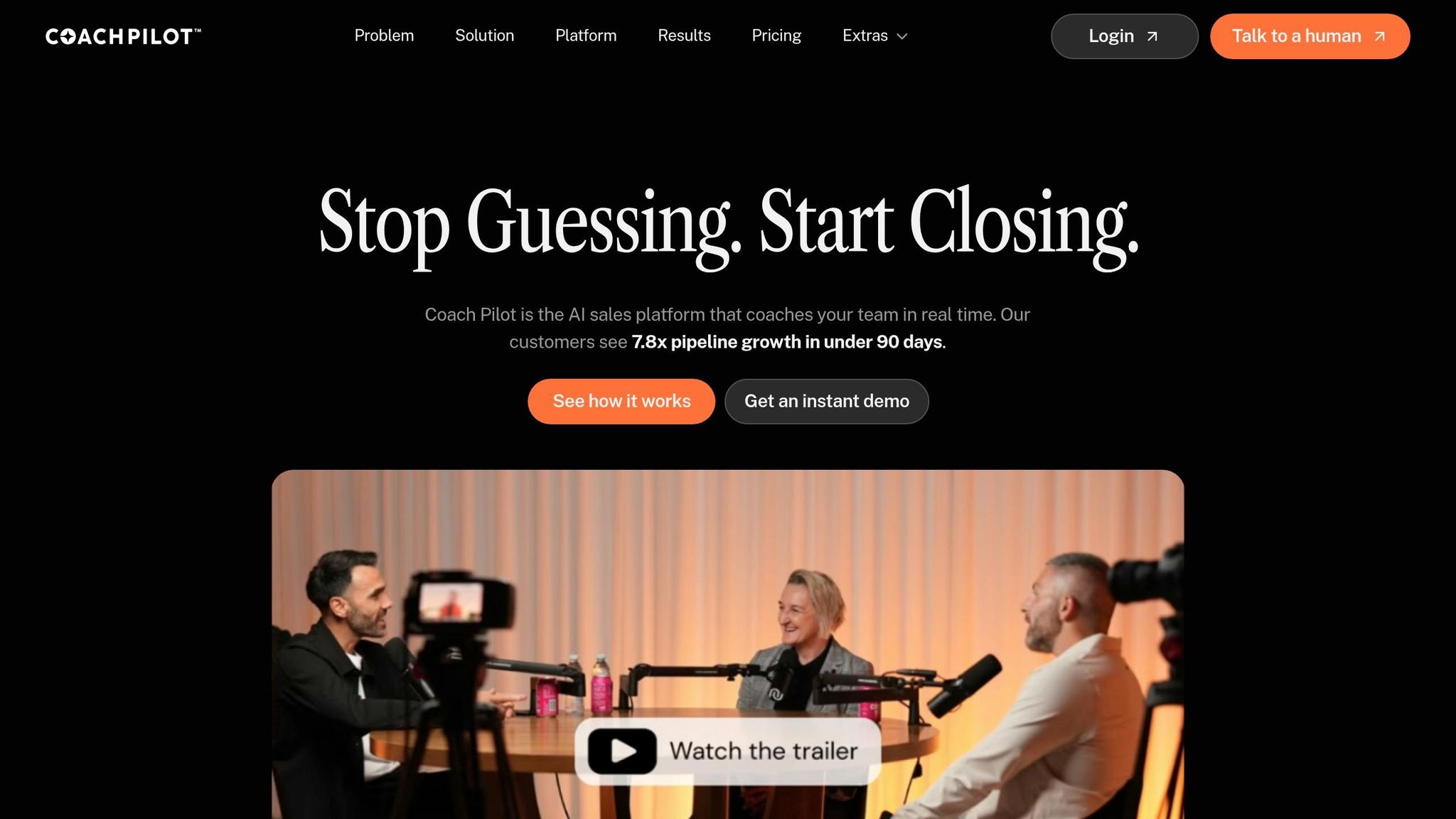
Coach Pilot brings AI into your sales process, turning your strategy into a dynamic playbook that ensures every deal is handled with precision and consistency [17].
Custom Sales Playbooks for Qualification
Coach Pilot takes your organization’s unique sales process - everything from messaging and deal stages to handling objections and proof points - and transforms it into a repeatable, AI-powered strategy [17]. Unlike static PDFs, these playbooks are dynamic, continuously updating with best practices and integrating directly into daily workflows. Through AI coaching, they help teams replace generic outreach with personalized, value-driven communication. The results? Organizations report 7.8x pipeline growth in less than 90 days and see 39% higher quota attainment [17].
"We turn your best sales practices into an AI-powered system that guides every deal." – Coach Pilot [17]
Before launching AI tools, it’s crucial to audit your existing sales materials. By training the system on your most effective strategies, you’ll set the stage for higher adoption rates and better outcomes from day one [17]. This foundation allows the AI coach to step in with real-time guidance in the next phase.
AI-Driven Real-Time Coaching
Coach Pilot’s AI coach takes execution to the next level. Unlike traditional conversation intelligence tools that only analyze past calls, this AI provides actionable recommendations for what to do next. It identifies patterns - like when to loop in executives or how to manage procurement hurdles - and scales this expertise across your team [17]. For example, it might suggest:
"Email the CFO by Thursday with tailored messaging and call the economic buyer on Friday", minimizing delays and keeping deals on track. – Coach Pilot [17]
The AI coach adapts its guidance in real time, using live data to adjust recommendations as deal conditions evolve. It also automates tedious tasks like CRM updates, saving reps an average of 19.5 hours per week [17]. This not only frees up time for more strategic work but also ensures greater data accuracy - critical in a world where 76% of CRM users believe less than half of their data is reliable [4].
Integration into Existing Workflows
Coach Pilot fits seamlessly into the tools your team already uses, such as Microsoft Teams, Salesforce, and HubSpot [17]. The AI coach is available around the clock, providing guidance no matter where reps are working. Additionally, the platform adheres to strict security standards like SOC2 and ISO27001, making it a trusted choice for industries with high regulatory demands, such as finance and healthcare [17].
Conclusion
AI takes hours of manual research and turns it into a task that can be completed in minutes. Instead of relying on static data points, AI zeroes in on dynamic behavioral signals like visits to pricing pages, email interactions, and committee-level engagement [1][18]. This shift delivers a major boost in accuracy - organizations using AI achieve qualification rates of 40–60%, compared to just 15–25% with manual methods [1].
The time savings are just as impressive. Tasks that might take 2–3 hours per prospect manually can be wrapped up in just 2–3 minutes with AI [1]. And this speed isn’t just about convenience - it’s about results. Sales reps using AI are 3.7 times more likely to meet their quotas, while organizations see 43% higher win rates and 37% faster sales cycles [19].
AI also excels in real-time intent detection, helping teams instantly identify and engage with qualified prospects. With 60% of high-intent buyers expecting a response within an hour [18], speed is critical. By removing the bottlenecks of manual processes, AI enables teams to scale their qualification efforts without needing to hire more staff [1].
FAQs
What data does AI need to score leads well?
AI relies on a blend of behavioral, firmographic, technographic, and contextual data to accurately score leads. This includes real-time behavioral cues like website visits and engagement trends, firmographic details such as company size and industry, and technographic information about the tools and technology a company uses. Additionally, historical interaction data plays a key role. By combining all these inputs, AI can analyze signals dynamically, leading to more precise lead scoring and better prioritization.
How can we prevent AI lead scoring from adopting our team’s biases?
To keep AI lead scoring free from team biases, start by ensuring that your training data is unbiased, clean, and accurately represents real buyer behavior. Regular audits and updates of both your data and models are crucial for spotting and addressing any bias that might creep in. Incorporate a variety of data sources to avoid over-reliance on subjective opinions, and closely monitor AI predictions to identify any questionable patterns. These practices help uphold objectivity and improve the accuracy of your lead scoring efforts.
How long does it take to implement AI deal qualification in a CRM?
Implementing AI to streamline deal qualification in a CRM usually takes 3 to 5 weeks. During this period, several key steps are involved:
Connecting your CRM and lead sources: Ensuring all data flows seamlessly into the system.
Configuring qualification criteria: Defining the specific factors that determine lead quality.
Setting up automated workflows: Creating processes that handle leads without manual intervention.
Defining scoring thresholds: Establishing the benchmarks for lead prioritization.
Deploying the AI system: Activating and integrating the AI into your CRM.
With a well-thought-out plan, this process can be completed smoothly within the given timeframe.
Related Blog Posts

Remove the guesswork from winning more deals.