B2B Sales
How to Spot Sales Cycle Bottlenecks with AI
Mar 6, 2026
AI pinpoints stalled deals by tracking deal age, pipeline velocity, and communication signals, sending real-time alerts and coaching to resolve bottlenecks fast.

85% of B2B companies miss sales forecasts by more than 5%. Why? Sales cycle bottlenecks. These hidden delays - caused by slow follow-ups, internal approvals, or stalled deals - can cut closures by 20-30% and derail revenue goals. Traditional CRM tools often miss these issues, but AI changes the game.
AI analyzes deal velocity, email sentiment, and stage progression in real time to flag at-risk opportunities before they fail. For example, deals stalled for over 28 days see a 67% drop in conversion rates, but addressing them within 72 hours reduces failure rates to 28%. Key metrics like pipeline velocity, deal age, and stage duration help pinpoint where deals are stuck.
AI tools also provide real-time alerts, predictive analytics, and personalized coaching to resolve bottlenecks faster. By automating tasks and improving team alignment, companies report faster deal cycles, improved forecast accuracy, and up to 7.8x pipeline growth.
If your sales team struggles with stalled deals or missed forecasts, AI can help identify and fix bottlenecks, keeping your pipeline moving and revenue growing.
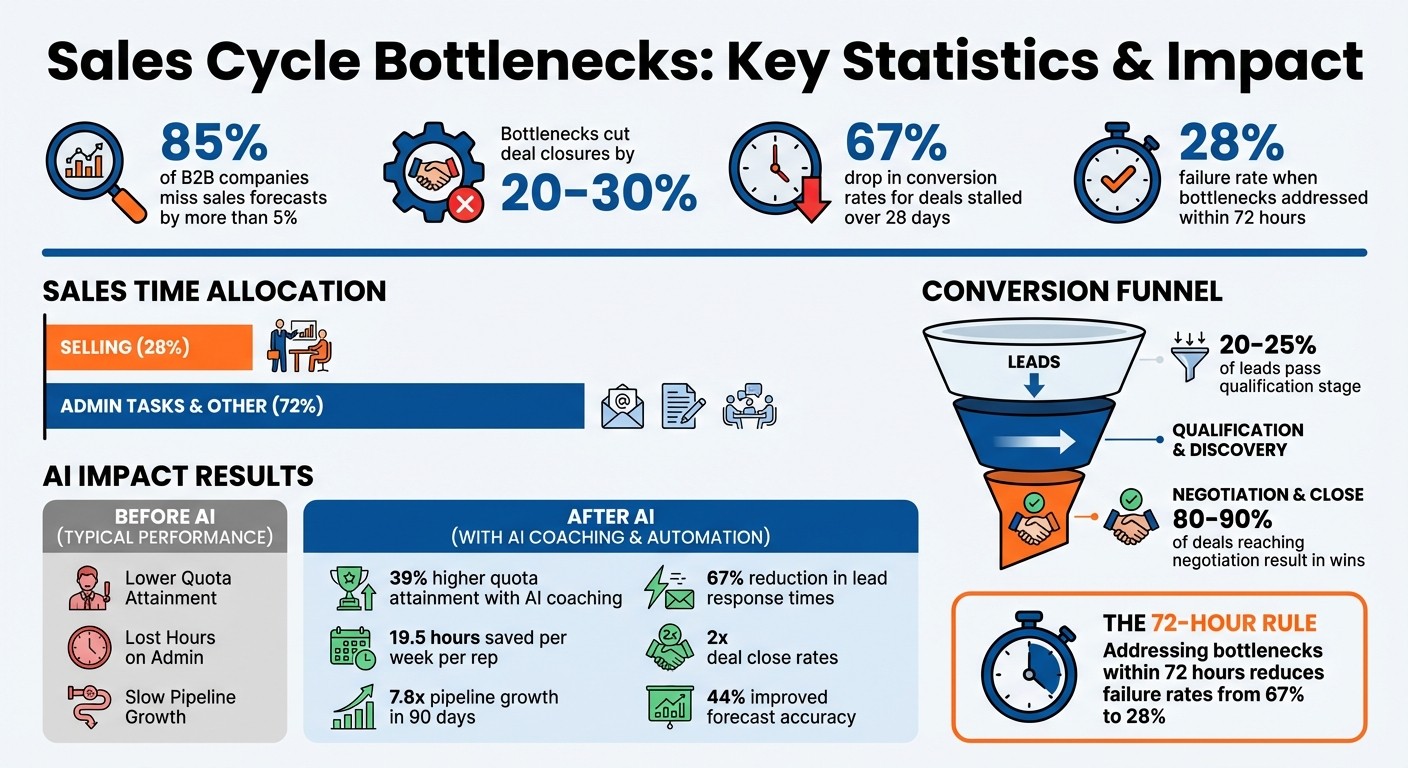
Key Sales Cycle Bottleneck Statistics and Impact Metrics
A Day in the Life of a Sales Leader with AI
What Are Sales Cycle Bottlenecks?
A sales cycle bottleneck occurs when deals get stuck because resources, information, or decisions fail to move forward [6][2]. Think of it like a traffic jam - one blockage halts progress, causing everything behind it to grind to a halt. The result? Your sales team struggles to keep operations flowing smoothly.
Even a single bottleneck can have a big impact, cutting deal closures by 20-30% [6]. Beyond that, it can mess with sales forecasts, lower team morale, and erode customer trust [6][2]. When deals stall, prospects start to lose faith, and competitors are quick to swoop in.
"Internal bottlenecks are silently killing your momentum while competitors circle." - Victoria Myers, Vivun [6]
To tackle bottlenecks, it’s crucial to understand where they happen within the sales cycle.
The Sales Cycle and Its Stages
The sales cycle follows a series of predictable stages: lead generation, qualification, discovery, proposal, negotiation, and closing. Each stage demands specific actions, decisions, and smooth transitions between team members. Interestingly, while only about 20-25% of leads make it past the qualification stage, 80-90% of deals that reach the negotiation stage typically result in a win [2].
However, certain stages are more prone to bottlenecks. For example:
The lead-to-SQL (sales-qualified lead) stage often suffers from poor targeting and slow responses [7].
Midway through the funnel, deals can stall during technical validation when Sales Engineers are stretched too thin [6].
At the final stages, proposal and negotiation can drag on due to lengthy internal approval processes involving departments like legal, finance, or leadership [1][5].
What Causes Bottlenecks
Bottlenecks arise for many reasons, often tied to specific stages of the sales cycle. Here’s a closer look at common causes:
Delayed follow-ups and poor communication: Prospects lose interest fast. In fact, 53% of sales professionals say selling has become harder over the past year [5].
Internal approval delays: Deals can get stuck in "contract limbo" while waiting for legal reviews or pricing approvals [5][6].
Overloaded technical resources: When Sales Engineers or other specialists are overwhelmed, critical validations are delayed, slowing progress [6].
Team misalignment: Sales, marketing, and product teams working in silos often fail to communicate effectively. This leads to inconsistent messaging and dropped handoffs, frustrating both teams and prospects [6].
Time-sapping admin tasks: Sales reps spend just 28% of their time actually selling, with the rest eaten up by manual data entry and other administrative work [7].
Here’s a breakdown of common bottlenecks, their causes, and the impact they have:
Understanding these sticking points is the first step to keeping your sales cycle moving smoothly.
Metrics That Reveal Sales Cycle Bottlenecks
Understanding where your sales cycle slows down is key to keeping deals on track. Certain metrics can spotlight these bottlenecks, allowing you to act quickly and prevent disruptions to your forecast.
Pipeline Velocity and Deal Age
Pipeline velocity provides a snapshot of your daily revenue potential by combining four key factors: the number of opportunities, average deal size, win rate, and sales cycle length. The formula is straightforward: (Number of Opportunities × Average Deal Size × Win Rate) / Sales Cycle Length. A drop in velocity often signals that one or more of these areas - like deal size or cycle duration - needs attention.
Deal age, on the other hand, measures how long opportunities linger in your pipeline. This metric is particularly useful for identifying "ghost deals" - those that have shown no activity for weeks but still inflate your pipeline value. Ideally, your stall rate should stay below 20%. If it climbs higher, your forecast accuracy could take a hit.
Time is critical here. Deals stalled for more than 28 days see a 67% drop in conversion rates, with each additional day between days 21 and 35 reducing the chances of success by 2.3% on average. And if a deal shows three or more red flags - like no activity for over a week, no contact with decision-makers, or a prolonged deal age - it’s 89% likely to fail.
"A deal that's been in 'proposal' for 45 days when the average is 15 days is almost certainly stalled, even if the rep insists it's 'moving forward.'" - Semir Jahic, CEO, Salesmotion [9]
Industry-specific thresholds vary. For example, in SaaS, deals stalled for 24 days are already concerning, with win rates dropping by 30–40%. By day 36, the situation becomes critical. In manufacturing or financial services, these danger zones typically occur around 50–60 days.
Conversion Rates and Stage Progression Times
Stage conversion rates help pinpoint where leads fall off in your pipeline. For instance, only 20–25% of leads typically move past initial qualification, while 80–90% of deals that reach final negotiation stages tend to close. A sharp drop at any stage could signal issues like pricing objections, competitive challenges, or poor stakeholder alignment.
Stage duration measures how long deals stay in each step of the process. If deals regularly exceed the median time in a specific stage, such as during legal reviews or proposal discussions, you’ve likely found a bottleneck. Additionally, tracking the slippage rate - when expected close dates keep getting pushed back - can reveal forecasting issues or misaligned buyer timelines.
Watch out for stage bloating, where a large portion of your pipeline value gets stuck in a single stage, often "Proposal" or "Business Case." These "parking lots" can give a false sense of progress while hiding underlying issues.
Lead Scoring Accuracy
Lead scoring accuracy ensures your team focuses on the right opportunities. Using AI-driven predictive scoring, based on historical data, helps prioritize leads that are most likely to convert and prevents wasted effort on low-potential prospects.
AI analytics can boost forecast accuracy by up to 43%, while a thorough pipeline review can improve forecast reliability by 30–40% [3][2]. For example, Analytic Partners saw a 40% year-over-year increase in their qualified pipeline by integrating account intelligence into their pipeline reviews. This allowed managers to focus their coaching on deals with strong buyer readiness signals [9].
The 72-hour rule is a useful benchmark: addressing bottlenecks within 72 hours of detection can reduce failure rates from 67% to 28% [8]. This highlights the importance of real-time monitoring over periodic reviews, giving you the agility to act when it matters most.
Using AI Tools to Find and Fix Bottlenecks
AI tools go beyond just reporting - they spot patterns in data that hint at potential roadblocks before they fully develop. Instead of waiting for delays to happen, these systems predict bottlenecks and offer actionable recommendations to keep things moving smoothly. Let’s dive into how predictive analytics helps pinpoint when and why bottlenecks occur.
AI Predictive Analytics for Bottleneck Forecasting
Predictive models work by analyzing historical data to uncover patterns that often lead to delays. For instance, AI might notice that deals with enterprise clients in the financial services sector frequently slow down during the legal review process. Recognizing these patterns early allows you to make adjustments before the deal gets stuck.
One effective approach is monitoring "stage overstay." This involves comparing the time a deal spends in a specific stage to the median time for similar deals that were successfully closed [11]. Predictive models also factor in deal-specific details like company size, industry, and the makeup of the buying committee to anticipate where friction is likely to occur [5].
In 2025, a SaaS team leveraged AI-powered automation and analytics to achieve impressive results: they reduced lead response times by 67%, doubled their deal close rates, and improved forecast accuracy by 44%.
Real-Time Monitoring and Alerts
Real-time monitoring takes the guesswork out of identifying bottlenecks by keeping tabs on pipeline velocity, engagement levels, and stage progress. For example, if a deal hasn’t seen activity for seven days or if buyer-initiated interactions suddenly drop, the system sends out instant alerts [10].
These alerts focus on key indicators, such as deals lingering longer than expected in a stage [11] or a noticeable lack of engagement across multiple decision-makers [4]. Tools like Coach Pilot integrate these monitoring capabilities directly into sales workflows, offering AI-driven coaching prompts to help sales reps act quickly when pipeline momentum slows.
"69% of sales operations leaders say forecasting is harder than it was three years ago." - Gartner [11]
Communication and Activity Analysis
AI also analyzes communication patterns to uncover inefficiencies that might be slowing deals down. Using natural language processing (NLP) and sentiment analysis, these tools can detect changes in buyer tone, flagging signs of hesitation or reduced enthusiasm [1][11]. For instance, if a prospect shifts from sounding excited to cautious, the system flags it as a signal for immediate follow-up.
Activity analysis digs deeper by tracking the balance between buyer-initiated and seller-initiated interactions. When buyers stop reaching out and reps are the only ones driving the conversation, it’s a clear sign of a potential bottleneck [11]. AI also monitors "multithreading", alerting reps when engagement is limited to just one contact instead of involving other key decision-makers on the buying committee [11][4]. These insights enable reps to adjust their strategies in real time, re-engaging stakeholders or addressing objections before the deal loses momentum.
Fixing Sales Workflows with AI-Driven Coaching
Identifying bottlenecks in sales workflows is one thing - actually fixing them is where the challenge lies. AI-driven coaching platforms tackle inefficiencies by embedding guidance directly into daily workflows. Instead of waiting for quarterly reviews, these tools offer real-time support to keep deals progressing smoothly.
Custom Sales Playbooks and Training
AI has transformed static, outdated PDF playbooks into dynamic, workflow-integrated tools that sales teams can actually use.
Take Bureau, for example. By combining automation with coaching reinforcement, they enhanced their discovery process, leading to a 30% increase in deal conversions in 2025 [13]. The secret? Moving away from generic, one-off training sessions and focusing on targeted, continuous reinforcement. This approach helped build lasting execution habits. Live workshops now complement this system, emphasizing skill reinforcement instead of simple memorization.
Beyond better playbook integration, AI-driven feedback takes sales techniques to the next level.
AI-Driven Feedback and Coaching
AI coaching platforms analyze calls and emails to identify skill gaps and provide personalized coaching tips [16]. Unlike basic conversation intelligence tools that summarize calls, solutions like Coach Pilot offer real-time guidance. They provide actionable advice, such as suggesting specific talking points or recommending the best timing for follow-ups.
Teams using AI coaching see impressive results: a 39% higher quota attainment and an average of 19.5 hours saved per week per rep by automating tasks like CRM updates and call summaries [12]. Companies with structured coaching processes also report 28% higher revenue growth and a 15% increase in win rates [15].
AI doesn’t stop there. It reviews call transcripts to uncover potential obstacles, such as missing stakeholders, unresolved budget concerns, or delays in procurement cycles [14]. Versa Networks, for instance, introduced AI-driven pipeline reviews in 2025, cutting the time managers spent on coaching in half while improving consistency across their global sales team [13]. By automating routine feedback, managers can focus on impactful coaching conversations, leaving the administrative grind behind.
In addition to real-time feedback, performance dashboards provide a big-picture view of sales activities and outcomes.
Performance Dashboards and Insights
AI-powered dashboards are the final piece of the puzzle, offering actionable insights to optimize workflows continuously. These dashboards track performance on both individual and team levels, identifying bottlenecks before they derail deals. They rely on behavior-based metrics like talk-to-listen ratios, customer sentiment, and multi-thread engagement, rather than simply measuring activities [15][17]. For example, if buyer engagement drops or emotional tone shifts, the dashboard flags the deal for immediate action.
Currently, sales reps spend only 24% of their time actively selling, with the rest eaten up by administrative tasks and meetings [13]. By automating these time-consuming activities, AI frees reps to focus on what truly matters - closing deals. This shift can lead to a staggering 7.8x pipeline growth within just 90 days of implementation [12]. The key? Removing execution bottlenecks and ensuring that effective strategies are applied consistently across the board.
Conclusion
Sales cycle bottlenecks don’t resolve themselves, and waiting too long can cost your team valuable opportunities. AI-driven insights give your team the tools to address these roadblocks quickly, leading to measurable improvements. For example, teams using AI coaching report a 39% increase in quota attainment and save an average of 19.5 hours per week on administrative tasks [18]. Plus, when deals stall for more than 28 days, conversion rates drop by 67% - but acting on AI alerts within 72 hours can slash failure rates to just 28% [8]. These numbers highlight how real-time coaching and actionable insights can make a massive difference.
Coach Pilot integrates AI-powered coaching directly into your team’s workflows, offering tailored guidance on the next best steps - like emailing the CFO by a specific deadline or reaching out to key stakeholders [18]. It also eliminates the hassle of administrative tasks by automatically capturing critical deal data, making it easier to pinpoint where progress is stalling.
By scaling the strategies of your top performers, Coach Pilot ensures consistent execution across the board. The results are hard to ignore: customers have reported 7.8x pipeline growth in less than 90 days by addressing bottlenecks and focusing their teams on high-impact activities [18].
If your team struggles to move from identifying bottlenecks to resolving them, AI-driven coaching can be the game-changer you need. It’s a solution designed to turn missed opportunities into consistent wins, paving the way for steady revenue growth. Embrace AI-driven sales coaching and watch as bottlenecks transform into opportunities for faster, more reliable success.
FAQs
What data does AI need to spot sales bottlenecks?
AI thrives on data like deal progression, communication trends, lead qualification details, follow-up activity, and sales performance metrics. By processing this information in real-time, it can spot exactly where deals hit a snag - whether it's due to weak lead qualification or delays in follow-ups. It also assesses how sales reps perform and examines the pipeline stages to uncover inefficiencies. This insight helps teams tackle bottlenecks, sharpen forecast accuracy, and speed up the pace of closing deals.
Which sales-cycle metrics should I track first?
To truly understand how your sales process is performing, keep an eye on metrics that shed light on deal progression, pipeline health, and potential bottlenecks. Some of the most important ones to track include:
Sales cycle length: How long it takes to close a deal from start to finish.
Deal velocity: The speed at which deals move through your pipeline.
Pipeline coverage: The ratio of your pipeline value to your sales target.
Stage conversion rates: The percentage of leads that successfully move from one stage to the next.
Lead qualification quality: How well your leads align with your ideal customer profile.
These metrics aren’t just numbers - they’re tools that help you spot delays, identify where deals are stalling, and uncover gaps in your pipeline. With this insight, you can use AI-driven strategies to fine-tune your sales process for better results.
How fast should my team act after an AI bottleneck alert?
When your team gets an AI bottleneck alert, it's important to act right away. Taking action within minutes can make a big difference, helping to avoid delays in deals and potential revenue loss. Quick responses not only keep the sales process moving smoothly but also lower the chances of sales stalling. Addressing these alerts promptly ensures your team stays on track and maintains momentum.
Related Blog Posts

Remove the guesswork from winning more deals.