B2B Sales
Sales Forecasting Accuracy: 5 Common Mistakes to Avoid
Feb 5, 2026
Fix bad CRM data, reduce bias, standardize stages, modernize tools, and track accuracy—use AI and process changes to make forecasts reliable.

Sales forecasts are often wrong, with 79% of organizations missing their targets by over 10%. This leads to wasted resources, poor decisions, and lost revenue. The good news? You can improve accuracy by avoiding five common mistakes:
Using bad or incomplete data: Missing deal amounts or close dates can skew predictions, costing millions. AI tools can fix 95% of these issues and improve accuracy by 25% in 90 days.
Relying on gut feelings: Sales reps often overestimate or underestimate deals. AI-driven insights reduce bias and identify at-risk deals weeks earlier.
Inconsistent pipeline stages: Misaligned definitions create bloated pipelines. Standardizing stages based on customer actions improves reliability.
Outdated methods: Spreadsheets and manual tracking are prone to errors. AI tools analyze hundreds of deal signals, achieving up to 95% accuracy.
Not tracking accuracy: Without reviewing past forecasts, errors go uncorrected. Regular reviews and AI-powered feedback improve precision.
Companies with accurate forecasts are 10% more likely to grow revenue and 7% more likely to hit quotas. Start by cleaning your CRM data, defining clear pipeline stages, and leveraging AI tools for real-time insights.
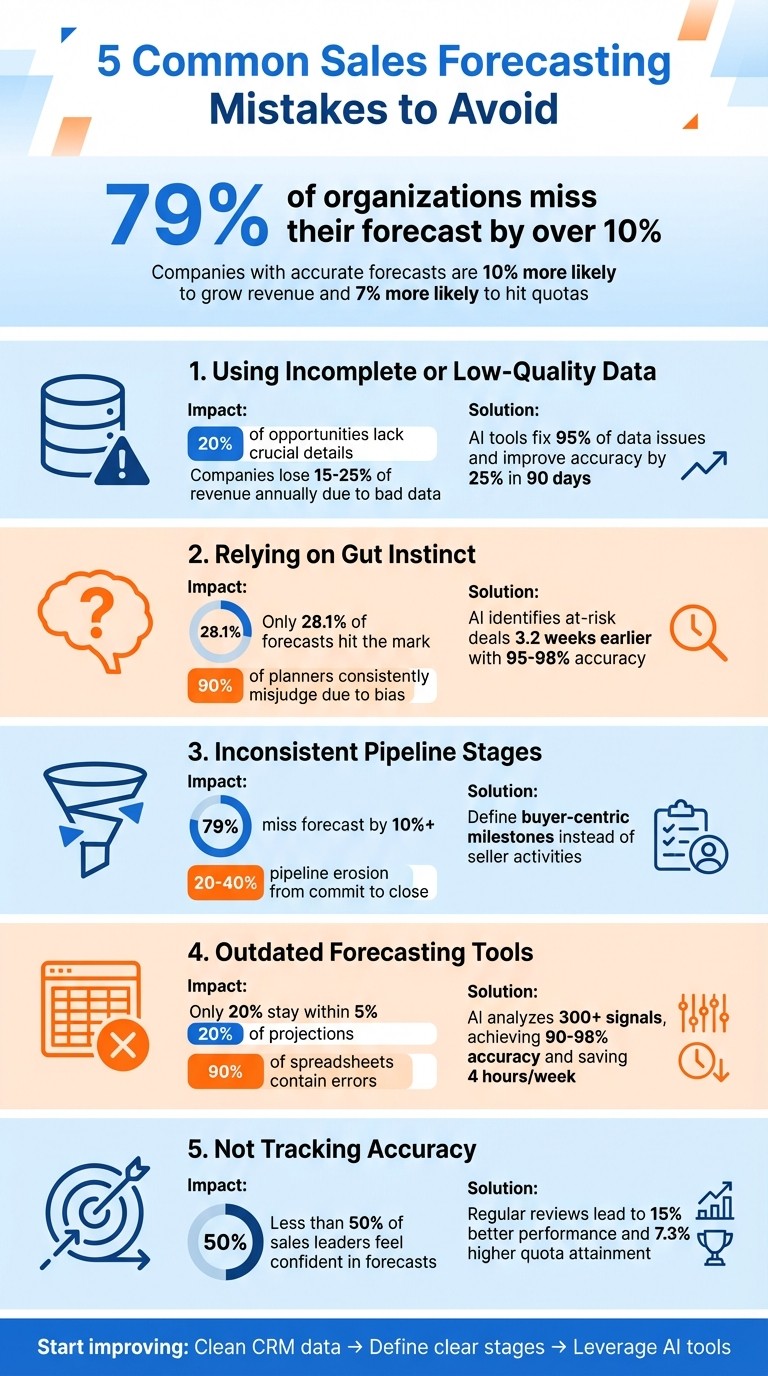
5 Common Sales Forecasting Mistakes and Their Impact on Revenue
The Three Biggest Mistakes in Forecasting (And How to Fix Them)
1. Using Incomplete or Low-Quality Data
The accuracy of your forecast hinges on the quality of the data you feed into it. When 20% of opportunities lack crucial details like amounts or close dates [6], the reliability of your predictions takes a hit. Experts often refer to the "Five Horsemen" of bad data to describe these challenges: Ghost Deals (missing amounts), Timeless Wonders (missing close dates), Walking Dead (deals that endlessly slip), Fossil Records (outdated opportunities), and Lone Wolves (deals with no activity) [6]. Tackling these issues is essential to build a dependable, AI-powered forecasting system.
Impact on Forecast Precision
Missing or incomplete data doesn’t just skew forecasts - it can cost you big. For example, if 10% of deals in a pipeline of 1,000 lack amounts, your forecast could be undervalued by millions [6]. Poor data quality also takes a financial toll, with companies losing between 15% and 25% of their revenue every year due to bad data [4]. This leads to wasted resources and strategic missteps [6].
"Bad data is worse than no data at all." - Forecastio [6]
What’s worse, many forecasting systems overlook a treasure trove of predictive insights buried in "dark data" - like call notes, email sentiment, and meeting transcripts [8]. Relying solely on surface-level CRM fields means missing out on critical buyer signals that can forecast deal outcomes. To close this gap, modern AI tools are key.
Reliance on AI-Driven Solutions
Advanced AI tools can transform forecasting by capturing 99% of customer interactions, analyzing unstructured data, and automatically updating CRM fields. These tools can identify deal risks 3.2 weeks earlier and resolve over 95% of data issues [12][15][6].
Ease of Implementation
Getting started with AI doesn’t have to be complicated. Begin by automating data monitoring to flag inconsistencies, such as deals missing key details or showing 30+ days of inactivity - a red flag, as these deals are 80% less likely to close [4]. Companies that implement automated data integrity reports often see a 25% boost in forecast accuracy within the first 90 days [6]. To maintain high data quality, make key CRM fields mandatory and incorporate data integrity metrics into performance reviews. Gamifying this process can also help balance the focus on data entry with the pressure to close deals [6].
2. Relying Too Much on Gut Instinct and Sales Rep Opinions
Sales reps often bring optimism to the table, but their assessments can lack measurable evidence, leading to distorted revenue forecasts. For instance, reps may keep deal probabilities at 90%, even after weeks of no communication from the buyer, driven by overly positive biases [8]. This highlights the importance of incorporating objective, AI-driven insights into the forecasting process.
Impact on Forecast Precision
Sales forecasts are notoriously inaccurate - only 28.1% come close to hitting the mark. This happens because reps either "sandbag" (lowering expectations to outperform later) or make "hero commits" (promising outcomes they can’t deliver) [16][2]. Without solid evidence, such as buyer-confirmed close dates or mutual action plans, these forecasts fall apart [2].
"Feelings – positive or negative – really just add up to guesswork rather than measurable data." - Salesforce [9]
When forecasts rely heavily on gut feelings, businesses face real consequences. They might over-hire based on inflated pipeline numbers or scramble to recover from unexpected revenue gaps. Poor data quality alone costs companies between 15% and 25% of their revenue annually [3][4]. Additionally, nearly 90% of Demand Planners consistently misjudge forecasts due to unconscious biases, either overestimating or underestimating [16].
Reliance on AI-Driven Solutions
AI-powered forecasting tools can analyze over 300 contextual signals - like email sentiment, stakeholder engagement, and communication frequency - offering insights that human intuition often misses [15]. These tools can identify at-risk deals an average of 3.2 weeks earlier than manual methods, boosting accuracy to an impressive 95% to 98% within 90 days [15]. Companies with precise forecasts are 10% more likely to grow revenue year-over-year and 7% more likely to meet quotas [4].
A great example is RUCKUS Networks, which saved $2 million annually by using AI to detect pipeline risks early, rather than discovering gaps during last-minute end-of-quarter reviews [10]. When AI flags a deal as 45% likely to close, while a rep insists it’s at 80%, this discrepancy becomes a valuable coaching opportunity [10]. However, making these insights actionable requires clear definitions and accountability in the forecasting process.
Ease of Implementation
The first step is to define what "Commit" means in your organization. Replace vague percentage guesses with concrete evidence, such as contracts in legal review or buyer-confirmed dates [15][2]. Monitor individual reps to identify patterns - do they consistently over-forecast or under-forecast? Use these patterns to guide targeted coaching [2]. Implement a weekly forecast lock, where any changes afterward require a documented explanation and manager approval. This builds accountability into the process [2].
Switching from gut-based to data-driven forecasting doesn’t mean sidelining reps. Instead, it combines their experience with objective AI insights. Use AI-generated deal health scores as starting points for pipeline discussions, not as substitutes for human judgment [10]. This balanced approach shifts forecasting from a subjective exercise to a more reliable, data-informed process.
3. Allowing Inconsistent Pipeline Stage Definitions
When your sales team doesn’t have a shared understanding of what each pipeline stage represents, your forecasting becomes unreliable. One rep might classify a deal as "Negotiation" after sending a proposal, while another waits until legal review begins. This lack of alignment leads to distorted signals and a bloated pipeline. The result? Miscommunication and forecasts you can’t trust.
Impact on Forecast Precision
Here’s the reality: 79% of sales organizations miss their forecast by more than 10%, and only 15% land within 5% of actuals [3][14]. Without clear criteria for moving deals through stages, pipelines become clogged with stalled opportunities. This makes your revenue projections look better than they really are [18].
"If you fail to define the milestones of the purchase journey, your salespeople won't be speaking the same language. And that inevitably distorts your forecast." – Salesforce [9]
Teams with inconsistent pipeline definitions often see 20-40% erosion from their initial commitments to what actually closes [17]. If your stages are based on seller activities (like "sent proposal") rather than buyer actions (like "legal review initiated"), you’re measuring internal effort instead of the customer’s buying journey. This mismatch corrupts your data and reduces the effectiveness of AI tools [17].
Reliance on AI-Driven Solutions
Just like other data quality issues, inconsistent stage definitions need strong AI support. For example, 67% of sales opportunities lack complete qualification fields due to manual entry [15]. AI can help by analyzing conversations - calls, emails, and even Slack messages - to fill in missing details. These systems can identify "ghost deals" (missing amounts) and "timeless wonders" (missing close dates) caused by unclear stage definitions [6]. AI can also flag at-risk deals up to 3.2 weeks earlier than traditional manager reviews, but only if your CRM data is consistent [15].
Ease of Implementation
The solution starts with defining buyer-centric milestones - specific, observable actions your customer takes rather than tasks completed by your team [17][18]. For example, a deal shouldn’t move to "Negotiation" without documented proof of value and engagement from an economic buyer [2].
Separate your review processes to maintain focus. Conduct weekly "Pipeline Reviews" to ensure data hygiene - checking that deals meet stage criteria - separately from "Deal Reviews", which focus on strategy [17]. Keep an eye on time-in-stage as a loss predictor: if a deal stays in one stage 1.5x longer than your median without activity, flag it automatically [15][4]. This approach shifts forecasting from guesswork to a data-driven process, helping you make informed decisions about hiring and investments.
Relevance to Sales Process Improvement
Clear, consistent stage definitions do more than improve forecast accuracy - they drive accountability across your entire revenue operation. When everyone speaks the same language, trends become easier to spot. Which stages see the most drop-offs? Where do deals tend to stall? Companies with accurate forecasting grow revenue 10% faster than those with poor habits [14]. Standardizing pipeline definitions isn’t about adding red tape - it’s about creating a solid framework for predictable, scalable growth.
4. Using Outdated Forecasting Tools and Methods
Relying on spreadsheets and manual forecasting can give a misleading sense of control. The reality? The moment you save that Excel file, it's already outdated. Deals change, conversations evolve, and suddenly, your "single source of truth" becomes a tangle of conflicting versions [9]. Instead of clarity, you’re left with confusion.
This outdated approach creates a domino effect of errors, throwing off forecasting accuracy and leaving your team scrambling.
Impact on Forecast Precision
The numbers don’t lie: only 20% of sales organizations manage to stay within 5% of their projections when using traditional methods. Worse, around 90% of forecasting spreadsheets contain errors [19]. These methods often rely on subjective judgments and can predict if a deal might close - but not when. This leads to unexpected revenue delays, with deals slipping into later quarters [4].
Then there’s the issue of incomplete data. Manual entry only catches about 40% of data issues, and 67% of opportunities are missing critical details like next steps or key decision-makers [6][15]. Without the right context, you’re left sifting through low-value alerts while missing the real red flags.
The Shift to AI-Driven Solutions
Modern AI-powered tools bring a whole new level of precision. Instead of just scanning for keywords, these systems analyze over 300 contextual signals - things like sentiment changes, engagement patterns, and language that signals commitment [15]. AI tools also capture data automatically by tracking calls, emails, and even Slack messages. This eliminates the need for managers to spend over 6 hours a week piecing together deal histories [15].
AI takes human bias out of the equation by relying on objective historical data rather than gut instincts. It doesn’t just predict whether a deal will close; it also forecasts the exact month it’s likely to close [13][4].
"Before implementing our new forecasting process, we were essentially guessing. Now, we have data-driven confidence in our numbers, which has transformed how we run the business." – Sarah Johnson, CRO [4]
The results speak for themselves. Companies that switch to automated forecasting tools see a 20%+ improvement in accuracy compared to manual methods. The best AI systems achieve accuracy rates of 90–98% [4][15]. These tools also identify at-risk deals 3.2 weeks earlier than manual reviews by spotting drops in engagement or weakening commitment language [15].
Beyond accuracy, AI simplifies the entire forecasting process.
Ease of Implementation
Switching from outdated tools doesn’t have to be overwhelming. A gradual approach works best. Start with a 90-day plan: clean up your data, standardize your forecasting stages, and then roll out AI-powered automation with real-time updates [15][4]. Replace static monthly reports with continuously updated insights [20][11].
Built-in features like automated flags for "ghost deals" (missing amounts) and "timeless wonders" (missing close dates) help prevent inflated pipelines [6]. AI can also track deal velocity - if a deal lingers in one stage 1.5x longer than usual, it’s flagged automatically [15]. These changes transform forecasting into a seamless, data-driven process that works in the background.
Relevance to Sales Process Improvement
Accurate forecasting impacts more than just your numbers - it reshapes how you run your business. Companies with reliable forecasts are 10% more likely to grow revenue year-over-year and 7% more likely to hit quota [4][19]. This accuracy enables smarter decisions about hiring, marketing budgets, and product investments, so you’re not blindsided by surprises at the end of the quarter.
Modern tools also free up valuable time. By reducing forecast prep from 6 hours to just 2 hours a week, managers gain 65% more time to coach their teams and focus on strategic deals [15]. Shifting from manual data entry to automated intelligence lets your team concentrate on selling, not reporting - giving you a competitive edge.
5. Not Tracking or Adjusting Forecast Accuracy Over Time
Creating a forecast is just the beginning. If you’re not monitoring how accurate those predictions are, you’re missing the feedback needed to improve. The result? 79% of sales organizations miss their forecast by more than 10% [3]. Even worse, fewer than 50% of sales leaders feel confident in their own forecasts [3]. Without ongoing adjustments, the entire process - setting targets, refining strategies, and improving outcomes - falls apart.
Impact on Forecast Precision
Skipping accuracy tracking turns forecasting into guesswork. Without data on past performance, your team can’t engage in forecast calibration - adjusting future projections based on previous errors [3]. For instance, if forecasts consistently overshoot by 15%, applying a 0.85 correction factor can bring them closer to reality. Without this feedback loop, you’re stuck reacting to problems rather than preventing them, which can lead to resource mismanagement and cash flow headaches.
The numbers back this up. Companies that regularly review forecast accuracy see 15% better sales performance on average [3]. Accurate forecasts also make organizations 7.3% more likely to hit their quotas [5]. In contrast, inaccurate predictions lead to over-hiring (draining budgets) or under-hiring (stifling growth). Repeated misses also erode trust with executives, finance teams, and investors [3].
Reliance on AI-Driven Solutions
AI-powered tools take forecasting to the next level by not only predicting outcomes but learning from them. These systems track metrics like MAPE (Mean Absolute Percentage Error) and Forecast Bias, helping identify whether specific reps or teams consistently overestimate or underestimate results [3][2]. With AI, forecast accuracy can improve by 20–30%, with top systems achieving 95–98% accuracy [3][4][15]. High-performing organizations aim for at least 85% accuracy [4].
AI platforms also provide explainable insights, revealing why a forecast shifted - whether it’s due to declining email engagement, missing stakeholders, or less confident language [10]. This level of transparency allows you to identify at-risk deals 3.2 weeks earlier than traditional methods [15]. Instead of scrambling at the end of the quarter, you can address issues while there’s still time to make a difference.
By combining AI’s continuous feedback with disciplined tracking, you can make real-time adjustments that keep your forecasts on point.
Ease of Implementation
Start by focusing on a few key metrics: Forecast Accuracy % (how close forecasts are to actual results), MAPE (average error across time periods), and Forecast Bias (whether you’re consistently over or under) [3]. Conduct weekly reviews instead of waiting until the end of the quarter when it’s too late to fix anything [3][2]. Keep an audit trail that logs changes to forecasts - who made them, what changed, and why. This builds accountability and helps uncover patterns of bias [2][14].
Here’s a real-world example: In 2022, Atlassian improved its forecast accuracy from 65% to 87% in just two quarters by focusing on structured data and moving from static monthly snapshots to real-time updates. This shift also shortened their sales cycle by 12 days [6].
Relevance to Sales Process Improvement
Tracking forecast accuracy isn’t just about better numbers - it’s about running a smarter business. By analyzing why certain deals succeeded or failed, you can refine your probability models and tighten stage exit criteria [1][8]. For example, you might identify "stage thrash" (deals bouncing between stages) or spot shrinking deals after a "verbal commit." This insight allows you to strengthen qualification frameworks like MEDDIC [8][2]. Paired with AI’s ability to flag at-risk deals, tracking accuracy creates a stronger, data-driven foundation for your sales process.
"Without data, you're just another person with an opinion." – W. Edwards Deming [14]
Accurate forecasts also boost morale. When quotas are based on reliable data rather than guesswork, top performers stay motivated instead of being discouraged by unrealistic targets [3]. With better numbers, you’ll spend less time defending your forecasts and more time executing strategies - empowering your team with the confidence and autonomy to succeed.
Conclusion
Sales forecasting isn't about guessing - it's about making informed decisions that drive results. The five mistakes we discussed - incomplete data, gut-feel forecasting, inconsistent pipeline definitions, outdated tools, and lack of tracking - can lead to costly issues. These include overspending on unnecessary hires, missing growth opportunities due to underinvestment, and losing credibility with stakeholders. Fixing these problems is essential for dependable revenue planning.
When these errors are addressed, businesses can shift from uncertainty to actionable insights. Companies with accurate forecasts are 10% more likely to grow revenue year-over-year and 7% more likely to meet their sales quotas[4]. Automated, AI-driven tools can boost accuracy by 20% or more compared to manual methods, with top-performing teams achieving 90–95% accuracy[4]. This kind of precision can mean the difference between scrambling to react and executing with confidence.
"Sales forecasting is not about predicting the future; it's about making informed decisions today." – Chris Voss, Author[7]
To get there, start by cleaning up your CRM data, setting clear criteria for pipeline stages, and holding weekly forecast reviews with documented accountability. Then, take it a step further by adopting AI tools that monitor deal health in real time, identify risks before they escalate, and provide the transparency your team needs to trust the numbers. Coach Pilot brings AI coaching directly into your workflow, offering real-time insights and analytics to keep your team ahead of the curve.
FAQs
How do AI tools help improve the accuracy of sales forecasts?
AI tools improve sales forecasting by processing massive datasets to identify trends and patterns that might otherwise go unnoticed. They offer real-time insights into your sales pipeline, enabling more accurate and dependable predictions.
By automating the analysis process, AI minimizes the risk of human error and ensures forecasts are grounded in data-backed insights, not assumptions. This results in more precise projections, smarter decisions, and stronger support for revenue growth.
What are the risks of relying on outdated sales forecasting methods?
Relying on old-school sales forecasting methods can lead to wrong predictions, which can snowball into missed revenue chances and bad decisions. These errors might leave you with too much stock or not enough, mess up how resources are allocated, and create headaches for managing cash flow.
In today’s fast-moving business world, accurate forecasting is a must to keep up. Outdated techniques often overlook shifting market trends, evolving customer behaviors, and external influences - factors that can directly affect your profits and growth.
Why is it essential to have clear and consistent pipeline stage definitions?
Having clear and consistent pipeline stage definitions is key to keeping your sales forecasts accurate and your sales process running smoothly. When everyone on your team understands each stage the same way, it minimizes confusion and eliminates subjective interpretations.
Standardizing pipeline stages makes it simpler to track buyer behavior, monitor the progress of deals, and base decisions on solid data. This shared clarity not only improves forecast reliability but also strengthens team alignment, paving the way for smarter decisions and steady revenue growth.
Related Blog Posts

Remove the guesswork from winning more deals.