B2B Sales
How AI Improves Industry-Specific Revenue Accuracy
Mar 6, 2026
Industry-tailored AI models raise revenue forecast accuracy to 94–98%, cut errors and costs, and shorten cycles across SaaS, retail, finance and manufacturing.

AI-powered revenue forecasting is transforming how industries predict and manage revenue. By tailoring models to specific sectors, businesses achieve 94%–98% accuracy, compared to the outdated 67% average. This precision leads to better decision-making, higher ROI, and millions in financial gains. Key highlights include:
Customization is key: Generic models fail to account for industry-specific variables like SaaS subscription churn or manufacturing production cycles.
Real-world success: A German manufacturer cut its quote-to-cash cycle by 43%, while a SaaS company improved forecast accuracy by 35%.
Industry-specific results:
SaaS: Tracks metrics like Usage-based ARR (UARR) for spiky revenue patterns.
Retail: Reduces inventory losses by analyzing real-time demand factors.
Financial Services: Uses AI to uncover patterns, improving forecast accuracy to 93%.
Manufacturing: Streamlines supply chains, achieving up to 94% accuracy.
AI doesn’t just predict revenue - it optimizes processes, reduces errors, and drives growth. Businesses leveraging AI see shorter sales cycles, reduced costs, and more predictable outcomes.
AI in Predictive Revenue Forecasting | Exclusive Lesson
AI Revenue Forecasting by Industry
Tailored AI models are transforming revenue forecasting by addressing the unique challenges of specific industries. Generic models often fall short because they can't adapt to industry-specific metrics or variables. Below, we'll dive into four industries where customized AI solutions have significantly improved forecasting accuracy.
SaaS: Predicting MRR and ARR
Subscription-based businesses are moving away from simple seat-based contracts to usage-based pricing models, which makes their revenue patterns harder to predict. Traditional monthly forecasts fail when customer consumption varies daily. For example, Monte Carlo, a data observability company, highlighted this challenge:
"AI-native usage [is] 'spiky,' with unpredictable patterns that made traditional monthly forecasts unreliable" [8].
To adapt, they shifted to daily revenue tracking and gave their product team control over pricing to reflect real-time customer behavior [8].
AI helps SaaS companies monitor new metrics beyond Annual Recurring Revenue (ARR). These include CARR (Contracted ARR from fixed contracts), UARR (Usage-based ARR from real-time consumption), and AI ARR (revenue from GenAI features) [8]. Additionally, metrics like Time to Usage and Usage Ramp Rate allow companies to predict when customers will start generating revenue - offering a clearer picture of actual product consumption rather than relying on contract values alone. This approach boosts forecasting accuracy and aligns revenue predictions with real-world usage.
Retail: Demand Forecasting and Inventory Management
Retailers face massive losses - over $1 trillion annually - due to poor inventory management [7]. AI mitigates these losses by analyzing real-time data like weather, social media trends, local events, and economic indicators to predict demand more effectively. This shifts retailers from reactive ordering to proactive inventory planning.
For instance, Migros, a leading grocery retailer, adopted AI-driven forecasting across its network in April 2025. By managing 20 million inventory decisions daily, they reduced inventory days by 11% and increased product availability by 1.7% [9]. Similarly, Groupe Casino improved demand forecast accuracy by 30% using Vertex AI, while cutting model training time by 4x [7].
AI-driven supply chain forecasting can cut product unavailability by up to 65% [10] and reduce inventory holding costs by 25% [9]. These advancements not only minimize lost sales due to stockouts but also prevent markdowns caused by overstocking, directly improving revenue predictability.
Financial Services: Risk Reduction and Forecast Optimization
Traditional forecasting methods in financial services often miss non-linear patterns in data, leading to inaccuracies. AI-powered analytics, however, can uncover hidden relationships - like how website traffic might predict sales weeks in advance - that typical spreadsheet models fail to detect [7].
A global professional services company with over $20 billion in annual revenue used C3 AI CRM to analyze 50,000+ opportunities and 200 external data sources. This resulted in a bookings forecast accuracy of 93% on day one of each month, a significant improvement from their previous forecast error of 60%, which dropped to just 7% [11]. Such precision enables better resource allocation and reduces revenue loss from missed opportunities by improving revenue execution.
Companies leveraging AI forecasting are 1.5x more likely to outperform competitors [7], with AI reducing errors by 20% to 50% compared to traditional methods [7][10]. Additionally, AI completes analyses in minutes or hours, compared to the days or weeks required by older approaches [7].
Manufacturing: Supply Chain and Production Efficiency
Manufacturers face unique forecasting challenges, such as long production cycles, supply chain complexities, and facility capacity constraints. AI addresses these issues by streamlining "demand-to-delivery" processes, enabling leaner manufacturing and better warehouse management [10].
By integrating data from ERP systems, CRM platforms, and data warehouses, AI creates a unified source of truth, extending forecast visibility beyond 90 days. This allows manufacturers to plan production schedules and material procurement with greater accuracy [5]. Pharmaceutical and manufacturing firms, for instance, use AI to run thousands of "what-if" scenarios, helping them predict drug demand and optimize production levels through hyperparameter tuning [10].
Traditional B2B sales forecasting accuracy hovers around 47%, but advanced AI models can achieve 85% to 94% accuracy [3]. For manufacturers dealing with lengthy approval processes and intricate supply chains, these improvements mean fewer delays, lower inventory costs, and more dependable revenue forecasts.
How Coach Pilot Improves Forecast Accuracy with AI
Custom Sales Playbooks for Different Industries
Static playbooks often end up collecting dust because they fail to adapt to real-world scenarios. Coach Pilot changes the game by turning these into dynamic, actionable guides tailored to your sales strategy. It personalizes messaging, deal stages, objection handling, and proof points specific to each industry [12] [14].
For example, SaaS companies focused on usage-based revenue can rely on the platform to determine the right time to involve product teams or how to present consumption metrics during renewals. In manufacturing, it captures and scales the complex strategies that top performers use to navigate long procurement cycles and multi-stakeholder decisions. This isn’t guesswork - the AI identifies these patterns directly from deal data and shares them across your team [12] [14].
Coach Pilot’s custom-trained AI learns your business’s language and proven strategies. The results? Companies adopting this approach see 7.8x pipeline growth in just 90 days and achieve 39% higher quota attainment by replacing generic outreach with personalized, value-packed messages [12] [14]. This tailored method also paves the way for real-time coaching that delivers actionable insights exactly when they’re needed.
AI-Driven Real-Time Coaching for Sales Teams
Unlike tools that only provide post-call summaries, Coach Pilot offers real-time, actionable prompts like “Email the CFO by Thursday” or “Call the economic buyer Friday at 9:00 AM” [12].
This immediate feedback eliminates execution delays that often lead to inaccurate forecasts. When sales reps know exactly what to do and when to do it, deals move smoothly through the pipeline. Plus, the system automatically logs deal data and interaction history, reducing the need for manual CRM updates and removing the guesswork that can derail forecasting [12].
The results speak for themselves. In June 2024, Connor Bell, a BDM at HubSpot, saw a 50% increase in net new opportunities over 11 weeks, closing 12 deals and boosting quarterly revenue by 38% [15] [16]. Similarly, in May 2024, Naum Sekulovski at Food By Us secured 13 new contracts in just 9 weeks, driving a 45% jump in sales revenue [15] [16]. Organizations using AI-driven coaching report a 95% year-over-year increase in sales productivity, with significant improvements in both pipeline growth and quota attainment [12] [13] [14].
Connecting Strategy with Execution Through AI
The real challenge for many sales teams isn’t creating a strategy - it’s making sure that strategy translates into action. Coach Pilot bridges this gap by embedding AI-driven coaching directly into tools like Microsoft Teams or ChatGPT for Teams, ensuring that your sales process is always active and accessible [12].
Forget one-off training sessions that fade over time. Coach Pilot provides continuous reinforcement, surfacing proven strategies when reps need them most. For example, when a rep encounters a tricky procurement process or needs to loop in executives, the AI delivers insights based on successful patterns from similar situations [12]. By aligning strategies with real-time actions, this approach improves forecast accuracy and ensures revenue predictability. In December 2024, Stephen Luxmoore, Founder & CEO of Your HR Team, reported a 32% rise in new client acquisitions and signed 8 contracts within 9 weeks of using the platform [15].
Industry Metrics Comparison
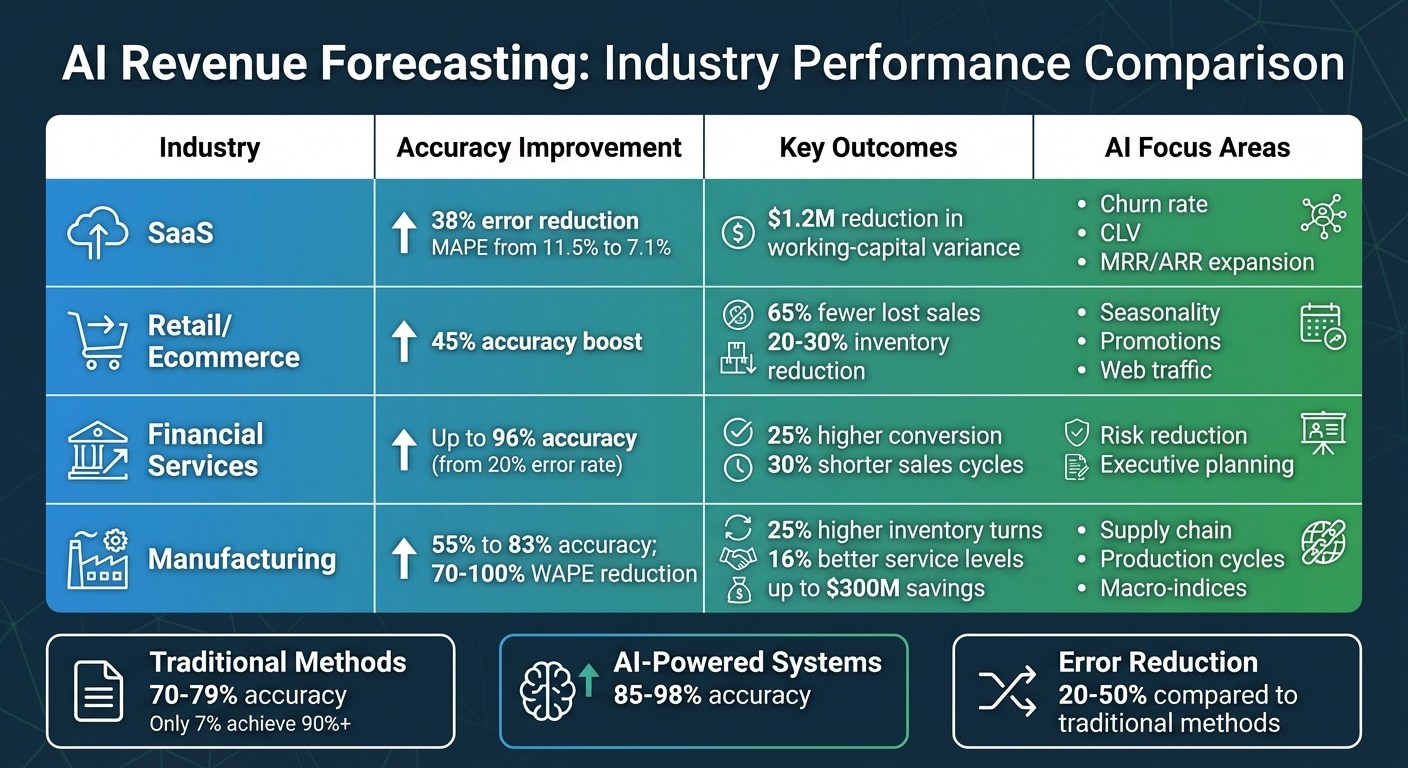
AI Revenue Forecasting Accuracy by Industry: Comparison of Traditional vs AI Methods
AI has reshaped revenue forecasting across industries, consistently cutting forecast errors by 20–50% compared to traditional methods [17]. While manual forecasts typically achieve 70–79% accuracy, AI-powered systems raise that range to an impressive 85–98% [18]. Interestingly, only 7% of sales organizations using traditional techniques manage to hit a forecast accuracy of 90% or higher [18]. On the other hand, companies with precise forecasts are 10% more likely to see year-over-year revenue growth [18].
When broken down by industry, the benefits of AI become even clearer.
SaaS: By incorporating churn rates and marketing spend into an XGBoost model, SaaS companies reduced their Mean Absolute Percentage Error (MAPE) from 11.5% to 7.1%. This highlights AI's ability to manage subscription-based revenue variables effectively [17].
Retail: AI’s ability to analyze seasonality and web traffic patterns boosted forecast accuracy by 45% and reduced lost sales by 65% [17].
Financial Services: MUFG saw a 25% jump in conversion rates and a 30% drop in sales cycles by using AI to analyze customer engagement patterns [18]. Meanwhile, a C3 AI fintech client improved quarterly prediction accuracy to 96%, a massive leap from its earlier 20% error rate [20].
Manufacturing: Lennox Residential applied machine learning to detect seasonal trends across its product lines, leading to a 16% improvement in service levels and a 25% increase in inventory turns [18]. Similarly, a global hardware manufacturer reduced its Weighted Absolute Percentage Error (WAPE) by 70–100%, cutting inventory by 7% and saving up to $300 million [18].
Metrics by Industry Table
These results underline how tailored AI models drive revenue improvements across sectors. Companies leveraging AI report 15–30% higher win rates and 20–40% shorter sales cycles [18]. In manufacturing, AI-powered sales deployments have delivered returns as high as 14–34× [1]. These figures highlight AI’s ability to revolutionize revenue predictability and operational efficiency across industries.
Conclusion
Our research and case studies highlight how AI is reshaping revenue forecasting with impressive precision. AI-powered models now achieve accuracy rates between 94% and 98%, a significant leap from the traditional 67% accuracy of older methods [4].
The secret to these improvements lies in customization. By tailoring AI models to account for specific industry patterns and nuances, businesses can significantly reduce forecast errors - by as much as 30–50% [17]. Tools like Coach Pilot showcase this approach by integrating real-time sales coaching directly into forecasting processes, creating a seamless and adaptive workflow.
Key Takeaways for Businesses
These findings translate into practical steps for adopting AI-driven forecasting:
Start with clean data. Ensure that your CRM, ERP, and sales data are accurate and error-free before deploying AI. As the saying goes, "garbage in, garbage out." Automated tools can help catch errors early, preventing them from skewing your forecasts [21][22].
Test before scaling. Launch a pilot program focusing on a specific product line, region, or customer segment. This allows you to measure the impact of AI on forecasting accuracy in a controlled environment before a full-scale rollout [19].
Build confidence with backtesting. Use "what-if" scenarios to compare AI-generated forecasts against historical data. This process not only validates the model but also helps gain buy-in from stakeholders by proving its reliability [2][17].
FAQs
What data do I need to start AI revenue forecasting?
To get started with AI revenue forecasting, the first step is collecting high-quality, structured data. This includes critical inputs like historical revenue figures, market trends, sales activities, and pipeline indicators. Ensuring your data is clean and well-organized is absolutely essential - messy or incomplete data can lead to errors and unreliable predictions. When datasets are thorough and properly prepared, AI models can spot patterns more effectively, leading to forecasts you can trust.
How do I tailor a forecast model to my industry?
To create a forecast model that works for your industry, it’s essential to customize it around your specific revenue processes and data. Off-the-shelf models often miss key elements like territory structures, quota systems, or compensation plans unique to your business. Start by clearly defining your goals, cleaning your data, and incorporating features that are specific to your industry. Then, choose machine learning models that fit your sales cycle. This approach improves the accuracy and relevance of your revenue predictions.
How can I validate AI forecasts before rolling them out?
To ensure AI forecasts are reliable, it's crucial to follow a clear and structured process. Start by defining specific business goals - what exactly do you want the AI to predict or achieve? Next, gather the relevant data, clean it thoroughly, and prepare it for use. This step is essential because messy or incomplete data can lead to inaccurate predictions.
Once your data is ready, train the AI model and test its accuracy. Compare its predictions to actual outcomes to spot any inconsistencies or biases. This step helps you understand where the model might fall short and allows adjustments to improve its performance.
Finally, keep in mind that markets and conditions change over time. Regular monitoring and retraining of the model are necessary to maintain its accuracy and relevance. By following this process, you can ensure your forecasts are dependable and instill confidence before rolling out the AI system fully.
Related Blog Posts

Remove the guesswork from winning more deals.