B2B Sales
How AI Powers Predictive Collaboration Metrics
Mar 14, 2026
AI turns collaboration data—emails, calls, CRM—into predictive deal scores, real-time coaching, and forecasts that increase win rates and efficiency.

AI is reshaping sales forecasting by replacing guesswork with data-driven insights. Predictive collaboration metrics analyze team interactions, such as emails, calls, and meetings, to predict deal outcomes with up to 95% accuracy. This approach helps sales teams focus on high-value opportunities, reduce inefficiencies, and improve win rates by 35%–45%.
Key takeaways:
AI evaluates signals like sentiment, response times, and engagement to predict deal health.
Machine learning models and NLP analyze data from CRMs, emails, meetings, and more.
Companies using AI report higher revenue growth and faster sales cycles.
Real-world results: Salesforce's AI-driven metrics added $28M to its sales pipeline, closing $9M in revenue in just four months. Tools like Coach Pilot also provide real-time coaching, helping sales reps take precise actions to close more deals. AI doesn’t just predict - it enables smarter decision-making at every stage of the sales process.
Predictive AI Explained: What Business Leaders Need to Know
AI Technologies Behind Predictive Metrics
AI technologies are the engine behind decoding sales patterns and forecasting outcomes. These cutting-edge techniques form the foundation of predictive collaboration metrics in today’s sales operations.
Machine Learning Models for Prediction
Machine learning transforms CRM data into actionable forecasts. Various models, such as classification techniques like logistic regression, random forest, and gradient boosting, help categorize deals as either a "win" or "loss" by identifying underlying patterns [6][2]. Regression models are used to estimate outcomes like deal size, while time-series models such as ARIMA and Prophet detect seasonal trends. For more complex scenarios, advanced neural networks, particularly Long Short-Term Memory (LSTM) architectures, track sequences of deal activity across the long sales cycles typical of B2B transactions [6].
The impact of these data-driven methods is significant. Forecasting accuracy improves by 20%–30% with AI, and overall accuracy rates for AI models range between 85% and 95%, compared to just 7% for non-AI approaches [2].
Take Autodesk, for example. In 2022, the company integrated Chorus.ai's conversation intelligence to analyze over 50,000 sales calls. By using machine learning to detect recurring closing signals and flag high-risk deals based on negative sentiment, Autodesk reduced forecast error rates by 26% and increased close rates by 14% [8].
Building on these machine learning models, Natural Language Processing (NLP) takes things a step further by turning unstructured conversations into actionable insights.
Natural Language Processing in Collaboration Analysis
AI doesn’t just crunch numbers - it also interprets language to refine sales forecasting. Natural Language Processing (NLP) converts unstructured data from sales calls, emails, and meeting transcripts into structured signals that predict outcomes. For instance, NLP can extract key details like competitor names, stakeholder titles, urgency signals, and even budget figures or decision dates [9][10].
NLP also provides insight into conversational dynamics. Research shows that calls featuring collaborative language - phrases such as "we", "together", and "let's" - are 35% more likely to close compared to those dominated by transactional terms like "contract" or "terms" [8]. Additionally, maintaining an ideal talk-to-listen ratio (around 43% talk time for sales reps) is crucial. NLP tools can even provide real-time alerts when this balance is off [8].
Pattern Recognition and Behavioral Analysis
AI’s ability to recognize patterns adds another layer of precision to sales forecasting. It can differentiate real deal momentum from superficial activity. For example, AI analyzes the composition of the buying committee, flagging risks if executive involvement is missing or communication is limited to just one contact [5][7]. It also tracks response times and emotional tone to detect when interest in a deal may be fading [8][7].
By examining thousands of transactions, AI creates a "DNA profile" of winning deals. These deal health scores, driven by AI, achieve up to 81% accuracy by identifying the specific attributes and activity patterns that lead to successful closures [7]. Deals that align with these patterns are 6.3 times more likely to close than those that don’t [5].
"You have a lot of different platforms out there that will say they're using AI to give you a deal score or health score… Reality of it is a lot of times that's really just more of an activity score... true deal scoring measures progress toward a close."
– Rob Stanger, The Go-to-Market Podcast [5]
Research Findings on Predictive Metrics
Recent studies highlight how advanced technologies like machine learning, NLP, and pattern recognition are reshaping sales forecasting. These tools are delivering not only improved accuracy but also significant business outcomes.
Accuracy Improvements with AI
AI has transformed sales forecasting from educated guesses into a data-driven science. Traditional methods typically achieve accuracy rates between 47% and 67%. Even with manual optimization, only about 7% of sales organizations hit 90% or higher accuracy [11][12][13][14]. By contrast, AI-powered models consistently deliver accuracy rates of 85% to 94%, with some platforms reaching as high as 95% to 98% by analyzing over 300 contextual signals [11][12][14].
One compelling example comes from a B2B SaaS company that adopted GPT-5.3 Codex-based forecasting. Their accuracy rate jumped from 52% to 91%. The system also improved close date precision, narrowing the margin of error from ±23 days to just ±7 days. On top of that, it cut the time spent on weekly forecast calls by 81%, reducing a 4-hour task to just 45 minutes [11].
These improvements in accuracy lead directly to practical, measurable business benefits.
Business Benefits of Predictive Metrics
AI-driven forecasting doesn't just enhance accuracy - it drives meaningful results. Companies using AI tools report win rate increases of 15% to 30% and sales cycle reductions of 20% to 40% [14]. Accurate forecasting also correlates with a 10% higher likelihood of achieving year-over-year revenue growth [14].
For instance, Salesforce’s internal "Customer Zero" team leveraged AI sales coaching tools like Agentforce and Data Cloud between February and May 2025. They delivered 24,000 personalized recommendations, achieving a 38% action completion rate - nearly five times the baseline of 8%. This effort generated $28 million in pipeline and $9 million in closed ACV within just four months [4]. Another success story comes from MUFG (Mitsubishi UFJ Financial Group), which saw a 25% boost in conversion rates, a 30% reduction in sales cycles, and identified 300% more qualified leads after deploying AI-driven qualification and engagement tools [14].
"AI doesn't replace managers; it equips them. Forecast accuracy increases when reps don't have to manually maintain data."
– Abhinandan Sahgal, Co-founder & CTO, Pepsales [15]
How AI-Powered Metrics Work in Practice
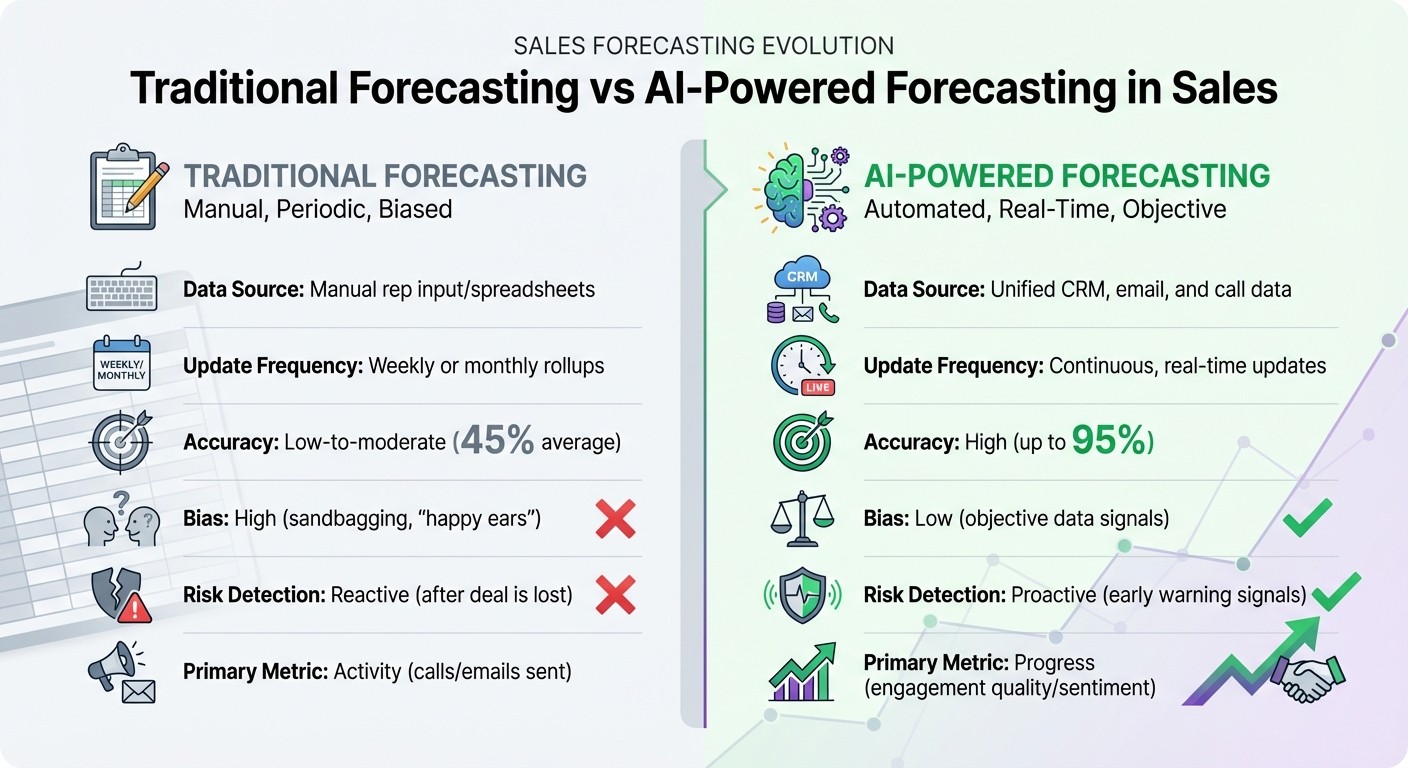
Traditional vs AI-Powered Sales Forecasting: Key Differences and Performance Metrics
Research highlights what AI can achieve, but how does it function day-to-day? Predictive collaboration metrics are reshaping how sales teams forecast, coach, and allocate resources - bringing real-time insights into their workflow.
Better Sales Forecasting
AI takes the guesswork out of forecasting by replacing subjective judgments with real-time, data-driven insights. Instead of relying on a rep’s optimism or a manager’s gut instinct, AI evaluates factors like deal velocity, stage conversion rates, and buyer engagement patterns to predict outcomes [2][5]. While traditional forecasting updates occur weekly or monthly, AI systems provide continuous updates as fresh data flows in from emails, meetings, and calls [2][17].
Here’s the difference: traditional methods often achieve just 45% accuracy, while AI-powered forecasting can push accuracy up to 95% by analyzing hundreds of contextual signals [2][16][17]. Teams leveraging AI to pinpoint high-probability deals report a 45% boost in win rates [5].
AI also acts as an early warning system. For example, if a deal shows no activity for more than 45 days or lacks engagement from key stakeholders, the system flags it for managers - offering time to intervene before the quarter ends [2][17]. This minimizes last-minute surprises and allows for proactive adjustments.
"In B2B sales, guessing is no longer an option. The best teams don't rely on opinions - they rely on data-driven forecasting methods."
– Alex Zlotko, CEO, Forecastio [2]
But AI doesn’t just stop at forecasting; it actively helps sellers seize opportunities in the moment.
Real-Time Coaching and Feedback
Modern AI tools represent the future of sales enablement by going beyond predictions to offer actionable advice. Instead of labeling a deal as "at-risk", they guide reps with specific next steps, such as contacting a particular stakeholder, refining a pitch, or involving the customer success team [4][10].
Salesforce’s internal pilot demonstrated how effective this can be. By delivering personalized recommendations directly in Slack, where reps already spend their time, they achieved a 38% action completion rate - nearly five times the baseline [4]. This approach makes it easier for reps to act, as coaching delivered within tools like Slack or Teams is far more likely to be followed [4][18]. Teams using real-time AI coaching have also seen an average 7% increase in closure rates [18].
"We're not just predicting the future. We're shaping it in partnership with sellers, in real time."
– Ali Nahvi, Director of Product Innovation, Salesforce [4]
Beyond coaching, AI optimizes how sales teams use their time and resources.
Smarter Resource Allocation
AI-powered metrics help managers focus their team’s energy where it matters most. For instance, lead scoring systems prioritize high-intent prospects, ensuring reps concentrate on opportunities with the best chances of closing [1][3]. This targeted approach has been shown to improve win rates by up to 35% [3].
AI also reduces time spent on tedious tasks. Automating deal analysis and CRM updates saves sellers at least 1.5 hours each week [5]. Considering that 61% of sales teams spend over five hours weekly on manual data entry and analysis, these efficiency gains - ranging from 10% to 15% - allow reps to dedicate more time to selling [1][20].
For managers, AI simplifies forecasting processes. Automated roll-ups and real-time dashboards cut the time spent on weekly forecast calls by up to two-thirds [19][3][9]. Instead of juggling spreadsheets, managers can focus on strategic coaching and addressing critical issues.
Together, these tools - precise forecasting, actionable coaching, and smarter resource management - help sales teams align strategy with execution.
Feature | Traditional Forecasting | AI-Powered Forecasting |
|---|---|---|
Data Source | Manual rep input/spreadsheets | Unified CRM, email, and call data |
Update Frequency | Weekly or monthly rollups | Continuous, real-time updates |
Accuracy | Low-to-moderate (45% avg) | High (up to 95%) |
Bias | High (sandbagging, "happy ears") | Low (objective data signals) |
Risk Detection | Reactive (after deal is lost) | Proactive (early warning signals) |
Primary Metric | Activity (calls/emails sent) | Progress (engagement quality/sentiment) |
How Coach Pilot Uses Predictive Collaboration
Coach Pilot takes the insights from real-time coaching and precise forecasting and integrates them into everyday sales workflows. This approach transforms predictions into actionable steps, delivering measurable sales improvements.
AI-Driven Sales Coaching
Unlike tools that simply report past performance - like "your talk ratio was 65%" - Coach Pilot uses predictive collaboration metrics to provide actionable guidance. It tells sales reps who to contact, when to reach out, and what messaging to use, all based on patterns proven to work [21].
The results speak for themselves. In May 2024, Naum Sekulovski, a Business Development Manager at Food By Us, closed 13 new contracts in just 9 weeks, driving a 45% increase in sales revenue by leveraging the platform's guidance [21]. Similarly, Connor Bell at HubSpot boosted net new opportunities by 50% over an 11-week period, leading to a 38% jump in quarterly sales revenue [21].
Coach Pilot analyzes every single sales interaction, providing real-time, contextual feedback during calls and meetings. This ensures coaching is applied when it matters most. Companies using AI coaching are 1.3 times more likely to achieve revenue growth [22], and teams leveraging Coach Pilot have seen customers achieve 7.8x pipeline growth in less than 90 days [21].
Custom Sales Playbooks and Training
Coach Pilot takes static sales playbooks and breathes life into them. Instead of sitting idle as unused playbooks, these tools are integrated into Microsoft Teams and Slack. The platform's AI learns a company's specific sales processes, messaging, and deal stages, then identifies patterns from top performers. For example, it can pinpoint the right time to involve executives or navigate procurement challenges, scaling these insights across the team [21].
The impact is clear. In December 2024, Stephen Luxmoore, CEO of Your HR Team, saw a 32% increase in client acquisitions and secured 8 contracts within 9 weeks of adopting Coach Pilot [21]. Similarly, Rebecca Veksler, Co-Founder of Four Rooms, tripled monthly sales and closed 14 deals in just 8 weeks by optimizing her sales process with the platform [21].
Teams using Coach Pilot report a 39% increase in quota attainment by replacing generic outreach with personalized, value-driven messaging [21]. The platform combines AI-driven consistency with human mentorship, including weekly live coaching sessions, addressing both the data and the human side of sales. This hybrid approach ensures the entire team operates with precision and confidence.
Closing the Gap Between Strategy and Execution
Executing a strategy is often more challenging than creating it. Coach Pilot addresses this by automating deal tracking and integrating AI insights into every stage of the sales process. The platform automatically updates CRM records, reducing administrative tasks and ensuring predictive metrics are always based on accurate, real-time data. On average, reps save 19.5 hours per week by automating CRM updates and other repetitive tasks [21].
"Coach Pilot tells your reps what to do next... Only one removes the execution bottleneck." [21]
With 24/7 real-time guidance, the platform ensures sales reps receive immediate direction on critical actions - whether it's emailing a CFO or engaging customer success. This continuous feedback loop bridges the gap between training and execution, ensuring strategies are consistently implemented rather than left as good intentions.
Conclusion
AI-powered sales teams generate 41% more revenue per rep ($1.75M compared to $1.24M) while handling 18% fewer activities. The secret? It’s not about grinding harder - it’s about working smarter. By focusing on high-value prospects and automating repetitive tasks, these teams redefine efficiency[23].
The key to maximizing these results lies in combining AI precision with human expertise. In a hybrid model - where AI takes care of routine tasks, and managers address strategic challenges - teams report an impressive 8.4/10 satisfaction rating and 89% retention rates[25].
The momentum for AI adoption is undeniable. By 2025, 79% of sales professionals are expected to use AI tools, a sharp rise from just 19% in 2023[24]. Even more compelling, companies that embed AI into their sales strategies are 65% more likely to improve win rates[26].
Take tools like Coach Pilot, for example. It seamlessly integrates predictive metrics into daily workflows, offering tailored playbooks, immersive training, and real-time coaching. This shift allows your team to spend less time on mundane tasks and more time closing deals. The real question isn’t if you should adopt AI - it’s whether you can afford to wait while your competitors surge ahead.
FAQs
What data does AI use to predict deal outcomes?
AI evaluates deal outcomes by examining a wealth of conversation data from sales calls. This includes spoken words, tone of voice, hesitations, questions, objections, and even moments of silence. Beyond calls, it also factors in signals from CRM systems, emails, activity logs, buyer and seller behaviors, stage transitions, and engagement metrics. By piecing together these elements, AI uncovers patterns that make predicting deal success far more precise.
How does AI turn emails and calls into deal health scores?
AI evaluates communication patterns, sentiment, signals, and digital activity in real time to generate predictive scores. These scores provide an objective view of deal success or potential risks, helping teams take proactive steps for coaching and deliver more precise forecasts.
How do you roll out predictive metrics without disrupting workflows?
To make predictive metrics work effectively, it's best to introduce AI insights step by step, ensuring they fit seamlessly into your existing processes. Begin with small pilot programs to test the waters. Focus on tracking collaboration metrics such as task success rates and time saved. Collect feedback from participants to understand what’s working and what needs tweaking. Use this data to fine-tune the implementation, ensuring the AI tools genuinely boost productivity without causing disruptions. Keep an eye on the results over time and adjust your approach as needed to fully integrate AI into daily workflows.
Related Blog Posts

Remove the guesswork from winning more deals.