B2B Sales
Real-Time Pipeline Risk Alerts with AI
Mar 15, 2026
AI detects stalled deals, ghosting, and missing decision-makers in real time, delivering actionable alerts and coaching to improve win rates and forecast accuracy.
Sales teams often lose deals due to late risk detection - but AI can change that. By using real-time alerts to monitor risks like stalled deals, reduced engagement, or missing decision-makers, you can act weeks earlier than traditional methods. This approach not only saves time but also improves win rates and forecast accuracy.
Key Highlights:
79% of B2B companies miss forecasts by over 10%.
AI flags risks like deal stalling (67% failure rate) and ghosting (61% failure rate).
Acting on alerts within 72 hours can reduce failure rates from 67% to 28%.
Tools like Coach Pilot provide actionable steps, saving sales reps 19.5 hours weekly.
AI doesn’t just highlight risks - it recommends solutions. For instance, if a deal stalls, it might suggest contacting the CFO or re-confirming next steps. This shift toward the future of sales enablement helps safeguard revenue and streamline workflows by moving from reactive to real-time action.
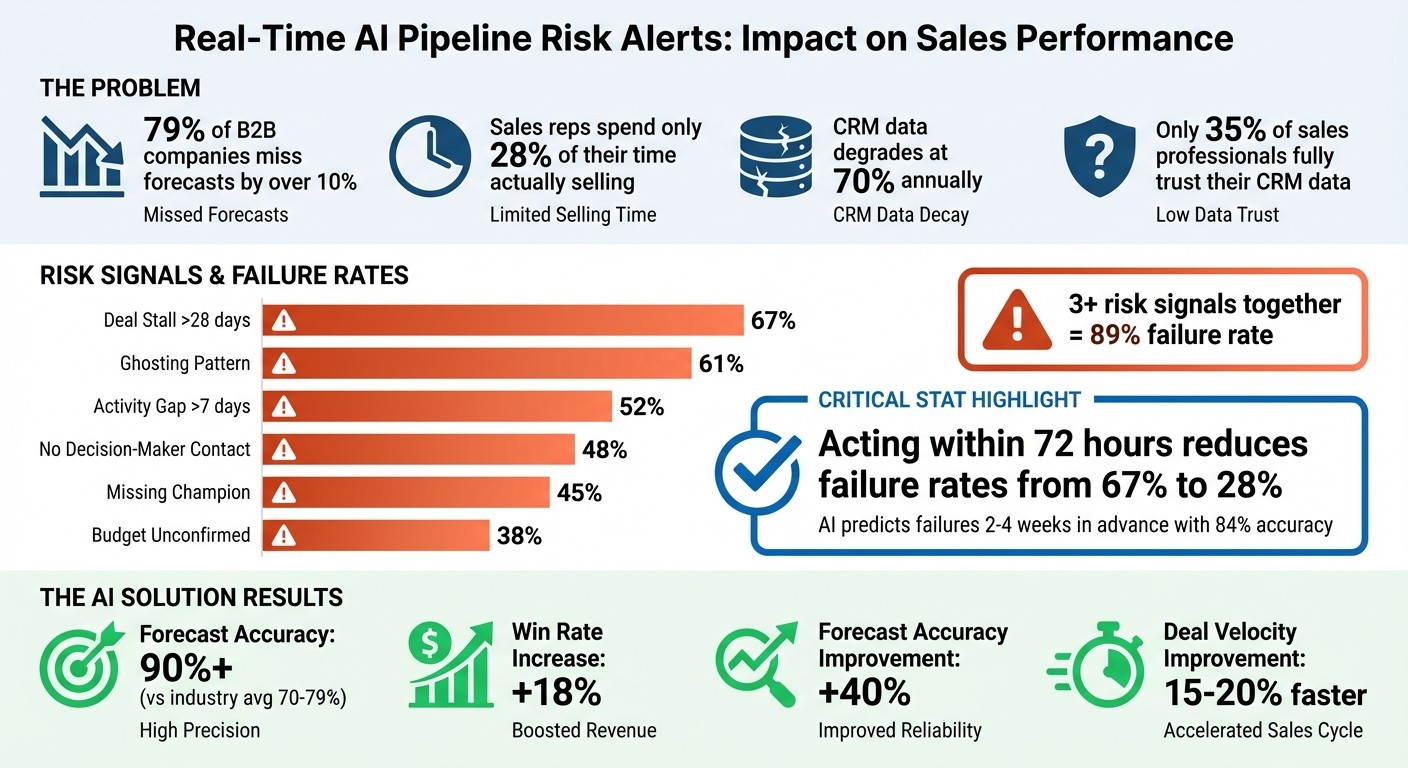
AI Pipeline Risk Alerts: Key Statistics and Impact on Sales Performance
How Sales Leaders Instantly Identify Deals at Risk | MIKI Agentic Chief of Staff Demo
Pipeline Risk Indicators
AI systems are reshaping how sales teams monitor and manage risks in their pipelines. By analyzing behavioral patterns and comparing them to historical data from thousands of deals - both successful and failed - AI provides early warnings when something seems off. These insights form the basis for actionable risk assessments that can help save deals before it’s too late.
Risk Signals Detected by AI
The most telling warning signs often come from buyer behavior rather than sales rep activity. For example, AI flags engagement decay when prospects stop responding after three consecutive unreturned touchpoints. It also tracks the balance between buyer-initiated and seller-initiated interactions. If the seller is doing all the chasing, the deal is likely at risk [6].
Another critical metric is how long deals linger in specific stages. AI benchmarks these durations against industry norms and raises alerts when deals stall. For instance, a SaaS deal stuck for more than 24 days or a financial services deal stalled past 42 days signals a steep drop in win probability [6]. On average, every additional day of stalling between days 21 and 35 reduces the likelihood of winning by 2.3% [6].
AI also monitors stakeholder engagement. Warning signs include champions going silent, fewer people attending meetings, or a lack of involvement from decision-makers. Similarly, vague updates in the CRM - like "follow up next week" instead of concrete commitments - signal declining momentum [2].
Other triggers include delays in action items like legal reviews or security questionnaires. AI also picks up on competitive threats, such as mentions of alternative solutions or early pricing inquiries, which may indicate the buyer is shopping around [6].
Risk Signal | Failure Probability |
|---|---|
Deal Stall >28 days | 67% |
Ghosting Pattern | 61% |
Activity Gap >7 days | 52% |
No Decision-Maker Contact | 48% |
Missing Champion | 45% |
Budget Unconfirmed | 38% |
Source: Analysis of 47,548 B2B deals [6]
When three or more of these risk signals occur together, the likelihood of deal failure jumps to 89%. However, timing is everything - acting on these warnings within 72 hours can reduce failure rates from 67% to 28% [6].
How AI Interprets Risk Patterns
AI doesn’t just flag isolated issues; it connects the dots across multiple data points to deliver a comprehensive risk evaluation. By analyzing email metadata, calendar invites, call transcripts, and CRM logs, AI compensates for incomplete or outdated information - especially since only 35% of sales professionals fully trust their CRM data [2].
The focus isn’t on sheer activity levels, like the number of emails sent or calls made. Instead, AI prioritizes buyer-driven actions that indicate real interest, such as scheduling meetings, involving additional stakeholders, or requesting technical reviews [7]. As Pintel.ai aptly explains:
"Pipeline health isn't about how many deals are active. It's about whether the pipeline can be trusted" [7].
AI also uses cohort analysis to refine its assessments. For example, a deal stuck in stage three for 18 days might be normal for e-commerce but worrisome for SaaS. By comparing deal timelines to the median for similar successful deals in the same sector, AI ensures its risk evaluations are contextually accurate [1][2].
Machine learning models like Random Forest or Logistic Regression weigh these signals to calculate a probabilistic failure score. With an 84% accuracy rate, these models can predict pipeline failures 2–4 weeks in advance. This gives sales teams a critical window to act, enabling them to address risks proactively and protect revenue [6].
Setting Up AI Risk Monitoring with Coach Pilot
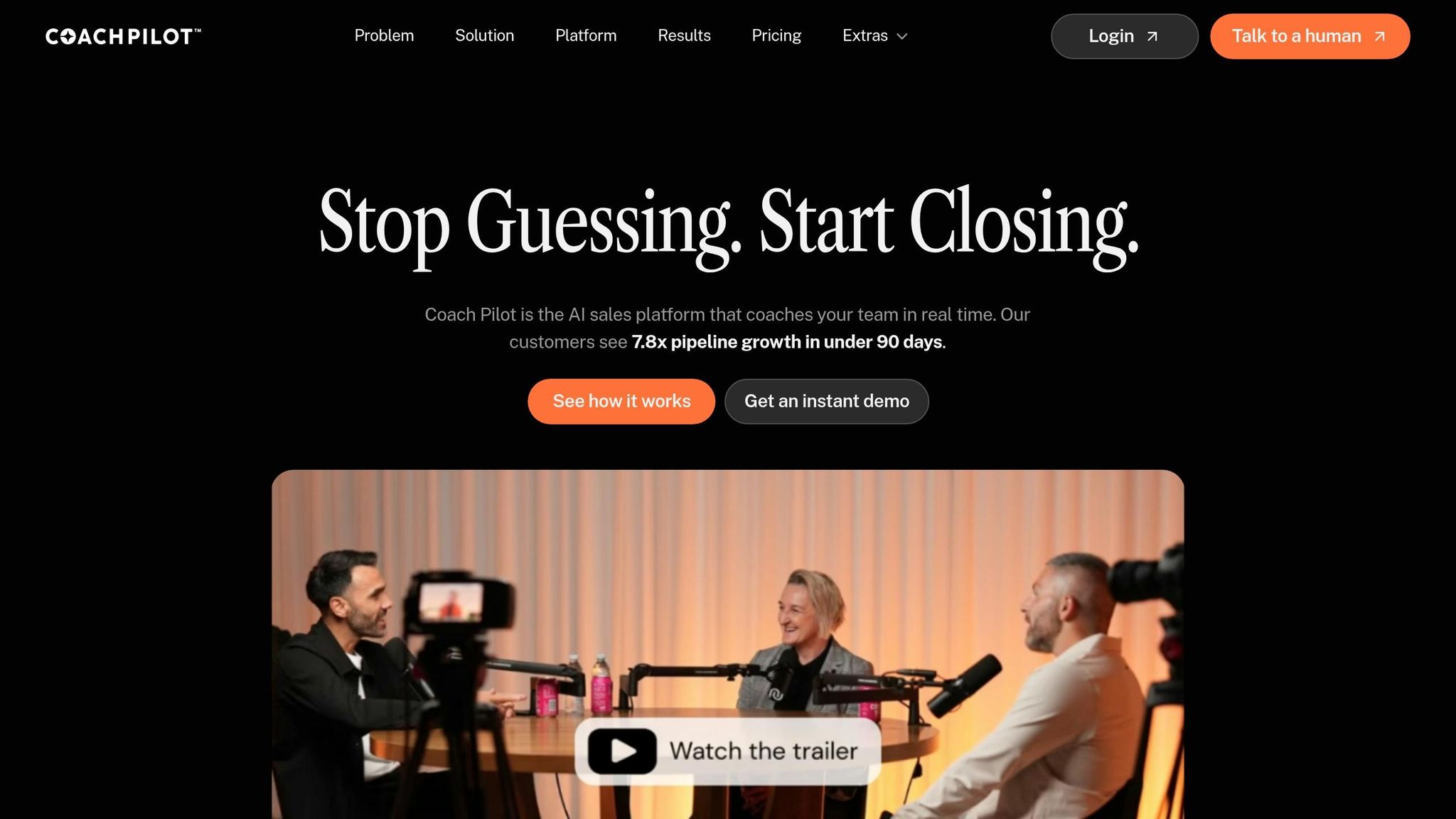
Once you've identified risk signals, the next step is setting up tailored alerts to ensure timely responses that protect your sales pipeline. With Coach Pilot, you can transform your static sales playbook - those PDFs that often go untouched - into a dynamic "Living Playbook" that actively supports reps through every stage of a deal [8][9]. The process kicks off with a thorough audit of your current sales process, messaging frameworks, deal stages, and objection-handling strategies. By capturing what works best, the AI is trained on your proven sales patterns, aligning it with your specific approach and preparing it to deliver actionable, relevant alerts.
Configuring AI Risk Alerts in Coach Pilot
Coach Pilot integrates seamlessly with tools like Microsoft Teams, Microsoft Copilot, and ChatGPT for Teams, delivering risk alerts where your reps already collaborate [8]. It automatically collects critical deal data from calls, emails, and meetings [8], eliminating the need for manual CRM updates - which, on average, consume about 70% of a sales rep's time [1]. This real-time data collection ensures that alerts are based on the latest activity rather than outdated or incomplete information.
The AI tracks deal velocity, engagement trends, and stakeholder activity, comparing each deal against benchmarks established during playbook training. If it detects red flags - like a champion going silent or a deal dragging past its expected timeline - the system doesn't just highlight the issue. It also provides actionable guidance, such as "Email the CFO by Thursday" or "Call the economic buyer Friday at 9am" [8]. This proactive approach shifts the focus from simply identifying risks to offering clear steps to address them, driving more consistent results.
Customizing Alerts by Team and Role
To get the most out of risk alerts, customization by role is key. Tailor alerts to ensure they deliver the right level of detail to the right people. Managers, for example, get high-level summaries that help them prioritize coaching opportunities and focus on deals requiring strategic input [8]. Meanwhile, individual reps receive specific, actionable instructions - like talking points, next steps, and timing recommendations - all based on strategies proven effective in similar deals [8].
The customization process includes setting role-specific thresholds during the setup phase. For instance, managers might be alerted when three or more risk signals occur simultaneously (a pattern linked to an 89% failure rate), while reps are notified of a single critical issue, such as a 7-day inactivity gap [8]. Coach Pilot follows an 8-week deployment schedule: Weeks 1-2 focus on building the playbook, Weeks 3-4 on team training, Weeks 5-6 on launching AI coaching, and Weeks 7-8 on scaling execution. This phased approach allows teams to establish baseline risk scores, fine-tune signals, and pilot alerts with a smaller group before expanding across the organization [8].
Responding to AI Risk Alerts
Reviewing and Prioritizing Alerts
Not all alerts demand immediate action. Modern AI systems categorize deals as low, medium, or high risk based on factors like revenue impact and how close the deal is to its expected close date [1]. This approach shifts the focus from sheer activity counts to real signs of progress. For example, indicators like a security review being initiated or an economic buyer getting involved show mutual advancement, unlike simply counting emails or meetings [2].
Alert notifications are tailored to roles: detailed tasks for reps and summarized overviews for managers, making follow-up more efficient [2]. With forecast accuracy typically falling between 70% and 79% [1], and only 35% of sales professionals fully trusting CRM data [2], prioritizing alerts based on objective signals is essential.
Key red flags to watch for include "stage overstay" - when deals linger too long in a particular stage relative to their segment or contract value - and "stakeholder entropy", where meeting attendance drops or the primary champion becomes unresponsive [1][2]. These patterns are often strong indicators of potential deal failure and require immediate attention.
Once the critical alerts are identified, the next step is turning these insights into actionable strategies through coaching plays.
Using Coaching Plays to Address Risks
After spotting high-risk alerts, the focus shifts to activating targeted coaching plays. These AI-driven plays transform problem detection into actionable solutions. As Jonathan M Kvarfordt from Momentum.io explains:
"An alert that says 'Problem Detected' is noise. An alert that says 'Problem Detected. Here is the solution. Click to execute,' is orchestration" [3].
Building on the identified risks, these plays outline precise steps to counter negative trends. For instance, when a deal is flagged as "High Risk", the system might recommend actions like scheduling a call with the economic buyer or reconfirming the mutual action plan [1]. Additionally, tools like Coach Pilot generate tailored "redo" examples for reps, helping them refine their tone, reframe value propositions, or handle objections more effectively based on call sentiment analysis and detected issues [10]. This personalized guidance ensures reps always know the best next move.
Proactive vs. Reactive Risk Management
This proactive approach stands in stark contrast to traditional reactive methods, addressing issues before deals stall. The key difference lies in timing and intervention. Reactive methods rely on periodic reviews - weekly or monthly - that often uncover problems only after a deal has stalled or been lost. In contrast, AI-powered proactive management continuously monitors the pipeline, catching "silent stalls" like vague next steps or a sudden lack of communication from key stakeholders in real time [2][11].
Here’s a side-by-side look at how these approaches compare:
Feature | Reactive Approach (Traditional) | Proactive Approach (AI-Powered) |
|---|---|---|
Detection | Weekly/monthly reviews or post-deal [1] | Real-time, continuous monitoring [11] |
Primary Tool | Static dashboards and spreadsheets [4] | AI workers and orchestration systems [3] |
Coaching Focus | "Why did we lose?" [10] | "How do we win sooner?" [10] |
Data Source | Subjective rep narratives and manual notes [1] | Automated activity capture and sentiment analysis [1] |
Trigger | Manual follow-up after identifying a stall [3] | Automated tasks, alerts, and one-click fixes [3] |
Outcome | Lagging indicators; lost deal momentum [3] | Leading indicators; immediate course correction [11] |
This shift to proactive, real-time intervention is all about protecting revenue through immediate, data-driven decisions. Moving from "Systems of Insight" to "Systems of Orchestration" enables teams to go beyond simply reporting on pipeline health - they actively improve it [3]. The results speak for themselves: teams using real-time AI coaching report a 7% increase in closure rates, a 40% boost in forecast accuracy, and an 18% rise in win rates [2]. Plus, with sales reps spending only 28% of their time actually selling [3], automating risk detection and response allows them to dedicate more time to building relationships and closing deals.
Measuring and Improving AI Alert Performance
Tracking Performance Metrics
When it comes to AI risk alerts, there are five key metrics to keep an eye on: forecast accuracy, win rate uplift, slippage reduction, deal velocity, and signal-to-action latency. Let’s break these down.
Forecast accuracy is all about comparing predicted revenue to actual results. While most teams in the industry hit accuracy rates of 70%-79%, those using AI often surpass this, with AI-enabled sales teams achieving revenue growth of 83%, compared to just 66% for non-AI teams [1][4].
Next is win rate uplift, which measures how often deals flagged as at-risk are saved through coaching and intervention. Then there’s slippage reduction, or how much you can cut down on deals getting delayed beyond the current quarter. Deal velocity - the time it takes to close a deal - is another critical metric. AI can speed this up by 15%-20%, and when teams act on AI alerts within 72 hours, they save an average of $31,200 per deal [5][6][12].
Finally, there’s signal-to-action latency, which tracks how quickly teams respond to alerts. This is crucial because deals that stall for more than 28 days see conversion rates drop dramatically - from 43.2% to just 14.3%. Plus, each additional day of delay between days 21-35 reduces the chance of closing by 2.3% on average [6]. Integrating alerts into tools like Slack or Microsoft Teams, where sales reps already spend their time, can help cut down this delay [3].
By keeping these metrics front and center, you can spot what’s working and fine-tune your approach to maximize results.
Refining AI Models with Data
AI models aren’t a one-and-done deal - they need constant tweaking to stay sharp. Regular recalibration and historical data analysis are key.
Start by calibrating thresholds by segment. For example, a 24-day stall might be a red flag for SaaS deals but could be perfectly normal in Financial Services, where the threshold might be 42 days [6]. Before rolling out changes, backtest risk tiers using 12-18 months of CRM data to ensure accuracy [1].
It’s also a good idea to retrain models quarterly. This allows the AI to incorporate feedback on recent outcomes and adapt to evolving buyer behavior [1][6]. Tools like Coach Pilot can automatically refine alert thresholds and coaching strategies based on win/loss data and performance analytics. Additionally, running a monthly "pipeline clean-up" to weed out stale deals is essential - CRM data tends to degrade at an alarming rate of 70% annually [13]. Clean, up-to-date data means your AI can make smarter decisions.
For context, a 10-person sales team that intervenes early on AI-flagged high-risk deals could save approximately $1.17 million in annual revenue [6]. That’s a compelling case for keeping your AI models sharp and your data clean.
Conclusion
Real-time AI alerts are changing the game for pipeline risk management. Instead of relying on passive dashboards that simply report past issues, these alerts actively guide teams with actionable steps. For example, when AI spots a stalled deal or declining buyer engagement, it doesn’t just flag the issue - it provides one-click solutions, like drafting re-engagement emails [3].
The results speak for themselves. AI-driven alerts significantly improve performance metrics, boosting forecast accuracy to over 90%, far above the industry average of 70–79% [1]. They also lead to up to an 18% increase in win rates and a 40% improvement in forecast accuracy by addressing risks as they arise [2]. On top of that, these alerts help eliminate "zombie deals" that clog pipelines and drain resources [3].
Coach Pilot takes this concept further by embedding AI coaching directly into workflows. Instead of relying on static playbooks or post-call reviews, reps get real-time guidance on their next steps - whether that’s reaching out to decision-makers, fine-tuning messaging, or escalating issues to leadership. This dynamic approach, powered by actionable alerts, has driven an average of 7.8x pipeline growth within 90 days and saved users about 19.5 hours per week on administrative tasks [8]. It’s a practical way to turn strategic insights into immediate action.
The real advantage lies in moving from identifying problems to solving them. As Jonathan M Kvarfordt from Momentum explains, effective alerts don’t just detect risks - they deliver solutions [3]. This shift from recognition to resolution ensures deals are secured before risks escalate, underscoring the main takeaway: proactive execution is the key to protecting revenue.
FAQs
What data does AI use to spot pipeline risk?
AI helps spot risks in the sales pipeline by examining crucial deal signals like activities, buyer engagement, stage progression speed, sentiment, and historical trends. By leveraging these insights, sales teams can identify potential problems early and take action to safeguard revenue.
How do we choose the right alert thresholds for our deals?
To determine the best alert thresholds, it's important to evaluate critical elements like deal signals, buyer engagement, stage velocity, and sentiment. Establish risk flags that genuinely represent the health of a deal. This approach ensures alerts are both timely and actionable, without overwhelming users with unnecessary notifications. Strive to strike a balance between sensitivity and practicality to achieve the most effective outcomes.
What should reps do first when an alert fires?
Reps should begin by carefully examining the alert to pinpoint the specific risk or issue being flagged. Grasping the context behind the alert is crucial before determining the appropriate course of action.
Related Blog Posts

Remove the guesswork from winning more deals.