B2B Sales
How AI Improves Revenue Forecast Accuracy
Mar 13, 2026
AI improves forecast accuracy to 80–95%, flags at-risk deals weeks earlier, removes bias, and saves sales teams time for smarter revenue decisions.

AI-driven forecasting transforms how businesses predict revenue by replacing guesswork with living AI playbooks and data-based insights. Here's the bottom line: AI improves forecast accuracy to 80–95%, compared to 60–70% with manual methods. It identifies risks earlier, reduces errors, and saves time for sales teams. Companies using AI report fewer missed targets, better resource allocation, and improved revenue growth.
Key Takeaways:
AI vs. Manual Forecasting: AI analyzes historical and real-time data, removing human bias and increasing accuracy.
Time Savings: Reduces forecast prep time by 65%, letting managers focus on strategy.
Risk Detection: Flags at-risk deals 3.2 weeks earlier than manual methods.
Revenue Impact: 83% of teams using AI saw revenue growth, compared to 66% without it.
Bias-Free Predictions: AI eliminates optimism and recency bias, ensuring forecasts are objective.
By integrating tools like Coach Pilot, businesses can automate updates, improve deal management, and boost team performance. AI isn’t just about numbers - it’s about smarter, faster decisions that drive results.
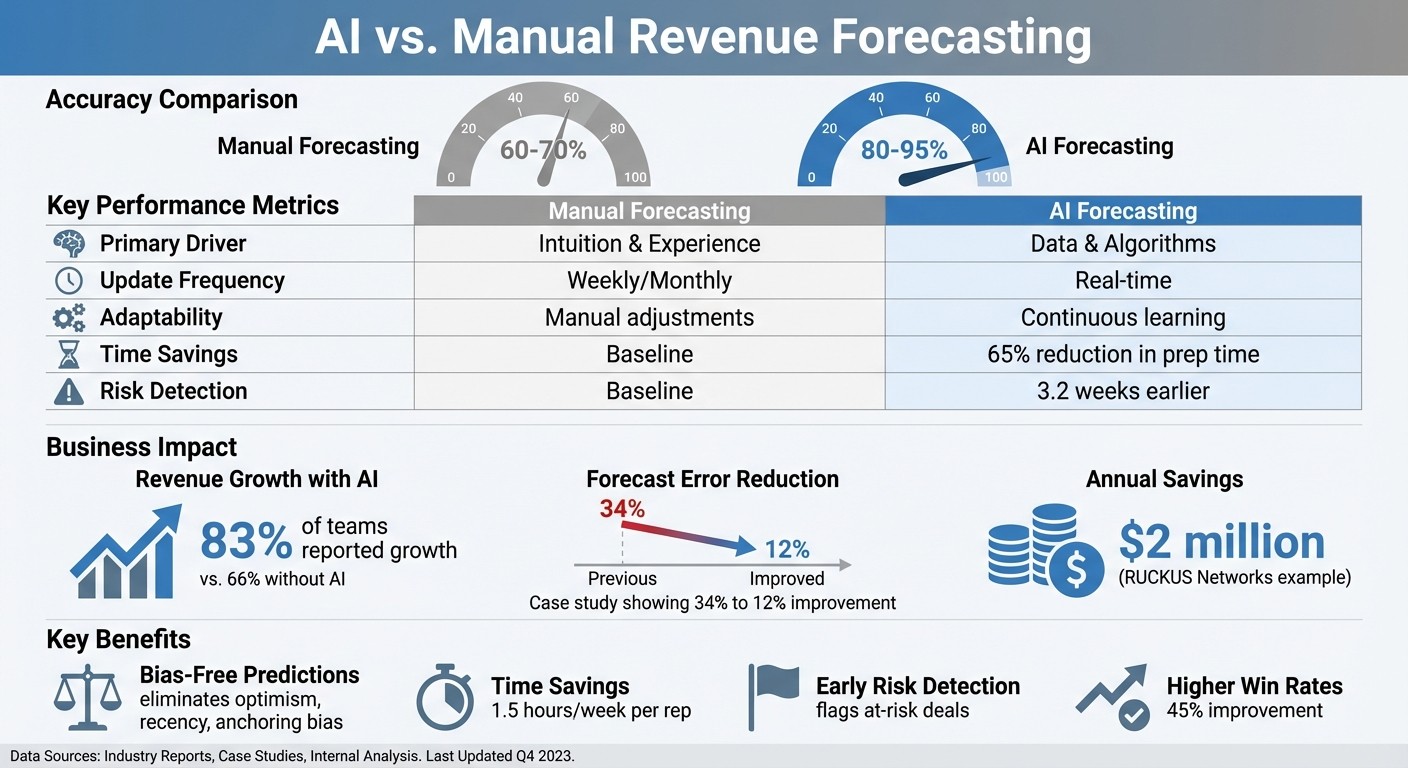
AI vs Manual Revenue Forecasting: Accuracy, Speed, and Performance Comparison
How AI Improves Forecast Accuracy
Analyzing Historical and Real-Time Data with AI
AI tools excel at crunching massive amounts of data, combining details from 12–24 months of CRM records - like win rates, sales cycles, deal sizes, and rep performance - to create accurate benchmarks. These systems update predictions in real time, tracking buyer behaviors such as email responses, meeting attendance, and the addition of new stakeholders. AI even uses conversation intelligence from calls and emails to fine-tune the likelihood of deals closing as situations evolve [3][8][9].
Take Omniplex Learning, for example. In 2025, the company scaled its sales team from 10 to 30 reps while maintaining forecast accuracy by using Outreach's AI-powered forecasting. By replacing manual monthly estimates with real-time insights into deal velocity and engagement patterns, they avoided the usual pitfalls of scaling while keeping their predictions on point [7].
"AI doesn't work because it's smart - it works because it pays attention to everything humans don't have time to track." - Sonny Aulakh, Founder of MaxIQ [9]
AI also improves accuracy through backtesting, comparing past forecasts with actual outcomes to refine its algorithms. It flags risks like "silent pipeline decay" - for instance, deals that go unresponsive for over 10 days - long before a human might notice [3]. These systems ensure predictions are based on hard data, not subjective interpretations.
Removing Bias from Forecasting
One of AI's standout strengths is its ability to remove human biases that often skew sales forecasts. Traditional methods are prone to optimism bias, where reps overestimate their chances of closing deals, or sandbagging, where they under-promise to make targets easier to hit [10]. AI sidesteps these pitfalls by focusing solely on objective, data-driven insights.
"Algorithms do not have quotas to hit or managers to impress. They analyze thousands of data points without emotion or fear." - Nathan Thompson, Fullcast [5]
In 2025, a SaaS company generating $600 million in annual revenue cut its forecast error from 34% to 12% in just one quarter by adopting MaxIQ's ForecastIQ. The tool identified risks earlier and introduced a "Forecast Integrity Loop", which refreshed win rates monthly based on real-time signals. AI also counters biases like recency bias (overemphasizing recent interactions), anchoring bias (relying too heavily on initial assessments), and confirmation bias (favoring information that supports pre-existing beliefs) [9][10]. By enforcing structured frameworks like MEDDIC or BANT, AI ensures stage assignments are based on consistent criteria. The results are clear: 57% of CFOs report fewer errors in sales forecasts after implementing AI, and the technology can flag at-risk deals an average of 3.2 weeks earlier than manual methods by analyzing trends like declining email response times [2].
Adapting to Market Changes with Machine Learning
Machine learning models thrive in dynamic environments, continuously improving predictions as data and market conditions shift [3]. This flexibility is crucial during disruptions - like budget freezes, key stakeholders leaving, or new competitors entering a deal.
AI employs temporal sequence analysis to track changes in signals, such as a drop in stakeholder attendance over several meetings, and adjusts predictions accordingly [2]. Advanced models also incorporate external factors, like economic trends, to account for larger market shifts [4]. For companies with consumption-based SaaS models, AI monitors real-time usage patterns, offering more precise renewal and expansion forecasts than traditional CRM data alone [9].
Feature | Human Forecasting | AI Forecasting |
|---|---|---|
Primary Driver | Intuition & Experience | Data & Algorithms [5] |
Update Frequency | Weekly/Monthly | Real-time [3] |
Adaptability | Manual adjustments | Continuous learning [3] |
Accuracy | 60–70% | 80–95% [5] |
The impact is undeniable: 83% of sales teams using AI reported revenue growth this year, compared to just 66% of teams that didn’t adopt AI [4]. Modern tools even offer "explainability", showing sales teams exactly why a deal's probability score is high or low - for example, citing "no executive involvement" or "stalled engagement" - which helps build trust in these systems [3].
Enhancing Sales Forecasting Accuracy with AI and Machine Learning
Preparing Your Data for AI Integration
Once you understand how AI can transform forecasting, the next step is preparing your data to ensure the technology works as intended. Proper preparation allows AI to provide accurate, real-time predictions that drive better decision-making.
Consolidating Data from Multiple Sources
AI forecasting thrives on a complete view of your data. This means gathering information from every system connected to revenue - like your CRM, ChatGPT for Teams, email and calendar tools, marketing automation platforms, ERP systems, and billing software. For example, in 2025, Piano achieved 90% forecast accuracy by unifying pipeline data from Salesforce, spreadsheets, Google Drive, and Slack. Similarly, Verse.ai saw a 25% improvement in accuracy after eliminating manual entry errors in spreadsheets and CRM updates [11].
To make this work, you’ll need to identify common identifiers such as Contact Records, Opportunity IDs, or Account Hierarchies to link these platforms together. Without these connectors, you risk duplicate or conflicting records. It’s also important to define which system "owns" specific data types - for instance, your CRM might handle opportunity stages, while conversation intelligence tools manage interaction data. Using real-time API connections instead of manual exports or batch processes can further streamline this effort. Companies like Frontify improved forecast accuracy by 20% after consolidating fragmented data sources, while SpotOn reached 95% accuracy by automatically capturing and connecting critical data streams [11].
"AI can work, but if you don't have the data foundation that's set up properly for it, you can't just lay AI on top of crappy data… because the AI can be crappy, and so garbage in, garbage out." - Adam Cornwell, GTM Expert [12]
Once your data is unified, the focus shifts to maintaining its quality and consistency.
Ensuring Data Quality and Consistency
Clean, reliable data is non-negotiable. Take Atlassian's experience: in 2022, their forecast accuracy hovered at 65% because 20% of their opportunities were missing key details like amounts or close dates, and 30% were outdated. By automating data monitoring and enforcing better data hygiene, they boosted accuracy to 87% in just two quarters and shortened their sales cycle by 12 days [15]. The takeaway? Audit your data before introducing automation. Merge duplicates, verify critical fields like deal amounts and close dates, and remove outdated entries.
Consistency is just as crucial as cleanliness. Ensure all departments agree on definitions for key terms like "pipeline" or "negotiation", and standardize formats for dates (MM/DD/YYYY), currency (e.g., $), and categories. Automated workflows can help by flagging missing fields and guiding deals through standardized processes. For instance, RUCKUS Networks saved $2 million annually by replacing manual spreadsheet reconciliation with an AI-driven platform that identified pipeline risks and data gaps [1]. Regularly scheduled cleanups - whether weekly or monthly - can also keep your data in top shape by addressing outdated entries, mismatched numbers, and duplicates [15].
With clean and standardized data, you’re ready to unlock even more precision by incorporating both structured and unstructured data.
Using Structured and Unstructured Data
AI forecasts become more precise when they include both structured data (like CRM fields, deal values, close dates, and historical win rates) and unstructured data (such as email sentiment, call transcripts, and meeting attendance patterns) [11]. Structured data provides measurable metrics, while unstructured data adds valuable context, capturing interaction details like tone and engagement.
Traditional forecasting often overlooks 99% of customer interactions, relying only on the limited data stored in CRMs [11]. Modern AI tools close this gap by automatically pulling information from invoices, contracts, emails, and calls [14]. This eliminates the "manager tax" - the hours sales managers used to spend each week manually reviewing recordings and emails to fill in CRM gaps [2]. To further refine AI models, tie CRM "Close Dates" to verifiable deadlines like quote expirations, and apply consistent qualification frameworks (such as MEDDIC or BANT) to ensure all data entries are comparable [16].
Implementing AI-Powered Forecasting Tools
Once your data is prepared, it’s time to use AI tools to turn forecasting into a real-time, actionable process. The success of this step hinges on choosing the right tool for your sales model, integrating it seamlessly into workflows, and ensuring your team is ready to use it effectively.
Selecting the Right AI Tools
The AI tool you choose should align with your sales model and existing technology. For example, small sales teams handling fast-moving deals need tools designed for high-volume tracking. Enterprise teams, on the other hand, require solutions capable of analyzing complex stakeholder interactions. If your business operates on a consumption-based model, look for tools that monitor real-time usage patterns to predict renewals based on actual product adoption rather than just relationship metrics [9].
Bidirectional CRM integration is another must-have. This feature ensures automated data flow between systems, saving reps from wasting 5–10 minutes each time they switch between applications [18]. It’s also important to select tools that complement your sales methodology - whether it’s MEDDIC, BANT, or SPICED - so the platform evaluates deal health using criteria your team already understands [3][2].
Transparency is key. Choose platforms that provide "glass-box" logic, meaning they clearly explain why a deal is flagged as risky or assigned a specific win probability. This builds trust within your team and enables managers to coach using objective data rather than instinct [3][17][9].
"AI doesn't work because it's smart; it works because it pays attention to everything humans don't have time to track." - Sonny Aulakh, Founder of MaxIQ [9]
To ensure the tool is a good fit, run backtests comparing its forecasts against 12–24 months of historical data. This process highlights error rates and confirms whether the platform understands your unique pipeline. Currently, only 7% of sales organizations achieve forecast accuracy above 90%, but AI tools can often identify risks weeks earlier than manual methods, giving you time to act [3][2].
Integrating AI into Existing Workflows
For successful adoption, embed AI insights into tools your team already uses, such as Slack notifications, CRM dashboards, or email summaries. This integration allows real-time analysis of revenue trends without requiring reps to use separate platforms [4][2].
Start small by automating simple tasks like meeting briefs or lead categorization. Once your team sees the initial benefits, you can gradually introduce more advanced forecasting features. This phased approach minimizes disruption and demonstrates the tool’s value over time [4].
Gaining stakeholder buy-in is critical. Show reps how AI helps them meet quotas by identifying at-risk deals early. Highlight for managers how it improves coaching by pinpointing which opportunities need attention. And for finance teams, emphasize how accurate revenue predictions reduce last-minute surprises. Notably, 83% of sales teams using AI reported revenue growth this year, compared to just 66% of those without it [4].
Training is essential. Teach your team the basics, like data entry and report generation. Managers should receive additional training on predictive analytics, while power users can act as internal experts to assist colleagues.
Remember, AI is a tool to enhance human judgment, not replace it. The best results come from a "human-in-the-loop" approach, where managers can override AI predictions when their experience offers context the algorithm might miss.
"AI doesn't replace human judgment - it enhances it. The technology works best when combined with sales leaders' experience and intuition." - CaptivateIQ [4]
Using Coach Pilot for Better Forecast Accuracy
One standout example of AI in action is Coach Pilot, a platform that improves forecast accuracy through AI sales coaching and automated updates. It captures data automatically and provides clear, actionable guidance - whether that’s suggesting specific talking points or advising reps to engage decision-makers to move stalled deals forward [19].
Coach Pilot turns static sales playbooks into dynamic, integrated guides. Instead of relying on subjective CRM entries, it continuously updates deal information based on buyer behavior. This automation saves sales leaders time previously spent auditing deals or reviewing call recordings [19][2].
The results speak for themselves. In June 2024, Connor Bell, a Business Development Manager at HubSpot, achieved a 50% increase in net new opportunities over 11 weeks, securing 12 new deals and boosting quarterly sales revenue by 38% [19]. Similarly, in May 2024, Naum Sekulovski at Food By Us closed 13 contracts within 9 weeks, driving a 45% increase in sales revenue and consistently exceeding targets [19].
Coach Pilot also uncovers patterns used by top performers, such as the best time to involve executives or navigate procurement processes. These insights are shared across the team, enabling every rep to execute proven strategies instead of improvising. The result? Teams have reported a 7.8x growth in pipeline within 90 days and a 39% improvement in quota attainment [19].
Maximizing Business Impact with AI-Driven Forecasts
When AI becomes a part of your forecasting process, its power lies in turning data into actionable insights. It transforms predictions into smarter decisions, better resource management, and quicker deal closures.
Identifying Risks and Opportunities with AI
AI constantly scans deal signals, spotting potential risks early so you can act before deals fall through. For instance, RUCKUS Networks used AI-driven monitoring to uncover pipeline risks in real time, saving $2 million annually by addressing critical opportunities before the quarter-end crunch [1].
AI doesn’t just highlight risks - it also uncovers "pull-in" opportunities, where deals progress faster than usual. This allows you to reassign top-performing reps to high-value deals and adjust timelines to capture revenue sooner [2][6]. Additionally, AI dives into conversation transcripts, picking up subtle tone changes to tell the difference between genuine interest and less committed language like "we'll circle back" [2].
Siemens replaced subjective assessments with AI-powered deal scoring based on real engagement data. The result? Greater transparency into pipeline health [1]. Companies using AI scoring have reported 45% higher win rates [21], while sellers leveraging AI for buyer insights have seen 5% account growth [1].
These insights don’t just stop at identifying risks - they also refine your overall sales approach to seize new opportunities.
Optimizing Sales Strategies Based on AI Insights
Accurate forecasting enables smarter resource allocation. AI-generated confidence scores help you focus on deals most likely to close, instead of spreading resources thinly across all opportunities [21][8]. If AI spots gaps in coverage or identifies promising segments, you can redirect resources and adjust territories before issues escalate [1].
AI also connects sales activity to outcomes, identifying behaviors that influence success - like discussing pricing too early or neglecting key decision-makers [1][20]. This insight enables precise coaching, helping reps adopt strategies that drive results. For example, AI might reveal that top performers engage executive sponsors at specific deal stages or follow consistent cadences during procurement. By highlighting these patterns, AI helps all reps replicate proven tactics, reinforcing predictability in revenue outcomes.
You can even set up automated actions for specific AI-identified risks. For example, if AI detects that a key champion has left a company, it can trigger an executive outreach sequence [1]. Combine this with external data, like third-party intent signals showing prospects researching competitors or facing budget freezes, and you can tweak your approach to stay ahead [1].
AI doesn’t just optimize strategies - it also slashes the time spent on tedious forecasting tasks.
Reducing Time Spent on Manual Forecasting
AI takes over the most time-intensive parts of forecasting, saving teams hours of work. Revenue operations teams often spend 30+ hours per week cleaning CRM data and merging spreadsheets [7]. AI platforms cut manager prep time by 65% [2], while reps save 1.5 hours each week by automating deal health analysis [21]. These savings add up, letting teams focus on revenue-driving activities instead of admin work.
Accuracy sees a huge boost too. Traditional forecasting methods hit just 45% accuracy [20], but AI platforms can achieve 95% to 98% accuracy [2]. This reduces forecasting errors by 20% to 50% [20], leading to fewer cash flow surprises, better hiring strategies, and smarter budgeting.
"AI replaces subjective rep sentiment with objective data signals, leading to more reliable forecasts." - Nathan Thompson [21]
To maintain trust, you can set confidence thresholds where AI flags deals for review instead of making final calls [7]. This "human-in-the-loop" approach ensures AI supports decision-making without replacing it, blending technology with human expertise. Together, these benefits - early risk detection, improved strategies, and streamlined operations - lay the groundwork for ongoing revenue growth and a competitive edge.
Conclusion
AI-powered revenue forecasting goes beyond just improving numbers - it redefines how businesses function. While traditional methods often fall short, with 79% of B2B companies missing their revenue forecasts by over 10% [7], AI systems deliver an impressive 95% to 98% accuracy [13]. This level of precision has a ripple effect, positively impacting hiring decisions, cash flow management, and investor trust.
Sales teams embracing AI are seeing tangible results: 83% reported revenue growth this year, compared to just 66% of teams not using AI [4]. By eliminating bias, providing real-time insights, and identifying risks early, AI allows sales teams to focus less on wrestling with spreadsheets and more on closing deals.
"The forecast isn't a number. It's a bet. AI makes it an informed one." - Spotlight.ai [3]
This shift toward reliable, data-driven forecasting paves the way for integrated coaching solutions. Enter Coach Pilot, a platform that combines forecasting accuracy with actionable sales guidance. It predicts outcomes, assists with live deal execution, automates CRM updates, and provides unbiased data to strengthen forecasts. Companies using Coach Pilot have seen their pipelines grow 7.8x in under 90 days [19], proving that real-time, AI-driven coaching delivers measurable success.
FAQs
What data do I need before using AI for revenue forecasting?
To make the most of AI for revenue forecasting, start by collecting data from every corner of your tech stack. This includes pulling information from CRM systems, emails, call transcripts, and even meeting notes. Combining these sources gives you a well-rounded view and ensures your predictions are based on real-time, detailed insights.
How can I tell if an AI forecast is reliable for my pipeline?
To determine how reliable an AI forecast is for your pipeline, focus on evaluating its accuracy. AI can improve forecast precision by as much as 95% through features like real-time data analysis, minimizing bias, and delivering continuous updates. Opt for tools that not only provide actionable insights but also adjust dynamically to changes in your sales data, ensuring forecasts you can rely on.
How do I roll out AI forecasting without disrupting my sales team?
To bring AI forecasting into your operations effectively, start small and aim for tools that simplify processes rather than adding extra layers of complexity. Make sure your data is well-organized and select AI models that work effortlessly with your existing CRM system. Begin with a pilot program involving a small team, collect their feedback, and showcase the benefits - like saved time and better accuracy. Clear communication and proper training are key to helping your team embrace the technology and see how it enhances their decision-making.
Related Blog Posts

Remove the guesswork from winning more deals.