B2B Sales
10 AI Tools for Sales Funnel Optimization
Mar 7, 2026
Compare 10 AI tools that automate lead scoring, pipeline tasks, and conversation intelligence to speed sales cycles and boost conversion rates.

AI is transforming sales funnels. Businesses using AI report up to 50% more leads and appointments while cutting costs by 40–60%. This article highlights ten AI tools that automate tasks, improve lead scoring, and boost conversions. From Gong saving 6,700 hours at Uber for Business to Dashly increasing response speed by 99.6%, these tools deliver measurable results.
Key Takeaways:
Gong: Automates CRM updates and boosts forecast accuracy to 95%.
Dashly: AI chatbots qualify leads 99.4% faster.
Salesforce Einstein: Predicts lead quality and automates pipeline updates.
ActiveCampaign: Combines scoring with predictive analytics for a 30% MQL-to-SQL boost.
Outreach: AI agents streamline prospecting and deal execution.
Pipedrive: Visual dashboards highlight bottlenecks and improve forecasting.
HubSpot Sales Hub: AI scoring and automation cut closing time by 48%.
Zeliq Freddy AI: Virtual assistant boosts lead quality and efficiency.
Apollo AI: Combines prospecting, scoring, and analytics to increase win rates.
These tools address inefficiencies, automate repetitive tasks, and analyze buyer behavior to help sales teams focus on closing deals.
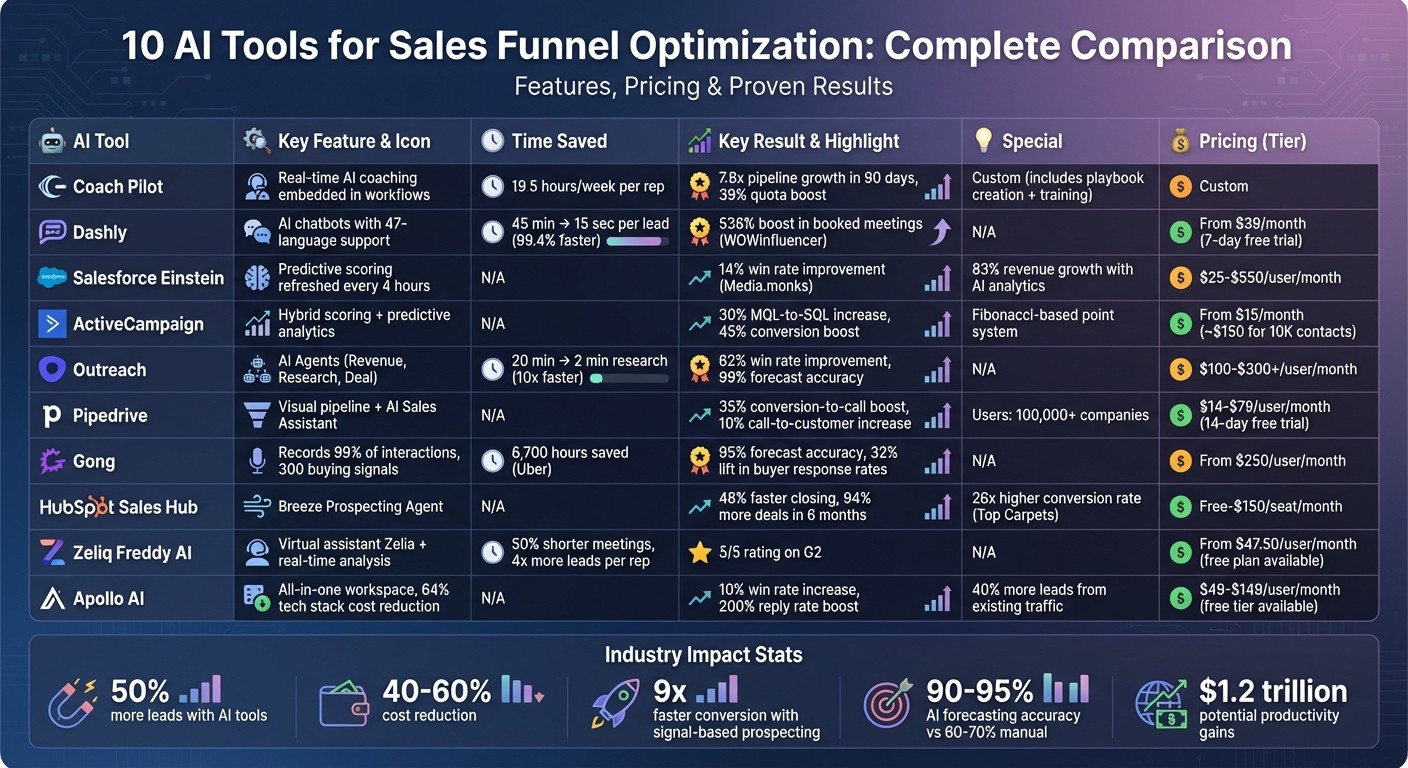
10 AI Sales Funnel Tools Comparison: Features, Pricing, and Key Results
How AI can Help You Improve Sales Funnel
1. Coach Pilot
Coach Pilot transforms traditional playbooks into real-time, actionable sales strategies. By embedding AI-powered coaching directly into sales workflows, it provides real-time guidance for every stage of the sales process. This approach helps sales teams make smarter, faster decisions.
Pipeline Automation Features
Coach Pilot takes the hassle out of manual CRM updates by automatically capturing deal data. This automation saves sales reps an average of 19.5 hours per week - time that can be redirected toward selling instead of data entry [4]. The platform ensures CRM systems are always up-to-date with accurate deal information, removing the need for manual input or recall.
Using advanced pattern recognition, Coach Pilot identifies strategies that drive success. Whether it’s pinpointing the right time to involve executives, navigating procurement processes, or crafting the most effective talking points for specific buyer personas, the platform provides actionable insights. For example, Coach Pilot might suggest:
Email the CFO by Thursday with this message. Call the economic buyer Friday at 9am. Use these talking points that closed three similar deals [4].
These insights empower sales teams to act with precision and confidence.
Conversion Analytics
Coach Pilot doesn’t just offer static advice - it delivers dynamic, real-time coaching tailored to the situation. By integrating seamlessly with tools like Microsoft Teams and ChatGPT for Teams, it provides 24/7 support within platforms reps already rely on [4]. This capability has driven impressive results for users, including a 7.8x increase in pipeline growth within 90 days and a 39% boost in quota attainment [4].
Pricing in USD
Coach Pilot offers starter packages with pricing customized to fit each organization’s unique sales process [4]. This includes not only the AI coaching tool but also sales playbook creation and live training workshops, ensuring the solution is tailored to meet specific needs.
2. Dashly
Dashly takes AI-driven strategies to the next level by focusing on top-of-funnel engagement. Its AI-powered chatbots interact with website visitors and automatically qualify leads, saving time for sales teams. Instead of relying on manual reviews, Dashly uses targeted "Strong Questions" to assess a prospect's buying potential. This method has helped businesses achieve lead qualification rates as high as 80% [6].
Lead Scoring Capabilities
Dashly gathers essential details like budget, industry, team size, and pain points through conversational quizzes. Based on the responses, the platform segments leads into three priority groups: Group A (ready to buy), Group B (requires nurturing), and Group C (cold leads). This segmentation ensures sales teams can focus their efforts on the most promising opportunities.
Pipeline Automation Features
Dashly’s AI agents work around the clock in 47 languages, responding to inquiries in under a minute - far faster than the typical four-hour wait time. By automating tasks like initial engagement and meeting scheduling, the platform reduces the time spent per lead from 45 minutes to just 15 seconds - a staggering 99.4% improvement. For example, WOWInfluencer saw a 536% boost in booked meetings after implementing Dashly’s automation tools [7][8][9]. These features are complemented by real-time analytics that provide insights into conversion performance.
Conversion Analytics
Dashly monitors visitor behavior in real time, offering visual dashboards to pinpoint where users drop off in the funnel. Its A/B testing tools allow teams to experiment with different chatbot scenarios to find the most effective approach. The platform also integrates seamlessly with CRMs like Salesforce and HubSpot, alongside over 30 other tools, ensuring all data stays synced and accessible [11].
Pricing in USD
Dashly provides a 7-day free trial for users to explore its features [5]. Paid plans start at $39 per month, with custom pricing available for businesses based on their website traffic and specific requirements [10]. All paid plans include unlimited agent seats, making it scalable for teams of any size.
3. Salesforce Einstein
Salesforce Einstein takes CRM tools to the next level by embedding AI to optimize your sales funnel. It doesn’t just streamline lead management; it predicts which leads and deals are worth your team’s time based on both historical data and real-time engagement. Unlike basic scoring systems, Einstein evaluates both business compatibility and buyer interest, refreshing scores every four hours to ensure your pipeline stays accurate and up-to-date [12].
Lead Scoring Capabilities
Einstein offers two scoring models to help prioritize your leads effectively. The Einstein Lead Scoring model analyzes historical data from both standard and custom fields to identify patterns linked to successful conversions. It then assigns scores based on these patterns. Meanwhile, Einstein Behavior Scoring focuses on real-time engagement signals - like link clicks or form submissions - and assigns a score from 0 to 100 to gauge how ready a prospect is to make a purchase [12].
Beyond just numbers, Einstein provides insights into what’s driving a lead’s score. For instance, it highlights “Top Positive” and “Top Negative” factors, such as frequent email opens or a lack of recent activity. For opportunities already in the pipeline, Einstein Opportunity Scoring categorizes deals into High (67–99), Medium (34–66), and Low (1–33) tiers. One notable success story: Media.monks improved their win rate by 14% using this feature [14][15].
These scoring tools integrate seamlessly with automated pipeline management, keeping your sales process efficient and data-driven.
Pipeline Automation Features
Einstein doesn’t just score leads - it keeps your pipeline moving with advanced automation. Einstein Activity Capture syncs emails, calendar events, and contact data directly into your CRM, giving you real-time visibility into your pipeline [15][17]. The Agentforce feature simplifies lead qualification by automating research and delivering high-value opportunities to your sellers only when they’re ready to buy. This automation speeds up meeting preparation by 33% and boosts win rates by 10% [15][16].
Einstein also keeps your pipeline up-to-date by automatically adjusting deal stages and lowering scores for inactive prospects, reducing the need for manual updates [12]. This ensures your sales team always has the most accurate data at their fingertips.
Automation like this paves the way for deeper insights into your sales conversations.
Conversion Analytics
With its up-to-date pipeline data, Einstein Conversation Insights identifies the key factors behind wins and losses - like pricing objections, competitor mentions, or a lack of follow-up. It flags critical moments in calls and video meetings, so managers can refine strategies without having to review entire recordings [18]. Dain Rasmussen, SVP of Sales at Inspirato, shared:
Conversation Insights has been invaluable when it comes to digital coaching and reinforcing best practices for our sales team. The ability to share what messaging is most effective across our remote workforce has made all the difference. [18]
Einstein also benchmarks current deals against similar historical ones, spotting opportunities that might have stalled. By analyzing synced email and calendar data, it reveals the optimal mix of activities and contacts needed to push deals forward. The results speak for themselves: teams using AI for sales analytics reported revenue growth 83% of the time, compared to 66% for those who didn’t [19].
Pricing in USD
Einstein Opportunity Scoring is included at no extra cost in the Enterprise, Performance, and Unlimited editions [13]. For teams interested in Einstein Conversation Insights, it’s available as a $50 per user/month add-on [18].
4. ActiveCampaign
ActiveCampaign combines point-based scoring with AI-driven predictive analytics to identify prospects most likely to convert. Rather than relying solely on manual rules, the platform evaluates historical customer behavior and real-time engagement to rank leads by their actual likelihood of conversion [22][25]. It dynamically adjusts scores using both explicit data (like job titles or industries) and implicit signals (such as email clicks or visits to pricing pages) [20][24][25].
Lead Scoring Capabilities
This hybrid scoring approach allows businesses to create tailored systems for different products or services. Leads are automatically funneled into the right nurture sequences based on their scores [25]. Once a lead reaches a specific threshold, the platform triggers CRM actions, streamlining sales enablement processes [20][25]. The results speak for themselves: LearnUpon saw a 30% increase in MQL to SQL conversions, while ZoomInfo boosted sales conversions by 45% through prioritized lead scoring [20].
A clever strategy involves assigning point values based on the Fibonacci sequence (1, 2, 3, 5, 8, 13, 21). This creates a clear distinction between minor actions, like visiting a webpage, and major intent signals, such as requesting a demo [23]. Additionally, points can expire after a set period - like three months - preventing outdated activity from inflating scores [20][21]. These dynamic scoring systems ensure leads are always accurately ranked and ready for the next step.
Pipeline Automation Features
ActiveCampaign's AI Automation Builder simplifies workflow creation. Just describe your goals in plain language, and the system generates fully automated workflows [27]. It can route leads to sales reps based on criteria like geography, industry, deal size, or even a round-robin system [26][28]. Prospects are also automatically moved to the next pipeline stage when they perform specific actions, like clicking on a link or replying to an email, ensuring your CRM stays up-to-date without manual intervention.
Conversion Analytics
ActiveCampaign takes automation a step further with predictive insights. Its predictive win probability feature evaluates deal health in real time, helping you identify promising opportunities and flag stalled deals [26]. For instance, its behavioral analysis shows that leads who visit a pricing page twice in one week are 40% more likely to convert [22]. Alexa Drake from ActiveCampaign explains:
By spotting trends like these, predictive models learn which signals truly matter, helping separate high-intent leads from casual browsers. [22]
The platform also tracks individual email metrics - such as opens, clicks, and replies - to fine-tune outreach strategies [26]. Additionally, it analyzes which marketing efforts, like webinars or whitepapers, have the most direct impact on revenue and lead-to-customer conversion rates [22][26].
Pricing in USD
ActiveCampaign's pricing starts at $15 per month and scales based on the number of contacts [26]. For businesses managing around 10,000 contacts, the ActiveCampaign Plus plan costs about $150 per month [29]. A 14-day free trial is available, requiring no credit card and offering full platform access [26]. With a 4.5/5 star rating on G2 from over 14,000 reviews, users frequently highlight the seamless integration between its email marketing and CRM tools [26].
5. Outreach
Outreach is reshaping sales processes by combining prospecting, deal execution, and forecasting into a single platform. Its AI-powered tools process billions of interaction signals weekly to deliver predictions that sales teams rely on for decision-making [31]. The platform features specialized AI Agents: the Revenue Agent handles prospecting sequences, the Research Agent gathers detailed account intelligence, and the Deal Agent updates CRM systems automatically based on call signals [32][33].
Pipeline Automation Features
Outreach streamlines communication by coordinating touchpoints across email, phone, social media, and SMS. Its multichannel sequencing and automated task routing help sales reps focus on selling instead of administrative tasks [35]. Companies using these AI-driven workflows have reported 15–20% increases in reply rates [32]. For example, in 2025, Amplitude consolidated five separate platforms into Outreach, saving over $600,000 annually and streamlining its revenue processes [30].
The Deal Agent simplifies CRM management by updating opportunity fields based on meeting signals [33]. Meanwhile, the Research Agent eliminates manual searches by pulling insights from sources like 10Ks, news articles, and internal data to create customized account briefs [33]. Sales Director Andrei Grayson from Omniplex Learning highlights the platform's importance:
If you work at Omniplex Learning in sales, Outreach is the tool you start with. It's where our reps live, and it's central to how we manage deals, train new hires, and keep scaling successfully. [30]
These automation tools seamlessly integrate with advanced analytics to boost conversion rates.
Conversion Analytics
Outreach's conversation intelligence tool, Kaia, captures real-time action items and gauges buyer sentiment during calls, reducing the chances of deals slipping through the cracks [31]. Kaia boasts 81% accuracy in predicting deal closures, while revenue forecasts achieve 99% accuracy [34]. Pushpay, after adopting Outreach's analytics and coaching features, experienced a 62% improvement in win rates and exceeded their quota by 179% [36].
The platform's Deal Health Score aggregates engagement signals into a single metric, helping teams prioritize deals that need immediate attention [36]. Users of conversation intelligence tools close deals 11 days faster on average and are 36% more likely to secure follow-up meetings [36]. LivePerson, for instance, cut prospect research time from 20 minutes to just two - a 10× improvement - and saw a 35% increase in engagement rates [36].
Pricing in USD
Outreach offers three subscription tiers: Amplify Core, Amplify Plus, and Amplify Pro. Pricing is customized, but industry estimates suggest entry-level costs range from $100 to $160 per user per month, with advanced plans exceeding $300 per user per month [37][38]. On average, users report a 44% increase in meetings booked per month, a 20% rise in opportunities created, and a 13% boost in deal velocity [39].
6. Pipedrive
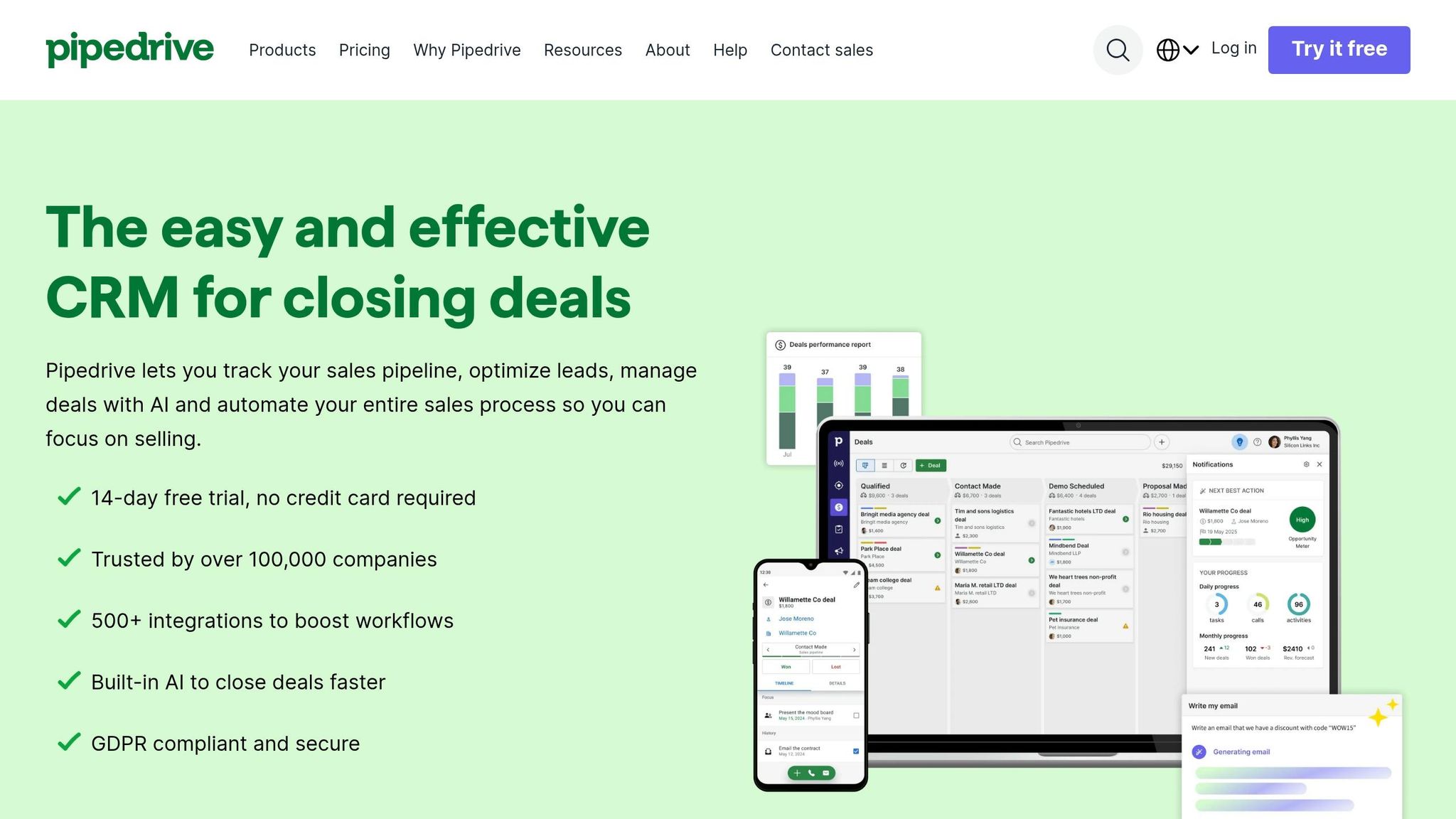
Pipedrive brings a visually-oriented approach to AI-driven funnel automation, catering to over 100,000 companies worldwide [43]. Its standout feature is the AI Sales Assistant, which analyzes historical deal data to predict win probabilities and flags stalled opportunities before they fall through the cracks [42][47]. Unlike traditional CRMs with cluttered dashboards, Pipedrive's activity-focused design keeps deals moving through every stage of the pipeline [50].
Pipeline Automation Features
Pipedrive simplifies B2B sales processes by automating key tasks. For example, it can create deals automatically when new contacts are added or transfer ownership at crucial stages [40][41]. Lead routing ensures prospects are assigned to the right sales reps based on custom rules, while automated follow-up sequences send personalized emails as deals progress [41][42]. The AI Sales Assistant also offers performance tips and highlights missing deal values, helping improve forecasting accuracy [40][42].
Jana Hodboďová, Chief Sales Officer at Leadspicker, shared her experience:
Our sales process has improved by 20% and overall hours spent on administrative tasks has been reduced by 40%. [43]
Monterail, a software company, reported impressive results after adopting Pipedrive’s automation tools, including a 35% boost in their conversion-to-call rate and a 10% increase in their call-to-qualified-customer conversion rate [49].
Conversion Analytics
Pipedrive pairs its automation with detailed conversion analytics, offering actionable insights through visual dashboards. These dashboards reveal where leads are stalling, helping teams fine-tune their strategies [45][47]. Features like "Better Opportunity" alerts highlight overlooked deals similar to past successes, enabling sales reps to focus on high-potential prospects [42][46]. The deal velocity analysis tracks how long deals linger in each stage, identifying bottlenecks that slow progress [47]. Additionally, the Prospector tool taps into a database of 400 million profiles to find the best-fit customers [44].
Suds Singh, Founder and MD of Interesting Content, praised the platform’s data-driven approach:
Pipedrive has enabled us to have instant access to that data, so it's not just quadrupling our revenue but ensuring that we have predictable revenue. [43]
Pricing in USD
Pipedrive offers four pricing tiers, with annual billing providing up to 42% savings compared to monthly payments [48][50].
Lite Plan: At $14 per user per month, this plan covers basic pipeline management and AI-generated reports [48].
Growth Plan: Priced at $39 per user per month, it includes email sync and automated nurturing sequences [48].
Premium Plan: For $59 per user per month, users gain access to custom lead scoring, automated lead routing, and AI email tools [48].
Ultimate Plan: At $79 per user per month, it adds features like phone and email data enrichment and sandbox testing [48].
The LeadBooster add-on costs $32.50 per month per company (billed annually) or $39 per month (billed monthly) and integrates chatbot and web form capabilities [44][48]. A 14-day free trial is also available, requiring no credit card [43].
7. Gong
Gong records 99% of customer interactions - calls, emails, and meetings - to deliver a precise, automated snapshot of your sales pipeline [58][59]. By analyzing 300 buying signals from customer conversations, it predicts which deals are likely to close and highlights those needing immediate attention [51][56].
Lead Scoring Capabilities
Gong's AI evaluates behavioral, engagement, transactional, and demographic data to estimate a prospect's likelihood of making a purchase [51]. Its "intent scoring" feature identifies high-value accounts by examining buyer engagement and sentiment [51][59]. For instance, DemandBase used Gong's intent scoring models to refine their lead qualification process, leading to a 25% boost in annual contract value [51]. Similarly, Hear.com tapped into Gong's conversation intelligence to monitor sales agent performance, achieving a 45% improvement in close rates [51].
With such precise lead assessments, Gong also simplifies workflow automation for sales teams.
Pipeline Automation Features
Gong Agents handle tasks like follow-up emails, pipeline updates, and CRM entries. Meanwhile, tools like the AI Deal Reviewer and daily to-do lists ensure timely deal updates and actionable insights [51][52][56]. In 2025, SpotOn adopted Gong to support its inside sales team. Matt McGonegle, their Director of Inside Sales, shared that they experienced a 16% increase in win rates, a 30% rise in revenue per sales rep, and 95% forecast accuracy. Additionally, onboarding time for new hires was cut by 60% [55].
Drew Korab, Director of RevOps at Upwork, highlighted Gong's impact:
Our forecast accuracy has grown to the point that we're now at 95%. Gong lets us run a predictable revenue organization, reduce the number of tools in our tech stack, and save tons of time on forecasting. [51]
Conversion Analytics
Gong's conversation intelligence transcribes and analyzes sales calls to uncover customer sentiment, intent, and effective talk tracks [51][57]. Its Deal Boards provide managers with centralized dashboards for clear visibility into pipeline health [54][57]. Additionally, AI-driven Deal Health Scores identify at-risk deals, allowing early intervention [59][61]. Naya Tsoukala, Head of Revenue Operations at Frontify, noted that using Gong to streamline pipeline management and forecasting resulted in a 30% increase in lead conversion, a 40% reduction in manual administrative tasks, and a 16% rise in win rates [58][60].
Damir Zecevic, Global Head of Revenue Operations at Uber for Business, shared:
Gong has saved us 6,700 hours across call prep, follow-up, and CRM updates. Gong's AI Tracker agent helped us lift buyer response rates by 32% by identifying which value props resonate most with different personas. [52]
Pricing in USD
Gong's pricing starts at around $250 per user per month, with annual costs ranging between $5,000 and $50,000 [62]. Notably, Gong includes integrations with tools like Salesforce, Zoom, and HubSpot at no extra charge [57]. While its pricing structure is ideal for larger companies, smaller teams might find it less accessible [53].
8. HubSpot Sales Hub
HubSpot Sales Hub builds on the idea of using AI to streamline sales processes, much like Gong. It offers tools like predictive lead scoring and automation to help sales teams focus on high-value prospects while cutting down on repetitive tasks. The Breeze Prospecting Agent is a standout feature, tracking buying signals such as funding announcements, leadership changes, and website activity to identify accounts that align with your Ideal Customer Profile. According to users, this platform has led to a 48% reduction in closing time and a 94% increase in deals within just six months [63].
Lead Scoring Capabilities
HubSpot uses machine learning to analyze a wide range of data points, assigning more weight to high-value actions like visits to pricing pages or email clicks, and deducting for inactivity. The Lead Management Workspace consolidates this data into an AI-powered dashboard, making it easy to filter prospects based on their score and engagement level [63]. In 2025, COPA-DATA launched the Sales Hub prospecting workspace worldwide, achieving a 5x increase in captured sales activities and a 3x faster MQL-to-SQL qualification rate [65]. Douglas Botchman, Director of Revenue Operations at Ceros, shared that implementing Sales Hub resulted in a 180% boost in deals from open meeting opportunities and an 18% growth in sales-qualified leads [65].
Sales Hub helps us prospect smarter. It makes our prospecting reps more productive, enables more relevant and personalized outreach, and empowers reps to get back to what they do best: connecting with prospects. - Douglas Botchman, Director of Revenue Operations, Ceros [65]
Pipeline Automation Features
HubSpot's AI tools take care of time-consuming tasks like lead research, qualification, and even scheduling meetings around the clock [64]. Multi-channel outreach sequences adjust dynamically based on how prospects respond to earlier messages. Features like smart queues ensure the most relevant leads are prioritized, while daily action summaries keep sales teams on track [63]. For example, in 2025, Andrew Romanyuk, Co-Founder of Pynest, used AI agents to analyze company behavior from open sources. This reduced lead screening time by 32%, allowing his team to concentrate on prospects showing genuine buying intent [66].
Conversion Analytics
HubSpot's Deal Pipeline Waterfall provides a detailed breakdown of revenue changes, categorizing deals into created, pushed, pulled, increased, decreased, lost, and won [67][68]. Automated reporting tools visualize conversion rates across funnel stages and track how long prospects spend in each stage, helping teams identify bottlenecks [67][68]. Closed-loop reporting connects marketing efforts to final sales outcomes, ensuring accurate performance tracking [67][68]. A compelling example comes from Top Carpets and Floors, an Australian retail flooring company. Over 12 months ending in 2025, they achieved a 26x higher conversion rate from organic traffic (climbing from under 1% to 7.38%), reduced their cost-per-lead by 98%, and increased organic traffic by 47% [69]. By combining analytics with automation, HubSpot empowers teams to refine their sales funnels more effectively.
Pricing in USD
HubSpot offers a range of pricing options to suit different team sizes and needs:
Free Plan: $0/month, includes basic deal tracking and meeting scheduling.
Starter Plan: Starts at $15 per seat/month, featuring automated outreach tools.
Professional Plan: Starts at $100 per seat/month, offering AI-powered forecasting and automated follow-ups.
Enterprise Plan: Starts at $150 per seat/month, unlocking advanced features like AI lead scoring, conversation intelligence, and custom objects [63].
It's worth noting that AI-powered lead scoring is exclusive to the Enterprise plan, while teams on lower tiers rely on manual scoring methods [63]. These pricing tiers ensure that businesses of all sizes can tap into HubSpot's AI-driven tools.
9. Zeliq Freddy AI
Zeliq brings together AI-driven prospecting and its virtual assistant, Zelia, to deliver real-time pipeline analysis. By streamlining every stage of the sales funnel with automation and actionable insights, Zeliq helps sales teams work smarter. With over 15,000 users onboard, the platform is credited with cutting meeting times by 50% and increasing leads per sales rep by four times [70]. Raphael Carriero, a user, highlighted how Zeliq has improved both efficiency and lead quality. It's no surprise the tool has earned recognition as a G2 High Performer, boasting a perfect 5/5 user rating [70][71]. With its blend of lead scoring and automation, Zeliq helps teams focus on what matters most - selling.
Lead Scoring Capabilities
Zeliq tracks key engagement signals like email opens, link clicks, and returned calls to rank prospects automatically. For instance, leads showing high engagement - such as opening emails twice or clicking links - are flagged as "Urgent", while unresponsive ones are labeled "Cold" [70]. Zelia also analyzes older leads and recent activity, offering quick recommendations to “bump, pause, or double-down” on specific opportunities [72].
Pipeline Automation Features
Zelia scans your sales pipeline to identify leads that need attention and generates follow-up drafts and tasks for easy one-click approval [72]. Its multichannel sequencer integrates emails, phone calls, and LinkedIn actions into a single workflow, removing the hassle of switching between tools. This feature addresses a common challenge - sales reps often spend up to 70% of their time on non-selling tasks. By automating these processes, Zeliq gives reps more time to focus on closing deals [72].
Pricing in USD
Zeliq provides a free plan for teams just starting out, while paid plans start at $47.50 per user per month [71].
10. Apollo AI
Apollo AI brings prospecting, outreach, and intelligence into one streamlined workspace, helping businesses cut tech stack costs by up to 64% while boosting sales efficiency [75]. With access to millions of contacts and companies, the platform uses machine learning to analyze thousands of signals - like company size, tech stack, website activity, and past interactions - to predict which prospects are most likely to convert [73]. Apollo’s AI models seamlessly integrate with CRMs like Salesforce and HubSpot, leveraging historical data to refine predictions. For example, Built-In reported a 10% increase in win rates by using Apollo's pipeline visibility and interaction tracking tools [75]. Another standout feature? Its real-time lead scoring that drives targeted outreach.
Lead Scoring Capabilities
Apollo’s AI-driven scoring models update in real time, letting sales reps filter leads directly in search results to prioritize outreach [74]. What sets Apollo apart is its transparency - users can see the exact criteria and weightings behind each lead’s score. Businesses can also create custom scoring models tailored to their needs [74]. Kaleb Jessee, VP of Sales at Talent Quest, highlighted this advantage:
Apollo's scores are in a league of their own due to their wealth of data. Setting up score models is a breeze, and the results are lightning-fast [74].
With a 4.8/5 rating on G2 and top rankings among AI sales tools, Apollo’s reputation speaks for itself [74].
Pipeline Automation Features
Apollo simplifies sales workflows by automating prospect research, cutting time spent on intelligence gathering from hours to minutes [75]. Its multi-channel sequences adapt dynamically, triggering follow-ups based on real-time prospect behavior [77]. For instance, Smartling’s BDRs increased their personalized email output by 10× using Apollo’s writing and research tools, while Afriwise saw a 200% increase in reply rates within just one week [77]. The platform also automatically enriches and updates contact records, leads, and accounts - eliminating manual data entry. Andrew Froning, BDR Leader at Cyera, shared his experience:
Every rep is more productive with Apollo. We booked 75% more meetings while cutting manual work in half [76].
Conversion Analytics
Apollo tracks conversion rates at every stage of the sales funnel - Awareness to Lead, Lead to MQL, MQL to SQL, and SQL to Opportunity - helping teams identify where prospects drop off [78]. It also analyzes which content assets and website pages generate the most qualified leads, comparing conversion rates across sources to measure revenue impact [78]. By monitoring website visits, email interactions, and LinkedIn activity, Apollo’s behavioral intent analysis gauges buying intent even before prospects fill out forms [79]. Its AI-powered visitor identification can capture 40% more leads from existing website traffic [78]. Nicole Coetzer, Head of Sales Development at Kinsta, noted:
Leveraging Apollo helped her team achieve a consistent 36% connection rate while routinely exceeding quota [76].
Pricing in USD
Apollo provides a free tier for basic prospecting and sequencing. Paid plans start at $49 and go up to $149 per user per month, with AI-generated scoring models included in the Professional and Custom plans [3].
Conclusion
AI tools have reshaped how businesses approach every stage of the sales funnel, streamlining processes and boosting efficiency. By automating time-consuming administrative tasks, these tools free up sales teams to focus on what they do best - selling. For instance, signal-based prospecting, which tracks real-time events like funding rounds and job changes, converts prospects 9 times faster than traditional cold outreach methods [1]. Meanwhile, AI-powered forecasting achieves an impressive 90% to 95% accuracy, far surpassing the 60% to 70% accuracy of manual methods [2].
Conversation intelligence platforms are another game-changer. These tools analyze sales calls to uncover effective strategies and common objections, helping managers replicate top-performing behaviors across their teams. Companies with AI-driven coaching programs have seen their annual revenue growth rise by 16.7% [1].
AI also plays a critical role in addressing bottlenecks in the funnel. By monitoring conversion rates at each stage, teams can identify where prospects are stalling and take action before deals are lost. Businesses using domain-specific AI tools report 81% shorter deal cycles and 73% larger deal sizes - a clear testament to the power of AI [2].
The shift is unmistakable: static lead lists are giving way to real-time intelligence, generic outreach is being replaced by hyper-personalized messaging, and reactive selling is evolving into predictive engagement. Generative AI alone has the potential to add up to $1.2 trillion in productivity gains across sales and marketing [1]. To start, focus on the weakest part of your funnel. Clean up your CRM data, implement one AI tool to address that pain point, measure the results, and expand from there [1].
With the right AI tools in place, sales teams can transform into high-performing revenue engines - automating prospecting, scaling personalized outreach, and embedding real-time coaching into their daily workflows. The future of sales is here, and it’s powered by AI.
FAQs
Which part of my sales funnel should I automate first with AI?
Start with automating lead qualification and initial outreach. By leveraging AI to sift through customer data, you can pinpoint high-potential leads without spending hours on manual research. This not only saves time but also streamlines your process.
You can also automate follow-ups and nurturing efforts at the top of the funnel. Sending consistent, personalized messages keeps prospects engaged and nudges them closer to conversion. This strategy ensures your sales process stays flexible and adapts to how buyers behave.
What data is needed for accurate AI lead scoring?
Accurate AI lead scoring hinges on having high-quality data. This includes demographic details like job titles and company size, firmographics such as industry, revenue, and location, behavioral data (think website visits and email interactions), and intent signals that indicate purchase interest.
To keep your models effective and relevant, it’s crucial to regularly update and integrate these data sources. When your data is diverse and reliable, AI can better identify patterns, making lead qualification and prioritization much more precise.
How can I measure ROI from AI funnel tools in 30–90 days?
To gauge ROI within the first 30–90 days, keep an eye on critical metrics like lead conversion rates, sales cycle length, and cost per lead. Compare these figures to your pre-AI benchmarks, such as revenue per sales rep and lead quality. During this timeframe, pay close attention to changes in sales efficiency, cost reductions, and revenue growth. Use these insights to evaluate the impact and fine-tune your strategies to maximize returns.
Related Blog Posts

Remove the guesswork from winning more deals.