B2B Sales
Scaling Leadership with AI: Challenges and Solutions
Mar 12, 2026
AI coaching and analytics fix coaching gaps, improve forecasting, speed onboarding, and help sales leaders scale teams with data-driven insights.

Sales leadership doesn’t scale automatically as teams grow. Expanding from small groups to larger teams brings challenges like limited coaching, poor forecasting, slow onboarding, and resistance to AI tools. Without addressing these issues, companies risk falling behind competitors leveraging AI to optimize sales enablement processes.
Here’s the key takeaway: AI tools like Coach Pilot can help sales leaders overcome these hurdles by analyzing 100% of interactions, providing tailored coaching, improving pipeline visibility, and accelerating onboarding. Companies using AI report faster sales cycles, larger deal sizes, and higher revenue growth.
Key Points:
Coaching Gaps: Managers review only 10% of calls, leaving most reps without feedback.
Forecasting Issues: Leaders see just 3% of customer interactions, leading to inaccurate forecasts.
Slow Onboarding: New reps take 6–9 months to reach full productivity.
AI Resistance: Teams fear AI will disrupt workflows or expose weaknesses.
AI Solutions:
Automated Coaching: AI analyzes all calls, emails, and CRM data for real-time feedback.
Improved Forecasting: Tracks behavioral signals and flags at-risk deals.
Faster Onboarding: Offers unlimited practice with AI avatars and standardized training.
Gradual Adoption: Introduces AI in "shadow mode" to build trust and familiarity.
AI isn’t replacing managers - it’s amplifying their ability to lead at scale. Companies using tools like Coach Pilot have seen results like a 30% revenue increase, 7.8× pipeline growth, and 39% improvement in quota attainment. The future of sales leadership lies in combining human judgment with AI-driven insights.
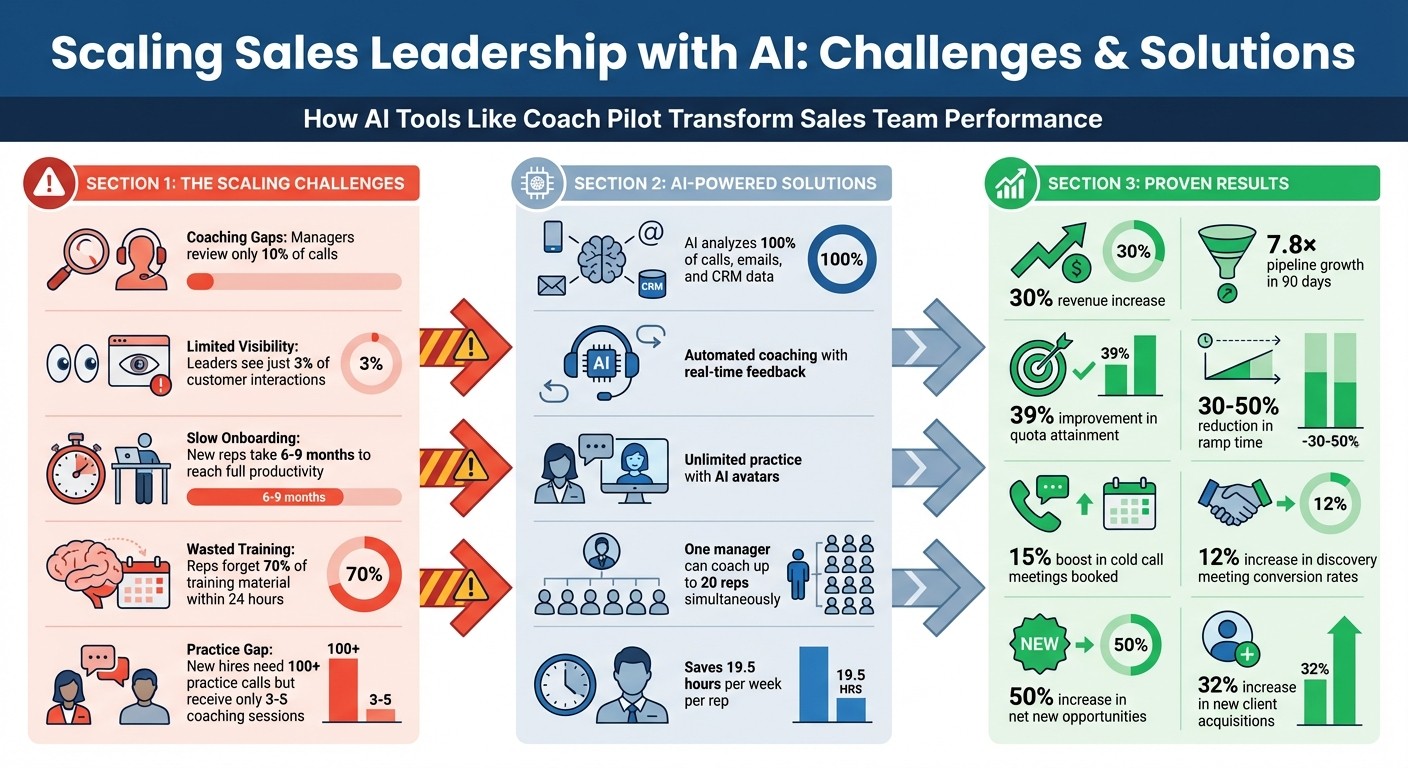
AI Impact on Sales Leadership: Key Statistics and Results
Common Challenges When Scaling Sales Leadership
Not Enough Coaching Time for Growing Teams
Sales managers often struggle to provide adequate coaching as their teams grow. They typically review only a small percentage of calls, leaving many interactions without guidance. For teams with more than 20 representatives, traditional one-on-one coaching models become less effective [5]. New hires, who need over 100 practice calls to gain confidence, may only receive 3–5 coaching sessions during onboarding [10]. This gap means feedback often arrives too late - after reps have already repeated the same mistakes [5][3]. Compounding the issue, regional teams frequently use different coaching methods, creating inconsistencies across the organization [5]. These coaching bottlenecks contribute to broader problems like poor forecasting and inefficient onboarding.
Poor Forecasting and Pipeline Visibility
Sales leaders often lack a clear view of their team’s activities. On average, they have visibility into just 3% of customer interactions, leaving 97% of calls, discovery sessions, and negotiations unexamined [8].
"Most sales leaders admit they only have visibility into about 3% of their team's customer interactions. That means 97% of sales calls, discovery calls, and negotiations happen in a black box."
– Jonathan M Kvarfordt, Head of GTM Growth, Momentum [8]
This limited oversight not only hinders coaching but also impacts forecasting accuracy. Less than half of sales leaders express confidence in their forecasts [6]. The problem stems from reliance on subjective inputs - sales reps often overestimate their pipeline health [6]. Additionally, revenue-related data is scattered across various systems, such as CRMs, analytics platforms, and customer success tools, making it hard to form a cohesive view [6]. Without standardized qualification frameworks like MEDDIC or BANT, pipeline definitions vary across teams. Many CRM dashboards add to the challenge by offering retrospective insights instead of real-time alerts that could guide interventions [8].
Slow Onboarding and Skill Development
Onboarding new sales reps is notoriously slow, often taking 6–9 months for them to reach full productivity. This delay translates to 3–6 months of reduced output per hire, and for a team of 10, it can result in a collective loss of 30–60 months of productivity annually [10]. Early prospect calls during onboarding often become "practice" sessions, wasting valuable leads [10]. Complicating matters, sales reps forget about 70% of new training material within 24 hours if it isn’t reinforced [10]. This leads to "messaging decay", where reps stray from the intended value proposition, creating an inconsistent experience for prospects. Managers then spend more time correcting these errors, leaving less room for strategic initiatives [3][10]. These inefficiencies highlight the need for quicker, more effective skill development.
Team Resistance to AI Tools
Cultural resistance can also slow the adoption of AI solutions. Sales reps often fear AI will expose weaknesses, leading to performance anxiety. Changes to established workflows and concerns about learning new tools further contribute to the hesitation [10]. Data quality issues add another layer of complexity, as Forrester notes: "Data quality is the primary factor impeding genAI enablement in B2B sales" [1].
"If you are not willing or able to become a great coach of skill, it's going to be over for you really fast. This is happening. There are no more bushes to hide behind."
– Brian Walsh, Managing Director, Force Management [9]
To ease the transition, organizations can introduce AI in "shadow mode", running it alongside existing processes for 2–4 weeks to align its feedback with the team’s sales methodology before fully implementing it [3]. AI isn’t meant to replace human judgment but to provide data-backed insights that improve performance. Overcoming resistance requires clear communication about these benefits and a structured approach to integration.
How AI Solves Leadership Scaling Problems
Delivering Coaching at Scale with AI
As teams grow, traditional coaching methods often fall short. Managers typically review less than 10% of calls, leaving most interactions without guidance [4]. AI changes the game by analyzing and providing feedback on 100% of prospect interactions [4].
AI operates through three key layers: post-call analysis (acting as "game tape" to transcribe and highlight patterns), role-play simulations (a practice field where reps train with AI avatars), and real-time call guidance (prompting actions like "ask about budget" or "slow down") [4].
"AI provides the diagnostics; the manager provides the cure."
– Momentum.io [8]
AI also enables what’s called "invisible shadowing", where managers can monitor all live calls simultaneously but only receive alerts for specific deviations - like a competitor being mentioned or a drop in sentiment [4]. This allows one manager to effectively coach up to 20 reps at once [4]. Companies using AI coaching have seen impressive results, including a 30–50% reduction in ramp time, a 15% boost in cold call meetings booked, and a 12% increase in discovery meeting conversion rates [2].
Platforms like Coach Pilot embed AI-driven feedback directly into workflows, generating scorecards based on methodologies like MEDDICC or SPICED immediately after calls. These scorecards highlight areas like discovery depth and next steps, making coaching more precise and data-driven [3][9]. By identifying top performers' micro-skills and flagging gaps, AI simplifies forecasting, speeds up onboarding, and streamlines tool adoption.
Better Forecasting Through AI Analytics
AI doesn’t just enhance coaching - it offers a clearer view of the sales pipeline. While leaders typically access only 3% of customer interactions, AI analyzes 100% of calls, emails, and CRM activity for a comprehensive perspective [8][3].
By automating data capture, AI eliminates the inaccuracies of manual updates, integrating key metrics like objections, MEDDIC fields, and persona pain points directly into CRMs [9]. Instead of relying on optimistic forecasts, AI tracks behavioral signals such as multi-threading, executive engagement, and the quality of next steps [7].
AI also flags at-risk deals by identifying execution gaps - like missing stakeholders or unclear close plans - rather than depending solely on rep updates [3][7]. Companies leveraging AI for sales are 1.3 times more likely to see revenue growth [7], and conversational intelligence improves win rates by 12% compared to traditional coaching alone [5].
With real-time feedback during or right after calls, AI enables proactive interventions before deals slip away [8][5]. Tools like Coach Pilot consolidate these insights with CRM data, pinpointing behaviors that lead to closed deals more reliably [5].
Faster Onboarding with AI-Powered Training
AI also accelerates onboarding for new hires. Traditional onboarding often limits practice opportunities, leaving reps underprepared for real-world scenarios. AI solves this by offering unlimited practice sessions with AI avatars in a controlled setting [10].
This approach significantly shortens ramp-up time. AI-assisted coaching can cut the time-to-first-deal by 30–50%, reducing the typical 6–9 month ramp to just 2–3 months [10][4]. Instead of passively shadowing live calls, new hires engage in simulated "ride-alongs", practicing objection handling and value delivery without risking real leads [10][12].
AI ensures consistency by using standardized rubrics and scorecards for evaluations, offering uniform feedback regardless of the manager [10][3]. It also benchmarks new hires against top performers by analyzing patterns like talk-to-listen ratios and discovery questions, setting clear training standards [11][5].
"Reps enter live calls experienced and confident... they make mistakes with AI prospects, not real pipeline opportunities."
– Sellible [10]
Coach Pilot enhances onboarding with custom sales playbooks and immersive training. AI provides instant feedback during practice, addressing the "forgetting curve", where individuals lose 70% of new information within 24 hours [10]. This frequent, focused practice builds muscle memory faster than traditional methods.
Getting Teams to Adopt AI Successfully
For AI to truly transform coaching, analytics, and onboarding, successful adoption is key. Resistance can arise when reps worry that AI might expose weaknesses or disrupt their workflow [10]. The solution? Gradual implementation.
A proven strategy is starting in "shadow mode", running AI alongside current processes for 2–4 weeks. This builds trust by aligning AI recommendations with manager judgment before full rollout [3]. Automating repetitive tasks like CRM updates and follow-ups also helps secure buy-in [8].
"AI won't fix a broken rhythm, but it will supercharge a good one."
– Brian Walsh, Managing Director, Force Management [9]
Integration is another critical factor. Embedding AI insights into tools teams already use - like Salesforce or Slack - reduces tool fatigue [9][3]. Establishing a weekly rhythm, such as reviewing AI coaching queues on Mondays, using prompts during midweek one-on-ones, and summarizing team trends on Fridays, can streamline the process further [3].
Defining success is equally important. Documenting top discovery calls and deal stages provides a benchmark for AI to measure performance [8][9]. Coach Pilot supports this by creating tailored playbooks that align with your sales methodology, ensuring AI reinforces the right behaviors from day one. Its seamless integration with existing workflows makes adoption feel natural rather than disruptive.
Scaling Enterprise Sales Teams in the AI Era: Strategy and the CRO Playbook | MSP #306
How to Implement Coach Pilot for Leadership Scaling
Tackling leadership gaps starts with integrating AI through Coach Pilot.
Creating Custom Sales Playbooks
A well-structured sales playbook lays the foundation for success. Coach Pilot helps centralize your team's core strategies - messaging, deal stages, objection handling, and proof points - into a streamlined, repeatable AI-driven process. For intricate B2B sales, the platform identifies nuanced patterns, like when to involve executives or how to manage procurement hurdles, and integrates these insights into its AI system. This strategy is embedded into tools like Microsoft Teams or Microsoft Copilot, ensuring real-time updates and seamless workflow integration [13].
In May 2024, Rebecca Veksler, Co-Founder of Four Rooms, leveraged these strategies to triple monthly sales and close 14 deals. Similarly, in June 2024, Connor Bell, Business Development Manager at HubSpot, refined his sales approach over 11 weeks, closing 12 deals, increasing net new opportunities by 50%, and boosting quarterly sales revenue by 38% [13].
"The evolving playbook not only helped me meet my target, it exceeded it early on."
– Craig Cant, Head of Sales, Industry Best
Teams adopting this approach often see a 7.8× pipeline growth within 90 days and a 39% improvement in meeting sales quotas [13].
Once the playbook is in place, the next step is incorporating AI coaching for real-time performance enhancements.
Using AI Coaching and Performance Analytics
With your playbook established, embedding AI coaching into daily routines can sharpen execution. Live workshops reinforce strong habits, while a coaching scorecard (featuring 6–10 key behaviors aligned with sales methodologies like MEDDICC or Challenger) ensures objective tracking. Real-time prompts - like reminders to "ask about budget" or "mention the new case study" - integrate seamlessly into platforms such as Microsoft Teams. A structured weekly cadence keeps coaching effective yet manageable, with Monday coaching queues, midweek one-on-ones, and Friday summaries [13].
In May 2024, Naum Sekulovski, Business Development Manager at Food By Us, used Coach Pilot training to secure 13 contracts in just 9 weeks, driving a 45% increase in sales revenue. Later, in December 2024, Stephen Luxmoore, Founder & CEO of Your HR Team, achieved a 32% rise in new client acquisitions, with 8 contracts signed over a similar period [13].
"The AI is insane, and the weekly live coaching is even more helpful. We can bring in real-life problems and have the coaches give specific examples and solutions."
– Linh Podetti, CEO, Virtual Outsourced Angels
By automating tasks like deal capture and CRM updates, AI saves reps an average of 19.5 hours per week [13]. These time savings allow teams to focus on high-value activities, driving better results.
Tracking Results with Performance Metrics
To measure the impact of Coach Pilot, focus on metrics that reflect efficiency and revenue growth. Key performance indicators include:
Pipeline Growth: Expansion of the sales funnel as reps apply proven strategies.
Quota Attainment: Percentage of team members hitting their targets.
Time Saved: Reduction in time spent on administrative tasks.
Revenue Growth: Direct impact on overall sales figures.
New Client Acquisitions: Turning prospects into signed deals.
Net New Opportunities: Generating fresh leads and deals.
With AI-generated scorecards and performance analytics, leaders can conduct data-driven one-on-ones to address skill gaps. The platform also keeps your CRM updated with accurate, real-time deal data.
Metric | Typical Result | Timeframe |
|---|---|---|
Pipeline Growth | 7.8× increase | 90 days |
Quota Attainment Lift | 39% improvement | Ongoing |
Time Saved per Rep | 19.5 hours/week | Immediate |
New Client Acquisitions | 32% increase | 9 weeks |
Net New Opportunities | 50% increase | 11 weeks |
"We've significantly increased our pipeline and boosted our bottom line. I highly recommend Coach Pilot to any business owner looking to drive sales fast."
– Costa Vasili, CEO, Ethnolink [13]
Conclusion
AI tools are stepping up to tackle some of the biggest challenges sales leaders face when growing their teams. From limited coaching capacity to inconsistent forecasting, slow onboarding, and resistance to adopting tools, these solutions aim to simplify and improve the entire process. The result? Greater efficiency and a stronger, more lasting impact for leaders.
Take Coach Pilot, for example. This tool integrates AI sales coaching into everyday workflows, offering unbiased scorecards that highlight skill gaps and deliver personalized feedback [16]. Automated CRM updates also allow sales reps to focus on what matters most - driving revenue [14]. By analyzing buyer behavior and tracking measurable actions tied to your sales strategy, AI helps leaders move past gut instincts. Instead, it provides data-driven insights to identify at-risk deals before they hit a standstill [14][15]. Companies leveraging AI for learning and coaching have even seen 29% higher sales growth compared to those sticking with traditional methods [16]. These tools aren’t just about solving today’s problems - they’re about preparing sales leaders for tomorrow’s demands while keeping the human element intact.
The shift in sales leadership is clear: it’s no longer just about working harder but working smarter. By automating repetitive tasks and scaling coaching efforts, leaders can grow their teams predictably without losing the personal connection that makes sales so effective.
FAQs
What data does AI need to coach my sales team accurately?
AI thrives on data from various sources like sales conversations, calls, emails, CRM activity, and identified skill gaps. By analyzing this information, it delivers personalized feedback and real-time insights that help boost team performance effectively.
How can we roll out AI coaching without hurting rep trust or morale?
To bring AI coaching into the mix without affecting trust or morale, it's essential to position it as a support tool rather than something that replaces human expertise. Make sure to highlight its advantages, like helping scale coaching efforts, delivering tailored feedback, and improving clarity in processes. Let reps know that AI is there to support their development by offering unbiased insights and addressing any coaching gaps. Including them in the rollout process can build trust and create a more welcoming environment for this new approach.
Which metrics best prove Coach Pilot is improving revenue and forecasting?
Key metrics to watch are increased pipeline value, higher win rates, and better forecast accuracy. For instance, AI-driven sales tools can sharpen coaching efforts, resulting in stronger deal outcomes and more accurate predictions. These advancements connect strategy with execution, ultimately boosting revenue in a measurable way.
Related Blog Posts

Remove the guesswork from winning more deals.