B2B Sales
10 Tips to Optimize Opportunity Stages
Apr 10, 2026
Align opportunity stages with buyer milestones, set clear entry/exit rules, use data-driven probabilities, automate progression, and train reps.

Opportunity stages are the backbone of a successful sales pipeline. When properly structured, they improve forecasting, identify bottlenecks, and simplify sales cycles. Misaligned or vague stages, however, can lead to poor results and missed revenue opportunities.
Here’s how to optimize your opportunity stages for better sales outcomes:
Map stages to your sales process: Align stages with buyer actions, not internal tasks.
Set clear criteria: Define specific entry and exit requirements for each stage.
Use data for probabilities: Base close probabilities on historical trends, not guesswork.
Simplify stages: Avoid excessive or unclear stages to keep your pipeline clean.
Track key metrics: Monitor conversion rates, stage duration, and pipeline velocity.
Automate updates: Use triggers to move deals through stages and reduce manual tasks.
Leverage AI coaching: Provide real-time guidance to reps during critical deal moments.
Customize stages: Tailor stages to reflect buyer milestones for better deal insights.
Use analytics tools: Turn data into actionable insights for improving pipeline performance.
Train your team: Ensure reps understand and apply stage best practices consistently.
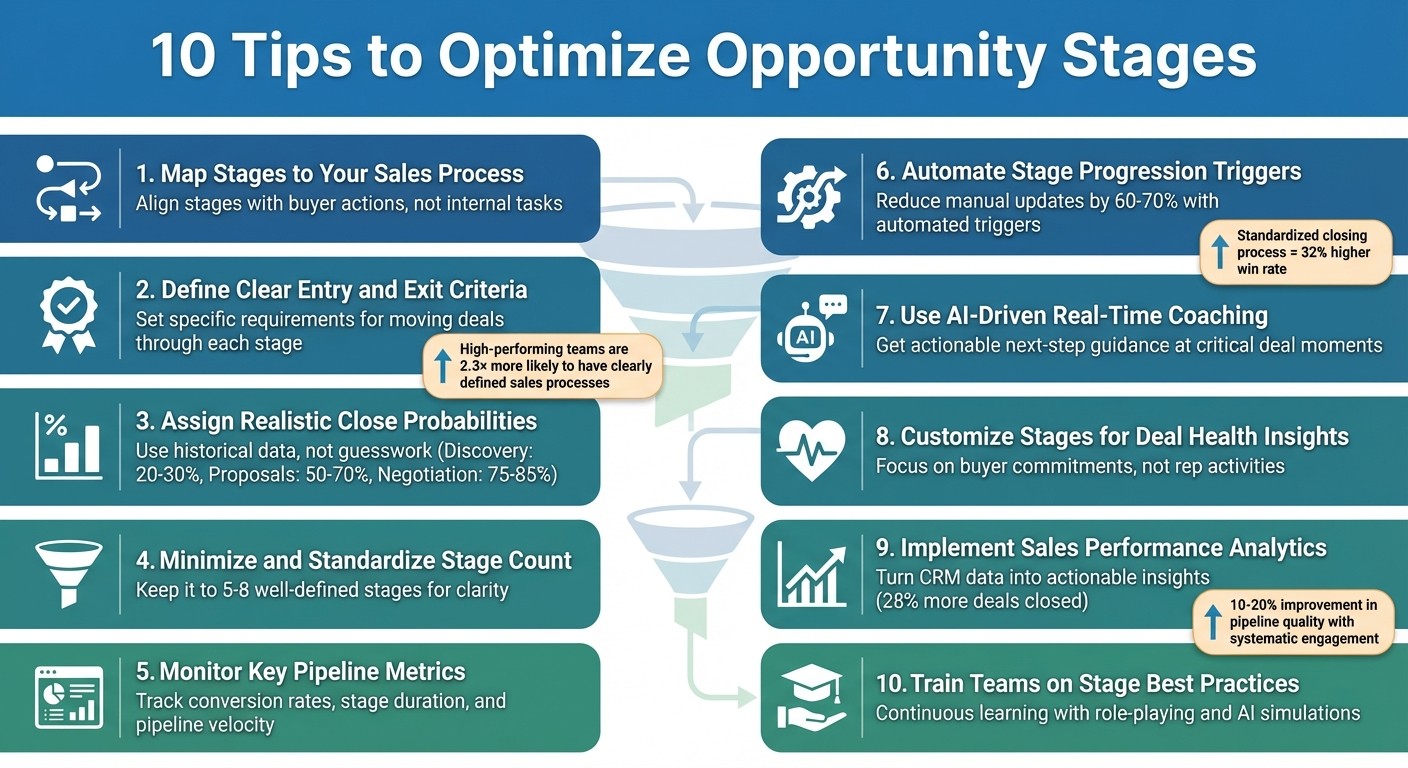
10 Tips to Optimize Sales Opportunity Stages
1. Map Stages to Your Actual Sales Process
Your opportunity stages need to mirror your sales process and how your buyers make decisions. If there's a mismatch, it can throw off your forecasts, make pipeline discussions unproductive, and lead to missed chances for coaching. Hannah Recker, Head of Growth Marketing at Coefficient, highlights the importance of alignment:
"If your Salesforce opportunity stages don't reflect how your team actually sells and your buyers actually buy, you can't forecast with confidence." [4]
Work closely with your sales team to map out every step from the initial contact to closing the deal using a B2B sales playbook. Each stage should represent a clear, measurable action - not just a vague status. As RT Dynamic advises:
"If reps can't say what happened in a stage, it shouldn't exist." [3]
Instead of using internally focused terms like "Demo Scheduled", switch to buyer-oriented milestones such as "Pain Points and Timeline Documented" or "Solution Accepted by Champion." This approach ensures your stages reflect genuine deal movement rather than just internal tasks.
Leverage Stage Duration Reports to identify where deals advance or get stuck, and check if your CRM stages align with how buyers behave. Schedule quarterly reviews with sales managers to ensure your process keeps pace with changing market dynamics. Misaligned stages aren't just a data issue - they can hide which deals are likely to close, ultimately affecting your bottom line. To take it a step further, define clear entry and exit criteria for each stage to sharpen your pipeline's accuracy.
2. Define Clear Entry and Exit Criteria
Once your sales stages align with your process, the next step is to establish specific requirements for moving deals through each stage. This ensures consistency and removes guesswork. Without these criteria, sales reps might rely on subjective opinions, which can hurt forecast accuracy and disrupt pipeline management. Elizabeth Nanosh from Evenbound emphasizes this point:
"Each stage should answer one clear question: What must be true for a deal to move forward?" [8]
Entry criteria define what qualifies a deal to enter a stage. For instance, a prospect might need to meet your Ideal Customer Profile or complete a discovery call. On the other hand, exit criteria are measurable outcomes that signal a deal is ready to progress. Examples include confirming the budget, signing a proposal, or scheduling a technical review. The focus should always be on buyer actions rather than sales rep activities. For example, "Buyer confirmed solution fit" is a clear milestone, while "Sent follow-up email" is not.
To enforce these standards, configure your CRM with required fields that prevent deals from advancing without key data points, such as "Decision Maker Identified" or "Budget Confirmed." This removes ambiguity and ensures every deal’s progress is well-documented. Nanosh highlights the importance of this approach:
"If it's subjective, it's unreliable." [8]
For most B2B teams, 5 to 8 well-defined stages work best [8]. Keep each stage limited to one to three measurable conditions, and consider using frameworks like BANT or MEDDIC to structure your criteria. Additionally, reviewing historical close rates can help refine stage probabilities. By setting clear guidelines, you can streamline deal progression and improve forecasting - critical steps for the next phase of optimization.
3. Assign Realistic Close Probabilities
Assigning accurate probabilities to each stage of your sales process is essential for reliable forecasting. Many teams rely on gut feelings - like saying, "Negotiation feels like 75%." While intuitive, this method often leads to inconsistent results. Instead, use your historical data to calculate probabilities. The formula is simple: take the number of deals that reached a specific stage and eventually closed, then divide it by the total number of deals that entered that stage. For example, if 500 deals reached the "Discovery" stage and 100 closed, the historical probability for that stage is 20% [9].
This approach shifts forecasting from guesswork to precise planning. Tara Minh, an operations expert, puts it bluntly:
"Most sales forecasts are fiction dressed up as data" [10].
To avoid inflated forecasts, leverage your CRM's opportunity history reports to build a conversion matrix for each stage. Avoid applying the same probability across all deals - break your data down by factors like deal size (e.g., SMB vs. Enterprise), lead source (Inbound vs. Outbound), and product line. Conversion rates often differ significantly based on these variables [9][10]. For example, B2B SaaS benchmarks typically show "Discovery" converting at 20–30%, "Proposals" at 50–70%, and "Negotiation" at 75–85% [9].
With entry and exit criteria defined for each stage, translate historical performance into probabilities. Once you have these probabilities, apply the weighted pipeline formula to forecast revenue. Multiply each deal's value by its stage probability. For instance, a $100,000 deal at 60% contributes $60,000 to the weighted pipeline. Frank Ferris, Sr. Manager of Product Specialists at Coefficient, explains:
"A weighted sales pipeline transforms uncertain projections into data-driven forecasts. By assigning probability values to deals based on their stage, you get a realistic view of future revenue" [11].
Keep refining these probabilities by comparing your weighted pipeline projections to actual revenue each quarter. Adjust probabilities as needed based on deal velocity and qualitative signals. For example, if your "Proposal" stage is set at 60% but converts at only 52.5%, adjust it to 55% for the next period [9]. Similarly, if a deal stays in a stage longer than the historical median duration, lower its probability [10]. Regular updates ensure your forecasts stay relevant, even as market conditions shift.
Experienced sales reps can adjust stage probabilities by up to ±20% when qualitative factors - like the loss of a key champion or a sudden budget freeze - come into play. However, track these overrides to avoid optimism bias [9][10]. By replacing guesswork with data, you can achieve forecast accuracy rates of 85–95% for the current quarter and 70–80% for the next quarter [9]. This level of precision gives leadership the confidence to make informed decisions about resources and revenue planning.
4. Minimize and Standardize Stage Count
After mapping your sales pipeline and defining clear criteria, the next step is simplifying and standardizing the number of stages. Too many stages can bog down the process, making it harder for sales reps to focus on closing deals. Labels like "In Progress" or "Follow-up" often create unnecessary complexity, forcing reps to spend more time on administrative tasks instead of selling. Katy Robinson from RT Dynamic sums it up well:
"Adding too many stages clutters the pipeline and slows down the sales process" [3].
Considering that sales reps already dedicate 71% of their time to non-selling activities [7], an overly complicated pipeline only worsens the problem. This can lead to CRM abandonment and messy data management.
The fix? Align your stages with buyer actions, not seller tasks. For instance, instead of using a stage like "Demo Sent", opt for something buyer-focused, such as "Problem Confirmed." This shift emphasizes clear progress based on the buyer’s decisions, rather than internal actions by your team. Each stage should represent a tangible, measurable milestone that reps can clearly explain [3].
Consistency across the team is just as important. Standardizing stage names ensures that everyone - from individual reps to leadership - is on the same page. When different teams use inconsistent terminology, like "Proposal Sent" versus "Proposal Under Review", reporting becomes unreliable. This can lead to poor decision-making based on fragmented or inaccurate data. As Digital Applied points out:
"Reps automating a poorly designed pipeline produce inaccurate forecasts faster and create more noise for management to filter" [7].
By unifying stage names and their definitions, you establish a single source of truth. This minimizes confusion, reduces reporting errors, and creates a more streamlined process [6].
Automation can further simplify things, eliminating 60–70% of manual CRM data entry [7]. For example, deals can automatically move to "Proposal Under Review" as soon as a document is opened. This allows reps to spend more time selling, not updating records. Northside Multi-Service Center achieved better workflow consistency by standardizing Salesforce stages to reflect key steps like "Prospecting" and "Internal Review", creating a more focused and efficient process [5].
To keep your pipeline relevant, audit your stages quarterly. Ensure they align with current buyer behaviors and market trends. Set clear exit criteria - one to three measurable conditions that must be met before advancing a deal - to maintain clean and accurate data [3]. With a leaner, more defined pipeline, managers can have more productive coaching sessions, zeroing in on exactly where deals are stalling [7].
5. Monitor Key Pipeline Metrics
Once your pipeline stages are streamlined, the next step is keeping a close eye on performance metrics. These numbers help you catch potential issues before they derail your sales forecast. For example, tracking conversion rates can highlight where deals are stalling. If most prospects move smoothly from Discovery to Demo but significantly fewer advance from Proposal to Negotiation (falling below the 40–50% benchmark), it’s a clear signal to adjust your coaching efforts. Typical benchmarks suggest Stage 1 to 2 conversions hover around 60–70%, Stage 2 to 3 at 40–50%, and Stage 3 to Close at 30–40% [12].
Another red flag to watch for is deals lingering too long in any stage. A good rule of thumb is to review any deal that exceeds 1.5× the average stage duration. For instance, if your Discovery stage typically lasts 10 days, deals stuck there for more than 15 days need immediate attention. Running weekly aging reports and flagging stalled deals for action - whether through coaching or removal - can help you avoid pipeline congestion.
Pipeline velocity is another critical metric to track. It combines four elements - deal count, average deal size, win rate, and sales cycle length - into a single number that reflects your revenue potential. As Semir Jahic, CEO & Co-Founder of Salesmotion, explains:
"Pipeline velocity is the single most important metric because it combines four factors... into one number that directly correlates with revenue" [15].
A drop of 15% or more in velocity compared to your four-week average should trigger an investigation. Look at whether you’re seeing fewer deals, smaller deal sizes, lower win rates, or longer sales cycles.
Beyond velocity, your overall pipeline health depends on having enough coverage. A general rule for B2B sales is ensuring your pipeline is 3× to 4× your sales target. For example, if your quarterly goal is $1 million but your pipeline only shows $2.5 million, you’re falling short. Adjust your coverage based on your win rate - if you close 25% of qualified deals, you’ll need 4× coverage to meet your quota [12][13][15].
A great example of leveraging metrics comes from Analytic Partners, which grew its qualified pipeline by 40% year-over-year in 2024. They achieved this by integrating account intelligence signals into their pipeline reviews. Andrew Giordano, VP of Global Commercial Operations, shared:
"We're no longer fishing. We know who the right customers are, and we can qualify them quickly. Salesmotion has had a direct impact on pipeline quality" [15].
This showcases how focusing on the right metrics - and acting on them - can lead to measurable improvements in pipeline performance.
6. Automate Stage Progression Triggers
Manual updates are a huge time sink. Sales reps spend less than 30% of their time on actual revenue-generating tasks, with administrative duties like data entry and lead prioritization eating up the rest [18]. Even worse, 71% of sales teams still rely on manual updates to move deals through stages, leaving room for errors and data gaps [16].
To fix this, tie stage progression to clear, objective milestones. For instance, when a meeting is scheduled in your CRM calendar, the deal can automatically move to "Discovery." Similarly, when a contract is signed using DocuSign, the stage updates instantly to "Closed Won" [16][18]. This eliminates guesswork. As Hannah Recker, Head of Growth Marketing at Coefficient, puts it:
"Ambiguity kills pipeline accuracy. Create specific, objective criteria for when deals enter and exit each stage" [17].
Automation delivers big results. Teams using automated pipeline progression see 45% faster deal velocity, 41% higher win rates, and a 52% reduction in stalled deals [16]. Plus, forecasting accuracy improves by 67%, as stage changes are tied to measurable actions rather than subjective inputs from reps [16].
To make this work, map triggers to buyer actions, not rep activities. For example, when a prospect views a proposal (tracked via document analytics), the deal can automatically advance to "Negotiation" [16]. If a deal sits idle in a stage for more than 10 days, set up automated alerts for both the rep and their manager. This kind of system helps avoid the 42% of deals that stall unnecessarily due to missed follow-ups [16][18].
Don’t stop there - automate handoffs between teams, too. When a deal hits "Closed Won", automatically assign tasks to Customer Success and kick off a welcome email sequence [18]. These automated triggers keep everything moving smoothly, ensuring a consistent, data-driven sales process.
7. Use AI-Driven Real-Time Coaching with Coach Pilot
Automation can streamline processes, but AI-driven coaching takes it a step further by guiding sales reps through every stage of the deal. While many sales tools focus on analyzing past performance - like talk ratios, competitor mentions, or sentiment scores - Coach Pilot stands out by offering actionable, next-step guidance to help push deals forward.
Here’s an example of the kind of direction Coach Pilot provides:
"Email the CFO by Thursday, call the economic buyer Friday at 9am, and use proven talking points." [19]
What makes Coach Pilot different? It transforms static playbooks into a dynamic AI-powered system, tailored to your sales processes, messaging, and objection-handling strategies [19]. By studying the habits of top-performing reps, it identifies key moments - like when to involve senior executives or how to handle procurement hurdles - and scales that expertise across your entire team. In fact, Bureau used this approach in 2025 to refine their discovery process, achieving a 30% increase in deal conversions by ensuring reps followed customized playbooks [20].
The results speak for themselves. Customers have reported a 7.8x pipeline growth in just 90 days, a 39% improvement in quota attainment, and saving 19.5 hours per week on administrative tasks [19]. These time savings allow reps to focus more on selling, which is crucial considering that sales reps typically spend only 24% of their week on revenue-generating activities [20].
Another advantage? Coach Pilot integrates directly into tools like Microsoft Teams, delivering real-time coaching at the exact moment it’s needed - not just during quarterly reviews. This means reps get specific, actionable advice during critical deal stages, helping them close faster and more consistently. By aligning perfectly with earlier pipeline optimizations, Coach Pilot ensures momentum is maintained throughout the entire sales process.
8. Customize Stages for Deal Health Insights
Generic opportunity stages like "In Progress" or "Follow-up" don’t provide much clarity about deal progress. By tailoring your stages to reflect buyer-driven milestones - rather than just sales rep activities - managers gain a clearer picture of which deals are on track and which might be faltering.
The key lies in shifting the focus from internal tasks to buyer commitments. For example, instead of using a stage like "Sent Email", opt for something like "Technical Qualification Completed" or "Business Case Development" [8]. This ensures that progress is tied to tangible actions from the buyer. As Elizabeth Nanosh from Evenbound explains:
"Each stage should answer one clear question: What must be true for a deal to move forward?" [8]
This approach not only validates deal progress but also pinpoints where delays are happening.
Tracking how long deals stay in each stage can uncover bottlenecks, such as prolonged "Legal Review" or "Engineering Review" periods [3][8]. In fact, a B2B tech client working with RT Dynamic in 2025 revamped their opportunity stages with specific KPIs, leading to a 22% boost in win rates in just a few months [3]. Katy Robinson from RT Dynamic highlighted:
"When every rep knows exactly where a deal stands, collaboration becomes easier. Managers can coach better, and teams stop relying on gut instinct" by leveraging revenue engine insights [3].
To implement this effectively, set up your CRM to require key data points before a deal can move forward. Fields like "Budget Confirmed" or "Decision Maker Identified" ensure reps don’t advance deals prematurely [8]. Daily snapshots can help flag issues like skipped stages, deals reversing, or those stuck for 15–30 days [4]. When paired with automated triggers, these customizations turn your pipeline into a real-time health tracker, empowering teams to take proactive measures.
9. Implement Sales Performance Analytics
Turn your CRM data into insights that drive action. By using analytics tools, you can uncover where deals are stalling, identify areas where your sales reps need extra support, and pinpoint process tweaks that actually work. For example, tracking where conversions drop off in your sales stages allows you to address these gaps with targeted coaching.
A good starting point is to monitor stage conversion rates - the percentage of deals moving from one stage to the next. Let’s say only 30% of your proposals advance to negotiations, but the industry benchmark is 50%. That’s a clear indicator of where coaching is needed [13]. Alex Zlotko, CEO of Forecastio, highlights the stakes:
"A single-stage conversion decline results in a $200K revenue loss per quarter, or $800K annually" [21].
This is a stark reminder of the cost of ignoring your data. These conversion metrics also play a key role in understanding your overall pipeline velocity.
Pipeline velocity offers a broader view of your revenue flow. Unlike static reports, daily snapshots reveal patterns like deals skipping stages, moving backward, or stalling for weeks [4]. Companies with well-defined sales processes see 18% higher revenue growth compared to those that operate without structure [13].
To calculate pipeline velocity, multiply the number of opportunities, win rate, and average deal size, then divide by the average sales cycle length [13][14]. This metric shows how quickly revenue moves through your pipeline. If you notice a slowdown, dig into the data to figure out whether the issue lies in qualification, negotiation, or another stage entirely.
The best sales leaders use analytics to uncover root causes. For example, if win rates are dropping, analytics can reveal whether the problem is weak discovery questions, ineffective objection handling, or pricing misalignment [21]. From there, you can create coaching plans to address these specific issues. Teams that leverage analytics tools close 28% more deals compared to those who rely on intuition, and coaching grounded in data is 3x more effective than coaching based on guesswork [23].
10. Train Teams on Stage Best Practices
Once you've gathered insights from performance analytics, the next step is ensuring your team knows how to act on that information. Even the most well-defined sales stages won't deliver results if your team isn't properly trained. Sales reps need to grasp the purpose of each stage and understand the specific actions and details required to move a deal forward. Here's a striking fact: learners can forget up to 70% of new information within just 24 hours unless they stay actively engaged [27]. This makes ongoing, hands-on training and the future of sales enablement a must.
To get the best results, combine different training formats. Live workshops are great for teaching high-impact skills like handling objections. Reinforce these skills with role-playing exercises that mirror real customer scenarios instead of relying on hypothetical ones [26]. For example, in April 2026, Vanta’s CRO, Stevie Case, used AI-powered simulations to cut ramp time for their BDR team by 60% - from 210 days to just 72. This allowed Vanta to scale operations by 4× and generate 5× more pipeline [28]. Similarly, Rob Rangel, Nivoda’s Director of Sales Performance, reduced rep ramp time by 50% and boosted demo rates by 150% by shifting from passive training to AI-driven role-plays. The result? A doubling of revenue year-over-year [28]. These examples show how continuous, AI-enhanced training can lock in the benefits of a streamlined pipeline.
It’s also essential to train reps on qualification frameworks like MEDDIC, BANT, or CHAMP. Reinforce exit criteria - like confirming a budget or identifying decision-makers - to keep everyone aligned and improve forecasting accuracy [24][26][25][5]. This ensures your team speaks the same language when assessing deal progress.
Training shouldn’t be a one-and-done event. Make it a regular practice. Weekly pipeline reviews are a great way to revisit and reinforce best practices [6][7]. Tools like Salesforce’s "Path" feature can also guide reps with step-by-step instructions directly within opportunity records [1]. And platforms like Coach Pilot use AI to deliver real-time coaching, helping reps consistently apply what they’ve learned.
For training to stick, leadership needs to lead by example. Managers should actively demonstrate the behaviors they expect from their teams. Without strong leadership buy-in, new sales processes often fail to take root [26]. Teams with solid onboarding programs see new reps hit full productivity three months faster - a 37% improvement [27].
Conclusion
Optimizing opportunity stages goes beyond simply organizing your CRM - it establishes a shared framework that keeps sales, marketing, and management aligned on deal progression [2][3]. When stages are clearly defined with strict exit criteria, your team can quickly identify where deals are stalling and apply targeted coaching to move them forward [2][29]. The benefits are undeniable: high-performing sales teams are 2.3 times more likely to have a clearly defined sales process, and companies with a standardized closing process see a 32% higher win rate [29].
The data backs this up. Systematic sales engagement can improve pipeline quality by 10–20%, enhance revenue forecasting by 25%, and increase win rates by as much as 22% [22][7][3]. As Hannah Recker, Head of Growth Marketing at Coefficient, explains:
"If your Salesforce opportunity stages don't reflect how your team actually sells and your buyers actually buy, you can't forecast with confidence" [4].
To achieve these results, focus on practical improvements. Map your opportunity stages to the buyer's journey instead of centering them on internal tasks. Set clear entry and exit criteria for each stage, use historical data to assign probabilities, and minimize the number of stages to only those that represent measurable milestones. Leverage automation to handle up to 60–70% of manual data entry, and monitor stage velocity to uncover bottlenecks [7][30][4][3].
With these adjustments, keep in mind that 79% of buyers expect personalized interactions during the sales process [29]. Accurate stage tracking is essential for delivering this level of personalization. Your stages should act as strategic indicators of pipeline health, allowing you to direct resources toward high-value opportunities. The most successful sales teams treat optimization as an ongoing process that adapts to market changes and evolving buyer behaviors [31].
To put these strategies into action, Coach Pilot offers tools to help. They create custom sales playbooks tailored to your optimized stages, provide immersive training to ensure your team understands the purpose of each stage, and integrate AI-driven coaching directly into your workflows. This combination bridges the gap between defining better stages and executing them effectively - leading to higher win rates, shorter sales cycles, and more reliable forecasts for your leadership team.
FAQs
What are the best opportunity stages for my sales cycle?
The best opportunity stages vary based on your specific sales process, but the most effective ones clearly map out the journey from the first contact to closing the deal. Common stages you might encounter include:
Prospecting: Identifying potential customers.
Qualification: Determining if leads meet your criteria.
Needs Analysis: Understanding the customer’s challenges and goals.
Proposal: Presenting tailored solutions.
Negotiation: Addressing objections and finalizing terms.
Closed/Won or Closed/Lost: Recording the outcome of the deal.
To keep things running smoothly, it’s essential to define clear entry and exit rules for each stage. This ensures your team stays consistent and avoids confusion. Tailoring these stages to align with your unique process - and leveraging tools like Coach Pilot - can make your sales cycle more efficient and effective.
How do I calculate stage probabilities from CRM data?
To figure out stage probabilities using your CRM data, you’ll need to analyze historical win rates for each step in your sales process. Here’s how it works:
Gather historical data: Look at past deals and track how many made it through each stage of your pipeline.
Calculate conversion rates: Determine the percentage of deals that successfully closed from each stage.
Apply these percentages: Use these numbers as your stage probabilities to help forecast revenue and decide where to focus your efforts.
By relying on this method, you can create more accurate forecasts and manage your pipeline in a way that aligns with your unique sales cycle.
What should I automate to move deals between stages?
Simplify your sales process by automating the movement of deals through your pipeline stages. Set up clear rules that trigger transitions automatically - like when a demo is completed, a contract is signed, or a prospect meets specific qualification criteria. This approach eliminates the need for manual updates, keeps deal progression consistent, and boosts the accuracy of your sales forecasts.
Related Blog Posts

Remove the guesswork from winning more deals.