B2B Sales
How to Increase Average Deal Size
Mar 19, 2026
Tactics to increase B2B average deal size: track ACV/TCV, qualify high-value leads, upsell/cross-sell, use value-based selling, bundles, and AI coaching.

Boosting your average deal size is one of the fastest ways to grow revenue in B2B sales. Larger deals bring more income without needing extra leads, additional sales reps, or increased costs. Here's how you can achieve this:
Focus on Metrics: Track key data like ACV (Annual Contract Value), TCV (Total Contract Value), median deal size, and win rates. Understand where your deals stand and identify patterns in smaller transactions.
Prioritize High-Value Leads: Qualify leads effectively using frameworks like BANT or MEDDIC. Target accounts with the budget and authority to close larger deals.
Use Upselling and Cross-Selling: Encourage customers to buy higher-tier options or complementary products. These strategies can increase profits by 20–30%.
Adopt Value-Based Selling: Highlight measurable outcomes like cost savings or revenue growth to justify larger investments.
Leverage Bundled and Tiered Pricing: Offer pre-packaged solutions and tiered options to simplify decisions and encourage upgrades.
Avoid Premature Discounts: Train sales reps to focus on value instead of price, protecting margins and closing bigger deals.
Utilize AI Coaching: Tools like Coach Pilot provide real-time guidance, helping reps identify upsell opportunities and refine their approach.
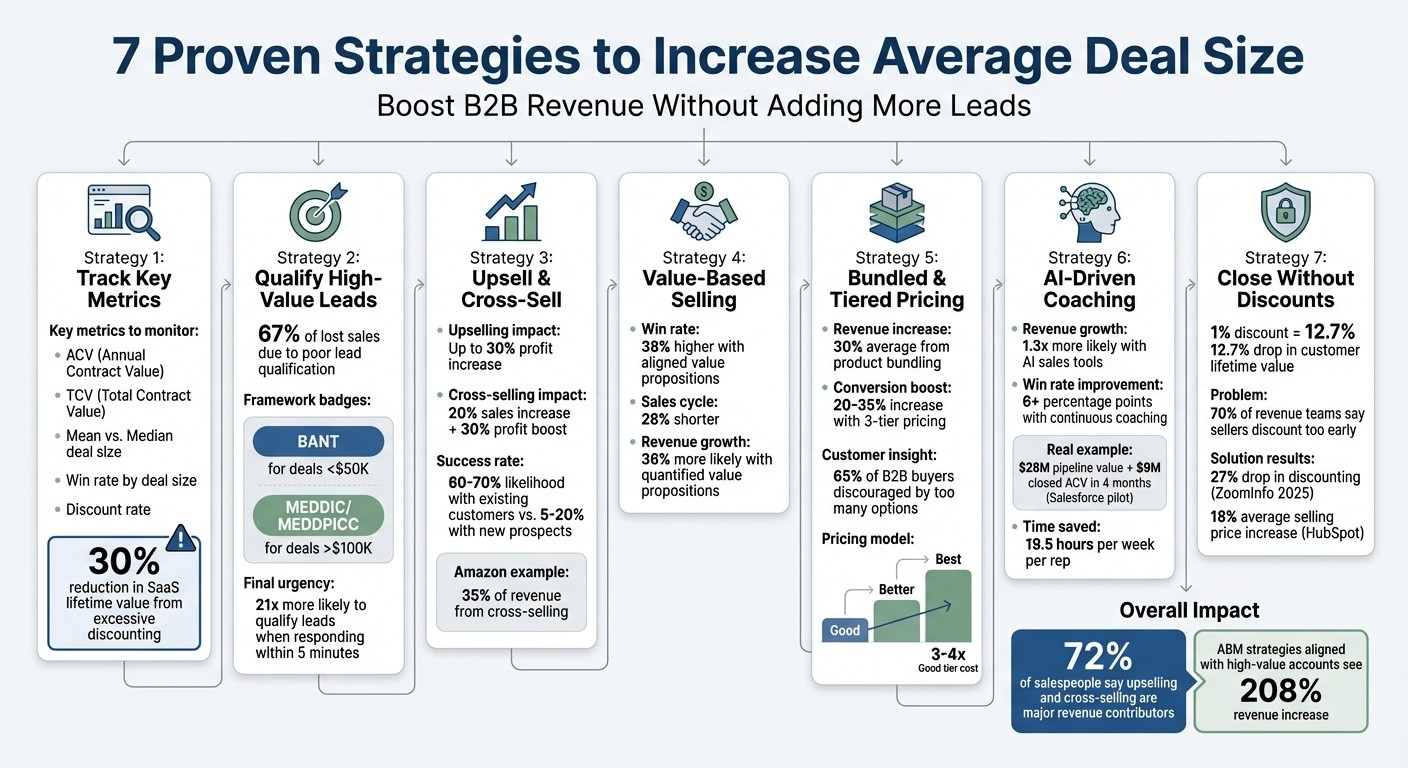
7 Proven Strategies to Increase Average Deal Size in B2B Sales
Masterclass: 3 Proven Strategies to Increase Deal Size in a Tough Market
Track Key Metrics to Understand Your Starting Point
Before increasing your average deal size, it’s crucial to understand where you currently stand. Measuring your performance now provides a baseline, helping you identify opportunities and avoid guesswork. Start by focusing on metrics like ACV (Annual Contract Value) and TCV (Total Contract Value) to establish this foundation.
ACV captures your annual recurring revenue, while TCV reflects multi-year commitments [2][4]. As Patrick Blair, Executive Vice President at Salesforce, emphasizes:
"At Salesforce, our most important sales metric is annualized contractual value, or ACV." [3]
But averages alone don’t tell the whole story. Track both mean and median deal sizes to avoid being misled by a few large outliers. While the mean might look healthy, the median can reveal whether most deals are actually much smaller [2][5]. Additionally, monitor metrics like win rate by deal size and sales cycle length by deal size. These indicators show whether your team is successfully closing larger deals or stretching too far into segments they can’t win [2][6].
Another critical metric is your discount rate - the percentage of the list price you’re giving up. Excessive discounting can erode SaaS lifetime value by as much as 30% [3]. Sofia Tyson, Senior Content Manager at Juro, highlights the importance of tracking these numbers:
"You can't manage what you don't measure. Tracking and monitoring your ACV will hold you accountable for it and increase transparency within your sales team." [3]
Identify Patterns in Smaller Deals
Smaller deals often reveal whether challenges stem from customer limitations (like budget) or internal issues such as weak qualification processes or poor value communication [2].
Break your data down by sales rep, customer segment, and industry vertical. This segmentation can uncover patterns, such as certain reps consistently closing smaller deals. These findings may point to a need for targeted coaching in areas like upselling or emphasizing value-based selling [1]. Similarly, you might notice underperformance in specific industries or buyer types, indicating missed opportunities for growth.
Tara Minh, Operation Enthusiast at Rework, suggests asking tough questions:
"Study your smallest deals: Why so small? Limited budget? Poor qualification? Incomplete discovery? Weak value articulation? These patterns reveal your optimization opportunities." [2]
Consider setting a minimum deal size threshold - a "deal floor" - to maintain productivity. Walking away from deals below this threshold can free up resources for higher-value opportunities. Companies that align their Account-Based Marketing strategies with high-value accounts often see a 208% increase in revenue [1]. By analyzing patterns in smaller deals, you can refine your sales approach and focus on quality over quantity.
Measure Revenue Per Deal
Tracking average revenue per deal is another essential metric. When deal size grows, it boosts efficiency more effectively than simply increasing the number of deals. This figure offers insight into your business's overall health and helps with planning sales capacity, designing territories, and setting realistic quotas [4][5][6].
Segment your revenue-per-deal data by industry, company size, geography, and sales rep to pinpoint your most valuable segments [4][5]. Keep an eye on trends over time. A declining average deal size might signal problems like ineffective marketing strategies, sales funnel issues, or intensified competition [7].
Dig deeper into these changes to understand whether growth is driven by selling higher-priced packages (price effect) or closing more large-enterprise deals (mix effect) [6]. This analysis can guide your focus toward effective upselling and cross-selling strategies, which we’ll explore further in the next sections.
Qualify and Prioritize High-Value Leads
67% of lost sales happen due to poor lead qualification [8][9]. This means your team might be wasting time on prospects that won’t result in large deals. Effective qualification is key to identifying worthwhile opportunities and avoiding dead ends.
Here’s a hard truth: only 25% of marketing-generated leads are ready for direct sales engagement [8][9]. The other 75%? They either need nurturing or should be disqualified quickly. Top-performing teams disqualify transactional leads within 48 hours and enterprise-level opportunities within 7 days [8][11]. This ensures your reps focus on accounts that have real potential for significant returns.
Timing is everything. Responding to a lead within 5 minutes makes a rep 21 times more likely to qualify that lead compared to waiting 30 minutes [9]. But speed alone isn’t enough. Without a solid qualification strategy, fast responses can turn into wasted effort. For deals under $50,000, use the BANT framework (Budget, Authority, Need, Timeline) to quickly determine if a lead is worth pursuing. For larger, more complex deals (over $100,000), frameworks like MEDDIC or MEDDPICC help navigate multiple decision-makers and intricate buying processes [8][9].
Focus on Budget and Authority
Once you’ve ruled out unqualified leads, the next step is to zero in on financial capacity and decision-making power.
When discussing budget, ask questions like: “If ROI was proven, could you find budget?” or “What other investments are competing for this capital this quarter?” [9][1]. These questions uncover whether the prospect can secure funding and how urgent their problem is.
In B2B sales, deals typically involve 8–13 stakeholders [9][10]. That means qualifying just one contact isn’t enough for large opportunities. You need to identify the "Economic Buyer" - the person who controls the budget - and find a "Champion" within the organization who will advocate for your solution. Questions like “Who else evaluates solutions like this?” and “Who will be most impacted by this decision?” can help you map out the full buying committee [9][12].
Sales expert Andy Paul sums it up perfectly:
"Understand the outcomes that really matter to your decision-makers. Because no one's buying a product, they're buying increased cash flow." [1]
Actions often speak louder than words. Behavioral signals - like replaying integration demos, spending over 3 minutes on pricing pages, or researching competitors - are better indicators of interest than simple form submissions [9]. Companies using AI-powered predictive scoring report 40–60% more accurate lead prioritization compared to those relying on rule-based systems [11].
Spot Expansion Opportunities
Qualifying leads isn’t just about closing one deal - it’s about identifying opportunities for growth.
High-value leads often come with the potential for expansion. Look for growth opportunities in four areas: vertical (adding more users or seats), horizontal (selling additional products or modules), temporal (securing multi-year contracts), and scope (offering services like premium support) [2].
AI tools can help you spot signals of expansion readiness. For example, hiring surges - such as posting three or more roles in 30 days - suggest a growing team that may need more licenses. Similarly, leadership changes at the VP level or above often lead to tool re-evaluations. Shifts in technology stacks, like moving to subscription models, indicate a company is investing in infrastructure [8][13][14].
A great way to gauge urgency is by asking a “reverse discovery” question: “What happens if this problem isn’t solved in the next 6 months?” This helps uncover the cost of inaction. If the urgency scores below a 7 on a 1–10 scale, it’s better to nurture the lead rather than push for a deal that’s unlikely to close [9][12].
Companies with Account-Based Marketing strategies see a 208% increase in revenue [1]. Why? Because they focus on accounts showing clear expansion signals. Use firmographic data - like company size, industry, and geography - alongside behavioral cues such as content downloads or webinar attendance to prioritize leads [10]. This layered approach ensures your team focuses on prospects with the potential for larger deals, setting the stage for upselling and value-based selling strategies discussed later.
Use Upselling and Cross-Selling Techniques
Once you've attracted high-value leads, the next step is to maximize revenue by implementing upselling and cross-selling strategies. Upselling involves encouraging customers to purchase a higher-tier or feature-rich version of the product they're considering - like moving from a Basic to a Pro plan. Cross-selling, on the other hand, suggests complementary products that enhance the original purchase, such as adding training services to a software license. These tactics work well because the likelihood of selling to an existing customer is 60–70%, compared to just 5–20% for a new prospect [15][19][21].
The impact of these strategies is undeniable. Upselling can boost profits by up to 30%, while cross-selling can increase sales by 20% and overall profits by 30% [18][20]. Amazon, for example, attributes around 35% of its revenue to cross-selling and recommendation engines [15][21]. But success hinges on timing and trust. As Ryan Vaillancourt, VP of Sales at Revenue.io, explains:
"Upselling and cross-selling only work when they're rooted in timing and trust. Data and AI-driven sales enablement help reps know when the moment is right - but reps still need to earn the right to recommend." [22]
With that in mind, let’s break down how to effectively use these strategies to unlock additional revenue streams.
Leverage Upselling Opportunities
Upselling works best when customers see the value they’ll gain rather than focusing on the added cost. Frame your offers around how the enhanced features will help them achieve their goals, rather than simply presenting a price increase [20][22].
Timing is everything. Present upsell offers during key moments - like during the evaluation phase or at checkout - when customers are already committed and open to spending more [15][19][22]. For instance, a $150 upgrade is often easier to justify after committing to a $1,000 purchase [23]. Tiered pricing models (e.g., Basic, Pro, Enterprise) also encourage natural progression. Highlighting the middle tier as "Most Popular" can serve as subtle social proof to guide decisions [15][21][23].
Keep it simple. Limit upsell options to two or three relevant choices to avoid overwhelming customers. Too many options can create decision fatigue and even derail the sale [16]. Also, avoid aggressive tactics like confusing user interfaces or misleading decoy pricing plans, as these can erode trust if the price jump feels unjustified [19].
Implement Cross-Selling Strategies
While upselling enhances the value of a single purchase, cross-selling expands the scope by adding related products. The key to cross-selling is relevance. Stick to the "50% Rule": the suggested product should cost no more than half the price of the primary item [17]. For example, if someone buys a $2,000 laptop, offering a $100 protective case and a $50 wireless mouse feels natural. Suggesting a $1,500 monitor, however, might feel excessive.
Use data to create thoughtful bundles. Features like "Frequently Bought Together" can showcase complete solutions [15][16]. For instance, if a customer purchases a CRM platform, offering a bundle with onboarding training and API integrations adds practical value. Personalized recommendations, driven by CRM data such as purchase history and browsing behavior, can further refine these offers. These personalized suggestions account for 10–30% of total e-commerce revenue [16].
Timing matters here, too. Cross-sell offers can be made before, during, or after the purchase. Post-purchase suggestions - like those presented on confirmation pages or in follow-up emails - convert at rates between 10% and 30% [15][19][23]. Interestingly, up to 60% of customers may make an additional purchase at the last minute if the offer is compelling [17].
Adopt Value-Based Selling to Drive Larger Deals
Value-based selling takes the concept of upselling and cross-selling to another level by focusing on client outcomes. Instead of just maximizing revenue from existing customers, it shifts the conversation to measurable financial results. When clients see how your solution can directly improve their bottom line - whether through higher revenue, cost savings, or better efficiency - they’re more likely to invest in premium options.
This isn't just a theory. Companies that align their sales and marketing efforts around clear value propositions see a 38% higher win rate and a 28% shorter sales cycle [24]. Additionally, businesses that quantify their value propositions are 36% more likely to achieve strong revenue growth and 38% more likely to see significant profit growth [25].
The process is straightforward: identify the client’s pain points, calculate the financial impact, and tie your solution to their goals. For example, if a company is losing money due to inefficiencies, translate that pain into real numbers - lost revenue, wasted time, or unnecessary expenses. Then, show how your solution can resolve those issues and deliver the results they care about. Importantly, involve the client in building this business case. When they help create the ROI model, they’re more likely to support it internally, especially when pitching it to decision-makers like their CFO [24].
Use Tiered Pricing Models
Tiered pricing goes beyond offering choices - it’s a way to subtly guide buyers toward higher-value packages. A well-structured "Good-Better-Best" pricing model can make a big difference. For example, pricing the "Best" tier at 3-4 times the cost of the "Good" tier helps anchor the perception of value and often nudges buyers toward the middle "Better" option [2].
Here’s how it works in practice: A SaaS company might offer a Basic plan at $500/month with essential features, a Premium plan at $1,500/month (labeled "Most Popular") with advanced tools, and an Enterprise plan at $4,000/month with tailored support and customization. The steep jump to the Enterprise tier makes the Premium option feel like the most logical and cost-effective choice, while still leaving room for high-budget clients to justify the top-tier package.
The success of this strategy lies in clearly differentiating each tier. Tailor your messaging to address specific buyer concerns:
CFOs care about ROI and cost efficiency: "Our platform delivers a 250% ROI within 12 months by cutting operational costs."
VPs of Operations focus on productivity: "We can boost your team’s output by 20% without increasing headcount."
IT Directors prioritize security and integration: "Our solution integrates with your systems in under a week, with zero security risks" [24].
Stakeholder | Primary Concern | Value-Based Messaging Angle |
|---|---|---|
CFO | ROI, Margin, Capital Efficiency | "Our platform delivers a 250% ROI by reducing overhead." |
VP of Operations | Productivity, Efficiency | "We can boost output by 20% without adding headcount." |
IT Director | Integration, Security | "Seamless integration with zero vulnerabilities." |
This structure helps buyers see the tangible benefits of upgrading, making it easier to justify larger investments.
Quantify Business Outcomes
When it comes to sales, numbers often speak louder than features. The best sales reps don’t just explain what their product does - they help prospects calculate the financial impact of sticking with the status quo. This means asking questions like: How much time is wasted on manual processes? What’s the revenue loss due to customer churn? When prospects calculate these costs themselves, they’re more motivated to act [24].
Take IT services as an example. Instead of saying your platform offers "99.9% uptime", ask the client to estimate the cost of an hour of downtime. If an outage costs $40,000 per hour, a $10,000/month service contract suddenly feels like a bargain - it’s insurance against a much larger risk [26].
This approach works best with multi-threading, where you engage decision-makers across different departments. By involving stakeholders like Legal, Customer Success, and Operations, you can pool their budgets to fund a comprehensive solution [3]. Each stakeholder sees the ROI through their own priorities, creating multiple internal advocates for your proposal.
Patrick Blair, Executive Vice President at Salesforce, highlights this focus on deal value:
"At Salesforce, our most important sales metric is annualized contractual value, or ACV." [3]
To make your case even stronger, avoid overwhelming the client with a "value dump." Instead, only highlight benefits that address their specific pain points [24]. Use financial metrics like Payback Period, Net Present Value (NPV), and Internal Rate of Return (IRR) to speak the language of finance [27]. By co-creating the business case from the start, you’re not just selling a product - you’re building a shared roadmap to measurable success.
Use AI-Driven Coaching to Improve Sales Performance
Strategies for sales success only work when they're implemented consistently. This is where AI-driven coaching steps in, offering support directly within your team's workflow and delivering real-time prompts exactly when they're needed. Sales teams using AI are 1.3 times more likely to achieve revenue growth, and organizations that embrace dynamic, continuous coaching see win rates improve by over 6 percentage points [28].
One of the standout advantages of AI coaching is its ability to scale and maintain consistency. A manager might only have time to review a few calls each week, but AI can analyze every interaction, uncovering patterns that lead to bigger deals and encouraging reps to replicate effective behaviors. For instance, during an internal pilot from February to May 2025, Salesforce's "Agentforce Sales Coach" provided over 24,000 personalized recommendations. This effort resulted in a 38% action completion rate, generating $28 million in pipeline value and $9 million in closed annual contract value in just four months [30]. This level of insight ensures sales reps receive actionable guidance during live calls, right when they need it most.
Real-Time Coaching for Upselling and Cross-Selling
AI-driven coaching isn't just about pointing out mistakes - it’s about offering actionable next steps. During live calls, AI tools analyze customer sentiment, usage trends, and buying signals to identify opportunities for upselling or cross-selling [30][31]. For example, if a customer shows high satisfaction and strong product engagement, the AI might suggest specific actions to encourage an additional purchase or upgrade, helping reps make the most of every opportunity.
Take Connor Bell, a Business Development Manager at HubSpot, as an example. Over an 11-week period in June 2024, he used Coach Pilot to refine his approach, leading to a 50% increase in net new opportunities and 12 closed deals. This effort boosted his quarterly sales revenue by 38% and resulted in larger, more lucrative deals [29]. Similarly, Charlotte Lloyd, Founder of Social Selling, leveraged real-time coaching to secure a six-figure deal [29].
Beyond identifying opportunities, AI also takes care of routine tasks like CRM updates and call summaries, saving reps an average of 19.5 hours per week [29]. This extra time allows salespeople to focus on building deeper relationships - key to growing deal sizes.
Custom Sales Playbooks and Training
Coach Pilot bridges the gap between static sales playbooks and real-world execution by embedding custom strategies directly into daily workflows [29][28]. It starts by capturing proven messaging, successful objection-handling techniques, and key discovery methods to create repeatable playbooks. Reps then practice these strategies in habit-based training workshops, while the AI reinforces them continuously in the field.
This blend of human expertise and AI-driven reinforcement delivers measurable outcomes. For example, in May 2024, Naum Sekulovski used Coach Pilot to close 13 contracts in just 9 weeks, driving a 45% boost in sales revenue [29]. Similarly, Rebecca Veksler, Co-Founder of Four Rooms, applied Coach Pilot's strategies over an 8-week period, tripling monthly sales and closing 14 deals, leading to more profitable outcomes [29].
Rather than replacing managers, AI enhances their effectiveness by automating tasks like call scoring and documentation. This frees managers to concentrate on complex deal strategies and high-stakes negotiations [31]. As Val Perea, an Account Executive at LinkedIn, shared:
"I went from not knowing the fundamentals of a sales process and having a fear of pushing through objections to then becoming one of the top sales reps at LinkedIn for North America. I am always learning with Coach Pilot." [29]
These examples highlight how AI supports individual reps while driving overall sales team performance. Customers using Coach Pilot report a 7.8× increase in pipeline growth within 90 days and a 39% improvement in quota attainment. By replacing generic outreach with tailored, value-driven messaging, AI helps teams close larger, more profitable deals. With the right tools, training, and ongoing AI support, your sales team can unlock its full potential.
Build Bundled and Tiered Offers
Bundled and tiered pricing make purchasing decisions easier and encourage larger transactions by offering complete, pre-packaged solutions. This approach taps into the "Completion Effect", a concept where customers feel more satisfied when they acquire a full solution rather than assembling individual components themselves [32]. The impact is clear: businesses using product bundling see an average revenue increase of 30% [34][36].
The psychology behind bundling is compelling. Combining multiple products or services into one package reduces decision fatigue and simplifies the buying process [32][33][34]. This is crucial because 65% of B2B buyers admit that having too many options actually discourages them from making a purchase [32]. By streamlining choices into a single, curated package, you eliminate barriers in the sales process. Bundling also consolidates the "pain of paying", turning multiple smaller transactions into one, which feels less painful psychologically [36]. Through clear and value-driven packages, sales teams can better communicate their offerings, making upselling and AI-driven coaching more effective.
Design Value Ladders
A well-thought-out value ladder encourages customers to move naturally toward premium options, making them feel attainable rather than out of reach. A Good-Better-Best model, for instance, directs buyers toward the middle tier by anchoring value with a premium option [37][38]. Using three tiers can increase conversion rates by 20–35%, and 78% of SaaS companies already use tiered pricing [38].
The secret lies in creating clear distinctions between tiers. Price gaps of 50–100% between tiers help highlight the added value [38]. Start by designing your "Best" tier with all possible features, then scale down for lower tiers by removing select features. This ensures that every tier feels worthwhile without appearing cheap [35]. Simplicity is key: bundles with more than seven components tend to perform 15–20% worse than simpler offerings [32].
Highlight Cost vs. Benefit
Shift the focus from features to measurable outcomes to emphasize ROI. Use price stacking - show the individual prices of components before revealing the bundled discount. This creates a high anchor point and highlights the savings [35]. Dusty Martin, Revenue Operations Manager at Qwilr, explains the value of this approach:
"The perceived value is higher than the actual cost. That's the magician's trick behind bundle pricing: it feels generous while remaining strategic." [33]
Customers often see bundled products as being 15–25% more valuable than the sum of their individual parts [32]. Well-structured tiers can encourage 20–30% of customers to choose higher-value bundles [32], and tiered pricing done right can boost revenue per customer by 25% to 40% compared to flat-rate models [38]. To make premium tiers more appealing, frame them around transformation levels - like Build, Growth, or Scale - instead of just listing extra features. Interactive pricing tables that let buyers toggle add-ons in real-time can also help them see immediate ROI updates [33][39].
Bundled and tiered pricing strategies not only simplify decision-making but also equip sales teams to close larger deals without relying on discounts. These approaches set the foundation for even more effective sales techniques.
Train Reps to Close Without Discounts
Avoiding premature discounting is crucial for protecting the value of larger deals and driving revenue growth. Discounts can quickly chip away at profits - just a 1% discount can lead to an estimated 12.7% drop in lifetime customer value. Alarmingly, 70% of revenue teams feel their sellers rely on discounts too early in the process [41]. This often stems from a lack of confidence in the product's worth [42][43]. That’s why value-based selling is so important - it lays the groundwork for securing bigger and more profitable deals.
The key is to shift the conversation from pricing to decision quality. Train your team to establish value anchors by demonstrating measurable benefits like saved headcount or increased revenue before even discussing costs. Blair Enns, author of The Win Without Pitching Manifesto, highlights this strategy:
"In effective SaaS negotiations, price is never discussed until value is fully established" [41].
When prospects mention that a competitor offers a cheaper option, use it as an opening to explain the trade-offs between cost and quality [45].
Investing in formal negotiation training can deliver significant returns. Companies that prioritize this see 5–10% more value captured in deals [41]. For instance, in 2025, ZoomInfo introduced structured value-anchoring training for its sales team, which led to a 27% drop in discounting within its mid-market segment [41]. Similarly, HubSpot implemented a "value exchange" framework, requiring customers to offer something in return for any discount - like quicker payment terms. This approach boosted their average selling price by 18% in just six months [41].
Use Analytics in Coaching
Analytics can play a powerful role in identifying when and why reps resort to discounts, enabling managers to offer precise coaching. By tracking discount percentages for each rep over 30-, 60-, and 90-day periods - and flagging deals where discounts exceed two standard deviations from the team average - managers can quickly address potential pricing issues [46].
Platforms like Coach Pilot take this a step further. Using analytics, it detects complex patterns in deal data and provides real-time AI coaching directly within sales workflows [44]. It can even analyze demo recordings to ensure reps are asking probing "why" questions and focusing on outcomes - an approach linked to closing higher-value, no-discount deals.
Conduct Training Workshops
Regular workshops are essential for building reps' confidence and sharpening their negotiation skills. Practice handling common objections like "We have no budget" or "Your competitor is cheaper" to prepare for real-world scenarios [41][43]. Encourage reps to interview 3–5 successful customers to gather concrete examples of how your product has delivered measurable business outcomes. This real-world evidence can be a game-changer during price discussions [42].
Another effective tool is a concession matrix - a list of value-added extras ranked by their cost to your company versus their perceived value to the buyer. This helps reps navigate negotiations without defaulting to price cuts [40]. Former FBI negotiator Chris Voss offers this advice:
"The key is to ensure sales has options beyond simply lowering the price" [41].
Instead of offering discounts, train reps to trade concessions for negotiation perks like accelerated onboarding, premium support, or additional training credits [40][41]. For example, Atlassian’s role-specific negotiation certification programs helped improve renewal pricing by 23%. Companies with formal pricing governance have seen profit margins rise by as much as 30% [41].
Conclusion
Boosting your deal size starts with refining your current sales processes. Begin by analyzing key metrics and identifying patterns in smaller deals to uncover genuine opportunities. Direct your team's efforts toward high-value leads - those with the budget and authority to commit to larger deals.
The best approach combines upselling, cross-selling, and value-based selling. Equip your sales team to guide customers toward premium solutions and introduce complementary products that solve related challenges. Shift the focus of every conversation from pricing and features to tangible financial results, like improving cash flow or reducing risks. These strategies create a natural flow from qualifying leads to closing profitable deals.
To make these methods stick, consistent coaching is essential. One-off training sessions often lose their impact, but ongoing reinforcement helps embed these strategies into everyday routines. Tools like Coach Pilot integrate AI-driven coaching directly into sales workflows, offering real-time advice during critical interactions and helping managers address specific skill gaps in upselling or cross-selling. With continuous support, your team builds the confidence and skills needed to secure high-value deals without resorting to discounts.
The results speak for themselves: 72% of salespeople say upselling and cross-selling are major contributors to their revenue growth [1]. By combining smart lead qualification, value-driven conversations, and continuous coaching, closing larger deals can become a regular outcome. Leverage tools like Coach Pilot’s AI-driven sales enablement platform to ensure your team consistently delivers bigger, more profitable deals.
FAQs
What’s the best way to set a minimum deal size?
Setting a minimum deal size means defining a baseline value below which a contract won’t be considered a "deal." This approach allows your team to zero in on more lucrative opportunities. By focusing on deals that meet defined revenue benchmarks, your sales team can work more efficiently, boost the quality of deals, and prioritize opportunities that have a meaningful impact on hitting revenue targets.
When should I upsell vs. cross-sell in a sales cycle?
Upselling is most effective when a customer is already interested in a product and might consider upgrading to a version with more features or benefits before finalizing their purchase. On the other hand, cross-selling tends to work better either during or after the purchase process. This involves suggesting complementary products or services that add value to what the customer has already chosen. Getting the timing right for these strategies can not only boost the overall transaction value but also leave customers feeling more satisfied with their purchase.
How do I calculate ROI to justify a larger contract?
To figure out ROI for a big contract, start by calculating the net benefits - this means taking the total benefits (like higher revenue or added strategic value) and subtracting the costs. Then, divide that number by the total costs and multiply by 100 to express it as a percentage. Here’s how it works:
Estimate total benefits: This could include things like increased revenue or other measurable gains.
Subtract the costs: Deduct all costs tied to the contract, such as production, implementation, or operational expenses.
Apply the formula: ROI = (Net Benefits / Total Costs) × 100.
This gives you a clear percentage that shows the financial return on the deal.
Related Blog Posts

Remove the guesswork from winning more deals.