B2B Sales
AI in Sales Coaching: Role of Feedback Loops
Apr 10, 2026
AI analyzes every sales call to deliver real-time, evidence-based coaching that speeds skill growth, boosts win rates, and saves time.
AI is transforming sales coaching by introducing real-time feedback loops that improve performance and revenue execution. Unlike traditional methods, which rely on sporadic call reviews and broad advice, AI analyzes every sales interaction, identifies skill gaps, and provides personalized coaching immediately. This approach helps sales teams make measurable improvements while saving time for managers.
Key Points:
AI Feedback Loops: Analyze 100% of calls, deliver instant feedback, and provide actionable insights.
Impact: Teams using AI are 1.3x more likely to achieve revenue growth; coaching time can be cut by 50%.
Features: Automated scorecards, real-time call analysis, and evidence-based feedback.
Implementation: Start with a structured, phased rollout - shadow mode testing, pilot programs, and full adoption.
Metrics to Track: Win rates, skill improvement velocity, and coaching adherence.
AI-powered coaching tools like Coach Pilot integrate seamlessly into sales workflows, creating a continuous cycle of learning and improvement. By leveraging these tools, sales teams can boost performance, improve consistency, and focus on high-impact behaviors.
How AI Powers Feedback Loops in Sales Coaching
AI Features That Enable Feedback Loops
AI drives ongoing improvement in sales coaching by leveraging three key tools: automated scorecards, real-time call analysis, and evidence-based feedback. Automated scorecards provide objective assessments of every interaction, aligning them with established sales methodologies like MEDDICC or SPICED [3]. Real-time call analysis identifies coachable moments as they happen, while evidence-based feedback backs up scores with specific audio clips and transcript excerpts [3].
The industry is evolving beyond basic generative AI that simply summarizes calls. Enter "Agentic AI", which actively participates in coaching workflows. These AI systems evaluate behaviors against your sales framework and monitor whether reps follow through on their commitments [3]. By standardizing coaching around observable habits and clear evidence, AI reduces the variability that often comes from individual managers' styles [3].
This combination of capabilities enables practical, effective workflows, as seen in the following examples.
AI in Action: Sales Coaching Examples
The best AI-powered feedback loops seamlessly link three stages: live call analysis, individualized skill diagnosis, and targeted practice scenarios [1]. For instance, if a salesperson struggles with handling a particular objection, the system can immediately generate a roleplay exercise to address that specific skill gap [1]. This direct transition from insight to action helps reps improve daily while staying aligned with broader sales strategies.
AI also simplifies coaching for managers by flagging key moments and organizing them into structured weekly agendas [3]. These agendas focus on high-impact behaviors like discovery discipline, quality of next steps, and stakeholder mapping, which are essential for boosting pipeline velocity [3]. A typical weekly routine might involve AI generating a coaching queue at the start of the week, managers addressing these points during midweek one-on-ones, and the system summarizing team-level trends by the end of the week [3].
How Coach Pilot Uses AI Feedback Loops
Coach Pilot takes these AI capabilities and integrates them directly into everyday sales operations. The platform combines customized playbooks with real-time feedback, analyzing sales conversations against your methodology. It highlights gaps between what the playbook recommends and what actually happens in calls. This creates a continuous cycle where strategic guidance shapes daily execution, and performance data refines the coaching process over time.
SDR Cold Call AI Coach Demo: Practicing Real Prospect Conversations Before Talking to Customers
How to Implement AI-Driven Feedback Loops
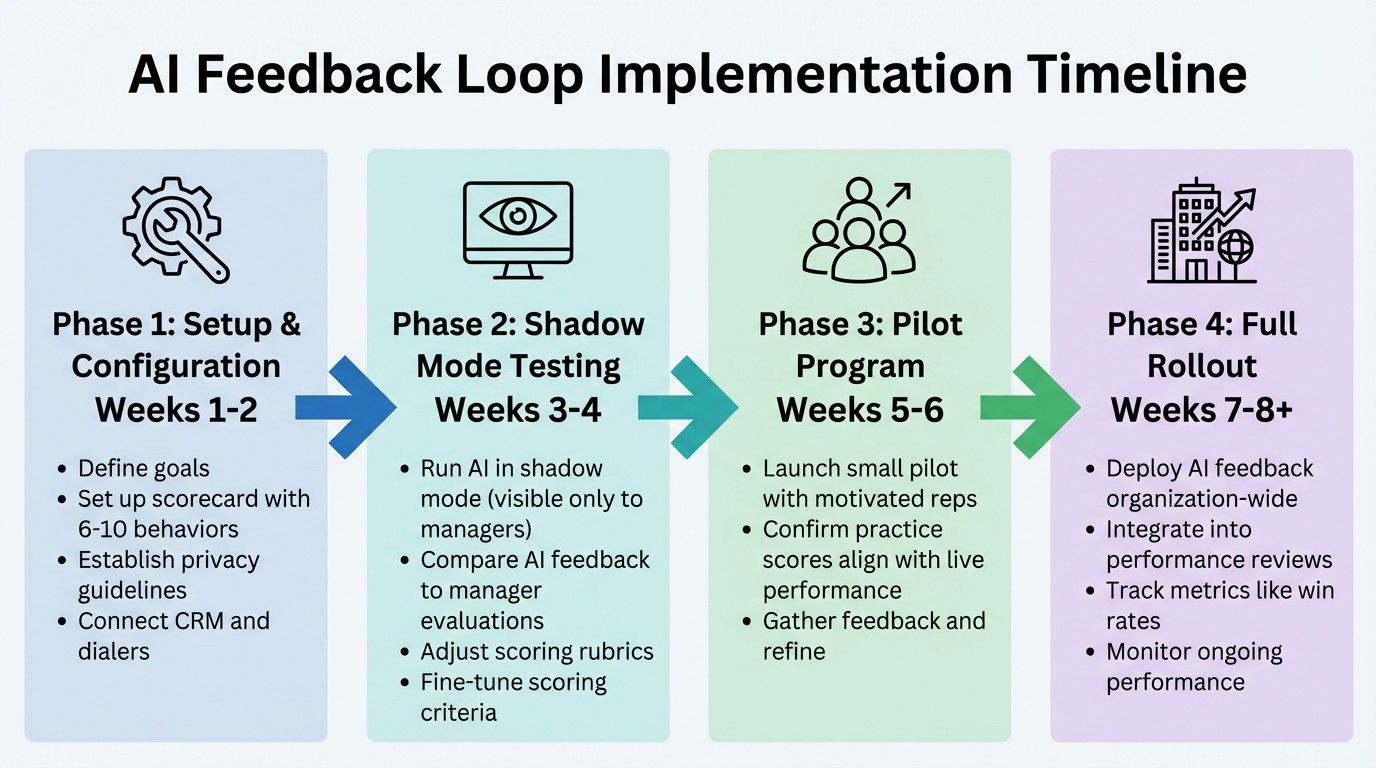
4-Phase AI Sales Coaching Implementation Timeline
Collecting and Preparing Your Data
An effective AI feedback system relies on three key data sources: conversation intelligence platforms for call recordings, CRM systems to monitor deal progress, and learning management systems to store training materials [1]. The idea is to create a smooth data flow that connects live sales calls, practice scenarios, and performance outcomes.
Start by setting up a coaching scorecard with 6–10 specific behaviors linked to your sales methodology [3]. For instance, if you use MEDDICC, your scorecard might include actions like "Identified economic buyer by name" or "Quantified metrics during discovery." These clear, measurable behaviors help the AI provide precise evaluations, steering away from vague feedback like "good discovery skills." Companies using this structured approach have reported efficiency improvements of 10–15% [3].
Before rolling out AI feedback to your team, run it in shadow mode for two weeks [3]. During this phase, the AI generates coaching outputs that are only visible to managers. This lets you fine-tune scoring criteria and weed out errors before sharing feedback with the team. Additionally, compile a "best of" library by organizing call clips based on scenarios like discovery, pricing discussions, or objection handling. This library serves as a self-guided coaching tool for reps [4].
Customizing AI Models for Your Sales Process
Implementing AI feedback follows a structured, four-phase timeline:
Phase 1 (weeks 1–2): Define goals, set up your scorecard with 6–10 behaviors, establish privacy guidelines, and connect your CRM and dialers [3].
Phase 2 (weeks 3–4): Run the AI in shadow mode to compare its feedback to manager evaluations and adjust scoring rubrics [3].
Phase 3 (weeks 5–6): Launch a small pilot with a group of motivated reps to confirm that practice scores align with live performance [1].
Phase 4 (weeks 7–8 and beyond): Roll out AI feedback across the organization, integrate it into performance reviews, and track metrics like win rates [1][3].
To maximize impact, focus AI training on behaviors that directly influence pipeline velocity - such as discovery discipline, quality of next steps, and stakeholder mapping. These areas tend to deliver the quickest return on investment [3].
"The choice isn't between AI and human coaching. It's between AI-augmented coaching that scales or manual coaching that doesn't" [1].
Once the AI model is calibrated and tested, the next step is incorporating these insights into your team's daily routine.
Training Your Team on AI Feedback Tools
With your data and AI models in place, the focus shifts to team adoption. Build a weekly coaching rhythm to make AI feedback part of your regular operations. For example:
On Mondays, the AI generates a coaching queue with highlights from the previous week [3].
Midweek, managers use these AI-generated clips during one-on-one sessions, spending time on strategy rather than sifting through hours of recordings [3].
By Friday, the system provides a summary of team-level trends [3].
Research shows that reps who receive call-based coaching are 20–30% more likely to hit their quotas than those who don’t [4]. Encourage daily 15–20 minute sessions with AI training bots to address specific weak points [5]. The goal is to move from generic advice like "ask more questions" to actionable tips such as "use 'Tell me more about...' when a prospect mentions a pain point" [4]. Teams that stick to consistent coaching routines are 51% more likely to outperform their peers [1].
Measuring the Impact of AI Feedback Loops
Key Metrics to Track
Choosing the right metrics is what sets effective AI feedback systems apart. Start by establishing a baseline with metrics like win rates, new-hire ramp time, and sales cycle length to calculate ROI [6][7].
One critical metric to monitor is Score Improvement Velocity over rolling 30-day periods. This provides a reliable indicator of future performance [8]. Another is the Coaching Adherence Rate, which measures the percentage of AI recommendations that lead to noticeable behavioral changes in subsequent calls [8]. If feedback isn't being applied, the loop isn't working as intended.
Conversation quality metrics dive deeper into skill gaps. For example, look at the talk-to-listen ratio (aim for a 40/60 split), the balance between open-ended and closed questions, and how well reps handle objections [6][8]. Reps scoring over 80% on these metrics tend to close 23% more deals [6]. Timeliness also matters - feedback provided within 24 hours boosts skill adoption rates by 42% [6].
Efficiency is another area to measure. Coaching Coverage shows how much of the team is benefiting from feedback. While managers can only review 1–2% of calls manually, AI systems analyze 100% [7]. This ensures no opportunity for coaching is overlooked. To link these behavioral metrics to broader outcomes, correlate them with revenue indicators like win rates, deal size, and sales cycle duration [6][7].
These metrics highlight how AI systems improve efficiency and effectiveness, making it easier to compare them to manual feedback methods.
AI vs. Manual Feedback Loops
When comparing AI-driven feedback loops to manual ones, the differences in speed, scale, and consistency are striking. Manual coaching demands a lot of time - managers must sift through hours of recordings, pick out relevant clips, and schedule one-on-one sessions. This limits them to reviewing just a small percentage of interactions. AI, on the other hand, analyzes every single call and delivers feedback - often within 24 hours - so no rep is left waiting.
Factor | AI Feedback Loops | Manual Feedback Loops |
|---|---|---|
Coverage | Analyzes 100% of conversations [7] | Reviews only 1–2% of conversations [7] |
Speed | Feedback delivered in 24 hours [6] | Days or even weeks for coaching sessions |
Scalability | Handles unlimited call analysis at once | Restricted by manager availability |
Consistency | Standardized scorecards for all reps | Influenced by manager bias and inconsistent standards |
Personalization | Tracks individual progress over time [8] | Relies on sporadic observations and memory |
Take Versa Networks as an example. They adopted AI-driven pipeline reviews and coaching, which cut the time managers spent on these tasks in half. At the same time, it improved consistency across their global sales team [2]. The real power of AI isn't about replacing human judgment - it’s about enhancing it with detailed, data-driven insights that would be impossible to gather manually.
Best Practices and Advanced Applications
Improving Competitive Messaging with Feedback Loops
AI-powered feedback loops can analyze sentiment and behavior to pinpoint why deals are won or lost, helping teams refine their competitive strategies in real time. For instance, if AI detects recurring objections about pricing or missing features, sales teams can adjust their messaging before the next strategic cycle.
A closed-loop system that connects real-time call analysis with tailored practice sessions is particularly effective. Take this example: if AI identifies a salesperson struggling with a competitor's objection, it can create a personalized roleplay scenario based on actual call language. This allows the rep to practice addressing the objection in a low-pressure environment, ensuring the team’s messaging stays aligned with changing market dynamics.
Using AI to Improve Forecast Accuracy
Once messaging improves, accurate forecasting becomes a critical part of a future of sales enablement strategy. Traditional forecasting often relies on subjective assessments and activity tracking. In contrast, AI systems use behavioral signals - like multi-threading, executive engagement, and the quality of next steps - to predict deal outcomes more reliably[2][5]. By connecting leading indicators, such as AI roleplay performance, to lagging metrics like win rates and deal velocity, forecasting becomes a precise, data-driven process.
Modern AI tools also evaluate factors like conversation alignment, target persona fit, and the depth of discovery calls to assign a conversion likelihood to each deal[5]. This objective analysis helps managers differentiate between risks tied to execution - such as weak discovery - and broader market challenges. For example, Versa Networks used this AI-driven approach to cut pipeline review times in half while significantly improving forecast reliability[2].
These advancements in forecasting pave the way for managing organizational changes and addressing privacy concerns tied to AI adoption.
Managing Change and Privacy Concerns
Introducing AI coaching tools successfully requires careful change management. It’s important to position AI as a development tool rather than a monitoring system. Starting with a small pilot group to test AI scoring and demonstrate its connection to improved performance - following a "crawl-walk-run" approach - can make the transition smoother for the entire organization[1].
Privacy is another key consideration. Clear guidelines should be established, such as defining who can access individual versus team-level insights and setting strict data retention policies[3]. Transparency is crucial: AI tools should provide specific evidence, like call clips, to explain scores or suggestions. This ensures reps understand exactly what triggered the feedback and builds trust in the system.
Beyond improving coaching, automation enhances operational efficiency. Sales teams using automation report a 10–15% boost in efficiency[3], while those leveraging AI are 1.3 times more likely to achieve revenue growth[2]. By automating administrative tasks, reps can reclaim valuable hours for actual selling, driving both productivity and results.
Conclusion and Key Takeaways
Summary of Benefits
AI-powered feedback loops are transforming sales coaching into an ongoing, data-driven process. By linking real-time call analysis with tailored practice, sales reps can act on feedback immediately. And the numbers back it up: teams that embrace dynamic, continuous coaching see win rates climb by over 6 percentage points, while those using AI are 1.3 times more likely to achieve revenue growth[2]. Plus, automation frees up 10–15% of your team's time[3], giving reps more bandwidth to focus on selling.
The evolution from generative to agentic AI is reshaping coaching workflows. Advanced AI systems now handle end-to-end coaching processes and track improvements over time[3]. As Sanchit Garg, Cofounder & CEO of Zime, explains:
"AI sales coaching, when executed well, delivers three outcomes: Time recovered, behavior reinforced, and outcomes measured"[2]
This approach ensures every rep receives consistent, evidence-based coaching, regardless of managerial differences or availability.
These advantages make adopting AI feedback loops a clear and achievable next step.
Getting Started with AI Feedback Loops
Start small with a phased approach: pilot AI scoring with a group of 3–5 motivated reps to validate its accuracy, demonstrate how practice scores align with live performance, and then scale across the organization[1]. Many companies can roll out an AI sales coaching system within 30–60 days by initially running it in "shadow mode." This lets managers compare AI feedback with their own assessments before granting the system more decision-making authority[3].
Focus on high-impact behaviors like discovery discipline, next-step quality, and stakeholder mapping to see a quick return on investment[3]. Establish a weekly coaching rhythm: have AI generate a coaching queue on Mondays, conduct AI-assisted 1:1s midweek, and review team-level trends on Fridays[3]. This step-by-step method ensures AI enhances all aspects of your coaching process while reinforcing the benefits mentioned earlier.
Coach Pilot seamlessly integrates AI-driven coaching into your sales workflows. By connecting strategy with execution through custom playbooks, immersive training, and continuous feedback loops, it helps improve win rates and forecast accuracy.
FAQs
What should my AI coaching scorecard measure?
Your AI coaching scorecard should focus on tracking metrics that directly influence skill growth. These include score improvement velocity, which shows how quickly skills are advancing; real-time performance feedback, offering immediate insights for adjustments; and evidence-backed call behaviors, which highlight actions proven to boost outcomes. Together, these metrics ensure coaching efforts translate into noticeable performance gains and tangible results.
How do we know AI feedback is accurate and fair?
AI feedback stands out for its accuracy and fairness because it relies on standardized evaluation criteria, removing the influence of human bias. Unlike traditional methods, it can analyze 100% of sales interactions, offering consistent, data-backed insights. This approach ensures a reliable foundation for coaching and performance improvement.
How do we prove ROI from AI coaching feedback loops?
To show the return on investment (ROI) from AI-powered coaching feedback loops, focus on measurable sales performance metrics. These could include higher conversion rates, shorter sales cycles, and less time spent on manual coaching by managers.
For instance, AI-driven coaching often results in faster deal velocity and improved win rates. By comparing sales data from before and after AI implementation or calculating cost savings from reduced manual coaching efforts, you can clearly highlight the impact and value of these AI feedback systems.
Related Blog Posts

Remove the guesswork from winning more deals.