B2B Sales
5 Behavioral Insights to Boost Sales Performance
Mar 9, 2026
Use loss aversion, personalization, social proof, leading-behavior tracking, and team motivation to improve buyer engagement and boost sales performance.

Sales success isn’t just about activity metrics - it’s about understanding the psychology behind decisions. Research shows 95% of purchasing decisions are subconscious, influenced by emotions and biases. By applying behavioral principles like loss aversion, personalization, and social proof, you can improve buyer engagement and team performance. Here’s a summary of the five key insights:
Use Loss Aversion: Frame messages around what prospects stand to lose, creating urgency and addressing objections effectively.
Personalize Outreach: Tailor communication based on engagement signals like pricing page visits or content downloads.
Leverage Social Proof: Use relevant case studies and testimonials to build trust, especially for analytical buyers.
Track Leading Behaviors: Focus on early indicators like follow-up rates or pipeline velocity to predict outcomes before it’s too late.
Motivate Your Team: Align sales goals with personal aspirations and celebrate daily efforts, not just results.
Incorporating these strategies into real-time actions is where tools like Coach Pilot shine, offering AI-driven insights to guide reps during live deals. For example, a HubSpot manager boosted quarterly sales revenue by 38% in just 11 weeks using these principles. Understanding and applying behavioral insights can transform both buyer and team outcomes.
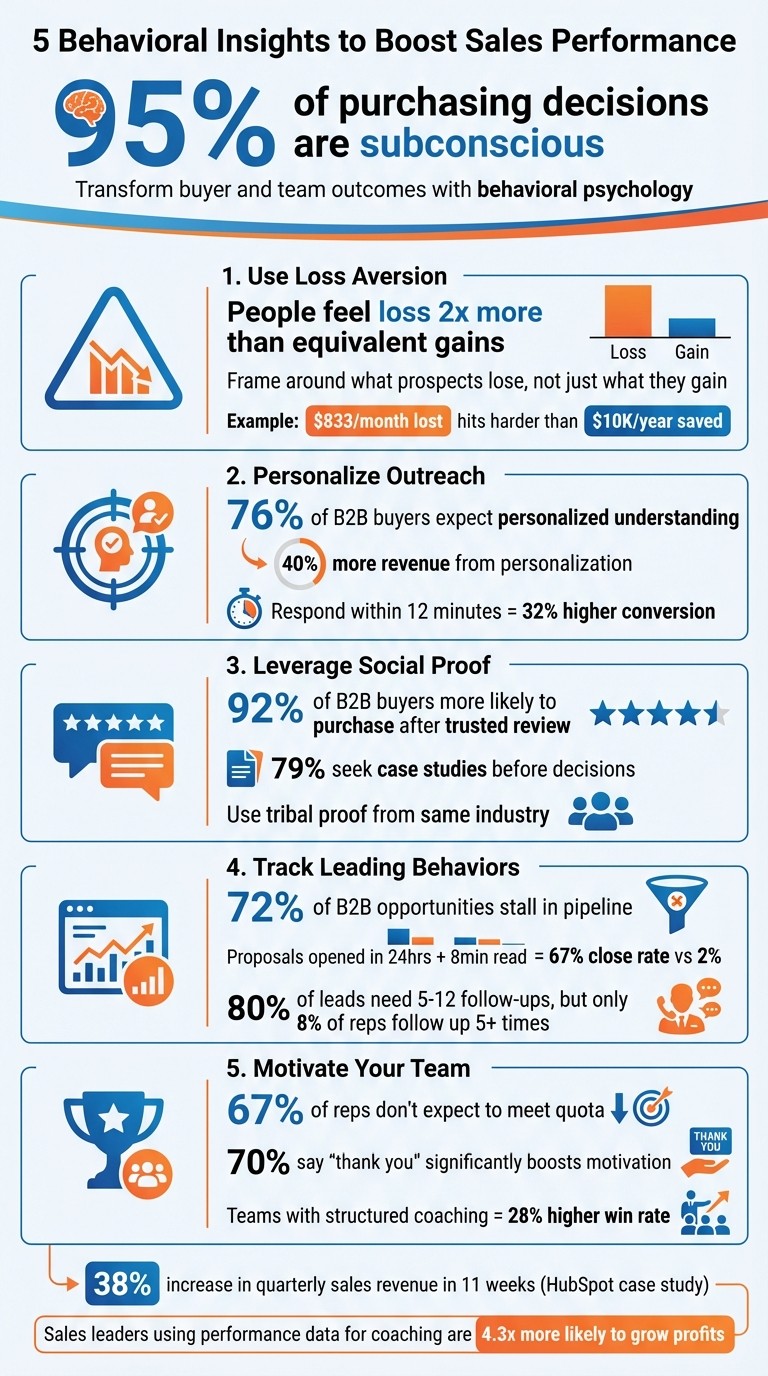
5 Behavioral Insights to Boost Sales Performance Infographic
Sales Psychology 101: Why Emotion Drives 90% of Buying Decisions | Ben Wise | Sales TechTO
1. Use Loss Aversion to Create Urgency
Did you know that people feel the pain of losing something about twice as much as the joy of gaining something of equal value? This psychological principle, known as loss aversion, is why a statement like "You're losing $833 every month" hits harder than "You could save $10,000 this year" [4]. Framing situations in terms of what’s being lost makes inaction feel far more costly - an essential insight when leveraging the Cost of Inaction (COI) during discovery.
Top-performing sales reps often lead with COI. During discovery, ask prospects how much their problem costs them each month. Then, highlight how every delay is like watching money slip away. If a prospect argues that your solution is "too expensive", flip the narrative: "Is the investment more expensive than the $200,000 you're losing annually in wasted labor?" This reframing shifts the focus from the price of your product to the ongoing cost of doing nothing [4].
True urgency comes from real constraints, not arbitrary deadlines. Instead of saying, "Our quarter ends Friday", tie urgency directly to the prospect’s goals. For example: "To be operational before your Q4 peak season, we need to start implementation by July 15th. Waiting beyond that could mean missing your busiest revenue period." Other urgency triggers could include upcoming price increases, limited implementation slots, or seasonal offers that are about to expire [3][4].
The Endowment Effect works hand-in-hand with loss aversion. When prospects feel ownership - like during a free trial - giving up the solution feels like losing something they already possess. Research backs this up: participants in studies were willing to sell a coffee mug they owned for $7 but would only pay $3 to buy the same mug [4][5].
In B2B sales, urgency also ties into decision-makers’ personal stakes. Many fear the career risk of losing credibility if a solution fails. To address this, use targeted social proof to show how others in similar roles made the change and avoided the ongoing losses. By combining loss aversion, urgency, and reassurance, you can guide prospects toward action [4][5].
2. Personalize Based on Engagement Signals
Generic outreach is a thing of the past. These days, 76% of B2B buyers expect companies to understand their specific needs and expectations [6]. What separates a successful response from complete silence? Context. By monitoring how prospects interact with your content - like email opens, page visits, or time spent on specific pages - you uncover valuable clues about their priorities and buying readiness. These subtle engagement signals not only indicate interest but also help you time your outreach perfectly.
Of course, not all signals are created equal. Someone repeatedly visiting your pricing page is sending a much stronger buying signal than someone quickly skimming a blog post. The trick lies in segmenting leads by intent. For example:
Tier 1 signals: Repeated visits to pricing pages combined with in-depth feature research. These prospects are ready for immediate outreach.
Tier 2 signals: Steady engagement with educational content like webinars or case studies. These leads may need nurturing before they’re ready to buy [9].
And the payoff for getting this right? Companies that excel at personalization generate 40% more revenue from these activities compared to their competitors [7].
Engagement signals also reveal where prospects are in their decision-making journey. For instance, someone downloading a whitepaper is likely in the early research phase, while a prospect reviewing case studies may be preparing for ROI discussions. If a CFO has been using your ROI calculator, focus on delivering a strong business case and emphasizing quick returns. On the other hand, if a technical buyer is diving into integration documentation, address their compliance and security concerns up front [8]. Acting on these signals quickly is crucial - responding to lead triggers within 12 minutes can boost conversion rates by approximately 32% [10].
"Sales personalization is the inflection point where conversations stop feeling like 'just another vendor outreach' and start feeling like a continuation of the buyer's internal dialogue." – Diego Mangabeira, HubSpot [7]
Tracking multi-recipient email engagement can also provide valuable insights. If your content is being forwarded and multiple stakeholders are engaging, it’s a clear sign to fast-track discussions with the decision-making team [9]. Combining these engagement signals with other behavioral insights allows sales teams to act with precision.
The bottom line? Using these signals to inform your outreach leads to faster, more tailored interactions. Tools like Coach Pilot can simplify tracking and analyzing engagement signals, empowering your team to deliver highly personalized outreach at scale.
3. Use Social Proof for Analytical Buyers
Analytical buyers aren't swayed by flashy marketing - they want solid, data-backed evidence. With 92% of B2B buyers more likely to purchase after reading a trusted review or case study [15][18], and 79% specifically seeking out case studies before making decisions [15], social proof is a must-have. Testimonials and case studies act as third-party endorsements, helping to ease the fear of making a poor choice. While emotional buyers might lean into brand loyalty or appeal, analytical buyers need hard facts to see that your solution delivers results.
The most effective approach? Tribal social proof - highlighting success stories from customers who face similar challenges and operate in the same industry. Generic examples from unrelated sectors can actually hurt your chances, reducing close rates by 22% when prospects feel the proof isn't relevant [17]. Instead, focus on relatable case studies. As Chris Orlob, Co-Founder and CEO of Pclub.io, explains:
"If you can describe the buyer's problem better than they can themselves, they will automatically assume you have the best solution" [17].
Listing five to seven customers from their industry or "tribe" creates a powerful sense of momentum, signaling that peers are already on board.
To truly resonate, your case studies need specific metrics. Avoid vague compliments like "great product", and instead use measurable results: "cut response time by 60%" or "boosted ROI by 15%." Analytical buyers are often accountable to stakeholders for their decisions, so they need precise data to back up their choice [12]. Structure your case studies with a clear "Challenge-Solution-Results" format, and use exact numbers instead of rounded estimates. For instance, "4,127 customers" feels more credible than "4,000+ customers" because it avoids sounding like a marketing exaggeration [16].
Layered social proof can also make a big impact throughout the buying process. Early-stage prospects benefit from case studies that showcase success. Mid-funnel buyers respond well to recognition from trusted analysts like Gartner or Forrester. Finally, as prospects near the decision point, offering reference calls with existing customers can seal the deal [19]. This approach helps address the concerns of the multiple decision-makers - often five to ten - involved in complex B2B purchases.
Don't underestimate the importance of transparency. While 72% of consumers say positive testimonials build trust [11], 82% actively look for negative reviews to confirm authenticity [19]. A mix of mostly positive reviews with a few constructive critiques feels more genuine than a spotless record of perfect 5.0 ratings. Analytical buyers value this honesty and are more likely to trust your brand because of it [13][14]. By layering social proof and keeping it transparent, you can meet their need for credible, data-driven validation at every step of the buying journey.
4. Track Leading Behaviors for Pipeline Health
Why wait for late-stage metrics like revenue or win rates to tell you what’s wrong? Instead, focus on leading indicators that can give you a heads-up 60–90 days in advance, allowing for proactive adjustments [20]. Lisa Carter, a Sales Strategy Consultant, sums it up perfectly:
"We spent years tracking lagging indicators and wondering why we kept missing our number. Then we started tracking leading indicators and suddenly we could see problems 60 days before they hit revenue" [20].
Start by monitoring critical behaviors such as:
Pipeline generation velocity: How much new qualified pipeline each rep creates weekly.
Qualification rate: The percentage of opportunities matching your Ideal Customer Profile.
Multi-threading rate: The number of deals involving three or more engaged stakeholders [20].
These metrics don’t just reflect past performance - they help you predict future outcomes. For instance, proposals opened within 24 hours and read for over eight minutes have a 67% close rate, compared to just 2% for unopened proposals [20]. That’s a clear signal of how small behaviors can make a big difference.
Here’s another eye-opener: 72% of new B2B sales opportunities stall in the middle or late pipeline stages, often sitting idle for over 60 days without any customer action [1]. Sales Leader Suraj Ramesh from Sprinto highlights this challenge:
"60 to 70 percent of the deals in our pipe will show as progressing... The problem is I'm missing signals on the deals that look fine but are quietly stalling" [1].
By consistently tracking these behaviors, you’ll spot early warning signs and have time to make strategic adjustments. For example, with 80% of leads requiring 5 to 12 follow-ups before a decision is made - but only 8% of reps following up more than five times - tracking follow-up habits becomes crucial [21]. This kind of proactive monitoring ensures your strategy aligns with real-time buyer behavior, giving you the tools to act before it’s too late.
To put this into action, kick off a 30-day roadmap:
Set up tracking systems.
Train your team to focus on key metrics.
Monitor trends closely.
Adjust targets based on data insights [20].
Automating these processes can reduce administrative tasks and shift the focus to data-driven decision-making. For example, use evidence-backed qualification metrics instead of relying on self-reported updates [1].
To streamline everything, consider using an integrated sales enablement platform like Coach Pilot. It automatically captures key behaviors and provides actionable insights in real time, making it easier to stay ahead of potential issues. By tracking the right behaviors, you’ll move from reacting to problems after the fact to preventing them before they arise.
5. Build Motivation and Resilience in Sales Teams
Sales is challenging - 67% of reps don’t expect to meet their quotas, and 84% missed them last year [23]. With constant rejection being part of the job, relying only on commissions or bonuses to keep morale high just doesn’t cut it. True motivation stems from connecting daily tasks to something personally meaningful.
Tony Cole from Anthony Cole Training Group puts it perfectly:
"True motivation is an 'inside-out' job. It comes when salespeople connect their daily activity to deeply personal goals and desires." [22]
To inspire your team, align their sales goals with what genuinely matters to them - whether it’s saving for a down payment, covering a child’s college tuition, or funding a dream vacation. A great tool for this is the "100 Goals" exercise: write down 100 personal goals, narrow it to 12 key objectives, and attach clear financial targets and deadlines [22]. Then, work backward to map out how many calls, meetings, or proposals are needed to hit those milestones. Suddenly, closing three extra deals this quarter isn’t just about numbers - it’s about making that long-awaited family trip a reality.
Once personal goals are in place, the next step is reinforcing the right behaviors. Building resilience in sales means celebrating actions that lead to success, not just the results. Instead of only rewarding closed deals, recognize efforts like scheduling high-quality demos or improving response times. Anita Nielsen from LDK Advisory Services explains:
"Motivation isn't about waiting for the big win - it's about reinforcing the behaviors that lead to it." [23]
Recognition doesn’t have to be extravagant. In fact, 70% of workers say a simple "thank you" from their manager significantly boosts their motivation [25]. A quick Slack message, a shoutout during a team meeting, or a small gesture - like tying a gold balloon to a rep’s chair after a standout call - can go a long way. The key is knowing your team as individuals and understanding whether they prefer public praise or private acknowledgment [23].
When setbacks happen - and they will - reframe them as opportunities to learn rather than failures [24][26]. Instead of asking, "Why did we lose?" after a deal falls through, shift the focus to "What did we learn?" During tough times, pivot from revenue-based goals to controllable actions, like the number of calls made or meetings booked, to rebuild confidence [27][28]. And when the pressure is on at the end of the month, working alongside your team shows solidarity and helps foster resilience [25].
For ongoing support, tools like Coach Pilot can integrate AI-driven coaching into your workflow, offering AI sales coaching and real-time guidance when your team needs it most.
Conclusion
Understanding buyer behavior is the backbone of sales success. The five key insights - loss aversion, personalized engagement, social proof, behavior tracking, and motivation building - offer a clear framework for improving performance. But the real challenge lies in turning these strategies into effective, real-time actions.
Execution is where success is decided. Metrics like closed deals and revenue are lagging indicators; the real focus needs to be on leading behaviors, such as timely follow-ups and personalized communication. Research shows that sales leaders who leverage comparative performance data for coaching are 4.3 times more likely to grow profits [1]. Additionally, teams with structured coaching programs enjoy a 28% higher win rate [29].
This is where tools like Coach Pilot make a difference. Instead of simply analyzing past calls, Coach Pilot provides real-time guidance, offering tailored next steps like CFO-specific talking points or ideal follow-up timings. It integrates seamlessly with your company’s sales playbook, messaging, and objection-handling strategies, ensuring that reps receive personalized, actionable advice. For example, in June 2024, HubSpot BDM Connor Bell used Coach Pilot to boost net new opportunities by 50% and close 12 new deals in just 11 weeks, leading to a 38% increase in quarterly sales revenue [2].
Beyond coaching, Coach Pilot automates administrative tasks, saving reps an average of 19.5 hours per week [2]. This freed-up time allows them to focus on activities that drive revenue. Combined with weekly live coaching and hands-on training, the platform ensures that teams don’t just understand behavioral insights - they apply them effectively in the field. As Zime CEO Sanchit Garg explains:
"A lot of deals are stuck and you don't know how many of them even met qualification criteria... That distinction matters enormously for how you coach and where you spend manager time" [1].
FAQs
How do I use loss aversion without sounding pushy?
To make loss aversion work in your favor, shift the focus to what could be missed rather than just spotlighting potential gains. For instance, point out what someone might lose - such as a limited-time deal or the risk of lagging behind competitors - in a conversational and respectful tone. Tailor the risks of inaction to align with their priorities and worries, making the message relatable without coming across as pushy or overly intense.
Which engagement signals matter most for personalization?
Recognizing the right engagement signals is key to understanding buyer intent and emotional responses. These signals often include detailed questions, positive body language, and specific behavioral patterns - all of which reveal what a prospect needs or wants. By paying attention to these cues, sales teams can craft messaging that's not only timely but also perfectly aligned with a prospect’s motivations.
Emotional triggers, such as creating a sense of urgency (think FOMO) or building trust through credibility, also play a big role in shaping buyer behavior. Tapping into these emotions can significantly boost engagement and improve conversion rates.
What leading indicators best predict pipeline health?
Leading indicators of pipeline health zero in on deal quality, velocity, and risk during the early stages of the sales process. Some of the most important metrics include:
Pipeline velocity: This tracks how quickly deals are moving through the sales pipeline.
Stage conversion rates: These reveal where deals tend to stall or successfully progress to the next stage.
Pipeline coverage ratio: This compares the overall pipeline size to the sales targets, helping gauge whether there’s enough activity to meet goals.
Spotting early warning signs, like deals that have stalled or a lack of decision-making authority, allows sales teams to tackle potential problems early. This proactive approach not only keeps deals on track but also boosts the accuracy of sales forecasts.
Related Blog Posts

Remove the guesswork from winning more deals.