B2B Sales
How AI Personalizes On-Demand Sales Microlearning
Mar 12, 2026
Short, on-demand AI microlearning delivers tailored lessons and real-time coaching to boost retention, win rates, and onboarding speed.
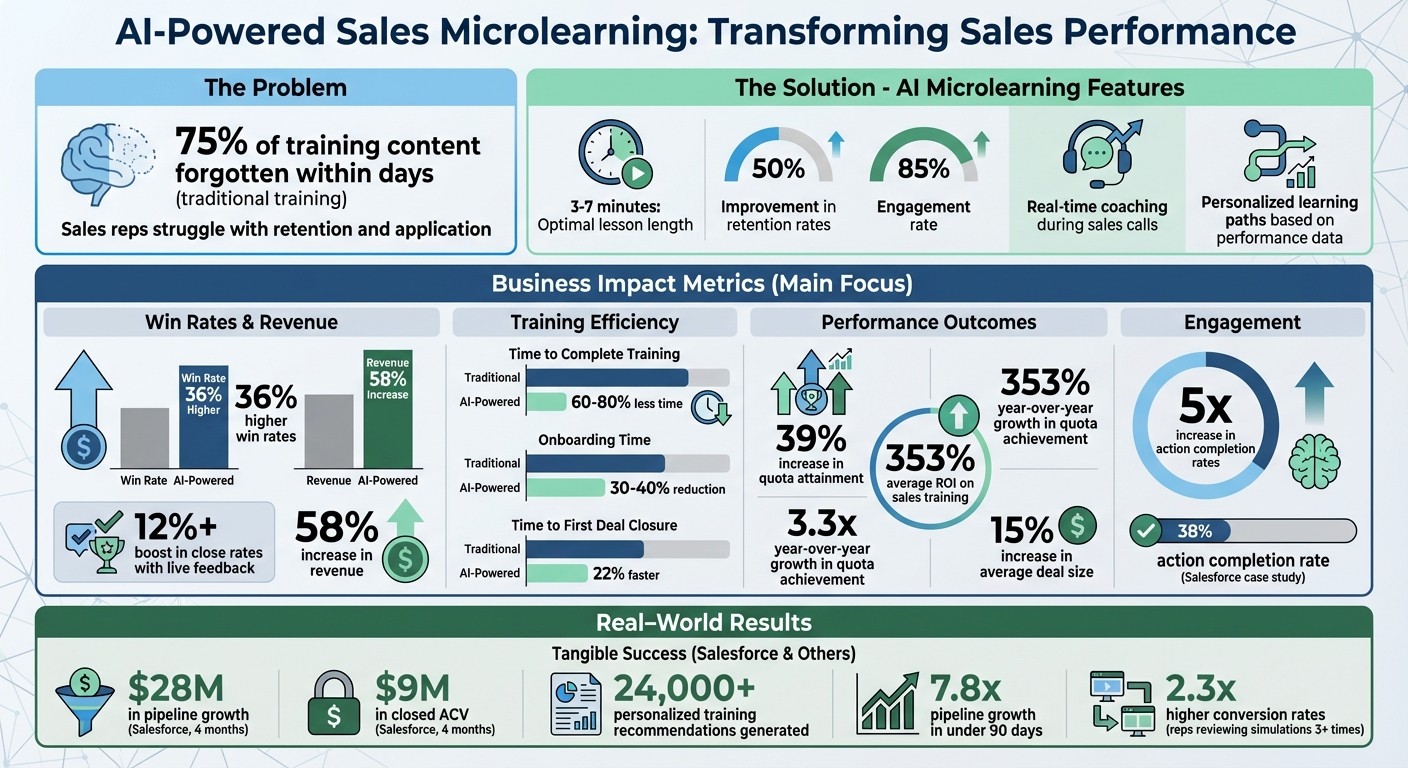
Sales training is often ineffective because most reps forget 75% of what they learn within days. AI-powered microlearning solves this by delivering short, targeted lessons (3–7 minutes) tailored to individual needs, ensuring learning happens when it’s most useful. By analyzing performance data, AI identifies gaps, provides real-time coaching, and boosts retention by 50% while increasing engagement to 85%.
Here’s why this matters:
Better Results: Companies using AI coaching report 36% higher win rates and faster training completion (60–80% less time).
Real-Time Coaching: AI offers instant guidance during sales calls, improving outcomes with context-specific advice.
Business Impact: AI-driven training increases quota attainment by 39% and reduces onboarding time by 30–40%.
AI doesn’t replace human coaching but enhances it, turning training into a tool that directly improves revenue and the future of sales enablement. Platforms like Coach Pilot integrate this approach seamlessly into daily workflows, ensuring reps get the right support at the right time.
AI-Powered Sales Microlearning: Key Performance Metrics and Business Impact
Why Is AI in Sales Training an Operational Upgrade - Not a Shiny Tool?
How AI Personalizes Sales Microlearning
AI creates training experiences tailored to each individual's performance and behavior. Using machine learning, it analyzes performance metrics, learning styles, and career objectives to design custom learning paths [4]. This means two sales reps working side by side might receive entirely different training, based on their unique strengths and areas for improvement.
Analyzing Performance and Behavioral Data
AI pulls from a variety of data sources to understand how each sales rep performs and learns. Tools powered by Natural Language Processing (NLP) dissect sales calls, demos, and emails, evaluating factors like topic coverage, vocal tone, delivery, and even perceived confidence [5][8]. It also tracks digital interactions to identify each rep's preferred learning methods [3][7].
One major advantage comes from CRM integration. AI examines deal outcomes, competitor mentions, and close rates to deliver highly targeted microlearning content [5][6]. For instance, if a rep frequently loses deals to a specific competitor, the system might provide a competitive battle card or an objection-handling refresher. A real-world example: Between February and May 2025, Salesforce used an AI-powered system with Data Cloud and Slack to generate over 24,000 personalized training recommendations for its sales teams. This effort resulted in a 38% action completion rate, contributing to $28M in pipeline growth and $9M in closed ACV in just four months [11].
Armed with this data, AI quickly identifies gaps and delivers microlearning modules that address them.
Tailored Learning Modules
After analyzing the data, AI delivers training content that directly addresses each rep's current needs. It adjusts the difficulty and sequence of modules on the fly [4], ensuring advanced reps can focus on refining skills like negotiation, while others receive foundational support where needed.
Just-in-time delivery ensures training arrives when it’s most useful. AI sends short, focused content - like 3-5 minute videos or quizzes - triggered by specific events, such as an upcoming meeting or a recent performance dip [5]. For example, a rep about to engage in a critical pricing discussion might get a quick refresher on pricing strategies right before the call. Platforms like Coach Pilot integrate this AI-driven coaching into daily workflows, so reps receive timely training without disrupting their schedules.
Real-Time Feedback and Coaching
AI has taken sales training to the next level by offering live, on-demand coaching that sharpens every sales interaction.
AI-Driven Real-Time Coaching
Imagine receiving instant feedback during a sales call - this is exactly what AI-powered coaching provides. By analyzing conversations in real-time, it offers actionable guidance right when it’s needed most. Advanced tools can capture audio from platforms like Zoom or Teams, transcribe it in under 700 milliseconds, and use Natural Language Processing to interpret the conversation’s context, intent, and flow [14].
These systems track key indicators like speaking pace, tone, filler words, and adherence to a living sales playbook. For example, if a prospect mentions a competitor or raises a pricing concern, the AI immediately pulls up relevant battle cards or ROI comparisons from the company’s knowledge base [14][17]. This isn’t generic advice - it’s tailored to the specific conversation unfolding at that moment.
The results speak for themselves: companies using this technology have seen nearly a fivefold increase in action completion rates, alongside major growth in pipeline and closed deals [11][12]. As Beyza Kumanova from Spiky explains:
"The difference between real-time and post-call coaching is timing... Real-time coaching intervenes before the moment passes" [12].
This immediate feedback evolves further, delivering dynamic, situation-specific content that adapts seamlessly to the conversation.
Dynamic Content Delivery
AI doesn’t just coach - it adjusts its recommendations based on the deal’s progress and the prospect’s input. For instance, if a rep is talking too much, a visual cue reminds them to listen more, aiming for an ideal talk-to-listen ratio of 30-40% [17][18]. If a technical question arises, the AI instantly provides the necessary specs or pricing details, allowing the rep to answer confidently and accurately [14].
The guidance evolves with the deal stage. Early discovery calls might prompt deeper questions to uncover needs, while later-stage discussions could focus on compliance requirements or discount approvals [17]. Tools like Coach Pilot integrate this real-time coaching directly into sales workflows, ensuring reps get the right advice at the exact moment they need it. Organizations leveraging this approach report 36% higher win rates and see live feedback boost close rates by over 12% [1][13].
The Business Impact of AI-Personalized Microlearning
AI-powered personalization is transforming sales training into a tool that directly boosts revenue. For instance, sales training shows an average ROI of 353% when the skills learned are applied to actual deals [20]. Companies that incorporate AI into their sales training programs have seen 3.3x year-over-year growth in their sales teams' ability to meet quota targets [21].
Engagement and Retention Metrics
One of the toughest hurdles in training is ensuring knowledge sticks. AI-personalized microlearning tackles this by delivering small, context-specific lessons exactly when they’re needed. This proactive approach - shifting from passive dashboards to active AI guidance - has made a measurable difference. Some companies report up to a fivefold increase in action completion rates when AI provides personalized recommendations directly within sales workflows [11]. This method not only helps retain critical knowledge but also boosts sales performance in tangible ways.
Improved Sales Outcomes
The impact of AI extends to onboarding and deal execution. AI-powered coaching has been shown to cut onboarding and ramp-up times by 30% to 40%, allowing sales reps to close their first deals 22% faster while also increasing the average deal size by 15% [20][22]. These efficiencies create a ripple effect. For example, a fintech company discovered that sales reps who reviewed objection-handling simulations three or more times achieved 2.3x higher conversion rates in their first quarter [20].
Platforms like Coach Pilot take this a step further, embedding continuous reinforcement into everyday workflows to ensure teams consistently apply their skills. Julie Thomas, CEO of ValueSelling Associates, highlights the human element AI brings to the table:
"AI can help to build and reinforce desired selling behaviors in a very human-centric way" [21].
Continuous Improvement Through Feedback
AI takes training to the next level by learning from every interaction, refining the process as it goes, much like how Coach Pilot for ChatGPT for Teams integrates into existing workflows. It doesn’t just deliver content - it actively tracks how sales reps engage with it. Metrics like completion speed, where users drop off, and content preferences (e.g., video vs. quizzes) all contribute to shaping future training sessions [9][25]. This constant feedback loop ensures that microlearning modules are not only relevant but also evolve to meet the needs of the learners.
During live sales calls, AI uses sentiment analysis to pick up on emotional cues - such as confusion, frustration, or engagement - from both the sales rep and the buyer [10]. For instance, if a specific pricing slide or talk track consistently causes a dip in buyer sentiment, the system flags it for review [19][2]. This helps fine-tune the content and approach for future interactions.
What makes this process powerful is its "closed-loop" system. AI identifies skill gaps from real conversations, designs targeted practice scenarios to address those gaps, and adjusts its recommendations if certain techniques don’t yield positive results [15][23]. Every sales call feeds into this loop, making the system smarter and better equipped to improve future training.
Pilot programs have shown that this feedback-driven approach can significantly enhance engagement and outcomes. Teams have reported noticeable improvements in both pipeline growth and course completion rates.
One standout feature is the use of spaced repetition, triggered by real-world performance data. Since people forget up to 70% of new information within a day [24], AI steps in with timely reinforcements. For example, if a rep struggles with handling objections during a call, the system delivers immediate follow-up training [10]. By tying these reinforcements to techniques that generate positive buyer sentiment [2], every interaction becomes a stepping stone for growth, creating a compounding effect over time.
Conclusion
AI-personalized sales microlearning bridges the gap between knowledge and execution. Traditional training often falls short because reps aren’t prepared when it matters most - during real-life sales interactions. AI changes the game by delivering just-in-time coaching and using spaced repetition to make sure knowledge sticks and gets applied effectively.
The results speak for themselves: companies using AI coaching have reported 36% higher win rates and a 58% increase in revenue [1][10][26]. In one pilot program, AI-driven coaching significantly boosted both engagement and pipeline growth [11].
One of AI’s biggest advantages is its ability to scale personalized coaching without overburdening managers. As Ameya Deshmukh from EverWorker explains:
"The real issue is not effort. It's bandwidth and coverage. Modern AI-driven coaching fixes this by turning unstructured revenue conversations into structured, coachable insights" [16].
AI achieves this with remarkable efficiency. For example, reviewing a role-play takes AI just 60 seconds - a task that would take a human manager 17 minutes [26]. This scalability allows teams to grow from 50 to 500+ reps while maintaining high-quality coaching. By turning static information into dynamic, actionable insights, AI ensures every deal benefits from expert guidance at the right time.
Platforms like Coach Pilot take this even further by embedding AI-powered coaching directly into sales workflows. These platforms transform outdated playbooks into interactive systems that guide reps through each stage of the sales process. The results? Teams have achieved 7.8x pipeline growth in under 90 days and a 39% increase in quota attainment [27]. Coach Pilot combines tailored playbooks, immersive training, and real-time AI coaching to turn strategy into action.
The move to AI-personalized microlearning isn’t just a step forward - it’s a complete shift in how sales teams learn, practice, and perform. With timely, targeted guidance, sales reps don’t just improve incrementally - they redefine how they sell. And that transformation is reflected in stronger pipelines, higher win rates, and increased revenue. AI transforms training from a passive process into a dynamic, revenue-boosting tool.
FAQs
What data does AI use to personalize sales microlearning?
AI takes sales microlearning to the next level by tailoring the experience to each individual. By analyzing performance data - like strengths, weaknesses, and recent interactions - it crafts customized learning paths. These personalized approaches help address specific needs, making training more effective and boosting overall learning outcomes.
How does real-time AI coaching work during live sales calls?
Real-time AI coaching works by capturing audio during live conversations, transcribing the speech almost instantly, and analyzing the context of the discussion. It steps in with timely, relevant advice whenever objections or tough questions come up. This allows sales reps to tweak their strategy in real-time, ensuring they handle challenges with confidence and respond effectively during calls.
How do teams measure ROI from AI-personalized microlearning?
Teams track the return on investment (ROI) of AI-personalized microlearning by keeping an eye on key performance indicators (KPIs) like win rates, average deal size, sales cycle length, and employee turnover rates. These metrics provide a clear picture of how training efforts are influencing performance and driving revenue growth.
Related Blog Posts

Remove the guesswork from winning more deals.