B2B Sales
How Adaptive Learning Improves Sales Team Performance
Mar 8, 2026
AI-driven adaptive learning personalizes sales training to cut ramp time, boost win rates, and grow deal size with CRM-integrated, role-specific coaching.
Sales training often fails because it treats everyone the same. New hires take too long to ramp up, seasoned reps waste time on irrelevant content, and most training is quickly forgotten. Adaptive learning changes this by using AI to personalize training for each rep, focusing on their specific needs and skill gaps.
Here’s why it works:
Cuts training time by up to 50%. Reps spend more time selling and less time on irrelevant content.
Boosts engagement. Personalized learning paths increase action completion rates (e.g., Salesforce saw a jump from 8% to 38%).
Improves sales metrics. Teams report faster ramp times, higher deal sizes, and better win rates.
Level Up Your Sales Training with the Power of AI, Adaptive and Immersive Learning
Aligning Sales Goals with Learning Objectives
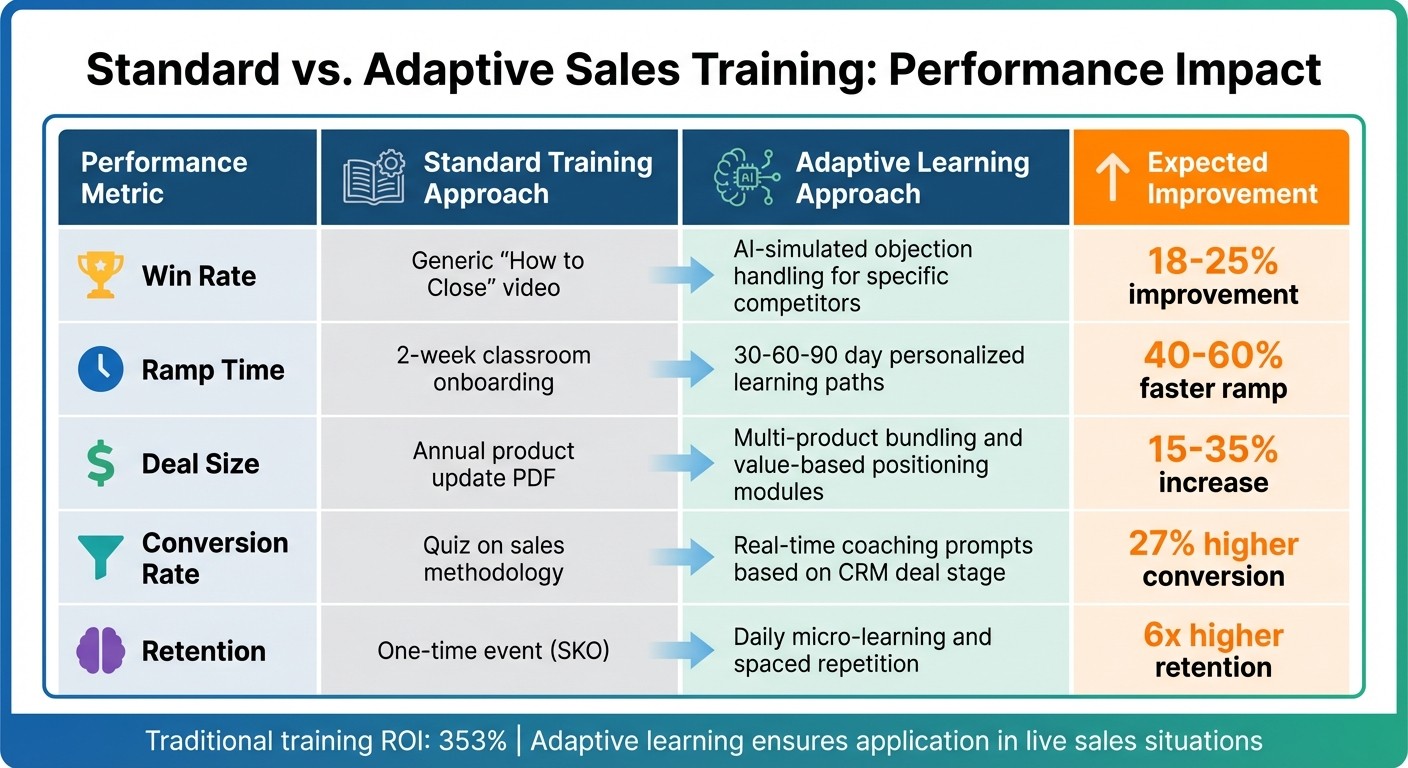
Standard vs Adaptive Sales Training: Performance Comparison
One of the biggest pitfalls in sales training is treating it as a routine checkbox activity instead of linking it to metrics that actually drive revenue. By leveraging CRM and conversation intelligence data, you can identify exactly where deals are stalling - like a high drop-off rate at the proposal stage - and design training to address those specific challenges. This data-driven approach ensures training aligns with measurable sales outcomes.
Sales Metrics That Matter Most
When it comes to metrics, focus on the ones that directly affect your revenue: win rates, ramp time, pipeline conversion rates, average deal size, and sales cycle length. These aren't just numbers on a dashboard - they reveal where your team needs support. For instance, if it takes your sales reps 10 months to reach full productivity[4], it’s a clear sign your onboarding process isn’t cutting it. Or, consider this: if 72% of your team struggles to articulate your product’s differentiation, your win rates could drop by up to 28%[4]. Instead of prioritizing vanity metrics like course completion rates, focus on how your reps perform in real-world customer interactions. This ties directly into the adaptive approach we discussed earlier, aligning learning with tangible sales improvements.
Converting Metrics into Learning Goals
The key to turning metrics into actionable learning objectives is mapping specific skills to the outcomes you want to improve. Here’s how:
Low win rates? Adaptive learning can focus on objection handling and competitive positioning.
Pipeline conversion issues? Train your team on qualification frameworks like MEDDIC or BANT to keep leads moving forward.
Need to grow average deal size? Modules on multi-product bundling and value-based positioning can make a big difference. In fact, AI-driven learning paths have been shown to increase deal size growth by 35%[1].
By using CRM webhooks, you can assign targeted training right when it’s needed - like after a lost deal or when conversation data reveals reps are talking more than they’re listening. This approach connects learning directly to performance, making it more relevant and impactful.
Platforms such as Coach Pilot (https://coachpilot.com) are great examples of this strategy in action. They integrate CRM data with adaptive learning to create personalized training paths, ensuring every learning objective directly translates into measurable results.
Standard vs. Adaptive Training: A Comparison
While traditional training can deliver an impressive 353% ROI when done well[2], adaptive learning takes it to the next level. It ensures that reps don’t just learn but actually apply their knowledge in live sales situations. This alignment of training objectives with real-world metrics underscores how adaptive learning can transform sales performance.
"Without metrics, you can't deliver tailored skill coaching that focuses on each team member's individual skill gaps"[6].
Helen Waite, Mindtickle
Creating Learning Paths for Different Sales Roles
Adaptive learning goes beyond just tailoring content to performance - it also adjusts to the specific needs of each sales role. This ensures that every rep gets targeted training that directly improves their effectiveness. Think about it: SDRs focusing on high-volume outreach have different priorities than AEs managing complex deals or Sales Managers guiding their teams. A common mistake many companies make? Forcing everyone through the same training modules, regardless of their role or experience. It wastes time and kills motivation.
Customizing Learning for Each Sales Role
The first step is defining success for each role - something often referred to as an "Ideal Rep Profile" (IRP) [8][1]. For SDRs, the focus should be on core skills like discovery techniques, lead qualification, and handling objections. These reps need to excel at cold outreach and manage high-volume pipelines effectively using CRM tools. Account Executives, on the other hand, require advanced skills like negotiation, managing complex sales cycles with multiple stakeholders, and value-based selling strategies - they’re the ones closing deals. For Sales Managers, the priority is honing data-driven AI sales coaching techniques, identifying skill gaps in their team, and using analytics to boost overall performance [8][1].
Personalized learning paths aren’t just a nice-to-have - they deliver results. Studies show a boost in buyer engagement by 11% and a 35% increase in average deal size when training is role-specific [1]. A real-world example? In 2024, Janssen India managed to cut sales rep ramp time in half by introducing role-specific training through a centralized platform. Dr. Somnath Datta, Head of Commercial Excellence, spearheaded this initiative, consolidating all training into a single portal tailored to each role’s needs [8].
To take it further, use assessments to pinpoint individual skill levels and customize learning journeys even more.
Using Assessments to Personalize Learning
Diagnostic assessments are a game-changer. They identify specific skill gaps, allowing experienced reps to skip over content they’ve already mastered and focus on areas where they need growth. Tools like quizzes, practical assignments, and self-checks help measure proficiency beyond just surface-level knowledge [7][11][1].
Adaptive systems take this a step further by analyzing responses in real time. For example, if an AE struggles with objection handling during an assessment, the system can immediately provide tailored resources or alternative explanations to address that gap [7][9]. It’s about giving reps exactly what they need, not just pushing them to complete courses. Tracking quiz scores alongside confidence levels is another smart approach - high scores paired with low confidence can signal underlying issues that might affect performance during live conversations [10].
Surprisingly, only 40% of C-level executives can accurately identify individual rep strengths and weaknesses for tailored training [8]. Diagnostic assessments remove the guesswork, providing clear, data-driven insights into where each rep needs support.
Scenario-Based Learning and Simulations
Scripted roleplays often miss the mark because they don’t reflect the complexities of real-world sales. Instead, effective simulations use realistic scenarios based on actual deal patterns, competitive challenges, and CRM insights [13]. For SDRs, this could mean practicing discovery calls and overcoming resistance, while for AEs, it’s about navigating complex negotiations or addressing pricing objections.
The impact of simulation-based learning is hard to ignore. Top-performing sellers engage in six times more roleplay practice than their peers, and AI-driven roleplay can cut ramp time for new reps by up to 50%. What normally takes six months can be achieved in just two or three [13][12]. Reps who use AI feedback to refine their roleplay sessions see their average scores improve by 10% [13].
A great example of this in action is Cisco’s 2024 training initiative. They introduced simulation-based training for 18,000 sellers, leveraging AI-driven roleplay to slash ramp times by half and improve performance scores by 10% [13]. Chris Jackson, Distinguished Solutions Engineer at Cisco, highlighted how AI tools scaled coaching efforts and achieved widespread adoption among their teams [13].
To make simulations effective, base them on the real challenges your team faces. Use CRM data to identify win/loss trends and common objections. Build detailed buyer personas with specific KPIs, business pressures, and personality traits like being "impatient" or "conservative." Each simulation should focus on a clear objective, such as uncovering pain points or handling budget concerns.
Platforms like Coach Pilot (https://coachpilot.com) make it easier to integrate scenario-based learning into sales workflows. They combine custom playbooks with immersive training and AI-driven coaching, giving reps a chance to practice real-world scenarios before facing actual buyers.
Integrating Learning into Daily Sales Work
Sales teams often struggle to fit learning into their packed schedules, with just 24% of their week spent actively selling [15][16]. The trick is to stop viewing learning as an extra task and embed it into their daily routines. When learning happens alongside actual sales activities, it sticks. Without reinforcement, reps forget 70% of new information within 24 hours [14]. By weaving learning into their everyday work, sales teams can keep their skills sharp.
Connecting Learning with CRM and Sales Data
Your CRM can do more than just track deals - it can actively drive learning. Imagine a system that assigns targeted practice sessions when deals stall for two weeks or when reps skip discovery calls. This kind of trigger-based learning transforms your CRM from a static tool into a dynamic performance enhancer [22].
For example, OpenPhone cut their speed-to-lead time by 67% in January 2026 by automating their inbound processes with enrichment and routing logic [20]. The same principle applies to learning. If an AE moves a deal to "Demo Scheduled", the CRM can trigger a tailored demo practice session using AI roleplay [22]. This approach has been shown to improve deal cycles by 37% and boost win rates by 24% [21].
To implement this, map out your sales process and identify the critical conversations - like discovery, objection handling, or pricing discussions - that drive deals forward. Then, set up workflows where low performance in specific areas (e.g., "competitive positioning") automatically assigns a relevant learning module [22]. One Fortune 500 tech company saved $2.3 million annually in onboarding costs and increased quota attainment by 34% by using behavioral analytics that tracked over 140 verbal cues in sales calls [21].
Building Daily and Weekly Learning Habits
Once automated triggers are in place, the next step is creating consistent learning habits. Short, regular practice sessions are more effective than occasional, intensive training events. Think of it like warming up before a workout. As John Oberg, CEO of Precina, explains:
"I've asked my team to practice once a day. They're warming up every day for professional calls... in the same way that musicians warm up before performing." [18]
A simple 10-minute AI roleplay session before calls can build muscle memory without disrupting productivity. Reps can also use AI tools to review and refine recent calls, reinforcing good habits right after live interactions.
For weekly learning, structure it like this: On Mondays, AI generates a "coaching queue" highlighting three key moments for each rep to review. Midweek, managers hold one-on-one sessions using AI-selected clips to address specific gaps, like improving discovery or handling objections. On Fridays, trend summaries help identify team-wide areas for improvement. In 2025, one SMB manager who completed 79% of their one-on-ones using a structured coaching platform grew their pipeline by 72% in a single quarter, compared to just 25% growth from the least consistent manager [3].
Automation can make this process even smoother. AI tools handle CRM updates, call summaries, and follow-up emails, giving reps back up to 10 hours a week for selling and learning [17]. As Mamta Tainwala from Sybill.ai puts it:
"A rep who spends 90 minutes a day on admin is a rep who has 90 fewer minutes to practice, prospect, and close. Freeing up that time is training by subtraction." [17]
AI-Driven Coaching for Real-Time Feedback
Real-time feedback is far more effective than delayed coaching [19]. AI-powered tools can analyze live calls and offer immediate suggestions, like handling objections, adjusting pricing, or pulling up a competitor battlecard [21].
Some platforms deliver feedback right after calls via Slack or email, while others provide real-time "whisper" prompts during live calls. These prompts guide reps without interrupting the flow. If a call starts to go off-track - due to a drop in sentiment or a competitor mention - managers can get alerts and step in via Slack, a method known as "invisible shadowing."
Checkpoint saw their reps practice sales conversations three times more often after introducing AI-powered training with timely feedback [14]. Spa World increased their closing rates by 25% using AI simulations that gave reps a safe space to practice [14]. The numbers are clear: traditional coaching covers less than 10% of conversations when a manager oversees eight reps. AI bridges that gap [19].
Tools like Coach Pilot (https://coachpilot.com) integrate AI-driven coaching directly into sales workflows. Reps receive real-time feedback on calls and emails, reinforcing learning right when it matters most - during execution.
Measuring Adaptive Learning Results
Tracking the impact of training programs is critical, especially when the average ROI can hit 353% [23][2][25]. The key is to focus on metrics that directly influence revenue instead of superficial ones. To gauge effectiveness, it’s important to monitor both leading indicators (like roleplay scores and practice completions) and lagging indicators (such as win rates and quota attainment) [29].
Data Points to Track
Here are five key performance indicators (KPIs) worth prioritizing:
Training NPS: Gauges how participants feel about the program.
Pre/post assessment lift: Measures knowledge gained through the training.
Talk-to-listen ratio change: Tracks behavioral improvements.
Ramp time by cohort: Measures how quickly new hires become productive.
Phillips ROI: Provides a financial evaluation of the program's impact [23].
For example, in 2025, one company using AI-driven microlearning saw impressive results: a 12% boost in deal size, a 20% shorter sales cycle, and 30% faster ramp times for new hires within six months [25].
To ensure skills are retained and not just crammed, monitor these metrics at intervals like 30, 60, and 90 days [26][29]. You could also enhance your CRM by tracking which training modules are applied during sales processes. This enables you to directly link learning to measurable outcomes [27]. Teams leveraging AI-powered adaptive learning often report stronger buyer engagement and larger deal sizes [1].
While these numbers are essential, they don’t tell the whole story. Qualitative insights can provide a deeper understanding of adaptive learning’s effectiveness.
Qualitative Signs of Success
Beyond the data, qualitative feedback helps explain the "why" behind the numbers. Managers and reps alike can observe changes in how salespeople handle discovery questions, manage objections with confidence, or apply effective talk tracks during calls [2][26].
Comparing reps' self-assessments with their managers’ evaluations can also reveal blind spots - known as the "Assessment Gap" - where reps might overestimate their abilities. This gap often highlights areas where coaching is still needed [26]. Additionally, tracking metrics like employee Net Promoter Score (eNPS) and turnover rates can be revealing. Notably, 94% of employees are more likely to stay at companies that invest in their development [25].
Building a Feedback Loop for Continuous Improvement
Before launching any training program, establish a baseline to measure progress accurately and ensure that any gains are due to the training - not external market factors [23][24]. For example, in 2024, a company streamlined its sales training into a single portal, giving reps clear visibility into their progress. This approach cut ramp time in half [28].
Consistently review results and tweak learning paths as needed. If a module isn’t improving CRM metrics, adjust it [29]. Integrating your learning platform with CRM systems can help connect training completion to outcomes like faster deal velocity and higher win rates [2][25]. By creating a continuous feedback loop, you can refine training programs and directly boost sales performance. As one expert put it, "Training without measurement is just a cost" [25].
Tools like Coach Pilot (https://coachpilot.com) can help track these metrics in real time, enabling you to identify successful strategies and fine-tune your program for even better results.
Conclusion
Adaptive learning is reshaping how sales teams grow and perform. By tailoring learning experiences, embedding coaching into everyday tasks, and focusing on meaningful metrics, companies can reduce ramp time by 40% to 50% [12] and add $47,000 in revenue per new hire during their first year [4]. Unlike traditional training methods, which often lead to reps forgetting up to 90% of new information within a week [30], adaptive learning ensures skills are reinforced continuously.
When training becomes part of CRM workflows and is supported by AI-powered coaching, the results are impressive. For example, sales reps can complete over 100 practice scenarios before making their first call [12]. This approach leads to faster deal closures (22% faster) [2], larger deal sizes (35% more likely to increase) [1], and a significant boost in quota attainment (up by 32%) [4].
The key takeaway is clear: adaptive learning drives real, measurable change. AI acts as a vital one-on-one coaching tool [30], helping organizations refine strategies by analyzing performance data. By regularly reviewing cohort results, updating training content to reflect real-world challenges, and linking learning progress to pipeline growth, companies can build a feedback loop that continually improves outcomes. Monitoring both leading indicators, like roleplay scores, and lagging indicators, such as win rates, helps pinpoint where reps struggle - whether it's handling pricing objections or asking better discovery questions - and provides targeted practice to close those gaps.
Tools like Coach Pilot (https://coachpilot.com) make this process seamless by integrating custom playbooks, immersive training, and AI-driven coaching directly into workflows. This approach empowers sales teams to adapt daily to market changes while delivering consistent revenue growth.
FAQs
How do I start adaptive sales training with our CRM data?
To kick off sales training tailored to your team, start by diving into your CRM data. This helps pinpoint skill gaps and spot performance trends. Leverage AI-powered coaching tools to design custom learning paths and deliver real-time feedback to your sales reps. Keep an eye on the results, and use insights from your CRM to tweak the training as needed. The goal? Boost sales performance, shorten onboarding times, and drive improved results across your team.
What assessments work best to personalize learning for SDRs vs AEs?
When it comes to evaluating Sales Development Reps (SDRs) and Account Executives (AEs), the key is tailoring assessments to match their specific roles. Each position demands a distinct set of skills, and targeted evaluations can help pinpoint strengths and areas for improvement.
For SDRs, the focus should be on skills like prospecting, cold-calling, and lead qualification. These are the foundation of their role, so assessments should measure how effectively they can identify and engage potential customers.
On the other hand, AEs thrive when they excel in closing deals, negotiation, and account management. Evaluations for AEs should center around these areas to ensure they’re equipped to turn opportunities into long-term relationships.
What makes this process even more effective? AI-driven adaptive learning platforms. These tools personalize assessments and training, aligning them with the specific needs of each role. The result? Better performance and higher productivity tailored to the unique demands of SDRs and AEs.
How can we prove adaptive learning ROI in 30–90 days?
To show the return on investment (ROI) for adaptive learning within 30–90 days, focus on tracking essential sales metrics like win rates, average deal size, sales cycle length, and time-to-ramp for new reps. By comparing data from before and after implementing adaptive learning, you can pinpoint measurable improvements. For instance, a shorter ramp time or higher win rates clearly highlights its impact. Using AI-powered coaching platforms with real-time analytics can make it easier to measure and present these results efficiently.
Related Blog Posts

Remove the guesswork from winning more deals.