B2B Sales
The Complete Guide to Sales Training That Sticks
Mar 1, 2026
Make sales training stick with personalized learning, real-time AI coaching, spaced repetition, and metrics that tie training to revenue.
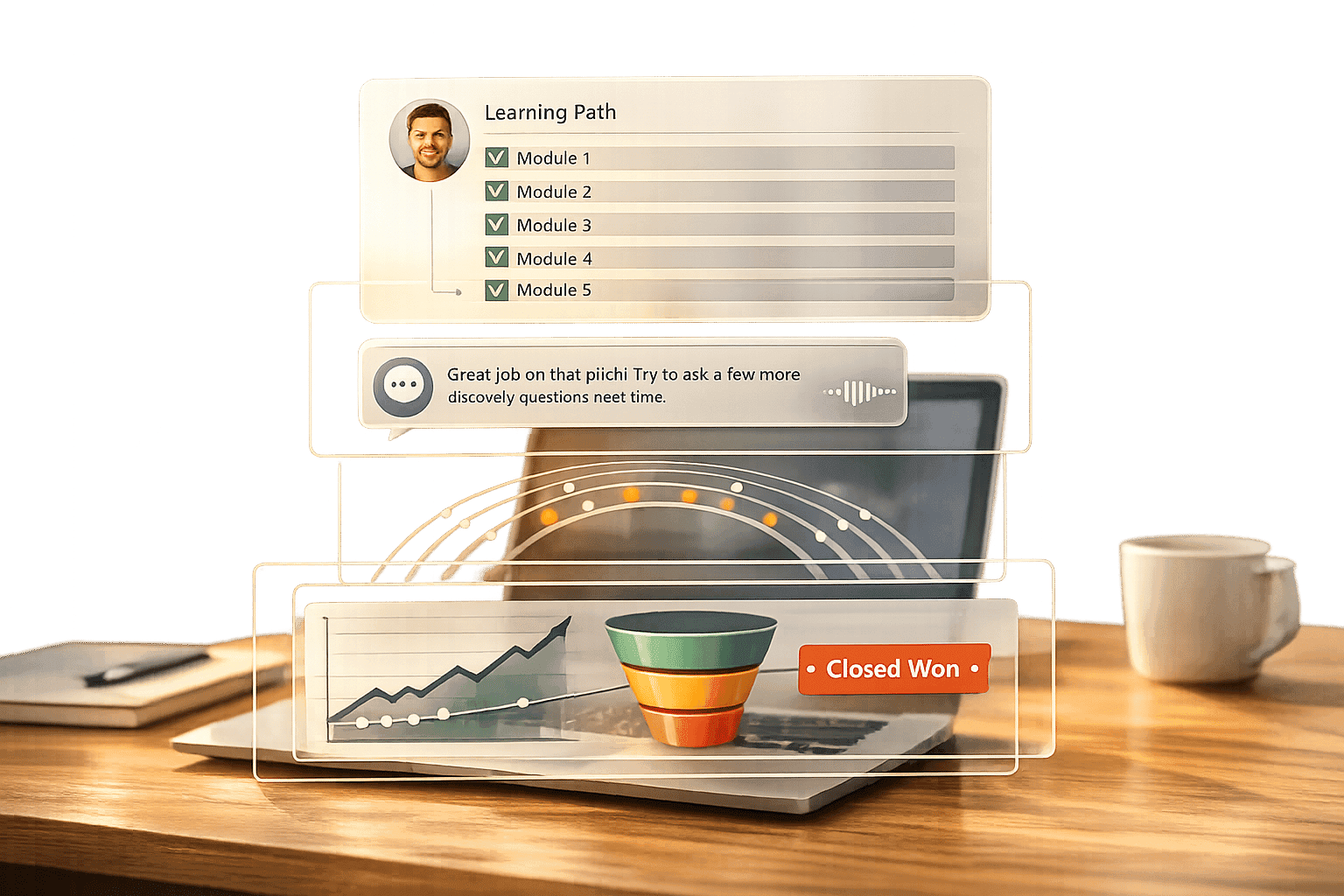
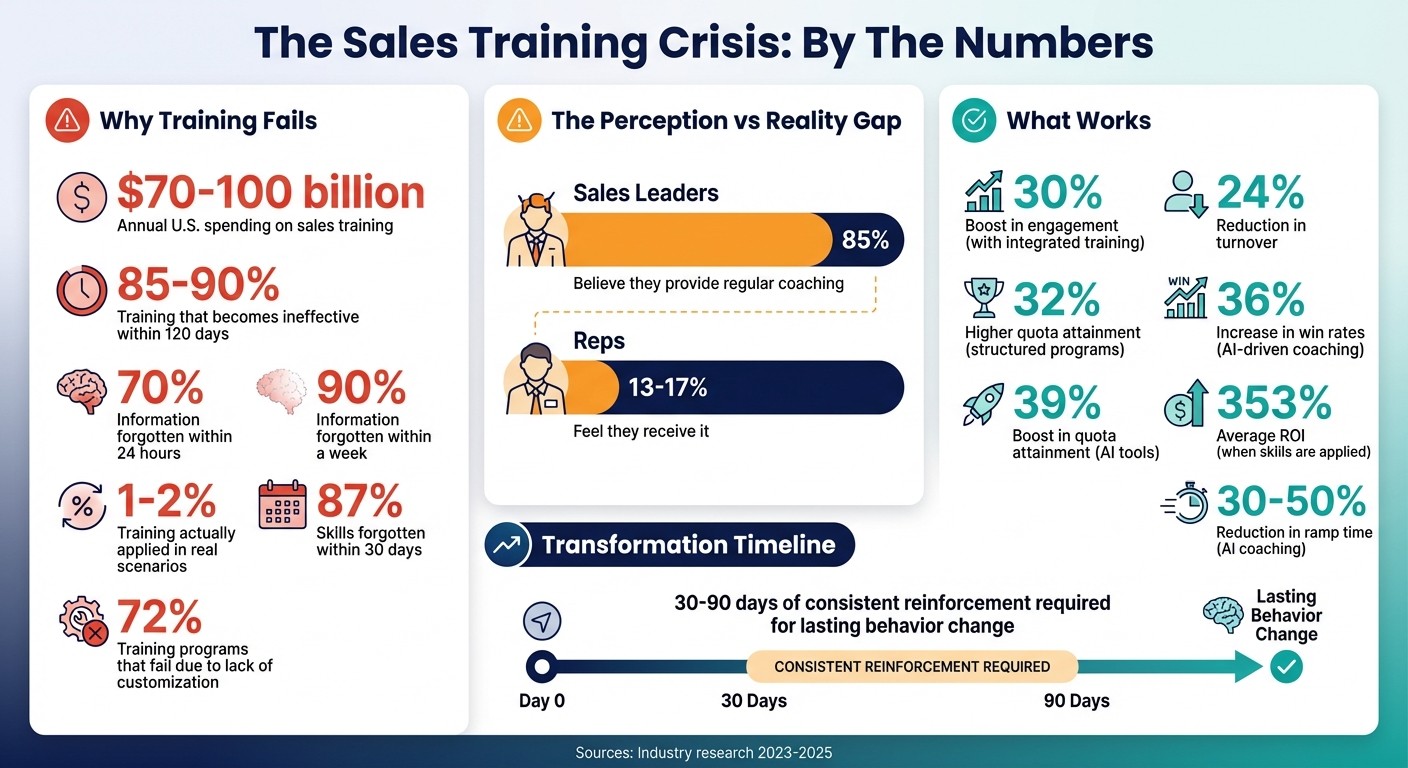
Every year, U.S. companies spend $70–$100 billion on sales training, but 85–90% of it becomes ineffective within 120 days. Why? Most reps forget 70% of what they learn in 24 hours and 90% within a week. Even worse, only 1–2% of training gets applied in real sales scenarios. The problem lies in treating training as a one-time event rather than a continuous process.
To fix this, sales training must focus on:
Personalized learning paths: Tailor training to individual skill gaps and roles.
AI-driven coaching: Provide real-time feedback during sales calls.
Spaced repetition: Reinforce learning over 90 days for long-term retention.
Companies that integrate training into daily workflows see up to a 30% boost in engagement and a 24% reduction in turnover. This guide explains how to transform short-lived workshops into lasting behavioral changes by leveraging modern tools, clear goals, and continuous practice.
Sales Training Failure Statistics and Success Metrics
Why Most Sales Training Programs Fail
The issue with most sales training programs isn't about the quality of the material - it’s about how that material is delivered and reinforced. These gaps explain why even massive investments in training often fail to produce lasting improvements.
Poor Retention and the Forgetting Curve
Human memory fades quickly without reinforcement. Research shows that people lose 50% of new information within an hour, 70% within 24 hours, and nearly 90% within a week [3]. Unfortunately, traditional training models treat learning as a one-time event rather than a gradual process. Sales reps may attend workshops crammed with information, but when they return to their daily routines, the training often becomes irrelevant. Within just 30 days, 87% of the skills they learned are forgotten [3].
"You don't rise to your level of training. You fall to your level of practice." – Brevity [13]
Simply knowing what to do in a controlled training environment isn’t enough. Performing under the pressure of real sales calls requires practice and repetition. Without continual reinforcement, training builds awareness but fails to create instinctive behavior.
This rapid loss of knowledge highlights the need for training programs that are role-specific and reinforced over time.
Generic Training That Ignores Individual Needs
Memory decay isn’t the only challenge. Many training programs fail because they take a one-size-fits-all approach, ignoring the unique needs of individual sales roles. For example, a renewal manager and an enterprise sales rep face vastly different hurdles. Yet, most programs deliver the same content to everyone, regardless of their role, experience, or skill gaps. This lack of customization leads to predictable issues.
Top performers disengage because the training doesn’t address their advanced challenges [14][4].
Struggling reps don’t improve because the training skips diagnosing their specific weaknesses.
The result? 72% of sales training programs fail because they aren’t tailored to individual needs or reinforced effectively [2].
"If the roles and motions are different, the training has to be different, or it won't land for anyone." – Chris Orlob, pclub.io [14]
Generic training also tends to overlook the complexities of real-world selling. It often fails to address actual buyer behaviors, industry-specific objections, or the nuances of complex deals. When the content doesn’t reflect real-life challenges, sales teams lose interest and fail to apply what they’ve learned.
Missing the Continuous Learning Component
Another major flaw is the lack of ongoing support after the initial training. While 85% of sales leaders believe they provide regular coaching, only 13–17% of reps feel they actually receive it [4]. Without consistent follow-up, the behavior changes required for success simply don’t stick.
"Transformation isn't about new content. It's about new habits." – Butler Street [4]
True behavior change requires 30 to 90 days of consistent reinforcement and accountability [2][5]. Without this, reps naturally fall back into old habits - even if those habits deliver mediocre results. To make matters worse, many companies lack the metrics to measure whether training is having any real impact [3]. As a result, potentially game-changing skills fade away from lack of use.
Understanding these common pitfalls is the first step toward creating sales training programs that lead to meaningful and lasting improvements in performance.
How to Build Sales Training That Produces Results
Building sales training that delivers measurable outcomes starts with a structured plan. It’s about knowing where your team stands, identifying where they need to go, and creating tailored strategies to close the gap. This approach ensures steady improvement that you can track and refine over time.
Evaluate Skills and Find Performance Gaps
Before you dive into designing a training program, figure out what skills your team actually needs. Start by creating a sales competency model - a roadmap that outlines the key skills and behaviors required for success in your organization [16][17]. Then, pull baseline data from your CRM. Look at metrics like win rates, deal cycle length, and average deal size. These numbers will give you a benchmark to measure progress [16][17].
But don’t stop at high-level metrics. Dig deeper into how your reps perform during customer interactions. Use call recordings and manager feedback to assess behaviors like asking thoughtful discovery questions or confidently handling objections [15][16]. Tools like AI-powered coaches can take this analysis further by identifying specific weaknesses - whether it’s an unbalanced talk-to-listen ratio, overuse of filler words, or poor objection handling [9][18]. Once you know the gaps, you can set focused, outcome-driven goals.
Set Clear, Measurable Training Goals
Vague goals lead to vague results. Instead of aiming to "improve sales skills", tie your training to specific business outcomes. For example, set objectives like "boost average deal size by 15% within six months" or "reduce ramp-up time for new reps by 30%" [16]. Research shows that organizations with clear training metrics are 13.6 times more likely to see meaningful results [19].
"Training isn't a one-and-done thing. Treating it that way leads to measuring the wrong metrics like completion rates instead of the ones that matter, such as deal velocity and close rates" [12].
Behavior change takes time, so plan for continuous reinforcement. Without it, sales skills can fade by as much as 87% within 90 days [8]. Build regular practice and feedback into your training to make sure the changes stick. With clear goals in place, you can tailor your content to meet the specific needs of your team.
Create Customized Learning Paths
Generic training rarely works because it doesn’t address individual needs. Start by defining an Ideal Rep Profile (IRP) - a detailed outline of the skills, behaviors, and knowledge your reps need to succeed. Use AI tools to analyze real sales calls and CRM data to uncover individual skill gaps that might go unnoticed in a one-size-fits-all approach [9][18].
Different roles within your sales team - like Business Development Representatives, Account Executives, and Account Managers - have unique responsibilities. Tailor your training content to reflect these differences [18][19]. For example, Janssen India reported in November 2023 that they cut their sales ramp time in half by using a personalized learning portal. This portal provided reps with targeted modules that matched their specific needs [18].
Modern training platforms can take personalization even further. Adaptive learning technology can recommend modules or content based on a rep’s current deals and performance data [8][9]. AI-powered role-play scenarios allow reps to practice tough situations - like negotiating with a skeptical CFO - and receive instant, unbiased feedback without risking real deals [6][9]. One healthcare company found that daily AI simulation warm-ups helped their reps ramp up faster and communicate more effectively [9][12].
To keep training manageable and effective, use microlearning and spaced repetition. Break content into short modules (2–7 minutes) and include automated quizzes at intervals to reinforce learning without overwhelming your team [8]. This method has proven results: companies with structured sales-readiness programs see 32% higher quota attainment [8].
"Managers can now create their own coaching content faster and personalize it to fit the specific needs of their reps" [18].
This adaptable approach ensures your training evolves as your team grows and their needs change.
Using AI to Improve Sales Training
AI has turned sales training into an ongoing process rather than a one-time event. By embracing continuous learning, AI provides real-time, data-driven coaching that bridges the gap between training sessions and actual performance. These tools analyze performance metrics, offer immediate feedback during live sales calls, and seamlessly integrate into existing workflows. The result? Sales reps can apply their training more effectively when interacting with prospects.
AI-Driven Skill Gap Analysis
AI dives deep into sales conversations, using performance data to identify gaps that traditional methods often overlook [20]. Instead of guessing where a rep might be struggling, AI pinpoints specific issues like ineffective discovery questions, weak objection handling, or imbalanced talk-to-listen ratios [21][26].
For example, Coach Pilot users have achieved 7.8x pipeline growth within just 90 days by addressing these targeted weaknesses [20]. The platform creates detailed competency profiles for every rep, highlighting strengths and areas needing improvement. This approach delivers measurable outcomes, with organizations reporting a 36% increase in win rates and a 39% boost in quota attainment [20][23]. By shifting from generic outreach to tailored, value-focused messaging, sales teams see tangible results.
Additionally, AI has significantly reduced new hire ramp time - by 30% to 50% - through simulated "ride-alongs" for every call. This eliminates the need for labor-intensive manual reviews [22]. Beyond identifying skill gaps, AI provides immediate feedback, ensuring reps can improve in real time rather than waiting for delayed reviews.
Real-Time AI Coaching During Sales Calls
Traditional coaching often happens after the fact, making it too late to influence the outcome of a deal. Real-time AI coaching changes that by offering actionable guidance during live calls [25]. For instance, when prospects ask about pricing, technical specs, or other details, AI delivers the relevant information instantly, reducing the need for follow-up emails or calls [25].
AI also tracks conversational dynamics, such as speaking speed and talk-to-listen ratios, and suggests adjustments on the fly [27]. These real-time insights have led to a 12% improvement in close rates [28]. Managers can also use "invisible shadowing" to monitor multiple live calls simultaneously, stepping in only when sentiment drops or specific cues are detected. This is crucial, as around 90% of prospect interactions occur without direct manager involvement [22].
Sales teams combining AI with traditional training methods have achieved 3.3x higher quota attainment compared to those relying solely on AI [24]. Additionally, reps have saved an average of 19.5 hours per week on CRM updates and other administrative tasks, thanks to AI automation [20].
Adding AI Tools to Your Sales Workflow
Once AI improves call performance, integrating it into daily workflows ensures maximum impact. Tools like Coach Pilot work seamlessly with CRMs such as Salesforce and HubSpot and platforms like Zoom and Microsoft Teams [24]. This means reps can access real-time coaching without switching systems or manually uploading call recordings.
Starting with a small pilot program - perhaps 3–5 reps - allows you to fine-tune triggers and knowledge base content before rolling it out to the entire team [25]. Configuring the AI to align with your sales methodology, whether it’s MEDDPICC, BANT, or a custom framework, ensures the tool fits your specific needs [27].
The ultimate goal is to create a "living playbook" where your sales strategy is embedded into the AI, providing 24/7 reinforcement during every deal [29]. By connecting the platform to essential resources like pricing guides, battle cards, and case studies, reps get instant access to critical information during live calls [25]. This continuous support integrates training into every step of the sales process.
"AI allows small businesses – which many times do not have the staff or resources of their competitors – to punch above their weight", says Jordan Crenshaw, Senior Vice President of the Chamber's Technology Engagement Center [24].
To avoid overwhelming reps, set the AI to activate only during key moments. Too many notifications can distract from the conversation [28]. When used thoughtfully, AI becomes an invisible assistant, helping every rep perform at their best.
How to Measure Training Program Effectiveness
Measuring the right metrics is what separates a training program that drives results from one that wastes resources. For example, sales training can deliver an average ROI of 353% when new skills are applied effectively in real-world scenarios [15]. Companies that emphasize sales training are 57% more effective than those that don’t, yet 70% of sales professionals still lack formal training [15].
The secret lies in balancing two types of metrics: lead indicators and lag indicators. Lead indicators, like training completion rates, post-training assessments, and behavioral tracking through CRM tools or AI-driven insights [30][32], provide early signs of whether the training is taking hold. On the other hand, lag indicators - such as win rates, sales cycle length, average deal size, and revenue growth [31][34] - show the long-term business impact. Below, we’ll break down the metrics and strategies you need to ensure your training delivers lasting results.
Key Performance Indicators for Training
To make training stick, you need to measure both short-term and long-term outcomes. Start by documenting your baseline metrics - things like win rates, deal size, and sales cycle length - so you can track how much improvement your training delivers [34]. Then, monitor progress at 30-, 60-, and 90-day intervals to see if new habits are becoming permanent [31][36].
For new hires, time to productivity is a critical metric. AI-powered coaching has been shown to cut onboarding time by up to 40% for high-performing teams [15]. Pay attention to how quickly new sales reps close their first deals or hit their quotas. Also, keep an eye on turnover rates since effective training programs often boost confidence and job satisfaction [34][16].
Don’t forget to track customer-focused metrics, like Net Promoter Score (NPS) and retention rates, to see if improved sales behaviors are enhancing the buyer experience [34][16]. Companies using modern enablement platforms have reported a 124% ROI over three years by tracking these kinds of metrics [16].
Sustaining Results Through Regular Coaching
Tracking metrics is only part of the equation. To maintain progress, consistent coaching is essential. Research shows companies with effective sales training are 4.8x more likely to provide ongoing reinforcement for their teams [1].
Sales reps who receive quality coaching outperform their peers, achieving 106% of their quota on average, compared to just 88% for those without coaching [8]. However, only 53% of sales managers use coaching tools to support their teams [15]. Top-performing managers are 51% more likely to hold regular coaching sessions, setting clear expectations and providing actionable feedback [32].
"Sales training can't be 'one and done.' Sales knowledge transfer and the mastery of competencies are too critical to be relegated to a single half-day classroom session."
– Forrester Research [16]
Hold managers accountable by tying coaching responsibilities to their performance reviews [32]. Companies that prioritize training resources are 5.2x more likely to equip their managers with tools to effectively coach and motivate their teams [1]. AI-driven tools can also audit live calls, tracking specific behaviors like improved discovery questioning or objection handling [31][32].
Incorporate short, daily reinforcement modules - just 2 to 5 minutes long - to sharpen skills. These microlearning sessions can focus on scenarios like handling objections or asking discovery questions and can be triggered by CRM activity or deal stages [35].
Using Data to Refine Your Training Program
AI is transforming how we measure training success, moving beyond completion rates to track true behavioral changes. For example, AI can analyze whether reps use skills like empathy or effective questioning during live calls [15][36]. By integrating AI training platforms with CRM tools like Salesforce or HubSpot, you can directly link training efforts to key metrics like win rates and deal size [15][35]. Reps who practice with AI simulations close deals 22% faster than those who don’t [15].
AI also scores soft skills - like active listening or objection handling - with objectivity. Yet, only 37% of sales reps feel their CRM data is fully utilized for coaching [15][32]. To prove ROI, compare the results of a "trained" group against an "untrained" control group, isolating the effects of training from external factors [32][33]. AI can even identify language patterns of top performers and use that data to update training content, creating a dynamic learning environment [15][37]. Effective training can cut sales cycle lengths by 20% and increase deal sizes by 10% [35].
The ultimate goal is a feedback loop where performance data informs how you coach and reinforce skills [31]. Clean, well-organized training data can improve AI accuracy by up to 5% and reduce training time by 30% [15]. Embedding learning tools directly into platforms like Slack, email, or your CRM ensures that coaching happens naturally, as part of the daily workflow [35][37].
Conclusion
Sales training often falls short when viewed as a one-time event rather than an ongoing process. Research highlights how quickly knowledge fades and how little of it gets applied in the field [7]. Companies that thrive in this area move away from generic workshops and focus on personalized, technology-driven coaching seamlessly integrated into everyday workflows.
AI is reshaping how training is delivered. Instead of waiting for periodic manager reviews, sales reps now receive immediate, unbiased feedback after each call, effectively upgrading your revenue engine. AI tools analyze CRM data to pinpoint skill gaps and provide customized practice scenarios. The results? Faster onboarding times - 40–60% quicker - and a 3.4x return on investment within the first year [11][8][9][10].
"Sales training is having its Moneyball moment right now. [...] The people who refuse to change with it get left behind."
– Mamta Tainwala, Sybill.ai [10]
The most effective programs treat practice as a daily ritual, much like an athlete warming up before a game. For example, in 2025, Precina’s CEO John Oberg mandated daily AI-driven practice for his sales team before they interacted with customers. This ensured consistent messaging and pitch quality across the board [9]. The lesson here is clear: training might be an event, but practice should become a part of your team’s daily routine [6].
To create a results-focused training culture, start by using CRM data to identify performance gaps, tie goals directly to revenue outcomes, and build reinforcement into your daily operations. The tools to scale personalized coaching are already available. The real question is whether you'll leverage them before your competitors do. Make continuous, AI-powered training the cornerstone of your sales strategy to drive lasting success.
FAQs
How do I pick the best sales training metrics to track?
To measure sales performance effectively, pick metrics that tie directly to outcomes and business impact. Examples include win rate, average deal size, sales cycle length, and pipeline activity. It’s also important to track behavioral shifts, such as how well skills are being applied and how those changes influence revenue. Avoid focusing only on completion rates or satisfaction scores - they don’t provide real insight into progress. Instead, prioritize metrics that evaluate sales execution and sustained behavior changes over time.
What’s a simple 90-day plan to make training actually stick?
A straightforward 90-day plan blends reinforcement, coaching, and hands-on practice to build skills effectively:
Days 1-30: Prioritize microlearning and role-playing exercises based on real-world sales situations to boost engagement and help concepts stick.
Days 31-60: Schedule weekly coaching sessions, monitor progress using measurable metrics, and incorporate targeted practice, such as skill drills, to fine-tune abilities.
Days 61-90: Leverage peer learning, focus on coaching tied to actual sales deals, and analyze data insights to solidify skills and ensure they last over time.
How can AI coaching fit into live sales calls without distracting reps?
AI coaching fits into live sales calls by delivering real-time support without causing interruptions. It works by transcribing and analyzing conversations as they happen, offering subtle suggestions that sales reps can implement on the spot. This approach allows reps to stay fully engaged with prospects while quietly leveraging insights to enhance their performance, maintaining the natural rhythm of the conversation.
Related Blog Posts

Remove the guesswork from winning more deals.