B2B Sales
Sales Manager Training: Step-by-Step Guide
Mar 12, 2026
Five-step framework to train sales managers: set measurable goals, identify skill gaps, design blended learning, embed coaching, and measure impact.

Most sales managers start their roles without formal training, leading to major performance gaps. Research shows that 59% of sales managers lack structured preparation, and ineffective leadership can cost businesses up to $1.3 trillion annually. However, proper training can deliver game-changing results: 91% higher quota attainment, 16.7% annual revenue growth, and a 28% increase in win rates.
Here’s how to build a successful sales manager training program:
Set clear goals: Focus on measurable business outcomes, like improving sales velocity or reducing time-to-quota.
Identify skill gaps: Use data-driven assessments to pinpoint weaknesses in areas like coaching or pipeline management.
Design engaging training: Combine workshops, microlearning, and role-playing to ensure new skills stick.
Secure leadership support: Embed coaching into workflows and make it a priority for managers.
Measure and improve: Track metrics like win rates and quota attainment to evaluate success and refine the program.
Done right, this approach transforms individual performers into effective leaders, driving team-wide success.
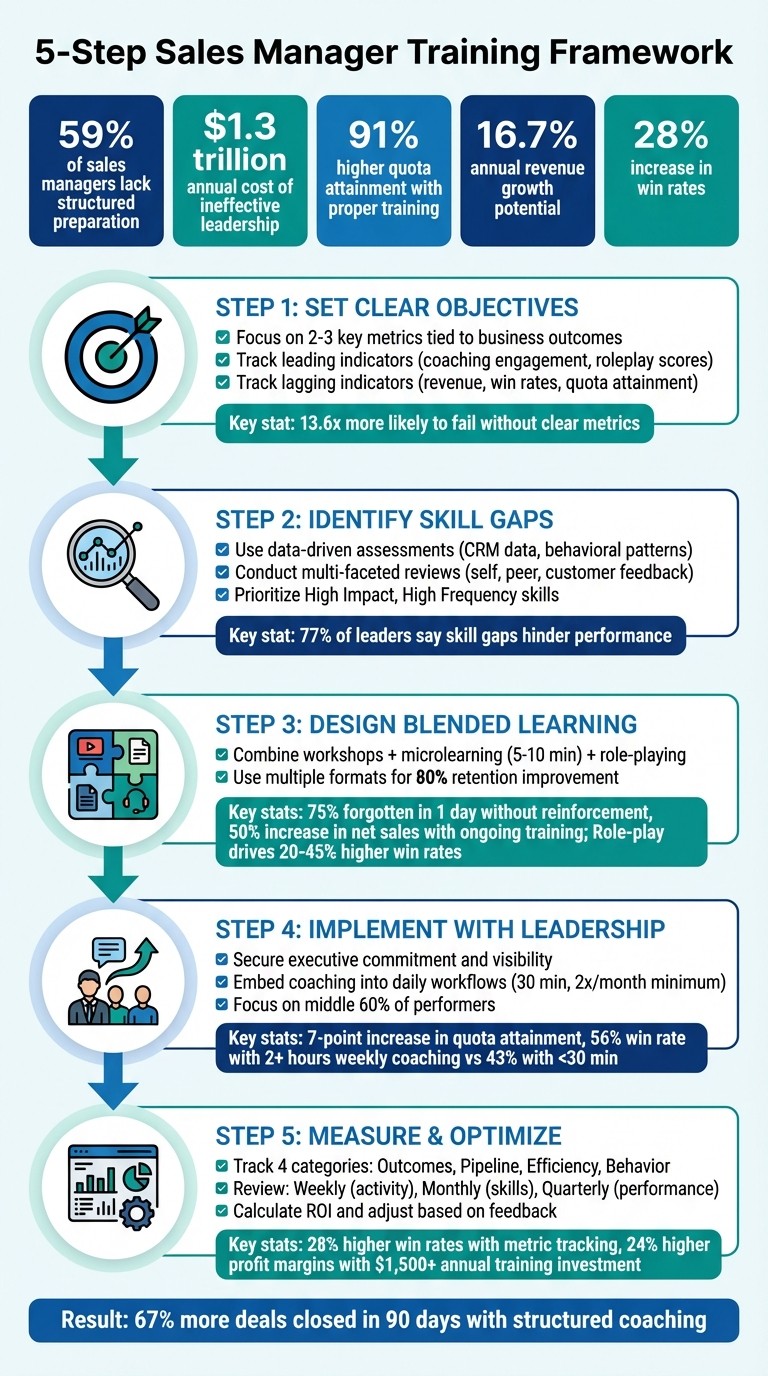
5-Step Sales Manager Training Framework with Key Performance Metrics
Building Effective Sales Leadership Programs: Strategies That Work
Step 1: Set Clear Training Objectives and Goals
Before launching any training program, it's essential to define what success looks like. Without specific goals tied to measurable business outcomes, it becomes nearly impossible to evaluate the program's effectiveness or justify the investment. In fact, organizations that rate their training as ineffective are 13.6 times more likely to lack clear performance metrics for evaluation [11].
The distinction between lagging indicators (e.g., revenue growth, win rates, quota attainment) and leading indicators (e.g., AI-driven coaching engagement, roleplay scores, call behavior trends) is vital. For example, if your goal is to boost win rates, you might start by tracking how many managers are applying new sales methodologies during live calls. This can serve as an early sign of future success.
"Training effectiveness should be measured by real business impact." - Mia Kosoglow, Hyperbound [9]
Avoid relying on vanity metrics like attendance or course completion rates. Instead, focus on 2–3 key metrics that directly tie to the business challenge you're addressing [9]. For instance, if your team struggles with lengthy sales cycles, you could measure sales velocity using this formula:
(Opportunities × Average Deal Value × Win Rate) ÷ Average Sales Cycle Length [10].
Similarly, if new managers are taking too long to ramp up, track their time to productivity - the number of days from their start date to reaching full quota [10].
Define Measurable Performance Metrics
Start by establishing a baseline before the training begins. Use CRM data or surveys to capture a "before" snapshot for comparison [10][11]. Then, identify metrics that align with your primary challenges. For example, track onboarding velocity for slow onboarding processes or win rates if closing performance is weak [9].
One useful metric is the Productivity Index, which measures the impact of training by dividing the average revenue per sales rep after training by the average revenue before training [10]. Companies have seen impressive results, such as doubling win rates and increasing revenue within just 90 days of targeted training [4].
Focus on tracking how skills are applied rather than just knowledge retention. For example, measure the percentage of managers implementing new methodologies on live calls and monitor how often desired behaviors show up in customer interactions [9]. This is especially important considering that sales professionals can forget up to 90% of new information within 30 days without reinforcement [4].
Beyond metrics, personalizing the training experience is critical for sustained improvement.
Create Individual Development Plans (IDPs)
Generic training programs often fail to meet the needs of top performers. To address this, Individual Development Plans (IDPs) align personal career goals and skill gaps with organizational objectives [11][7]. When managers actively participate in crafting their own development plans, they’re more likely to take ownership of their progress [14].
Leverage tools like CRM data, win-loss analysis, and conversation intelligence to identify where deals tend to stall - whether during discovery, negotiation, or another phase [1][7]. Structure IDPs around three core areas:
Skills (e.g., leading effective discovery calls)
Knowledge (e.g., understanding industry trends)
Attributes (e.g., improving motivation and productivity) [14]
Set clear proficiency targets using a 1–5 scale to assess current versus desired skill levels. Define specific ways to test proficiency, like reviewing calls or hosting monthly knowledge-sharing sessions [14].
"Choice drives motivation. If sellers come up with the plans themselves, they'll own them." - Andy Springer, Chief Client Officer, RAIN Group [14]
To maximize impact, focus on "High Impact, High Frequency" skills - those that influence every deal - before tackling less common scenarios [7]. Break larger goals into manageable steps, such as quarterly priorities, monthly objectives, and weekly action plans. This kind of task clarity has been shown to significantly boost salesperson motivation [12], ensuring managers know exactly where to focus their efforts.
Step 2: Identify Skills Gaps and Training Needs
After setting clear objectives, the next move is to pinpoint where your managers need support. Rely on data - not hunches - to uncover skill gaps. A 2024 study found that 77% of leaders believe these gaps are actively hindering organizational performance [15]. This makes identifying them a crucial step in creating an effective training program.
Using data-driven assessments ensures your training efforts address the specific gaps affecting performance. Without this step, you risk wasting resources on training that misses the mark - like teaching managers to close deals when the real issue is their inability to coach their teams effectively.
Conduct Skills Assessments
The best skills assessments pull from multiple data sources to provide a full picture of where managers are struggling. Start by examining CRM data and behavioral patterns, such as talk-to-listen ratios on calls, deal cycle durations, and pipeline velocity [15][1]. For example, if deals often stall during the discovery phase under a specific manager, that signals a need for coaching on discovery skills.
Take a multi-faceted approach that includes self-assessments, peer reviews, customer feedback, and hard performance metrics [15]. Tools like AI-powered sales simulations can also deliver instant feedback on soft skills such as empathy and conflict resolution [4][13][5]. Traditional assessments often overlook these subtle yet critical coaching abilities that set successful managers apart.
One key distinction to make during this process is whether your manager is truly leading or just acting as a high-priced salesperson [16]. If they’re constantly stepping in to close deals, writing emails for their reps, or saving stalled opportunities, they’re not building their team’s skills - they’re covering for gaps.
Before diving into assessments, establish clear benchmarks for what success looks like in your organization [15]. These benchmarks should reflect current demands, like digital expertise or consultative selling. Plan to revisit your skills gap analysis every 12 to 24 months to stay aligned with evolving technologies and market trends [15].
Use the insights gathered from these assessments to pinpoint the most critical skills that need immediate attention.
Prioritize Key Learning Objectives
Not all skill gaps carry equal weight. Focus first on the ones that directly impact your revenue goals [15]. For instance, if your pipeline is unpredictable or managers struggle to forecast within a ±15% margin, prioritize training in pipeline management and deal qualification [7][16]. If win rates are lagging, shift the focus to coaching managers on improving their reps’ closing techniques.
Use your CRM to map skill gaps to specific pipeline issues. For example, if deals often stall during negotiations or discovery, prioritize training managers in those areas [1]. Conversation intelligence data can also highlight areas for improvement, such as objection handling, which may need immediate attention [7].
Follow the "High Impact, High Frequency" rule: focus on skills that managers use in nearly every deal - like discovery and qualification - before addressing less common scenarios like procurement negotiations [7]. Don’t just rely on lagging indicators like quota attainment. Instead, look at leading metrics, such as pipeline coverage ratios (ideally 3× to 4× quota), to assess forecasting and planning skills [17]. Evaluate whether managers are using structured coaching frameworks like GROW (Goal, Reality, Options, Way Forward) during one-on-ones, ensuring they’re guiding their teams rather than dictating [17][7].
"If you're still the one chasing your biggest deal instead of coaching your reps on theirs, you're not managing, you're just a rep with reports." - Mamta Tainwala, Sybill.ai [7]
Structured coaching tied to clear objectives can boost sales performance by 8% [1]. By combining thorough assessments with targeted prioritization, you ensure your training program addresses the challenges most critical to achieving your business goals.
Step 3: Design Training Content Using Blended Learning
Once you’ve pinpointed the skill gaps in your sales managers, the next step is creating a training program that sticks. Here’s the challenge: 75% of new material is forgotten within just one day [26]. That’s why relying solely on traditional workshops doesn’t cut it anymore. Instead, blending multiple learning formats - like in-person workshops for collaboration, digital modules for flexibility, and hands-on practice for real-world application - delivers far better results [11][21].
This blended approach isn’t just about mixing things up. It’s designed to cater to different learning styles while taking into account the hectic schedules of sales managers. For example, 93% of organizations with highly effective training still rely on in-person instruction as a core element [11]. And the payoff? Companies with ongoing training processes report a 50% increase in net sales per employee [19].
The secret to success lies in making training both time-efficient and actionable. Instead of pulling managers out of their day-to-day for marathon sessions, use bite-sized microlearning modules - just 5–10 minutes long - that they can tackle between meetings [19][21]. Pair these with structured workshops where managers can practice challenging scenarios, like coaching a rep through a stalled deal or handling performance issues, in a safe and supportive environment [21].
Use Multiple Learning Formats
The most effective training programs use a mix of formats to reinforce learning and ensure skills stick. Start with in-person or virtual workshops for tackling complex topics, such as strategic pipeline management or coaching frameworks. These sessions allow for peer collaboration and problem-solving in real-time [11][21]. Follow up with self-paced digital modules that managers can complete when it suits them - perfect for product updates, methodology refreshers, or foundational knowledge [21].
But here’s the thing: knowledge alone doesn’t change behavior. That’s where role-playing and simulations come in. Reframe role-playing as “practice” to ease any discomfort managers might feel [3][21]. Record these sessions so managers can review their performance and get targeted feedback from coaches. This hands-on approach boosts confidence and prepares them for high-pressure situations. In fact, teams that incorporate sales role-play exercises see 20–45% higher win rates compared to those who skip the practice [22].
Another game-changer? Microlearning. These short, focused modules - just 5–10 minutes each - are proven to improve retention by up to 80% [22]. They’re easy to fit into busy schedules, making learning an ongoing process rather than a one-off event.
"A sales training process built on one-off sessions won't change behavior or drive results. Reps forget. Skills fade. Performance stalls." – Showell [19]
To make training stick, embed it into daily workflows. Instead of treating it as a separate activity, integrate coaching into existing meetings like pipeline reviews or one-on-ones [3]. This ensures managers can immediately apply what they’re learning, which significantly improves retention. By layering different formats and aligning content with real-world challenges, you can create a program that truly resonates.
Customize Training to Job Scenarios
To take your training to the next level, tailor it to the specific challenges your managers face. Generic content won’t cut it - it needs to reflect the realities of their day-to-day. Use sales-specific case studies based on your own win/loss data [23][24]. For instance, if your team struggles with enterprise procurement negotiations, design scenarios around deals that stalled at that stage. Or, if discovery calls are a weak spot, create practice sessions using real buyer personas and objections they encounter regularly.
Equip your managers with adaptable messaging frameworks rather than rigid scripts. Provide tools like talk tracks, positioning guides, and example scenarios they can tweak to suit their style and their team’s needs [19]. For example, develop one-page "battle cards" that outline competitor strengths, weaknesses, and tricky questions to anticipate during coaching on competitive deals [23][25].
Make these resources easy to access when managers need them most. A centralized digital platform - often referred to as a "source of truth" - should house all your key materials: messaging frameworks, value propositions, competitive cheat sheets, and objection-handling guides [19][20]. Platforms like Coach Pilot (https://coachpilot.com) can streamline this process, ensuring managers have real-time access to critical resources. The best systems even integrate with your CRM, surfacing relevant job aids based on the deal stage [23]. This approach can improve call effectiveness by 41%, giving managers the tools they need exactly when they need them.
Relevance is everything. When training mirrors actual challenges and offers immediate application, managers stay engaged. On the flip side, disconnected or overly theoretical training? That’s a recipe for being ignored. Tailor your content to reflect their reality, and you’ll see the difference.
Step 4: Implement Training With Leadership Support and Coaching
A well-crafted training program is only as effective as the support and reinforcement it receives. Without leadership involvement and ongoing coaching, even the best training initiatives can fall flat. Consider this: nearly 40% of sales teams lack a formal training program for their managers[27][6]. Among those that do, only 34% engaged in training within the past year[6]. The challenge lies not just in creating these programs but in executing them with accountability and consistent follow-through.
Sales teams with structured manager training report a 7-point increase in quota attainment[27], while companies prioritizing manager development see 7% higher overall performance[6]. Additionally, training investments only yield returns when someone reinforces the lessons learned[28].
Secure Leadership Commitment
For training to stick, leadership must be actively involved. Start by aligning coaching topics with real challenges like pipeline bottlenecks, stalled deals, or declining win rates. This ensures the training feels relevant to business outcomes[1].
Senior leaders should play a visible role from the outset. By kicking off training sessions and staying engaged throughout, they signal that development is a priority[27]. When executives participate alongside their teams, it underscores a clear message: this matters[8].
Address a common pitfall: the "super seller" mindset. Newly promoted managers often default to solving problems for their team instead of coaching them through challenges. Help leaders understand the difference between performance management (tracking metrics) and sales coaching (developing skills and critical thinking)[27][28]. Managers are more than just supervisors - they shape culture, drive tool adoption, and influence long-term behavior changes across the sales team. If performance is lagging, the solution isn’t just training reps - it’s empowering the managers guiding them.
To make coaching a practical daily activity, remove barriers that hinder managers. Simplify administrative tasks, automate routine reporting, and reduce unnecessary meetings[3][27]. Despite its potential to boost productivity, only 12% of enablement teams prioritize technology training for managers[27][6]. With the right tools and fewer distractions, managers can focus on coaching as a daily habit rather than an occasional task. This kind of leadership engagement ensures training objectives translate into real-world execution.
Embed Learning Into Daily Workflows
Once leadership is on board, the next step is weaving coaching into everyday activities to reinforce training consistently. Routine tasks, like pipeline reviews, can become coaching opportunities. Instead of asking, "Where are we with this deal?" shift the focus to, "What skills could help move this deal forward?"[1][3][8].
Establish a protected coaching cadence - dedicated time for coaching that’s treated as seriously as customer meetings[28]. Research shows that just 30 minutes of coaching twice a month can significantly improve performance[28]. Companies offering more than 2 hours of weekly coaching report win rates of 56%, compared to 43% for teams receiving less than 30 minutes[29]. Consistency is key - short, regular sessions are more impactful than infrequent, lengthy ones.
Leverage four distinct coaching types to address different needs:
Strategic: Focus on long-term goals like territory or account planning.
Tactical: Address immediate deal strategies.
Opportunistic: Take advantage of real-time teachable moments.
Developmental: Target skill gaps with structured, data-driven plans.
Coaching Type | Focus Area | Best Application |
|---|---|---|
Strategic | Long-term goals | Territory or account planning[3] |
Tactical | Immediate deals | Strategies to win key opportunities[3] |
Opportunistic | Real-time | Teachable moments during live observations[3] |
Developmental | Core skills | Addressing skill gaps with structured plans[3] |
Every coaching session should result in clear action steps. Document 1–2 immediate actions, set follow-up timelines, and define completion dates[3][5]. Tools like Coach Pilot can simplify this process by integrating AI-driven coaching into daily workflows, making it easier to track progress and access resources in real time.
Focus coaching efforts on the middle 60% of performers - the so-called "B-squad." While top and bottom performers also need guidance, small improvements within this group often yield the greatest impact on overall results[18].
"The deal you are focused on will only pay you ONCE. What if, as a leader, you focused instead on the skills the team needs to get the deal done?" – Scott Anschuetz, CEO of Visualize, Inc.[18]
The results speak for themselves. In 2024, Copado’s revenue teams, led by Director of Revenue Enablement John Guerriere, implemented the SalesHood platform to integrate coaching into their daily routines. Within just 90 days, win rates doubled, average selling prices rose, and the team closed 67% more deals[1][4]. This demonstrates the power of embedding coaching into everyday workflows instead of treating it as an occasional event.
Step 5: Measure Results and Improve the Program
To close the loop on your training efforts, it’s essential to measure outcomes carefully and use feedback to fine-tune the program. Here's the reality: while training costs have jumped by 34%, 75% of organizations still can’t prove whether their programs make a difference to business results [32]. Without tracking metrics, you can’t show value or improve effectiveness. The key is to focus on the right data points and use them to guide continuous improvements.
Tracking coaching metrics makes a noticeable difference - organizations that do so report 28% higher win rates compared to those that don’t [30]. To get a full picture, monitor both leading indicators (predictive metrics like pipeline velocity and participation in training) and lagging indicators (outcomes like revenue and quota attainment). This combination helps you capture early signals of success and measure the program's overall impact [30].
Track Key Metrics After Training
Start by gathering baseline data. Collect at least 90 days of historical data on metrics like win rates, sales cycle length, and average deal size before launching the training program [32][33].
Once training begins, focus on four key categories of metrics:
Outcomes: Track revenue, quota attainment, win rates, and average deal size to measure the direct impact on business performance [30][31].
Pipeline: Monitor pipeline velocity, conversion rates by stage, and funnel leakage to predict future results [30][32].
Efficiency: Measure metrics like sales cycle length, time to first deal, and time to quota attainment to gauge productivity [31][33].
Behavior: Assess skills application by analyzing talk-listen ratios (aiming for reps to talk 30–40% of the time), objection handling, and the quality of questions asked [30][34].
Set a consistent review schedule: weekly for activity metrics, monthly for skill development, and quarterly for overall performance. Use control groups to isolate the impact of the training by comparing trained teams with similar groups that haven’t yet participated [32]. Also, check knowledge retention at 30-, 60-, and 90-day intervals to ensure that learning sticks [34][35].
To calculate return on investment (ROI), use this formula:
ROI = ((Benefits – Costs) / Costs) × 100 [32][33].
The financial benefits of training are clear. Companies that spend $1,500 or more per employee annually on training see 24% higher profit margins [33], and comprehensive programs can lead to a 218% increase in income per employee [33]. These figures highlight why it’s worth putting in the effort to measure results.
Metric Category | Specific Examples | Purpose |
|---|---|---|
Outcomes (Lagging) | Revenue, Quota Attainment, Win Rate, Avg Deal Size | |
Pipeline (Leading) | Pipeline Velocity, Conversion by Stage, Funnel Leakage | |
Efficiency | Sales Cycle Length, Time to First Deal, Time to Quota | |
Behavioral | Talk-Listen Ratio, Objection Handling, Question Quality |
With your metrics in place, the next step is to collect and act on feedback to refine your program.
Use Feedback to Optimize the Program
Feedback is vital for understanding how well your training is working. The Kirkpatrick Model can help evaluate effectiveness at different stages. For example, use post-training surveys (Level 1: Reaction) and manager observations combined with follow-ups at 60–90 days (Level 3: Behavior) [37]. Structured surveys with both ratings and open-ended responses can reveal how training impacts day-to-day work [37].
Another useful method is the Success Case Method. Interview top and bottom performers 60–90 days after training to uncover what worked, what didn’t, and where confidence faltered under pressure [37]. This approach helps identify gaps between knowledge and execution.
Compare reps’ self-assessments with manager evaluations to expose blind spots. Reps often overestimate their abilities, but regular coaching sessions can address these gaps. In fact, top-performing sales managers are 51% more likely to hold consistent coaching sessions, which help set clear expectations and provide direction [36].
It’s also important to involve stakeholders from marketing, product, and sales leadership to ensure training content evolves with market demands and organizational goals [10]. Treat training as an ongoing process, refining it quarterly based on insights from both data and feedback [1].
Platforms like Coach Pilot can simplify this process by integrating AI-driven coaching into daily workflows. These tools make it easier to track progress, analyze performance, and provide resources in real time. Set clear expectations with leadership to report progress at 30-, 60-, and 90-day intervals, demonstrating how feedback is driving improvements [36]. This iterative approach turns training into a strategic tool that bridges the gap between planning and execution.
Conclusion
Training sales managers effectively isn't a one-and-done task - it’s a continuous effort that requires alignment with business goals, data-driven decisions, and consistent reinforcement. This guide outlines a five-step framework to build impactful training programs: set clear, revenue-focused objectives, pinpoint specific skill gaps, create engaging and varied learning experiences, implement training with leadership backing, and measure results to fine-tune the process. These steps aim to bridge the gap between strategy and execution.
The numbers speak for themselves. Research shows that companies failing to measure training effectiveness are 13.6 times more likely to have underperforming programs [11]. On the other hand, structured coaching tied to clear goals can improve sales performance by 8% [1]. Even more compelling, 69% of top-performing sales professionals credit their success to having exceptional sales managers [2]. This highlights the critical role that well-thought-out training programs play in building effective leadership.
As Erica Schultz, Strategic Advisor at RAIN Group, aptly states:
"Effective training isn't a one-time discrete event - it's an ongoing process" [11].
This means making training part of everyday operations. Incorporate coaching into daily workflows, conduct regular assessments to track skills, and use real-time data to spot bottlenecks in the sales pipeline. For example, when Copado adopted structured, AI-driven coaching in 2025, their sales teams doubled their win rates and closed 67% more deals within just 90 days [1][4].
Tools like Coach Pilot can simplify this entire process. By building custom sales playbooks, offering immersive workshops, and integrating AI-powered coaching into daily tasks, platforms like this ensure training translates into measurable results. Features like instant feedback, automated performance tracking, and seamless coaching directly address a major challenge: 80% of sales training is forgotten within three months without ongoing reinforcement [18].
Investing in sales manager development delivers measurable returns. Consistent coaching can lead to 16% higher annual revenue growth [18]. By following this framework and leveraging modern tools, organizations can transform their sales managers into strategic leaders who drive sustainable and predictable growth.
FAQs
How long should sales manager training last?
The length of sales manager training depends on the program's design and goals. Short, intensive courses usually span 1 to 3 days, offering quick insights and strategies. On the other hand, more in-depth programs can stretch over several weeks or months, allowing for a deeper dive into skills and leadership development. Some initiatives even provide long-term, structured support that lasts for months, ensuring sustained learning and growth. Ultimately, the duration hinges on the program's specific objectives and structure.
What metrics prove the training is working?
Effective sales training isn't about just completing courses - it's about driving real business results. The true measure of success lies in key outcomes like:
Behavior changes: Are reps handling objections better? Are they closing deals more effectively?
Performance metrics: Look at things like quota attainment and the overall health of your sales pipeline.
Revenue growth: Metrics such as win rates and pipeline development show if training is truly moving the needle.
By tracking these areas, you can ensure your training efforts align with your company's goals and deliver a solid return on investment.
How do you get leaders to support coaching?
To get leadership on board with coaching, focus on how it directly supports performance and revenue growth. Connect coaching initiatives to business objectives, emphasize measurable results, and show how it can seamlessly fit into everyday workflows. Leaders are more inclined to support coaching when it clearly enhances team performance, encourages continuous learning, and drives tangible outcomes. Creating an environment where coaching is part of the company’s DNA and proving its value to overall success are crucial for securing their long-term buy-in.
Related Blog Posts

Remove the guesswork from winning more deals.