B2B Sales
How AI Improves Lead Qualification Accuracy
Apr 6, 2026
AI uses behavioral signals, predictive scoring, and real-time updates to prioritize high-intent leads, reduce bias, and shorten sales cycles.

AI transforms lead qualification by using data-driven methods to identify high-potential prospects faster and more accurately than manual processes. Here's what you need to know:
Manual lead qualification wastes time: Sales reps spend over 67% of their time on unqualified leads, costing businesses significant resources.
AI leverages real-time data: It evaluates behavioral signals like website visits, content downloads, and email engagement to identify leads with genuine buying intent.
Boosts conversion rates: Companies using AI see up to a 35% increase in conversion rates and 60% more sales-qualified leads.
Saves time and reduces bias: AI processes leads in seconds, eliminates human bias, and ensures consistent scoring across all prospects.
Improves sales enablement efficiency: AI shortens sales cycles by 30–40% and helps focus efforts on the top 20–30% of leads most likely to convert.
AI-powered tools like predictive scoring and engagement analysis allow sales teams to focus on what matters - closing deals with high-intent buyers. Businesses adopting AI are 1.7 times more likely to grow their market share and reduce wasted effort on unproductive leads.
Lead Scoring vs Signals and Why AI Signals Work Better Than Traditional Lead Scoring Algorithms
Problems with Manual Lead Qualification
Manual lead qualification comes with several challenges that hinder a sales team's performance and their ability to focus on the right opportunities. These issues highlight why AI-driven approaches are gaining traction in sales.
Inconsistent Scoring and Human Bias
When humans are responsible for lead qualification, inconsistencies are inevitable. Relying on "gut feelings" leads to significant errors, with sales reps dismissing up to 40% of high-potential leads. Even worse, lead scores can fluctuate by 15–20%, depending on the rep or even the time of day [8][1].
Bias also plays a major role. For example, a Midwest-based rep might undervalue a lead from a coastal region simply because it's unfamiliar. This type of confirmation bias causes sales teams to focus on leads that resemble past successes while ignoring promising opportunities from new markets. The financial impact is staggering - human bias in sales is estimated to cost $1 trillion annually in missed opportunities [8].
Demographics vs. Behavioral Data
Traditional frameworks like BANT (Budget, Authority, Need, and Timeline) rely heavily on static demographic information, such as job titles, company size, or industry. However, these data points often fail to capture what truly matters: real-time buying intent. In fact, 40% of closed-won deals begin without a clearly defined budget [4]. This means that prioritizing budget as a key qualifier can lead to missed opportunities.
While reps can track static data like job titles, they can't keep up with dynamic behavioral signals such as website visits, content downloads, or interactions with pricing pages [4][1]. Manual scoring is often done at a single point in time - like when a form is submitted - and quickly becomes outdated. A lead's interest can peak and drop within 48 hours, a speed that manual processes simply can't keep up with. AI, on the other hand, excels at analyzing real-time data and identifying these fleeting moments of intent.
Slow Manual Processes
Manual lead qualification is time-consuming, taking 10–30 minutes per lead. For a batch of 100 leads, this adds up to 4–6 hours, whereas AI can handle the same workload in under 5 minutes [1][10].
The inefficiency doesn’t stop there. Sales reps lose an average of 23 minutes regaining focus after switching tasks [10]. As the day goes on, decision fatigue sets in, leading to poor prioritization. This results in teams spending 67% of their time on leads that never convert [4][7]. For a 15-person sales team, this inefficiency can waste about $480,000 annually in salary costs [7]. These delays not only eat into productivity but also slow down follow-ups on promising leads.
The time drain and inefficiency of manual processes make a strong case for adopting AI to streamline lead qualification.
How AI Improves Lead Qualification Accuracy
AI takes the guesswork out of lead qualification by turning it into a data-driven process. Companies using AI-powered lead scoring have seen conversion rates increase by 25–35%, with up to 60% more sales-qualified leads. This aligns with the market's growth, which is projected to expand from $600 million in 2023 to $1.4 billion by 2026 [6][9].
Interestingly, behavioral intent now carries three times more weight than traditional factors like job titles or company size when predicting conversions [9]. Let’s break down how AI uses behavioral intent modeling, predictive scoring, and engagement analysis to refine lead qualification.
Behavioral Intent Modeling
AI doesn’t just look at what leads say - it focuses on what they do. By tracking behaviors like website visits, email clicks, content downloads, and social media interactions, AI creates a detailed profile of each lead’s online activity [1]. It analyzes patterns to identify behaviors that signal a high likelihood of a sale. For instance, in 2025, TechFlow Solutions discovered that leads who viewed their API documentation twice within 48 hours had a 78% close rate. Automated demos triggered by this behavior increased conversions by 41% in just one quarter [12].
Unlike static scoring systems, AI continuously updates as new data comes in. Many models even apply a decay factor - usually around 15% per week - to ensure scores reflect current interest rather than outdated activity.
"AI doesn't just score leads - it understands them. By combining real-time behavior, historical data, and predictive analytics, AI identifies who's ready to buy, not just who filled out a form."
– AgentiveAIQ [12]
AI also sets up smart triggers to alert sales reps when high-intent actions, like repeated visits to a pricing page, occur [12]. Studies show that contacting a lead within five minutes of such behavior makes them nine times more likely to convert [12]. This real-time responsiveness lays the groundwork for even more precise predictive scoring.
Predictive Lead Scoring
Predictive lead scoring replaces subjective methods with machine learning models that analyze historical data. Instead of fixed point systems, AI identifies which combinations of behaviors have consistently led to closed deals [6]. This approach is 40–60% more accurate than traditional scoring methods and processes data much faster - just 2–3 seconds per lead compared to 10–30 minutes for manual evaluations [7][1].
In 2025, Microsoft integrated AI into its sales processes and saw a 25% boost in sales productivity by focusing on high-intent leads [6]. Similarly, CloudFlow, a SaaS company, used AI to identify three times as many high-potential prospects, cutting its sales cycle from 28 days to 17 - a 40% reduction [11]. By offering consistent and unbiased scoring, AI eliminates the human bias that often creeps into manual evaluations.
"AI's great at scoring qualification, extracting that from the core recordings and giving our leadership teams the insights they need to know who's qualifying well."
– Guy Rubin, Founder, Ebsta [13]
Beyond scoring, AI also monitors how quickly leads engage with content, adding another layer of precision.
Engagement Velocity Analysis
Engagement velocity measures how quickly a lead interacts with your content. For example, a prospect who visits your homepage, pricing page, and competitor comparison page within 24 hours shows far more intent than someone who takes months to do the same [1]. AI tracks this activity in real time to spot when a lead shifts from casual browsing to serious evaluation. This is critical, as 78% of sales go to the first vendor to respond [14]. By routing high-velocity leads to sales reps immediately, companies can seize the moment when interest is at its peak.
AI integrates signals from multiple channels - website activity, email engagement, and social media - to create a full engagement profile. It also flags red flags like declining interactions or changes in stakeholder sentiment, helping teams avoid wasting time on stalled deals or "zombie leads" [7].
Filtering Out Low-Quality Leads
AI ensures sales teams focus on the most promising prospects by analyzing conversion probabilities. Typically, only the top 20–30% of leads are flagged for immediate follow-up, while less promising ones are sent to nurturing campaigns [6]. Poor lead qualification is linked to 67% of lost sales, so focusing on quality leads can make a big difference. AI reduces manual lead evaluation time by up to 80%, shortens sales cycles by 30–40%, and improves overall win rates [6][7].
How to Implement AI Lead Scoring
To integrate AI into your lead qualification process, you'll need clean historical data, clear qualification standards, and a well-trained model. Here's how you can make it happen.
Analyze Historical Sales Data
AI relies on past data to learn patterns and make predictions. Ideally, you'll need 6–12 months of closed deal data from tools like your CRM, marketing automation platform, website analytics, and product usage data [1][4]. This gives the AI enough information to identify meaningful trends.
Most AI scoring systems require at least 100–200 historical leads with known outcomes to start identifying patterns [15]. For enterprise-level predictive models, having 500+ closed deals is often necessary [16]. For instance, Dynamics 365 Sales needs a minimum of 40 qualified and 40 disqualified leads within a set timeframe to train its model [7].
Before feeding data into the AI, clean it thoroughly. Remove duplicates, ensure lead sources are correctly attributed, and verify that conversion stages are accurate [15][4]. Define a clear target outcome, such as "leads that became Sales Accepted Leads (SAL) within 60 days", so the AI knows what success looks like [4]. Then, split your data into two sets: 80% for training the model and 20% for testing its accuracy [4].
"The model is only as good as your data. Before implementation, audit: Do you have at least 12 months of lead data with outcomes tracked?"
– Prospectory [4]
Watch out for red flags in your historical data, like leads who downloaded multiple whitepapers but never visited a pricing page [4]. These signals help the AI identify behaviors that are unlikely to lead to conversions. Once trends are clear, you can move on to defining what makes a lead high quality.
Define Your Qualification Criteria
AI needs a clear definition of what a "good lead" looks like for your business. Start by building an Ideal Customer Profile (ICP) with structured data points. This could include specifics like employee count (e.g., 50–500), targeted industries, or funding stages (e.g., Series A–C) [17][16].
Evaluate leads using five key dimensions:
Firmographics: Company size, industry
Technographics: Current tech stack
Contact-level: Seniority, department
Buying Intent: Recent funding news, hiring trends
Engagement History: Website visits, email interactions [17]
Weight these factors based on how strongly they correlate with conversions. For example, visiting a pricing page may carry more weight than reading a blog post [2][18].
Don’t forget to include disqualifiers in your criteria, such as industries you don’t serve, geographic exclusions, or minimum company size. This prevents the AI from over-prioritizing poor fits [18][16]. Businesses using AI-driven lead scoring often see a 77% boost in lead generation ROI compared to those that don’t [18].
Train AI Models and Score Leads
Once your data is clean and your qualification criteria are set, it's time to train your AI model. Most systems analyze historical data to find patterns that consistently lead to closed deals. Unlike static scoring systems, AI models calculate the likelihood (0–100%) of a lead reaching specific outcomes, such as "Meeting Held" or "Opportunity Created" [19].
To ensure accuracy, run the AI in shadow mode for 30–60 days alongside your manual process [4]. This helps you spot any issues without disrupting your sales workflow. If you're using AI tools like Claude or OpenAI, enforce a JSON schema for outputs to avoid errors that could corrupt your CRM data [16].
AI lead scoring is also cost-effective. On average, it costs about $0.15 per lead (including enrichment and API fees) compared to $2.20 for manual SDR qualification [16].
Finally, implement a tiered routing system to prioritize leads effectively. For example:
Tier A leads (top 5–10%) trigger immediate SDR alerts and auto-schedule meetings.
Tier D leads are excluded from retargeting efforts [19].
This ensures your sales team focuses on the most promising prospects while saving time and resources.
Improving AI Accuracy Through Continuous Learning
AI lead scoring thrives on regular updates to stay precise. Every closed deal - whether it’s a win or a loss - feeds new insights into the model. This constant refinement helps pinpoint the signals that matter most, keeping the system aligned with real-time market trends and reducing wasted effort on low-priority leads.
Using Sales Outcomes to Refine Predictions
Each closed deal contributes valuable data for the AI to recalibrate its scoring process. Wins reinforce effective signals, while losses help identify and discount patterns tied to inaccurate predictions [1]. False negatives - deals that close despite receiving low scores - are especially revealing. They highlight overlooked patterns that the model needs to learn [4].
"If you're consistently closing deals that the model scored low, the model is missing a pattern. Feed that information back into training"
– Alex Rivera, Prospectory [4]
Regularly reviewing outliers can uncover subtle trends that might otherwise go unnoticed. Many businesses retrain their models every quarter to reflect shifts in the market, new competitors, or changes in their ideal customer profile [4]. These feedback loops can significantly improve accuracy, often boosting it from 71% at launch to 89–91% within three months [16]. This improvement frequently translates into higher conversion rates, with lead-to-opportunity conversions climbing from 9% to 27% within six months [4].
Building on these learnings, real-time adjustments further enhance the accuracy of lead scoring as new data becomes available.
Real-Time Score Updates
AI models are designed to adapt on the fly, recalibrating scores as fresh engagement data rolls in [4][15]. For example, if a prospect visits your pricing page, downloads a competitor comparison guide, or attends a webinar, their score updates immediately to reflect these new activities [1][4]. To maintain relevance, applying a decay function is crucial. By reducing the weight of older signals by 15% weekly, the model ensures that recent interactions carry more influence [4][16].
"AI lead scoring models are dynamic and continuously learn from new data. As more leads enter the system and their outcomes are tracked, the model adjusts its predictions"
– Marc Perramond, VP Product at Demandbase [2]
Manual vs. AI Lead Qualification: Side-by-Side Comparison
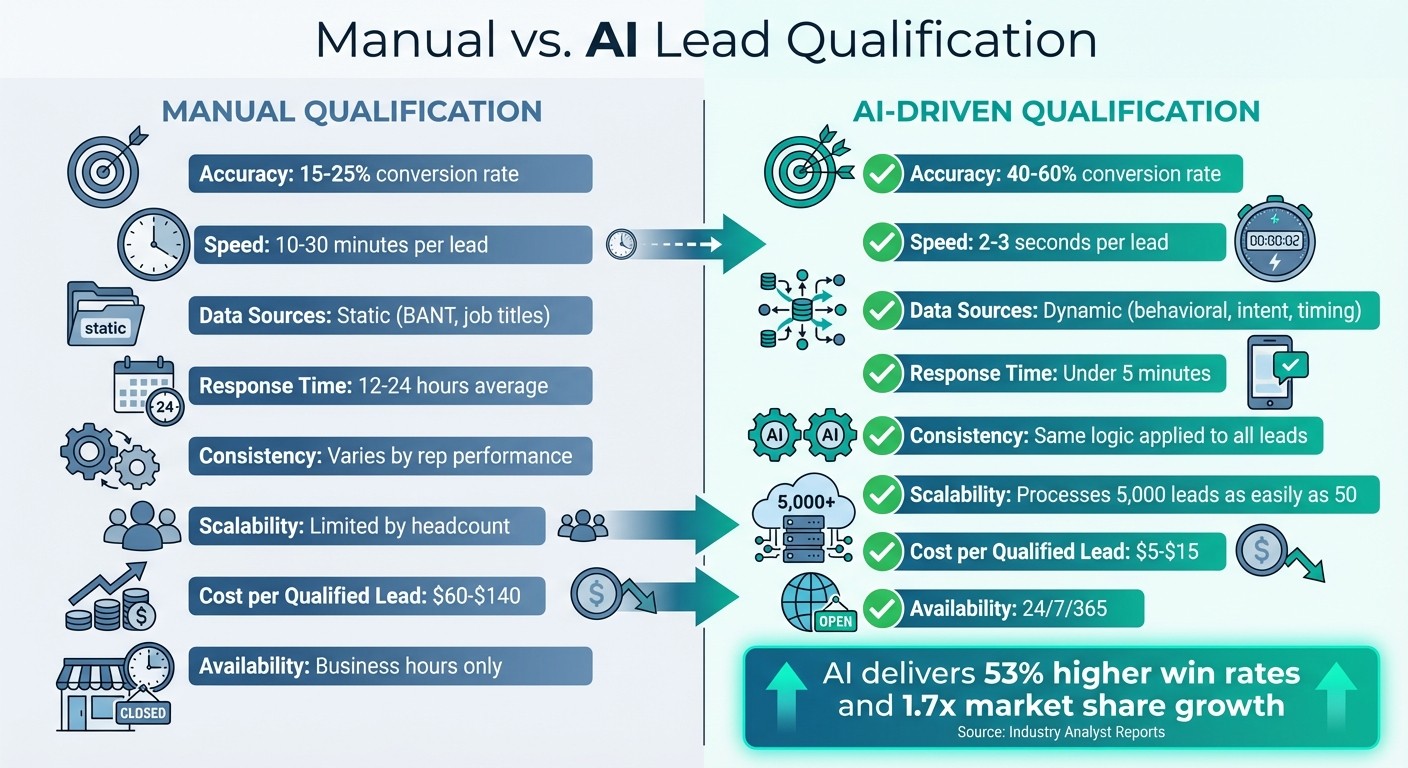
Manual vs AI Lead Qualification: Speed, Accuracy, and Cost Comparison
When it comes to lead qualification, AI-driven methods leave manual processes in the dust, especially in terms of speed, precision, and scalability. Manual methods rely heavily on static criteria like BANT (Budget, Authority, Need, and Timing) and subjective human judgment, which can lead to inconsistencies and delays. AI, on the other hand, dives deeper - analyzing behavioral signals like visits to pricing pages or patterns in content engagement - factors that humans often overlook due to time constraints.
Speed is a game-changer here. While manual lead scoring can take anywhere from 10 to 30 minutes per lead, AI handles the same task in just 2–3 seconds [1]. In fact, delays longer than five minutes can slash lead engagement by 80% [20]. AI eliminates this issue by ensuring follow-up happens within that critical five-minute window, capturing prospects' interest at its peak. This stark contrast highlights how AI transforms lead qualification into a faster, more reliable process.
"AI lead qualification agents can reduce manual scoring time from 2 hours to 2 minutes per prospect while identifying 40% more qualified opportunities."
– Arahi AI [20]
The numbers back it up: manual methods typically convert 15–25% of leads, while AI delivers a much higher conversion rate of 40–60% [20]. This leap in performance is due to AI's ability to process multiple data sources - like firmographics, behavioral intent, and engagement velocity - all at once. Plus, AI applies consistent criteria across every lead, eliminating the variability that comes with human performance.
Comparison Table
Here's a quick breakdown of how manual and AI-driven lead qualification stack up:
Feature | Manual Qualification | AI-Driven Qualification |
|---|---|---|
Accuracy (Conversion Rate) | 15–25% [20] | 40–60% [20] |
Initial Scoring Speed | 10–30 minutes per lead [1] | 2–3 seconds per lead [1] |
Data Sources | Static (BANT, job title) | Dynamic (behavioral, intent, timing) |
Response Time | 12–24 hours average [21] | Under 5 minutes [20] |
Consistency | Varies by rep performance | Applies same logic to all leads |
Scalability | Limited by headcount | Processes 5,000 leads as easily as 50 |
Cost per Qualified Lead | $60–$140 [21] | $5–$15 [21] |
Availability | Business hours only | 24/7/365 [21] |
Switching to AI-driven lead qualification isn’t just about speed - it’s about smarter resource allocation. AI handles high-volume, repetitive tasks, freeing up sales development representatives (SDRs) to focus on building relationships and closing deals. This shift allows sales teams to increase their monthly capacity from handling 20–25 qualified prospects to 30–40 [1]. It’s a win-win for efficiency and performance.
How Coach Pilot Supports AI Lead Qualification
Coach Pilot seamlessly integrates AI-driven lead qualification into your sales team's daily operations. It works with tools like Microsoft Teams, Microsoft Copilot, and ChatGPT for Teams to deliver tailored coaching based on data-driven insights[22]. By transforming static playbooks into dynamic, actionable guides, Coach Pilot ensures that sales reps have clear, role-specific directions for every deal.
The platform eliminates guesswork by offering precise next steps. For example, it might prompt a rep to "Email the CFO by Thursday with this message" or "Call the economic buyer Friday at 9:00 AM using these talking points that closed three similar deals." This approach ensures high-priority leads are handled with focused, strategic attention[22].
Custom Playbooks for AI Scoring
Coach Pilot takes AI scoring to the next level by creating dynamic playbooks tailored to proven sales techniques. It analyzes your company's most effective messaging, objection-handling strategies, and deal-closing patterns to train its AI systems. The result? Sales teams often see dramatic improvements, such as a 7.8× increase in pipeline growth within 90 days and a 39% boost in quota attainment. This shift from generic outreach to targeted, AI-guided messaging drives measurable results[22].
Real-Time Lead Prioritization and Coaching
The platform features six specialized AI agents, each designed to support different stages of the sales cycle, from prospecting to negotiation[23]. By identifying and prioritizing high-value leads, Coach Pilot ensures reps focus their efforts where it matters most. Sales reps can customize their experience by "pinning" their roles, KPIs, and active opportunities, allowing the AI to provide tailored guidance for their specific challenges. A centralized dashboard gives leaders real-time visibility into stalled deals and rep activity, while automated deal truth capture saves reps an average of 19.5 hours per week on CRM updates and admin tasks[22].
Analytics for Performance Tracking
Coach Pilot's built-in analytics offer a clear view of team performance by tracking metrics like win rates, sales cycle length, and forecast accuracy[22]. The platform identifies key patterns in deal data - such as the best time to involve executives or strategies for navigating procurement. According to Coach Pilot, "It scales the sophistication that top performers naturally employ"[22]. Weekly coaching sessions use these insights to refine AI models, ensuring they stay aligned with evolving buyer behaviors and market trends. These analytics not only monitor performance but also continuously improve the platform's lead qualification accuracy over time.
Conclusion
AI transforms lead qualification into a fast, objective, and scalable process. By analyzing real-time behavioral signals, it eliminates human bias and manages thousands of leads with the same precision as it would for a single prospect. Sales teams that use AI report win rates that are 53% higher [24] and are 1.7 times more likely to expand their market share [3]. On top of that, AI slashes lead response times from over 12 hours to less than 60 seconds [24], allowing businesses to seize high-intent opportunities before competitors even have a chance to respond.
Beyond speed, AI sharpens your team's focus. Its dynamic behavioral intelligence ensures that sales reps concentrate only on the leads most likely to convert. This refined scoring process significantly boosts results - companies using AI-powered lead scoring often achieve conversion rate increases of 35–50% [5] while reclaiming up to 70% of time wasted on unproductive prospecting [24].
AI's consistent and reliable scoring also drives predictable revenue growth. Unlike manual qualification methods, AI offers round-the-clock availability, objective scoring criteria, and instant lead prioritization, regardless of volume. By 2025, 80% of B2B sales interactions are expected to involve AI [5], making its adoption critical not just for staying competitive but for long-term success. This trend highlights the importance of integrating AI into platforms like Coach Pilot.
Coach Pilot connects AI-driven insights with daily sales operations, ensuring that every high-priority lead gets the attention it deserves. With features like actionable next steps, proven messaging strategies, and real-time performance tracking, Coach Pilot continuously improves lead qualification accuracy and helps teams stay ahead.
To secure predictable growth, your business needs to act now. Start by analyzing historical sales data, defining clear qualification criteria, and implementing AI models that adapt to every deal outcome. Teams that embrace these strategies today will gain the competitive edge others are still chasing.
FAQs
What data do I need to start AI lead scoring?
To get started with AI lead scoring, you'll need a mix of historical lead data, behavioral signals, and engagement patterns. Additionally, include contextual details like the company's size, the roles of key decision-makers, and any buying signals. Together, these elements enable AI models to evaluate and rank leads more effectively, leading to better qualification and prioritization.
How can AI lead scoring fit into my current CRM workflow?
AI lead scoring works effortlessly within your CRM by automating the entire scoring process. It uses real-time data to evaluate and rank leads, creating a more dynamic and accurate system. This approach also enhances lead profiles with detailed insights, ensuring that top-priority leads are directed to the right sales reps. The result? Your team can concentrate their energy on prospects with the highest intent, improving overall efficiency and productivity.
How do I keep AI lead scores accurate as buyer behavior changes?
To keep AI lead scores precise as buyer behavior shifts, it's essential to update models regularly with current data and relevant, context-rich inputs. AI depends on real-time signals, such as engagement trends and purchasing habits, which naturally evolve. By retraining models with fresh data and comparing predictions against actual outcomes, you can maintain both accuracy and relevance. Adding continuous feedback loops also sharpens the scoring process, ensuring it stays dependable as market dynamics change.
Related Blog Posts

Remove the guesswork from winning more deals.