B2B Sales
Personalized Forecasting with AI: Key Benefits
Apr 6, 2026
Real-time, rep-specific AI forecasts that boost accuracy, cut prep time, and surface at-risk deals for predictable revenue.
AI-powered sales forecasting is changing the game. It replaces outdated methods with real-time data analysis, improving accuracy and helping teams make better decisions. Here’s why it works:
Accuracy Boost: AI achieves up to 95% forecasting accuracy, compared to the 67% average of older methods.
Real-Time Updates: AI evaluates over 300 buyer signals (like email activity and stakeholder involvement) to keep forecasts current.
Tailored Insights: AI adjusts predictions based on each sales rep’s performance, eliminating bias and improving reliability.
Time Savings: Companies report cutting forecasting preparation time by up to 96%.
Revenue Impact: Teams using AI close more deals and reduce forecast errors by up to 50%.
These systems don’t just predict outcomes - they help sales teams focus on what matters most, from at-risk deals to coaching opportunities.
Why it matters: AI forecasting enables smarter, faster decisions, reduces wasted effort, and ensures more predictable revenue growth.
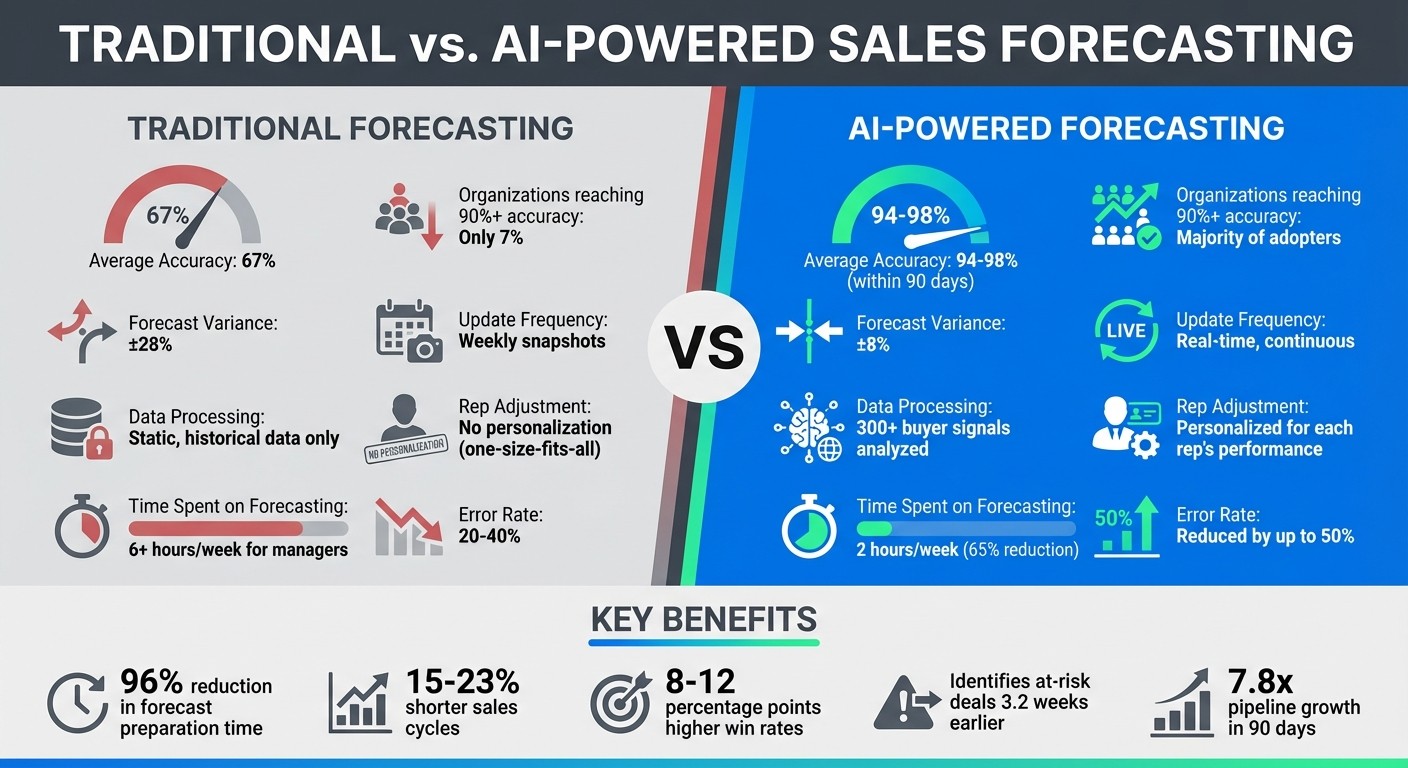
AI vs Traditional Sales Forecasting: Accuracy and Performance Comparison
Enhancing Sales Forecasting Accuracy with AI and Machine Learning
Problems with Generic Sales Forecasting
Traditional forecasting methods often rely on outdated, static data, which can drain revenue and derail planning in today’s ever-changing sales environment. These shortcomings highlight why modern sales teams need smarter, AI-driven solutions that can adapt to real-time data and account for individual sales dynamics.
Reliance on Static Data
Generic forecasting typically leans on last quarter’s numbers to predict future outcomes. The flaw? Markets don’t stand still. These methods focus solely on "what happened before" and ignore "what’s happening now" [6]. A prime example of this disconnect occurred during the COVID-19 pandemic when Procter & Gamble realized historical data was no longer reliable. In response, they turned to machine learning tools capable of processing real-time data [7].
"Traditional forecasting is like navigating with a map that updates once a week. You might be headed toward a cliff, but you won't know until your next map refresh." - Prospectory [1]
Sales landscapes can shift quickly, and weekly snapshots often fail to keep up with deal developments. These static assumptions don’t just miss the mark - they can lead to costly errors.
Forecast Errors and Lost Revenue
Manual forecasting struggles to account for the countless variables that influence today’s deals. Factors like email engagement, stakeholder sentiment, economic trends, and competitor activity are simply too complex for human analysts to process effectively [1]. The result? Only 7% of companies achieve 90% or higher forecasting accuracy without machine learning [2].
Take the case of a global food manufacturer in November 2025. Their manual forecasting process was time-intensive and still lacked precision. After adopting C3 AI’s platform to integrate 72 million rows of data from 18 different sources, they saw an 8% improvement in prediction accuracy and cut production schedule preparation time by 96% [6]. This shows how traditional methods not only waste time but also leave significant revenue on the table.
And that’s not all - generic models also fail to reflect the unique strengths and weaknesses of individual sales reps.
No Adjustment for Individual Sales Reps
Most traditional forecasting models treat every deal in the same stage as having the same likelihood of closing. But this ignores a critical reality: individual sales reps have vastly different conversion rates [1][3]. For instance, a deal at the "Proposal Sent" stage might be far more likely to close when handled by a top-performing rep compared to someone less experienced. Yet, traditional models lump everyone together, creating blind spots.
Michael Torres highlights another issue: rep optimism often skews forecasts. Reps might "sandbag" deals to manage expectations or inflate forecasts to avoid scrutiny, adding a layer of bias that distorts the overall picture. On top of that, relying on subjective judgment - like gut instincts - rather than objective signals, such as email response times or meeting frequency, further undermines the accuracy of these forecasts [3].
This cookie-cutter approach doesn’t just miss the mark - it fails to capture the complexity of modern sales dynamics.
How AI Creates Personalized Forecasts
AI has transformed forecasting by shifting from static, periodic updates to dynamic, real-time analysis. Unlike traditional methods that rely on sales reps' predictions, AI bases its insights on buyers' actual behavior. As Spotlight.ai explains: "Where traditional forecasting aggregates what reps believe, AI forecasting aggregates what buyers have done" [8].
Processing Real-Time Data
AI taps into a variety of digital touchpoints - like CRM systems, emails, calls, and meetings - to create a constantly updated view of deal progress. It evaluates over 300 buying signals to determine the health of each deal [11]. Instead of waiting for weekly updates, forecasts are automatically refreshed as new data flows in.
These systems rely on concrete, evidence-based signals rather than subjective opinions. For example, AI tracks factors like email response times, stakeholder engagement levels, and even the sentiment during calls. If a deal shows warning signs - such as going quiet for more than 10 days or involving too few engaged stakeholders - AI flags it as at-risk well before the quarter ends [9][10].
In 2025, Crayon, a competitive intelligence firm, replaced its manual Google Sheets forecasting method with an AI-driven system. This change cut their weekly forecasting meetings from 60 minutes to just 20 - a 66% reduction - while also improving transparency across the team [11].
AI doesn't stop at live deal signals; it also refines forecasts by tailoring them to each sales rep's unique approach. This shift represents a broader trend in the future of sales enablement, where technology adapts to human workflows.
Custom Insights for Each Rep
Beyond providing a real-time overview, AI personalizes forecasts based on each rep's historical performance and behavior. It recognizes that not all sales reps approach deals the same way. By analyzing individual patterns - such as win rates, activity levels, and tendencies toward optimism or conservatism - AI adjusts probabilities accordingly. As Spotlight.ai puts it: "A deal in Rep A's hands doesn't carry the same probability as the same deal in Rep B's hands" [8].
The system examines how often a rep updates the CRM, their follow-up habits, and the accuracy of their past forecasts. Using this data, AI calculates both the overall likelihood of winning a deal and the chances of closing it within a specific timeframe. This tailored approach reduces the generic bias of traditional models and delivers forecasts that align with each rep's unique selling style [3].
For example, in 2025, the data analytics platform Piano adopted AI forecasting under the guidance of VP of Revenue Operations Peter Lastowski. By using Deal Likelihood Scores customized to individual reps, Piano achieved 90% forecast accuracy at the end of the quarter. This improvement helped close a multi-million dollar gap between predicted and actual revenue [11].
Key Benefits of Personalized Forecasting with AI
AI-powered personalized forecasting offers better accuracy, saves time, and improves revenue predictability - often showing results within just 90 days.
Better Forecast Accuracy
Traditional forecasting methods average only 67% accuracy, with just 7% of sales organizations reaching 90% or higher without AI support [12][8]. AI changes the game by analyzing over 300 contextual signals, such as sentiment shifts, stakeholder participation velocity, and changes in commitment language. Unlike basic keyword tools, AI recognizes nuanced differences, like distinguishing between "budget is approved" and "we have no budget" [12].
The results speak for themselves: AI-driven systems achieve 94% to 98% accuracy within three months of implementation [12]. Forecast variance also drops significantly, from ±28% to ±8% [1]. As Spotlight.ai aptly puts it, "The pipeline doesn't lie. But it does require someone - or something - that can read it without bias" [8].
This high level of accuracy sets the stage for continuous, real-time updates.
Real-Time Pipeline Updates
Traditional forecasting methods rely on weekly updates that are often outdated by the time they’re reviewed. AI, on the other hand, provides a constant stream of pipeline updates by integrating data from emails, calls, and meetings in real time. This continuous monitoring helps identify risks earlier - AI spots at-risk deals about 3.2 weeks sooner than manual methods by analyzing indicators like slow email responses or the absence of key decision-makers [12].
For example, a B2B company using AI discovered a $340,000 deal marked as "commit" was at high risk, three weeks before the end of the quarter. The system flagged the absence of responses from the economic buyer and noted competitor activity with the prospect’s technical team on LinkedIn. This early warning allowed the sales team to re-engage through a different contact and close the deal successfully in the following quarter [1].
With real-time updates, managers can shift their focus from chasing outdated status reports to providing targeted coaching for deals that need attention [13].
Data-Driven Insights for Decisions
AI doesn’t just enhance accuracy and speed - it also provides detailed insights that help teams make smarter decisions faster. By analyzing conversations, AI auto-fills qualification fields, keeping the CRM accurate without requiring manual input [12].
When AI predictions differ from those of sales reps, the discrepancy becomes a coaching moment, revealing blind spots or missing details [8]. As People.ai puts it, "With AI, I start my day already knowing what's real and where to focus" [13].
The efficiency gains are substantial. Managers who spend over six hours a week on manual forecast roll-ups can cut this to just two hours with AI - a 65% reduction [12][1]. Additionally, using AI-powered forecasting shortens sales cycles by 15% to 23% and improves win rates by 8 to 12 percentage points [12].
Scaling Across Growing Teams
AI makes scaling with growing teams manageable by applying consistent analysis to every deal and rep. It accounts for individual differences, weighing deals handled by conservative reps differently from those managed by more optimistic ones [8]. This tailored modeling ensures accuracy even as new team members join.
By 2026, more than 60% of B2B sales teams are expected to adopt machine learning-based intent scoring for pipeline qualification, replacing instinct-based decisions with data-driven evaluations [8].
Increased Productivity Through AI Coaching
AI coaching embedded in personalized forecasts enhances both accuracy and skill development. By automating routine tasks, managers can focus on strategic coaching, which accelerates new hire productivity by 30% and improves key performance metrics [14].
For instance, Coach Pilot combines personalized forecasting with AI coaching by offering custom sales playbooks, immersive training, and real-time guidance. Teams using this approach report a 15% increase in cold call meetings booked and a 12% boost in discovery meeting conversions [14].
This shift to strategic coaching allows managers to address not just forecasting errors but also underlying issues like skill gaps, process inefficiencies, or incomplete qualification steps [12][13].
Using Coach Pilot for Personalized Forecasting
Coach Pilot takes your company's successful sales strategies and turns them into actionable insights, helping to refine forecasts and boost results. By embedding these personalized strategies into daily sales activities, the platform ensures every rep has access to proven methods that drive success.
Building Custom Sales Playbooks
Coach Pilot begins by transforming your winning strategies into custom playbooks. These playbooks are built from real deal data and include everything from effective messaging and objection-handling techniques to proof points and stage-specific tactics tailored to your market [15]. For complex B2B sales, the AI digs deep into the practices of top performers, identifying patterns like when to involve decision-makers or how to navigate procurement. This expertise is then shared with the entire team [15].
The platform also allows teams to assign roles, define KPIs, and pin active opportunities. This setup enables the AI to deliver deal-specific guidance. The results? Customers have reported a 7.8x increase in pipeline growth within just 90 days and a 39% boost in quota attainment by replacing generic outreach with messaging that’s tailored and value-driven [15].
These custom playbooks provide a foundation for immediate, actionable coaching.
Adding Real-Time AI Coaching
Once your playbooks are in place, Coach Pilot enhances them with real-time coaching. Unlike tools that analyze calls after the fact, this platform offers guidance during each stage of the deal process [17]. It automatically tracks key progress indicators - like agreed-upon next steps or executive involvement - saving reps an average of 19.5 hours per week on CRM updates [17].
Coach Pilot also uses deal slippage as a coaching opportunity. For example, if a deal’s close date shifts for the third time, the AI steps in with tailored advice, such as improving qualification efforts or creating a mutual action plan [18]. Six specialized AI coaching agents focus on different stages of the sales process, from prospecting to negotiation, ensuring consistent execution across the pipeline [16].
Using Analytics for Better Forecasts
In addition to tailored playbooks and coaching, Coach Pilot’s analytics provide insights that sharpen forecasting. By tracking how deals progress through stages, the platform highlights where deals tend to stall, enabling managers to offer targeted advice to address specific challenges like discovery or closing techniques [18]. Opportunity scoring prioritizes deals with the highest potential based on engagement trends, while the performance dashboard helps managers quickly identify disengaged reps or stalled deals before they affect quarterly results [16].
Managers also use these analytics for strategic deal reviews, uncovering the motivations of the buying committee and gaining deeper insights into what’s driving - or blocking - progress [18]. This approach has led to a 50% reduction in forecast error rates for teams using AI [19].
Conclusion
Traditional forecasting methods, often based on static data and overly optimistic assumptions, tend to produce error rates ranging from 20% to 40% [20][3][4]. In contrast, AI-driven personalized forecasting leverages real-time behavioral signals - like email response patterns, stakeholder interactions, and deal momentum - to deliver accuracy rates between 78% and 96%. This is a significant improvement over the 42% to 60% accuracy typical of older methods [20][3][4]. By addressing these gaps, AI removes the so-called "optimism tax", paving the way for dynamic, real-time sales strategies.
AI doesn't just stop at analyzing data; it continuously adjusts deal probabilities with every new signal, whether it's a missed email, a rescheduled meeting, or a competitor's involvement with key stakeholders. This kind of real-time insight allows sales managers to act quickly on at-risk deals, shifting their focus from simply collecting data to providing strategic coaching. It's a redefinition of their role, driven by smarter forecasting tools.
"The goal of AI in forecasting is not just more accurate predictions; it is a more predictable revenue engine." - Fullcast [4]
Tools like Coach Pilot integrate these AI-driven insights into daily operations, enabling a more proactive approach. Custom playbooks highlight proven strategies, AI coaching offers step-by-step guidance throughout the deal process, and analytics identify where deals are stalling. These capabilities ensure sales teams can intervene before poor performance impacts quarterly results. In fact, AI-powered forecasting has the potential to cut forecast error rates by up to 50% [5].
FAQs
What data does AI use to forecast sales?
AI predicts sales by examining historical sales trends, current pipeline information, customer behavior, and previous deal results. It assesses factors such as deal stages, customer actions, and behavioral patterns to deliver forecasts, providing sharper and more tailored insights.
How does AI tailor forecasts to each sales rep?
AI refines sales forecasts by tapping into various data sources such as CRM systems, emails, and conversation logs. Instead of relying on subjective opinions, it evaluates deals using concrete evidence, resulting in predictions that are both more precise and impartial. This approach moves past gut feelings, offering actionable insights specifically aligned with each sales rep's individual pipeline.
How fast can AI forecasting show results?
AI forecasting can show results quickly - sometimes within just a few months. Many models demonstrate clear improvements in accuracy within a year. Looking ahead, some predictions point to major progress and impactful outcomes as early as 2026 or 2027, depending on how and where the technology is applied.
Related Blog Posts

Remove the guesswork from winning more deals.