B2B Sales
AI Deal Risk Scoring: How It Works
Apr 7, 2026
How machine learning scores pipeline deals, detects risks early, and improves forecast accuracy and win rates.

AI deal risk scoring uses machine learning to predict sales deal outcomes, reducing errors in forecasts and highlighting risks earlier than traditional methods. By analyzing CRM data like buyer engagement, stage velocity, and conversation sentiment, it assigns a probability score to each deal. This approach not only improves forecast accuracy but also provides actionable insights to improve your sales team's performance.
Key Takeaways:
Forecast Accuracy: Reduces error margins to 10–15% (vs. 30–50% in manual methods).
Risk Detection: Flags at-risk deals up to 45 days earlier.
Win Rates: Boosts success rates by 15–28%.
Time Savings: Managers save 30% of manual evaluation time.
Actionable Insights: Offers recommendations like involving decision-makers or scheduling key meetings.
By integrating these scores into sales workflows, teams can focus on high-impact deals and act on risks before they escalate.
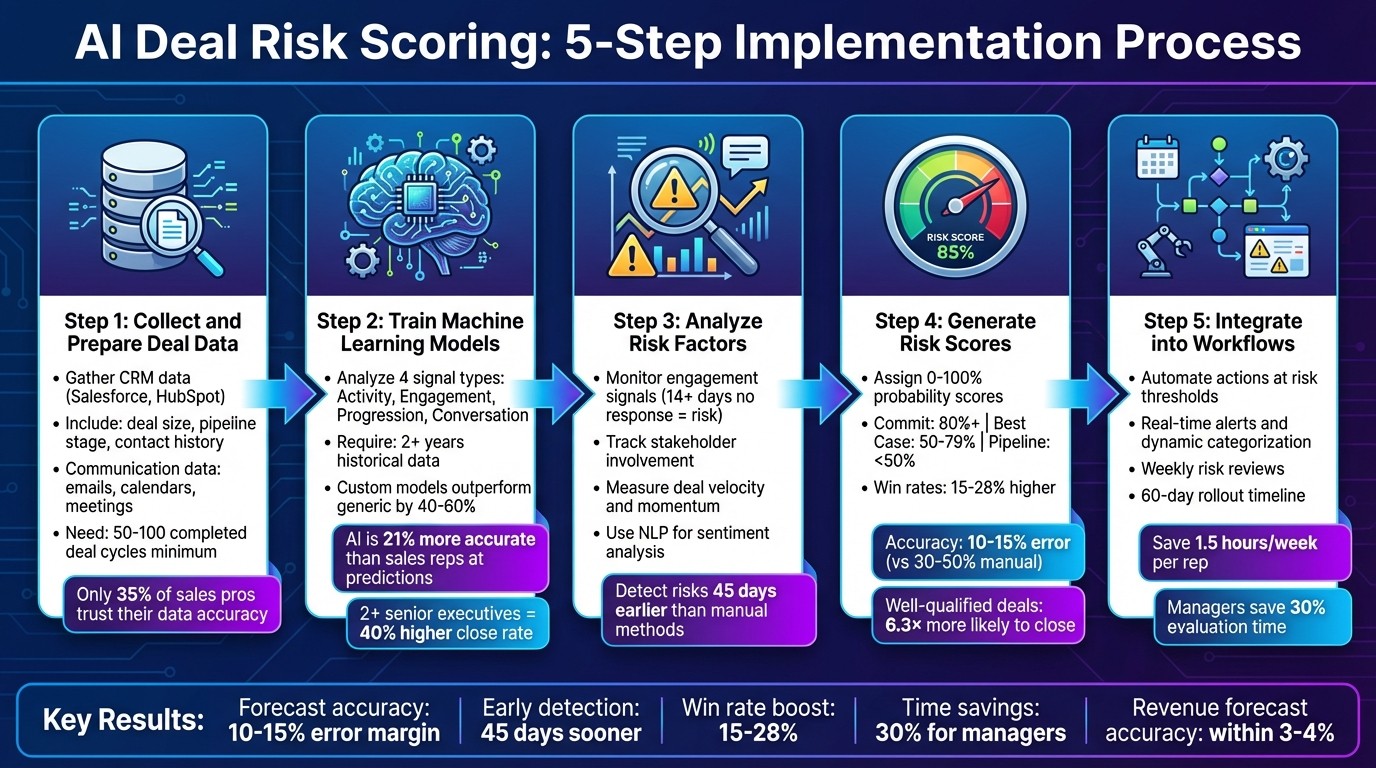
5-Step AI Deal Risk Scoring Implementation Process
New HubSpot Feature: Predictive Deal Scores in Sales Hub! 🎯

Step 1: Collect and Prepare Deal Data
AI deal risk scoring thrives on high-quality data. To predict outcomes effectively, the model needs clean, detailed information from every stage of the sales process. Here's how to gather the right data and ensure it remains reliable.
Collect Relevant Data Points
AI models rely on both numbers and behavioral insights to separate successful deals from those likely to fail. Start by pulling data from CRM systems like Salesforce or HubSpot. Focus on details such as deal size, pipeline stage, contact history, and past win/loss records. Communication tools like email servers, digital calendars, and platforms like Zoom or Microsoft Teams can also provide valuable insights into buyer engagement.
Key data to include: stakeholder involvement, stage durations, delays in close dates, and gaps between meetings. These factors play a major role in deal outcomes. For instance, well-qualified deals are 6.3× more likely to close successfully than poorly qualified ones [3].
Data Category | Specific Data Points | Significance |
|---|---|---|
CRM Fields | Deal amount, stage duration, close date history | Helps identify patterns in deal progression |
Engagement | Email response time, inbound/outbound ratio | Shows the level of buyer interest |
Relationship | Multi-threading, executive involvement | Highlights risk when deals lack multiple contacts |
Conversation | Sentiment analysis, competitor mentions | Reveals objections or competition-related risks |
Once you've gathered this data, the next step is ensuring it’s accurate and consistent.
Ensure Data Quality
Surprisingly, only 35% of sales professionals fully trust the accuracy of their organization's data [5]. Manual data entry often leads to errors and gaps that can compromise AI predictions. Automating data collection - like syncing emails, meetings, and contact roles - can help create a more complete and reliable dataset.
Before training the model, set up clear rules for managing data. For example, define binary criteria for each stage of the sales process, such as confirming the budget holder's involvement, so the AI learns from consistent inputs. Avoid vague loss reasons like "Timing" and instead use specific labels to help the model identify real risk patterns. To train the AI effectively, you’ll need historical data from at least 50–100 completed deal cycles [4]. Regularly audit CRM data against calendar events to spot stagnant deals and maintain confidence in the AI’s predictions.
"Data hygiene is the primary bottleneck for risk detection, as AI models cannot accurately score opportunities if activity data is missing from the CRM."
Step 2: Train and Build Machine Learning Models
With clean and organized data, the next step is teaching the AI to spot what sets successful deals apart from unsuccessful ones. This involves training machine learning models to recognize the subtle indicators that predict deal outcomes. By feeding the system historical data, it learns to identify patterns and forecast which deals are most likely to close.
Identify Key Patterns
Machine learning models rely on historical deal data to uncover the traits of winning deals within your sales process. To achieve reliable results, you'll need a robust dataset - ideally spanning at least two years and covering thousands of activities and contacts [3] [6]. These models analyze four main types of signals:
Activity capture: Information from calls, emails, and other outreach efforts.
Buyer engagement: Metrics like response rates and sentiment analysis.
Deal progression: Insights into the speed and duration of each deal stage.
Conversation intelligence: Key topics discussed, such as pricing, legal terms, or competitor mentions [1].
The system focuses on meaningful progress rather than just counting activities. For instance, it differentiates between a routine follow-up email and a serious pricing discussion. Gong's AI, for example, is 21% more accurate than sales reps at predicting successful deals by the fourth week of a quarter [7]. It also identifies specific patterns, like the involvement of at least two senior executives, which increases the likelihood of closing by 40% [4].
"The exact weighting given to any signal can change on a daily basis, per deal, depending on the data patterns learned by the AI model."
Gong [7]
Advanced models use dynamic weighting, adjusting the importance of signals - such as mentions of competitors - based on recent trends [6]. Once these patterns are identified, the next step is tailoring the model to fit the nuances of your sales process.
Customize Models for Your Sales Process
Generic models are a great starting point, but customizing them ensures they align with the future of sales enablement and your specific strategy. By integrating your team’s unique approaches and criteria, customized models can outperform generic ones by 40% to 60% [8].
Start by defining four to six key dimensions that influence your "go/no-go" decisions. These might include factors like financial viability, strategic alignment, or risk level [8]. For each dimension, create evaluation rubrics using clear scales (e.g., 1–10) and establish thresholds. Use precise numbers for measurable factors and descriptive guidelines for qualitative ones. Assign weights to these dimensions based on historical data, avoiding equal weighting across all factors [8].
Once your model is set, test it against 20 to 30 historical deals, both won and lost. A well-tuned model should match your past decisions at least 80% of the time [8]. If the results aren’t consistent, adjust the weights and rubrics through a few rounds of refinement. Keep in mind that regular updates - quarterly adjustments based on market shifts or product updates - are essential to maintaining accuracy [8].
Step 3: Analyze Risk Factors
Once your machine learning models are trained, they begin evaluating specific signals to determine whether a deal is on track or showing signs of trouble. These systems assess buyer engagement quality and deal momentum by analyzing real-time data from CRM logs, email exchanges, calendar invites, and call transcripts. Then, they compare these signals against historical win/loss patterns to uncover hidden risks [1].
Common Risk Indicators
AI pinpoints risk categories that manual reviews often miss. One of the most revealing is buyer engagement signals. The system tracks factors like the time since the last buyer response, the ratio of buyer-initiated to seller-initiated interactions, and how quickly emails are answered. As Chris Etterman, VP of Customer Revenue at People.ai, puts it: "Slow answers don't just cost time. They cost deals" [9].
Stakeholder involvement is another key area. AI highlights when important personas, such as the Economic Buyer or CFO, are absent from the contact record. Deals with active participation from at least two senior executives are 40% more likely to close [4]. The system also flags "single-threading", where a rep engages only one person instead of the full buying committee.
Deal velocity and momentum are also under scrutiny. Indicators like "stage overstay" identify deals stuck in a stage longer than the historical median for successful outcomes. Frequent close date delays without a clear reason and incomplete mutual action plans are additional warning signs [1]. Furthermore, conversation intelligence leverages Natural Language Processing (NLP) to detect sentiment changes, competitor mentions, and whether the buyer is asking detailed implementation or ROI-related questions [1].
Risk Category | Key AI Indicators | Identification Method |
|---|---|---|
Engagement | No buyer response in 14+ days; declining inbound-to-outbound ratio | Email/Calendar Auto-capture |
Stakeholders | Missing Economic Buyer; engagement limited to one persona | CRM Contact Role Analysis |
Velocity | Stage overstay vs. cohort; close date pushed >1 time | CRM Field History Tracking |
Sentiment | Competitor mentions; lack of ROI/budget discussion | NLP/Conversation Intelligence |
Activity | Scheduled meeting "no-show"; unanswered tasks | Calendar/Task Integration |
These indicators form the foundation for interpreting broader trends, which we'll explore next.
Interpret Risk Trends
After identifying risk indicators, the next step is to interpret these patterns for actionable insights. Modern AI systems now offer Explainable AI (XAI), which goes beyond assigning a percentage risk score. Instead, it provides specific reasons, such as "75% probability; Risk: Competitor mentioned in last 3 calls" [4]. This level of detail allows teams to take targeted actions.
Agentic AI workflows can even automate responses to risk patterns. For instance, if a deal is flagged as high-risk due to missing executive involvement, the AI might prompt a rep to schedule a call with the Economic Buyer [1]. These systems can spot problematic deals up to 45 days earlier than manual reviews, giving teams a critical window to act [4]. One major red flag to watch for is the "Calendar Cliff" - any deal in the negotiation or commit stage without a future meeting scheduled. This often signals stalled momentum [5].
"The issue isn't that risk exists in your pipeline - it always does. The issue is how long it takes to find out. Closing that gap from days to seconds changes what leaders can actually do about it."
Chris Etterman, VP of Customer Revenue, People.ai [9]
Step 4: Generate and Apply Risk Scores
After conducting a detailed risk analysis, the next step is to translate these insights into actionable risk scores. Using advanced predictive modeling techniques like logistic regression, gradient boosting, decision trees, and neural networks, AI assigns a quantifiable probability score to each deal. These models process complex, multidimensional data to evaluate risks effectively [1][4]. By comparing each deal against thousands of past successful and failed opportunities, the system identifies the "DNA" of a winning deal. This creates a predictive baseline tailored to your specific sales process [3].
The result is a clear, measurable score - either as a percentage (e.g., 0–100%) or a risk tier (Low, Medium, High) [1][4]. For instance, a deal might be rated at 75%, alongside an explanation of the key risk factors affecting its likelihood of success [4]. Modern systems also provide the reasoning behind these scores, making them easier to act on immediately [4].
The benefits are striking. While traditional manual deal assessments often have a 30–50% margin of error, AI-driven scoring cuts this down to 10–15% [4]. Companies using AI to evaluate deals report win rates that are 15–28% higher compared to those relying on traditional methods. Furthermore, AI-identified well-qualified deals win 6.3× more often than those not flagged by these patterns [4][3].
Assign Risk Levels
Risk scores can be mapped to forecast categories to guide decision-making:
"Commit" for scores of 80% or higher
"Best Case" for scores between 50–79%
"Pipeline" for scores below 50% [1]
This mapping allows teams to make quick, data-driven decisions. Moreover, the system goes beyond static CRM fields by incorporating behavioral indicators like email sentiment and stakeholder engagement [3][5]. For example, if a deal sees 10 days of inbound silence, the AI automatically increases the risk level by 40% [5]. Similarly, repeated delays in a deal's close date serve as a critical warning, often signaling a misunderstanding of the buyer's procurement process [5].
Visualize Risk Insights
To make risk scores more actionable, visualize them with color-coding: Green for low risk, Yellow for medium, and Red for high. This approach helps sales teams quickly identify deals requiring intervention [1]. Many systems enhance these visuals with automated playbooks that trigger specific actions when risk thresholds are crossed. For instance, if a deal is flagged as high risk due to "single-threading" (engaging with only one contact), the system might automatically create a task to "identify and engage a second stakeholder" [1][4]. Some platforms even act as "AI workers", not just displaying risk scores but initiating workflows and nudges to address them [1].
A critical distinction here is between "execution risk" (errors made by the seller) and "consensus risk" (conflicts within the buyer's team). With 74% of B2B buyer teams experiencing "unhealthy conflict" during decision-making, AI can track the involvement of the entire buying committee - typically 5 to 16 people - rather than relying on a single champion [5].
"The risk isn't that they are arguing; the risk is that they aren't arguing with you." - Justin Shriber, CEO, Terret [5]
These risk scores don't just highlight problems; they pave the way for proactive interventions to be seamlessly integrated into your sales process.
Step 5: Integrate Risk Scoring into Sales Workflows
Once you've generated actionable risk scores, the next step is weaving them into your daily sales processes. This integration is what turns predictions into meaningful actions. Without this step, risk scores risk becoming just "another dashboard to check" instead of a living, breathing AI tool that drives real, measurable results.
Use Scores for Timely Interventions
The most effective sales teams leverage AI risk scores to trigger automated actions, reducing reliance on manual reviews. For example, when a deal hits a certain risk threshold, your CRM can automatically create tasks like "schedule a call with the Economic Buyer" or "verify the paper process" [1][5]. This shift makes risk scoring an active tool for execution rather than a passive reporting mechanism.
Dynamic categorization ensures your pipeline stays up-to-date with real-time deal health. If a deal's risk score slips below 80%, it automatically moves from "Commit" to "Best Case." This dynamic adjustment ensures your forecasts reflect the current state of your pipeline, without waiting for the next scheduled review [1][10]. Sales managers benefit from real-time alerts when warning signs appear - like a drop in stakeholder engagement, a stalled deal, or a buying committee going quiet - allowing for immediate action instead of delayed problem-solving [10].
AI can also distinguish between "recoverable" deals that need strategic action and "dead" deals that are unlikely to close, no matter the effort. This is especially vital given that only 23% of sales reps typically have enough pipeline to hit their quotas [10]. With this clarity, managers can focus their coaching on deals that have the highest potential, rather than wasting time interrogating reps about every opportunity [3][10].
High-performing teams often conduct weekly "Risk Reviews" to identify anomalies in the "Commit" and "Best Case" categories. They establish clear objective exit criteria - such as confirming the budget holder's involvement - before allowing a deal to move stages or improve its risk score [5][10]. Additionally, they track inbound velocity, flagging any late-stage deal with 14 days of buyer silence as "High Risk." This is crucial because buyer silence tends to be a stronger indicator of deal failure than seller activity [5].
By automating these interventions and embedding insights into sales tools, teams can streamline their decision-making and focus on what matters most.
Embed Scores in Tools like Coach Pilot
Platforms such as Coach Pilot integrate AI risk scores directly into sales workflows, providing real-time coaching and sharper forecasts. These tools help sales teams pinpoint vulnerabilities in deals and offer actionable next steps. For instance, if a deal is flagged for single-threading, the platform might prompt a rep to "engage with a second stakeholder." By combining custom sales playbooks with AI-driven coaching, platforms like Coach Pilot ensure that reps get the guidance they need exactly when they need it.
To implement such a system, follow a structured 60-day rollout plan:
Weeks 1-2: Collect signals
Weeks 3-4: Build initial scores
Weeks 5-6: Pilot in shadow mode
Weeks 7-8: Automate actions [1]
This phased approach ensures your AI models are fine-tuned to your sales process before they start influencing decisions. By embedding risk scores into workflows, sales reps can save 1.5 hours per week on deal analysis [3]. This means less time on admin tasks and more time on the strategic actions that close deals.
Benefits of AI Deal Risk Scoring
AI deal risk scoring is changing the way sales teams approach opportunity evaluation by replacing subjective judgment with data-driven insights. Instead of relying on a sales rep's "happy ears" - a term often used to describe unwarranted optimism - AI uses measurable behavioral signals like email response times, meeting frequency, and stakeholder engagement to assess deal health [3][5]. By leveraging prepared data and trained models, this method enables smarter, more proactive sales management. It also makes it easy to see the stark differences between traditional and AI-driven evaluations.
The improvement in accuracy is striking. Traditional approaches often have a high error margin, but AI reduces this to just 10–15%. This precision also leads to revenue forecasts that are consistently within 3–4% of actual results, empowering teams to achieve win rates up to 45% higher [4][1][11][3]. For example, companies using AI-powered sales tools report a 30% increase in win rates [11]. In contrast, most organizations relying on traditional methods achieve only 70–79% forecast accuracy [1].
Speed is another critical advantage. AI identifies potential problems much earlier, giving teams the chance to address them before they escalate [4]. Subtle warning signs, like "close date drift" or declining inbound communication, often go unnoticed by human reviewers until it's too late, but AI catches them early [5]. This proactive approach saves time: sales reps gain back at least 1.5 hours per week previously spent on deal analysis [3], and managers reclaim up to 30% of the time they used to spend on manual evaluations [4].
"AI removes the human bias and 'happy ears' that plague traditional forecasting. Instead of relying on a sales rep's optimism, the system analyzes objective data signals to determine a deal's true health." - Nathan Thompson, Fullcast [3]
AI also helps teams allocate resources more strategically by focusing on high-impact opportunities [3]. It uncovers hidden risks, such as buyer conflicts, which are present in 74% of B2B buyer teams [5]. This ensures that efforts are directed where they can make the most difference. By addressing these risks and streamlining resource allocation, AI transforms sales management from reactive troubleshooting to proactive, data-informed decision-making.
Manual vs. AI Risk Scoring Comparison
The table below highlights the key differences between manual and AI-driven risk scoring, showcasing the clear advantages of the latter.
Metric | Manual Scoring | AI Scoring |
|---|---|---|
Accuracy | 30–50% margin of error [4] | 10–15% margin of error [4] |
Speed | Reactive response [5] | Proactive; identifies risks 45 days earlier [4] |
Scalability | Limited to a few basic variables [2] | Analyzes thousands of data points simultaneously [4] |
Cost | High managerial effort [1] | Saves 30% of manager evaluation time [4] |
Conclusion
AI deal risk scoring transforms how opportunities are evaluated by leveraging objective data signals. The process involves gathering high-quality data, training machine learning models, analyzing risk factors, generating scores, and embedding them into workflows. This approach enables early detection of potential problems and significantly reduces forecast errors [4].
Sales teams utilizing AI deal scoring report impressive results: win rates improve by 15–28%, managers save up to 30% of their evaluation time, and revenue forecasts align within 3–4% of actual outcomes [4][11]. These gains underline the importance of smooth integration. AI uncovers subtle red flags - such as shifts in close dates or declining buyer engagement - that human reviewers might overlook until it’s too late.
"The question isn't whether to embrace AI deal scoring, but how to implement it most effectively for your organization's specific needs." - John Martino, Ricavvo [2]
Embedding risk scores directly into daily tools like CRM dashboards, Slack notifications, or sales enablement platforms ensures actionable insights drive immediate responses, rather than being lost in standalone reports. Platforms like Coach Pilot enhance this integration by incorporating AI-driven coaching into sales workflows. They provide actionable next steps, such as "schedule a call with the Economic Buyer" or "verify the paper process", helping teams act swiftly on risk insights.
FAQs
How much historical deal data do I need to start?
You’ll need a solid amount of historical deal data for AI algorithms to identify patterns and make accurate predictions about deal outcomes. While the specific amount can differ depending on the complexity of your business, having several months to even a few years of deal history is typically advised to ensure reliable AI-based deal risk scoring.
What CRM and activity data matters most for scoring?
When it comes to predicting deal outcomes and spotting potential risks in the sales process, there are four key types of data to focus on:
Buyer engagement: Measures how actively a buyer is interacting with your team or content. High engagement often signals strong interest.
Stage velocity: Tracks how quickly deals move through different stages of the sales pipeline. Faster progression can indicate momentum, while delays might signal trouble.
Sentiment: Evaluates the tone and context of buyer communications. Positive sentiment can suggest alignment, while negative or neutral tones might highlight challenges.
Historical deal signals: Looks at patterns from past deals, such as deal size, timeline, or buyer behavior, to provide context for current opportunities.
These data points form the backbone of effective scoring, helping teams prioritize efforts and make informed decisions.
How do teams act on risk scores inside daily workflows?
Sales teams incorporate AI-driven risk scores into their daily workflows to spot and prioritize deals that may be at risk of slipping or falling through. These scores, typically embedded in CRM systems, evaluate factors like buyer engagement and activity velocity to pinpoint potential challenges. By identifying these red flags early, teams can adjust their strategies, allocate resources more effectively, improve forecasting accuracy, and boost their chances of securing deals that might otherwise be lost.
Related Blog Posts

Remove the guesswork from winning more deals.