B2B Sales
AI-Driven Churn Prediction: How It Works
Mar 10, 2026
How AI models use transaction, engagement, and sentiment data to predict customer churn and enable targeted retention actions.

AI churn prediction helps businesses identify which customers are likely to leave before they actually do. By analyzing data like purchase history, product usage, and customer feedback, it assigns risk scores to customers, enabling companies to take action early. This approach is more effective than traditional methods, which often react too late or miss subtle warning signs.
Key Insights:
Why AI is better: AI detects patterns across hundreds of variables, unlike static rules that treat all customers the same.
Real-world results:Shopify cut churn by 12% in 2023 using an AI model, while Zoom reduced churn by 18% among SMB users.
How it works: Models use algorithms like XGBoost or Neural Networks to predict churn and suggest targeted actions.
Data used: Transaction history, engagement metrics (e.g., login frequency), and sentiment analysis (e.g., tone in support tickets).
Impact: Even a 5% reduction in churn can boost profits by 25–125%, depending on the industry.
AI-powered churn prediction isn’t just about spotting risks - it’s about acting on them. For example, Salesforce embedded churn predictions into daily workflows, leading to a $37M revenue boost in just four months. By integrating these insights into AI sales coaching and sales processes, businesses can retain more customers and grow revenue.
AI/ML Customer Churn Prediction (XGBoost + OpenAI)

Data Features That Power AI Churn Models
To tackle churn effectively, AI models need to draw from a variety of data features. By combining transactional behavior, engagement patterns, and customer sentiment, these models can create a clearer picture of churn risk.
Transaction Data
A customer’s purchase history speaks volumes about their loyalty and financial standing. AI models focus on metrics like order frequency, average order value, and payment habits. Signals such as failed payments, late renewals, downgrades, or frequent returns can highlight underlying issues. For instance, a customer who previously made regular purchases using discounts but suddenly stops might be exploring other options. Interestingly, SaaS companies lose about 5–7% of their customers each month to involuntary churn caused by failed payments[1]. By identifying these transactional red flags, AI can differentiate between short-term financial hiccups and more serious disengagement trends. Coupling this with engagement metrics takes the analysis a step further.
Engagement Metrics
Behavioral data showcases how customers interact with a product, offering insights into their overall satisfaction. AI models track activities like login frequency, session duration, feature usage, and onboarding progress. Instead of just looking at overall activity, these models zero in on changes in a customer’s typical behavior. For example, if a daily user suddenly skips multiple logins, it could signal potential churn. In 2023, Spotify leveraged AI to analyze engagement patterns and listening habits, sending tailored re-engagement emails. This initiative successfully reduced churn among premium users by 21%[1]. Such deviations from a user’s norm can be early warning signs. However, understanding customer sentiment adds another crucial layer to the analysis.
Sentiment Analysis
Numbers alone don’t tell the full story - sentiment analysis helps uncover the emotional side of customer interactions. AI tools analyze data from support tickets, resolution times, and the tone in emails, chat logs, or feedback surveys[4]. For example, a sudden increase in unresolved tickets or a shift from neutral to negative sentiment can signal a potential cancellation weeks in advance[2]. In 2024, Verizon used generative AI to assess sentiment and intent across 170 million service calls annually. This initiative identified customer intent in 80% of calls and aimed to prevent over 100,000 customer losses each year[5]. By picking up on subtle cues, like a gradual decline in confidence, AI can detect customers who might not openly express dissatisfaction but are quietly disengaging.
How AI Models Predict Churn
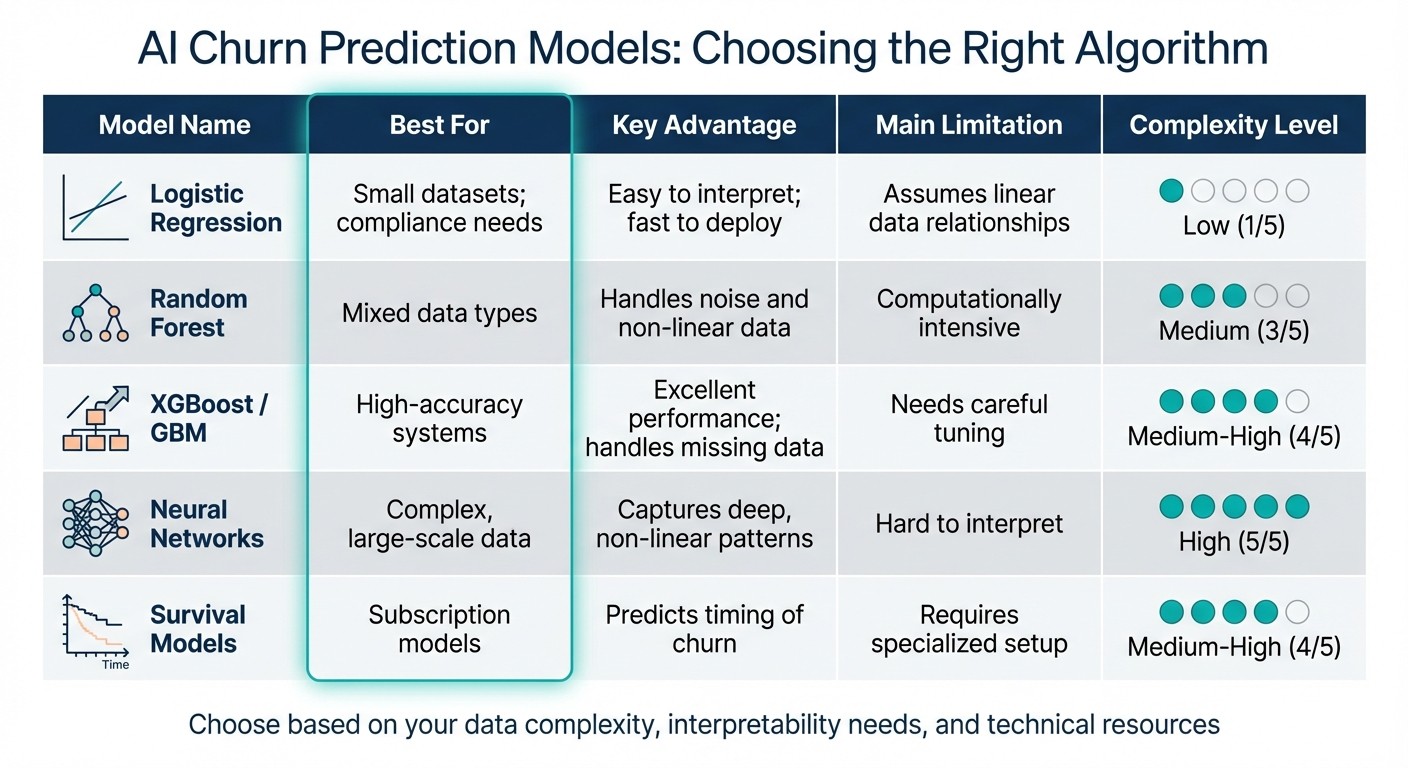
AI Churn Prediction Models Comparison: Algorithms, Advantages and Limitations
AI models use customer data to make churn predictions, enabling businesses to act before losing customers.
Algorithms and Their Applications
AI relies on various algorithms to predict churn, each suited for different scenarios. Logistic Regression is often the starting point, offering a simple way to classify churn likelihood. It calculates the probability of churn using odds ratios, making it especially useful in situations where explanations are required for compliance.
Random Forest takes a different approach by building multiple decision trees and using a majority vote for predictions. It’s great at handling non-linear relationships and mixed data types, and it’s less sensitive to noisy data or outliers.
For businesses needing high precision, Gradient Boosting Machines (GBMs) like XGBoost, LightGBM, and CatBoost are popular choices. These models improve accuracy by sequentially correcting errors from previous iterations. They also handle missing data automatically, making them ideal for structured datasets.
Neural Networks shine when dealing with large, complex data like chat transcripts or unstructured text. They uncover intricate patterns but are harder to interpret, which can be a drawback in certain contexts. Meanwhile, Survival Analysis models focus on predicting when churn will happen, which is invaluable for subscription-based businesses calculating Customer Lifetime Value.
Finally, Time-Series Foundation Models (like Google’s TimesFM 2.5 or Amazon’s Chronos 2) analyze customer behavior as a sequence, enabling predictions without extensive domain-specific training.
Model | Best For | Advantage | Limitation |
|---|---|---|---|
Logistic Regression | Small datasets; compliance needs | Easy to interpret; fast to deploy | Assumes linear data relationships |
Random Forest | Mixed data types | Handles noise and non-linear data | Computationally intensive |
XGBoost / GBM | High-accuracy systems | Excellent performance; handles missing data | Needs careful tuning |
Neural Networks | Complex, large-scale data | Captures deep, non-linear patterns | Hard to interpret |
Survival Models | Subscription models | Predicts timing of churn | Requires specialized setup |
Training and Testing Models
Training starts with collecting customer data - like support tickets, usage logs, billing info, and demographics. This raw data is cleaned, corrected, and transformed into a usable format. Feature engineering then identifies measurable patterns, such as how often a customer interacts with the product or sudden changes in behavior.
One common hurdle is class imbalance, as churned customers often represent a small fraction of the user base. Techniques like SMOTE (Synthetic Minority Oversampling Technique) create synthetic churn examples to balance the dataset, ensuring the model treats churn and non-churn cases equally.
Once the data is ready, algorithms like XGBoost or Random Forest are used for training. Models are fine-tuned by adjusting parameters like learning rate or tree depth. Performance is evaluated using metrics like Precision, Recall, F1-score, and Precision-Recall AUC, since standard accuracy metrics can be misleading in imbalanced datasets.
These techniques have been successfully applied in real-world scenarios, showing measurable reductions in churn.
Reading Churn Predictions
AI models assign each customer a churn probability score between 0.0 and 1.0. A score above 0.8 signals high churn risk and calls for immediate action, like a personalized call as part of modern sales enablement strategies. Medium scores might trigger automated follow-ups, while low-risk customers remain in standard engagement programs.
To make these predictions actionable, Explainable AI tools like SHAP values identify the factors driving high churn scores. For example, if low product usage is flagged as the primary issue, the response could involve targeted training or onboarding programs.
"The question is no longer whether transformer-based models can predict churn - they demonstrably can. The question is whether your infrastructure, data, and use case justify the added complexity over well-tuned gradient boosting."
Frederico Vicente, AI Research Engineer, Dypsis
To keep predictions accurate, models need regular updates - typically monthly or quarterly - to reflect changing customer behaviors and prevent outdated insights. This ensures retention strategies remain effective over time.
Using Churn Predictions in Sales Enablement
When AI models identify at-risk customers, the real value comes from turning those predictions into actionable steps that boost retention. Churn predictions only make an impact when integrated into sales processes and used to guide specific retention strategies. As the Salesforce Blog aptly put it:
"Insight doesn't equal impact. Our challenge wasn't to build more models - it was to operationalize the ones we already had." [7]
Targeted Retention Tactics
With churn predictions in hand, sales teams can craft tailored strategies for high-risk customer segments. AI churn scores allow teams to sort customers by both their risk level and account value, creating a clear prioritization framework. For instance:
High-value accounts with churn scores above 70: These require immediate, personalized attention, such as a direct call from an account manager or a customized product demo.
Medium-risk accounts (scores between 40–69): Automated re-engagement campaigns, like emails highlighting underused features or sharing success stories, often work well here.
Low-risk accounts: These can stay in standard nurture programs, which might include educational content or updates on new features.
Interventions should address the specific reasons behind the churn risk. For example, if the AI identifies declining login activity as the key issue, offering a refresher onboarding session or feature training might reignite engagement. On the other hand, if customer support sentiment analysis highlights frustration, a proactive call to resolve concerns could prevent escalation. Even a modest 5% improvement in retention can drive significant profit growth, especially when considering the high costs of acquiring new customers [3][6].
Between February and May 2025, Salesforce's "Customer Zero" team demonstrated how effective this approach can be. By embedding churn predictions directly into Slack and their CRM, they delivered 24,000 personalized recommendations. This led to a 38% action completion rate - five times higher than traditional dashboard-based methods - and generated $37 million in pipeline and revenue impact over just four months [7].
Integrating these insights into everyday sales activities makes retention strategies even more effective.
Adding AI to Sales Workflows
Embedding churn insights directly into daily workflows ensures they drive meaningful action. For example, automated CRM alerts can notify account managers as soon as a key customer's risk score crosses a critical threshold. These alerts often include pre-written email templates or talking points, making it easier for teams to respond quickly. Some systems even automate tasks like scheduling check-ins or sending targeted promotions based on specific risk signals.
Platforms like Coach Pilot take this a step further by weaving AI-driven coaching into sales workflows. Instead of relying on generic retention scripts, sales teams get tailored recommendations based on each customer’s unique risk factors and behavior. These tools also provide immersive training to prepare teams for sensitive conversations, while live coaching sessions help refine strategies based on real-world outcomes.
Modern systems also include features to pause retention efforts when customers show positive signals, such as increased usage or plan upgrades. This prevents unnecessary or intrusive outreach. By creating a feedback loop that compares predicted outcomes with actual results, these systems continuously improve both the AI models and the retention strategies they inform [8][9].
Conclusion
AI-powered churn prediction is reshaping how sales teams safeguard revenue. Instead of reacting to losses after they occur, teams can now take proactive measures. By uncovering subtle patterns in customer behavior, AI flags potential risks weeks or even months ahead, allowing for timely and informed interventions. With accuracy rates of 85–90%, AI models can identify at-risk customers early, and even a modest 5% reduction in churn can lead to profit margin increases of up to 125% [8][9][10][1].
This shift isn’t just about spotting risks - it’s about taking action. As Dr. Michael Wu puts it:
"Traditional analytics might tell you who churned, but AI tells you who will churn and precisely why" [10].
AI platforms today go beyond identifying at-risk customers; they suggest tailored actions to address those risks. Tools like Coach Pilot stand out by embedding AI-driven coaching directly into sales processes, offering actionable recommendations based on each customer’s specific risk factors.
The real value comes when these insights are seamlessly integrated into daily workflows. For instance, Salesforce reported a $37 million boost in pipeline and revenue within just four months by incorporating personalized recommendations into their team's regular activities [7]. This reinforces the idea that AI predictions only make an impact when they’re woven into everyday operations - not left sitting in reports. By embedding predictive insights directly into sales workflows, teams can not only anticipate churn but also take meaningful steps to prevent it.
FAQs
What data do I need to start predicting churn?
To forecast customer churn, start by collecting data that provides insights into their behavior and potential reasons for leaving. Focus on metrics like login frequency, feature usage, spending patterns, and customer support interactions. Additionally, data from behavior logs and tables can be critical for deeper analysis. Properly organizing and preparing this information is crucial, as it allows your model to spot patterns and trends with greater accuracy.
How accurate are churn prediction models in practice?
AI-powered churn prediction models have the ability to pinpoint at-risk customers well in advance - sometimes weeks or even months before they leave. Their success hinges on three main factors: the quality of the data, the complexity and precision of the model, and how effectively businesses act on the predictions. While no model can promise flawless accuracy, today’s AI can pick up on subtle behavioral patterns, even when data is incomplete. When businesses interpret these insights correctly and respond promptly, they can make a noticeable dent in churn rates.
How do I turn churn scores into retention actions in my CRM?
Integrate AI-generated churn scores into your CRM to pinpoint at-risk customers and categorize them based on their risk levels. This segmentation allows you to design targeted retention strategies, such as offering personalized deals or initiating timely support actions. Automate these processes within your CRM to streamline efforts. Make it a priority to regularly review and adjust your approach, ensuring your CRM workflows stay aligned with shifting customer behaviors and help minimize churn effectively.
Related Blog Posts

Remove the guesswork from winning more deals.