B2B Sales
AI in Sales Playbooks: Competitive Intelligence Tips
Mar 2, 2026
How AI updates sales playbooks with real-time competitive intel, battlecards, and coaching to boost win rates and cut research time.
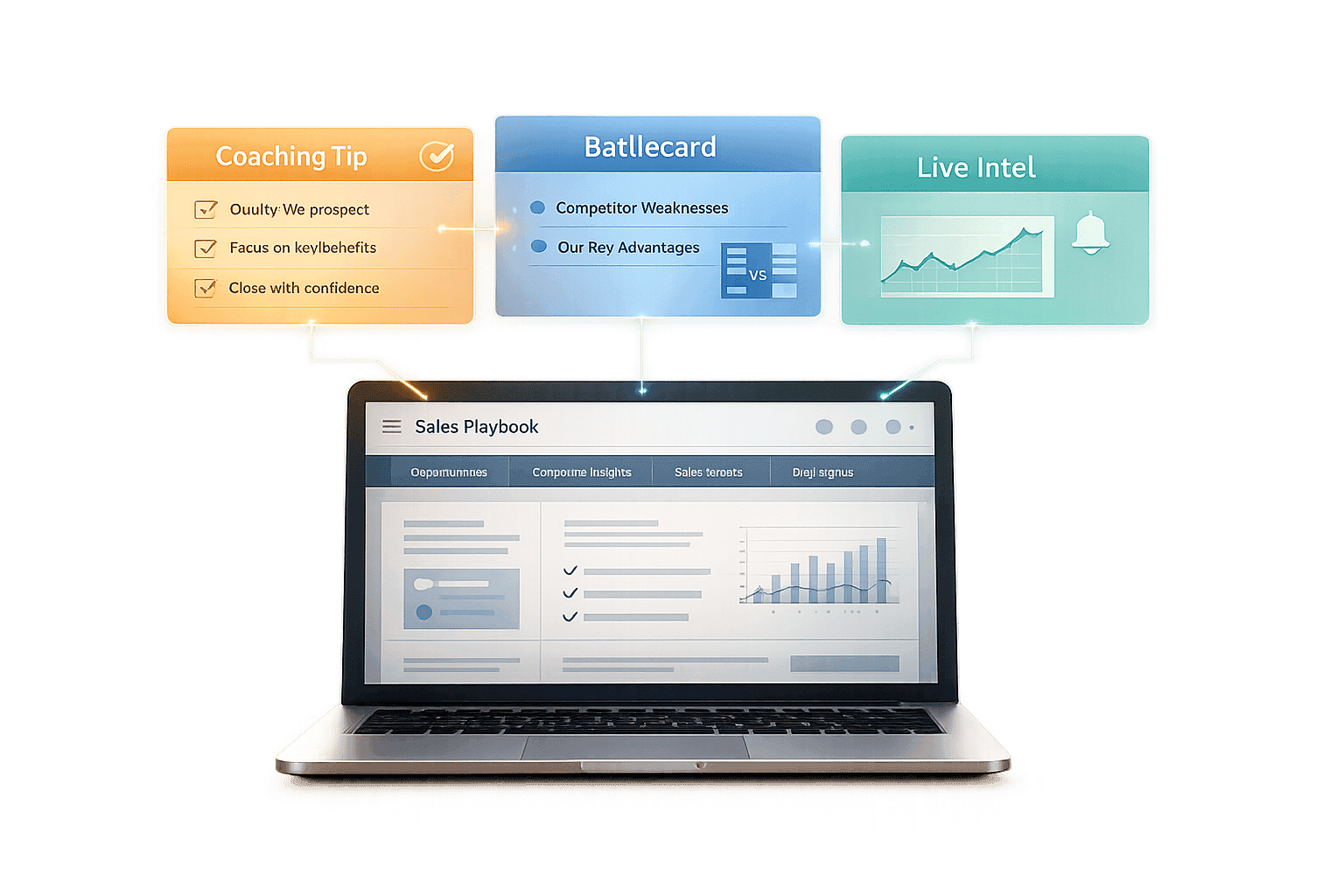
Sales teams lose deals when they rely on outdated playbooks. AI-powered sales tools are changing that by providing real-time insights, helping reps confidently counter competitor moves and objections. Here’s what you need to know:
Static playbooks are inefficient: They require manual updates, often becoming irrelevant within weeks.
AI saves time and boosts performance: Automating research reduces costs by up to 95%, while companies using AI report 30–40% higher win rates.
Real-time competitive intelligence: AI tracks competitor pricing, features, reviews, and even hiring trends, updating playbooks every few hours.
Tailored insights for better decisions: AI customizes battlecards and talking points based on deal stages, personas, and competitive context.
In short, AI transforms the future of sales enablement and how teams respond to competitors, enabling faster, smarter, and more effective selling strategies.
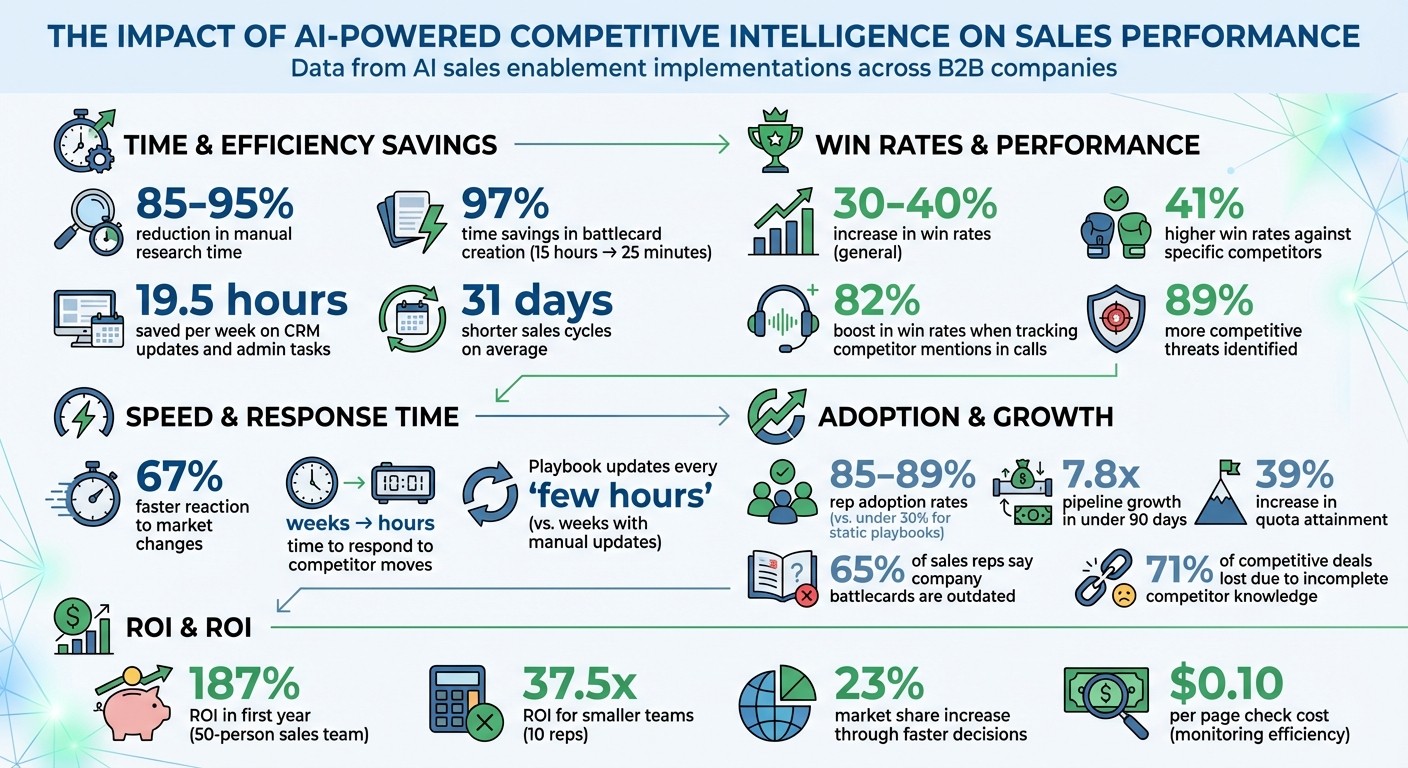
AI-Powered Sales Playbooks: Key Performance Metrics and ROI Statistics
The Three AI Workflows You Need to Nail in Competitive Intel | Compete Week 2025
How AI Collects and Monitors Competitive Intelligence
AI systems are a game-changer for keeping tabs on competitors. These tools can monitor a wide range of sources - pricing pages, product updates, job postings, patent filings, review sites, social media, and news outlets - all in real time. What would take weeks of manual effort is now done in a fraction of the time. For example, a 50-person sales team can cut research time by 85–95%, saving on labor costs and improving efficiency [4]. This level of monitoring ensures precise, real-time alerts that keep teams informed.
The real magic lies in AI's ability to understand context. Using advanced language models, AI doesn’t just flag keywords; it interprets the significance of changes. For instance, if a competitor shifts a key feature to a lower pricing tier, the system identifies it as a strategic threat. On the other hand, minor updates, like tweaks to a website footer, are ignored as irrelevant. This focus on material changes ensures that sales teams get alerts that actually matter [4][8].
Companies leveraging AI for competitive intelligence are seeing big results. They identify 89% more competitive threats and react to market changes 67% faster [7]. The typical delay of 6–9 weeks between a competitor’s move and a sales team’s awareness shrinks to just hours [4].
Monitoring Competitor Moves with AI Tools
AI tools excel at turning fragmented data into actionable insights. They track competitor behavior across multiple channels, providing a clear picture of what’s happening. For example:
Pricing pages: AI monitors these daily for changes in tiers, promotions, or billing models - key details that can influence deal negotiations.
Product pages: New features or integration announcements are flagged, helping teams adjust their competitive sales strategies.
Job postings: Hiring trends, such as a competitor recruiting healthcare-focused Sales Engineers, might signal a push into that vertical [4][6].
Review platforms like G2, Capterra, and TrustRadius also provide valuable clues. AI scans these sites for shifts in customer sentiment or recurring complaints, helping teams spot vulnerabilities in competitors' offerings.
"AI competitive intelligence transformed our market response. We now detect competitive moves within hours instead of weeks, and our market share has increased 23% through faster, better-informed decisions." - Maria Rodriguez, VP of Strategy at MarketLeader Corp [7]
AI doesn’t stop at gathering data - it delivers insights in context. For example, if a competitor is mentioned in a CRM deal record or a Zoom call transcript, the system might surface updated battlecards, pricing comparisons, or objection-handling scripts automatically through an AI-powered coaching platform [4][6]. This proactive approach ensures teams are always prepared, whether responding to a single competitor or analyzing broader trends.
Using AI to Spot Market Trends
AI isn’t just about tracking individual competitors - it’s also a powerful tool for identifying market-wide patterns. By analyzing messaging from dozens of companies, AI can highlight untapped opportunities or emerging trends. For instance, if several competitors start focusing on a specific use case, the system can flag it as a potential trend, offering suggestions on whether to follow suit or carve out a unique position [4].
Predictive intelligence takes this a step further. AI analyzes hiring trends, patent filings, and financial data to forecast competitors’ strategic moves months in advance. For example, a surge in engineering hires focused on API development might hint at an upcoming platform expansion. Similarly, new trademark filings in related categories could signal plans for a broader product lineup. This foresight gives sales teams the upper hand, allowing them to prepare before competitors even make their announcements [4].
This shift from reactive to predictive intelligence changes the game for sales teams. Instead of scrambling to respond to a competitor’s move, they’re armed with updated talking points, battlecards, and strategic insights - often before the competitor’s own team is fully briefed. AI doesn’t just help teams react faster; it helps them stay ahead.
Adding Competitive Intelligence to Your Sales Playbooks
Gathering competitive intelligence is tough, but getting it into the hands of your sales team at the right moment? That’s where the real challenge lies. The gap between what your team knows and what they actually use during sales conversations can make or break deals. AI steps in to close this gap by embedding real-time insights directly into the sales playbooks your team relies on every day.
The old way of doing things - like quarterly PDF updates - just doesn’t cut it anymore. A whopping 65% of sales reps say their company’s battlecards are outdated [11], and 71% of competitive deals are lost because teams lack complete competitor knowledge [11]. When a competitor rolls out a new feature or tweaks pricing, your team needs to know about it within hours - not weeks. That’s why AI tools that gather and transform data into actionable battlecards in real time are becoming essential.
Building AI-Generated Battlecards and Competitor Comparisons
AI has completely changed how battlecards are created. What used to take 15 hours can now be done in just 25 minutes - a 97% time savings. How? AI pulls data from sources like pricing pages, G2 reviews, job postings, and even call transcripts, then organizes it into structured, ready-to-use battlecards complete with citations and timestamps [9].
The magic happens with Retrieval Augmented Generation (RAG) architecture. This system ensures that the AI-generated content is based on solid, factual information. It pulls relevant snippets from your knowledge base, ranks them by importance, and generates responses with source links. Every claim comes with a “last updated” timestamp and a URL to back it up, so your team can trust the information is current [14][9].
AI doesn’t just gather everything - it filters out the noise. It focuses on major updates like pricing changes, new features, or integration shifts, skipping over minor tweaks like website design updates [10].
Another game-changer? These battlecards are modular. Instead of rewriting an entire document every time there’s an update, AI refreshes individual sections - like pricing, objection handling, or competitive landmines - so they stay relevant. For example, competitive landmines include specific questions reps can ask to highlight a competitor’s weaknesses [11][12].
"Static battlecards are a losing strategy in B2B sales. By the time someone in product marketing updates the Google Doc, your reps have already lost three competitive deals using outdated information." – MarketBetter [11]
AI also customizes battlecards based on the person and the stage of the deal. For instance, an SDR might need different talking points than an account executive working on a big enterprise deal. Similarly, a CTO might care more about security and integrations, while a CFO is laser-focused on ROI. AI ensures every rep has the right information for their specific situation [9][13].
Updating Playbooks Based on Competitor Actions
Once you’ve got dynamic battlecards, the next step is integrating them into your sales playbooks. With AI’s ability to collect data quickly, event-driven triggers make sure your playbooks stay up-to-date. For example, if a competitor is mentioned in a call transcript or deal record, AI can instantly surface updated battlecards, pricing comparisons, or objection-handling scripts directly in your sales workflow [14].
High-priority pages like pricing and comparison pages should be monitored daily, while feature pages and case studies can be checked every two to three days [10]. Tools like FoeSight make this affordable, charging around $0.10 per page check. By mapping specific competitor URLs to sections of your playbook - for instance, linking a competitor’s pricing page to your “Pricing Objection” section - you can ensure seamless updates.
It’s also smart to set up a Slack channel (e.g., #battlecard-feedback) where reps can share new competitor claims they hear during calls [12][14]. AI can summarize this feedback and turn it into structured updates for your playbooks. This creates a two-way system where automated monitoring combines with insights from the field, keeping your playbooks fresh from both top-down and bottom-up perspectives.
Even with automation, having a human review AI-flagged changes before they go live is crucial [12]. A dedicated reviewer can validate lower-confidence updates and fine-tune the messaging to maintain consistency across your materials.
The results speak for themselves. Companies using AI for competitive intelligence report a 30%–40% improvement in win rates [4], and teams that track competitor mentions in call transcripts see an 82% boost in win rates [14]. With AI delivering the latest insights exactly when they’re needed, reps are better equipped to win deals instead of losing them to outdated information.
Using Coach Pilot for AI-Powered Sales Enablement
Once you've created actionable battlecards, the next step is turning insights into action. This is where Coach Pilot steps in, bridging the gap between strategy and execution. By integrating competitive intelligence directly into key sales interactions, it replaces outdated static PDFs with a dynamic, AI-driven playbook.
Coach Pilot embeds itself into your sales workflow, capturing your team's successful processes and using AI to recognize critical patterns - like identifying the best times to engage executives or navigate procurement challenges.
The impact? Customers using Coach Pilot have reported 7.8x pipeline growth in less than 90 days, a 39% increase in quota attainment, and an average of 19.5 hours saved per week on CRM updates and administrative tasks [15].
Creating Custom Sales Playbooks with Coach Pilot
Coach Pilot doesn’t rely on generic advice - it tailors playbooks to your specific sales strategies. By codifying your team’s winning methods, it captures deal stages, competitive positioning, and objection-handling techniques, scaling that expertise across your organization.
Here’s a real-world example: Instead of vaguely telling a sales rep to "address pricing concerns", Coach Pilot delivers the exact messaging your top-performing reps use to tackle pricing objections effectively.
The implementation process takes just eight weeks:
Weeks 1–2: Map and codify your team’s processes.
Weeks 3–4: Conduct live workshops to refine strategies.
Weeks 5–6: Deploy the custom AI within Microsoft Copilot and Teams.
Weeks 7–8: Optimize with weekly coaching sessions.
What makes Coach Pilot stand out is its proactive approach. Instead of merely summarizing past conversations - like noting that "a competitor was mentioned" - it provides actionable next steps. For example, it might suggest, “Send the CFO an email by Thursday with this specific message” [15].
Real-Time AI Coaching and Performance Tracking
Once your playbook is live, Coach Pilot’s AI coach ensures it’s continuously reinforced. This AI, designed to understand your company’s unique sales process, offers real-time guidance - from surfacing updated battlecards to suggesting immediate next steps during calls.
Seamlessly integrated with Microsoft Teams, Copilot, and your CRM, Coach Pilot delivers tailored talking points whenever a competitor is mentioned. It also provides objection responses based on the latest competitive intelligence, ensuring your team is always prepared.
The platform doesn’t stop there. It tracks key metrics like battlecard usage, recurring objections, and deal roadblocks. This constant feedback loop helps refine your approach over time.
"Your playbook lives in a PDF. Your reps improvise instead of executing your proven approach." – Coach Pilot [15]
Measuring Results from AI-Enhanced Sales Playbooks
Tracking the right metrics is essential to gauge whether your AI-driven sales playbook is delivering results or needs fine-tuning.
Metrics That Show Success
Start by focusing on leading indicators. One key metric is playbook adoption rates among qualified opportunities. If adoption drops below 10% for two consecutive quarters, it’s time to retire that play [16]. Tools like conversation intelligence can also help you monitor how often talk tracks are used during live calls, giving you a better sense of engagement.
When it comes to business impact, competitive win rates are a critical measure. This is calculated by dividing the number of deals won against specific competitors by the total number of deals against those competitors [3]. Companies leveraging AI for competitive intelligence report impressive results, including 85-95% less manual research time and up to 41% higher win rates against competitors [3][4]. Other key metrics to track include average deal size, sales cycle length, and quota attainment, which together provide a clearer picture of overall revenue performance.
For a holistic view, use a composite Playbook Health Score. This combines several metrics: 40% for adoption rates, 30% for stage conversion, 20% for talk-track usage, and 10% for AI sales coaching completion [16]. A single score like this offers a quick snapshot of your playbook’s health and highlights areas needing attention.
Operational efficiency is another crucial area. Track how much time your reps save on manual research and measure "time-to-insight" - the time it takes for competitive market updates to be reflected in your playbook. Thanks to AI, this lag time can be reduced to just a few days [4][5].
By keeping an eye on these metrics, you can refine your AI-powered playbooks to ensure they stay relevant and effective.
Creating Feedback Loops for Ongoing Improvement
Metrics are just the start - continuous feedback is what keeps your playbook dynamic and aligned with real-world data. To achieve this, capture input from three key sources: Rep signals (quick 30-second surveys after using a play), Manager signals (structured deal reviews and coaching notes), and Customer signals (lost-reason analysis and post-demo scores) [16].
Incorporate CRM fields like Playbook_Play_Used__c and Playbook_Version__c to tie specific plays to revenue outcomes [16]. However, with 97% of corporate data containing quality issues [16], it’s vital to ensure these fields are clean and consistently updated.
Test new competitive messaging with a targeted group, such as your mid-market region, over a 4-8 week period to measure conversion improvements [16]. AI tools can analyze call transcripts and CRM data to identify which talk tracks are most effective in closing deals. These insights are then automatically integrated into your playbook, keeping it fresh and aligned with what works [3][1].
"Unmeasured playbooks become folklore: they live in slide decks and tribal memory but never move the needle." – Becky, beefed.ai [16]
Finally, implement strict retirement rules. Plays that fail to show a meaningful lift in win rates or maintain adoption below 10% for two quarters should be archived [16]. This approach ensures your playbook remains streamlined and focused on strategies that actually drive results.
Conclusion: Winning More Deals with AI and Competitive Intelligence
AI takes static playbooks and turns them into tools that adapt in real time, giving sales teams a significant edge. Companies leveraging AI for competitive intelligence report 30-40% increases in win rates while slashing manual research time by 85-95% [4]. In some cases, teams have seen their win rates soar by as much as 41% against specific competitors [3].
Beyond improving efficiency, AI changes the game from being reactive to predictive. Instead of taking 6-9 weeks to respond to a competitor's move, AI can identify changes within hours. Even more impressively, it can forecast strategic shifts 3-6 months in advance by analyzing trends like hiring patterns or patent filings [4]. And when reps have real-time insights during live calls, they’re able to close deals confidently without scrambling for answers.
"Speed is a weapon. With AI battlecards, you're not just keeping up, you're leading the conversation." - Paul Towers, Founder of Playwise HQ [2]
The financial impact of AI in sales is just as compelling. A 50-person sales team can see a 187% ROI in the first year, while smaller teams of 10 reps have modeled returns as high as 37.5x [4][3]. Sales cycles are shortened by an average of 31 days, and rep adoption rates jump from under 30% to 85-89% when intelligence is seamlessly integrated into their workflows [3][4]. Tools like Coach Pilot showcase how AI bridges the gap between strategy and execution, transforming how teams operate.
When your playbooks refresh every few hours and reflect what truly works in the field, intelligence becomes your competitive advantage - keeping you miles ahead of the competition.
FAQs
What data sources should AI monitor for competitor moves?
AI can monitor competitor websites, pricing pages, product launches, marketing campaigns, job postings, news updates, and social media activity. These sources offer key insights into shifts in competitor strategies or broader market trends. By keeping an eye on these areas, businesses can stay informed and adapt to changes effectively.
How do we keep AI battlecards accurate and trustworthy?
AI battlecards need consistent, real-time updates to stay accurate and dependable. This means keeping a close eye on competitor activities, backing up claims with reliable data, and weaving dynamic intelligence into sales workflows. These updates ensure that the battlecards reflect the latest market trends, helping teams stay relevant and effective in fast-changing environments.
What metrics best demonstrate ROI from AI sales playbooks?
Key metrics that showcase the return on investment (ROI) from AI-driven sales playbooks include increased win rates, shortened sales cycles, and higher deal conversion rates. These playbooks also offer real-time performance tracking and deliver actionable insights tailored to specific deals, enabling sales teams to fine-tune their strategies for better results.
Related Blog Posts

Remove the guesswork from winning more deals.