B2B Sales
How Personalization Shortens Sales Cycles
Mar 2, 2026
How buyer-focused personalization—using AI, tailored outreach, and role-specific demos—cuts B2B sales cycles while boosting conversion and revenue.
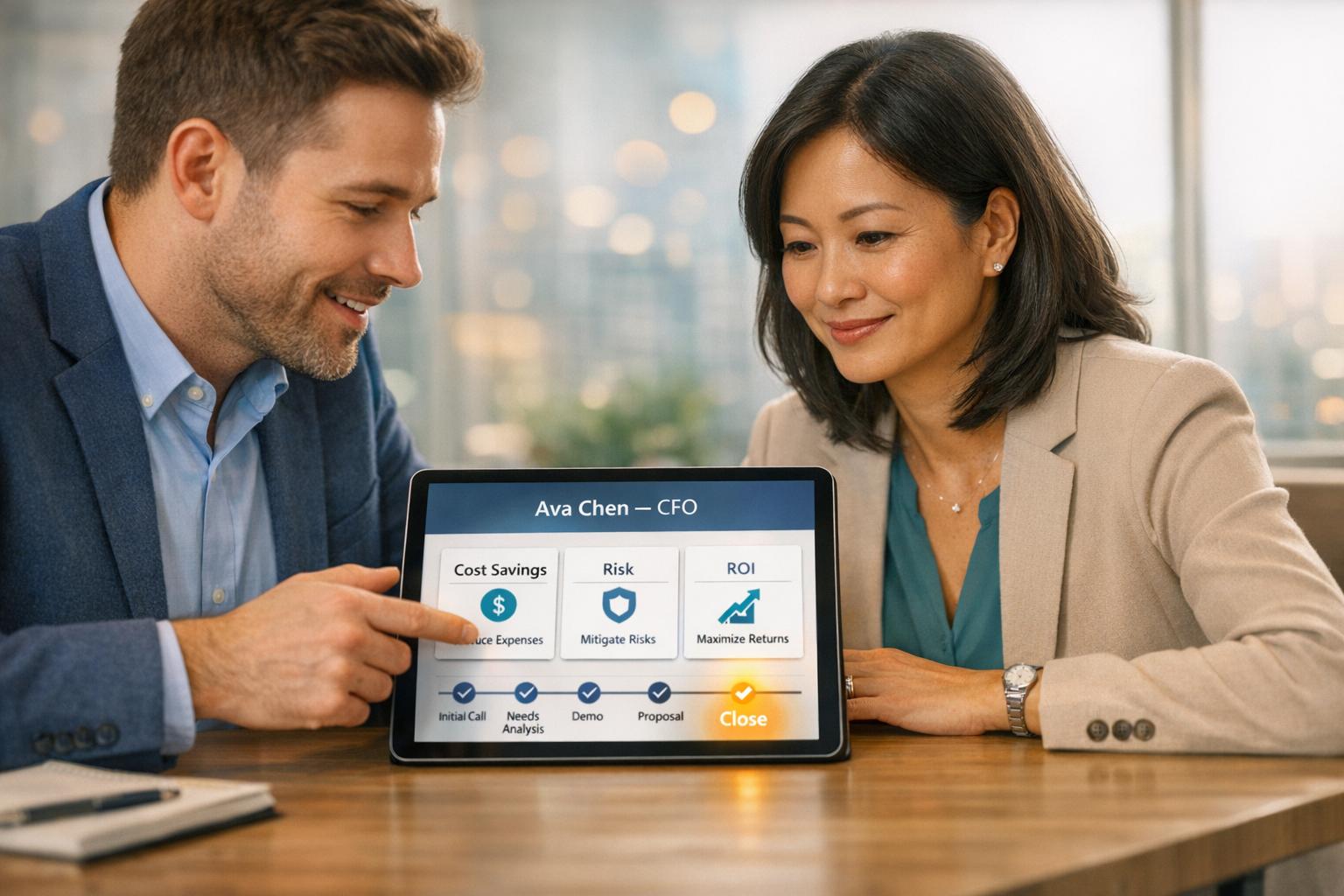
Personalization in sales is no longer optional - it’s a necessity. Tailoring your approach to a prospect’s specific needs, challenges, and goals can drastically reduce sales cycles, improve conversion rates, and boost revenue. Here’s why it works and how to apply it:
Why It Matters: B2B buyers expect personalized experiences, yet only 25% feel vendors meet this expectation. Personalization addresses this gap by focusing on relevant pain points, behavioral cues, and business priorities.
The Problem: Sales cycles have extended by 25% in recent years, creating inefficiencies, higher costs, and lost opportunities.
The Solution: Personalization streamlines decision-making by reducing friction, building trust, and addressing the concerns of all stakeholders.
Results: Companies using personalization see up to a 35% increase in conversion rates, a 10–15% revenue boost, and faster deal closures.
6 Winning Strategies to Shorten Your Sales Cycle in B2B
How Personalization Speeds Up Sales Cycles
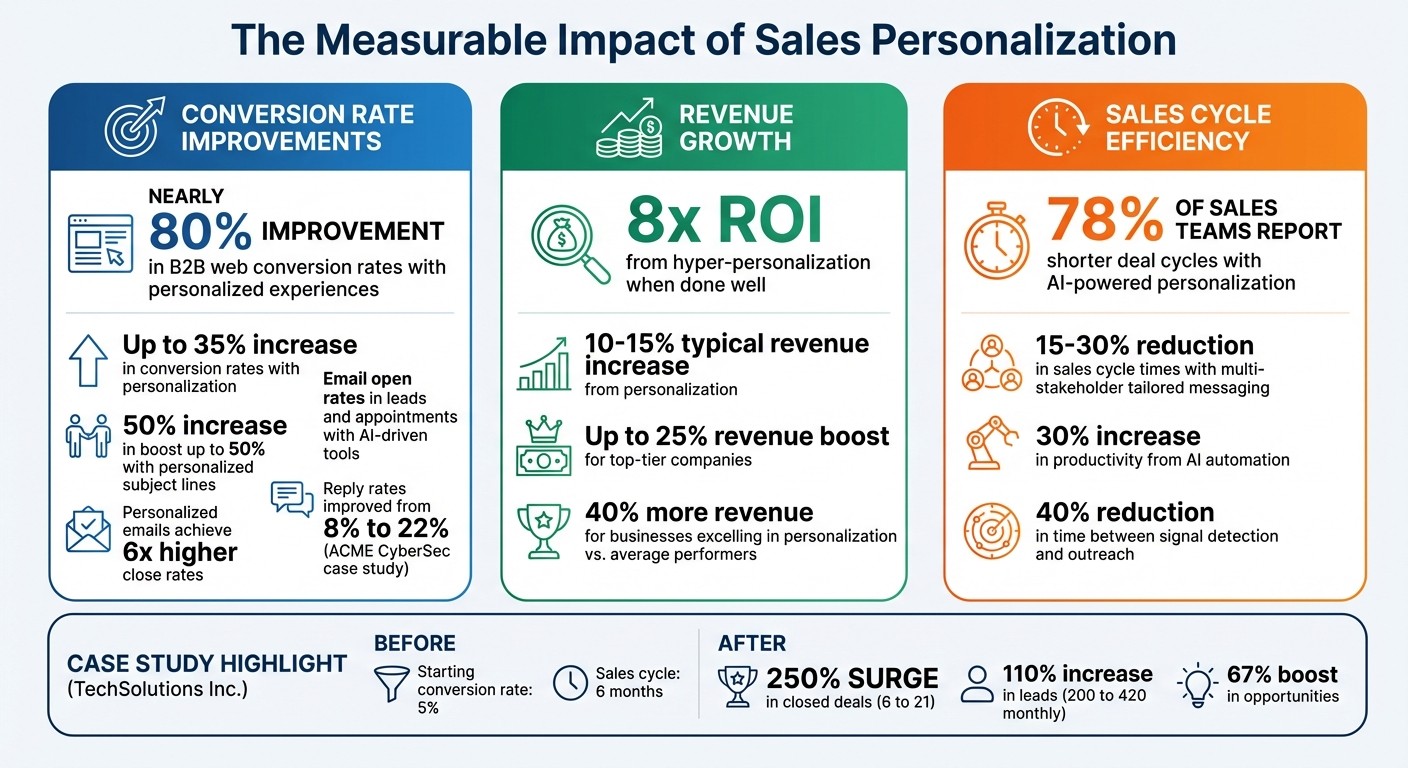
Impact of Sales Personalization: Key Statistics on Conversion Rates, Revenue Growth, and Sales Cycle Reduction
Personalization transforms drawn-out sales processes into efficient, focused conversations, delivering measurable results that accelerate deal closures.
The Numbers Behind Personalization
The statistics paint a clear picture: personalization has a powerful impact on conversion rates and revenue. For instance, companies leveraging personalization see conversion rates climb by up to 35% [8]. Those using AI-powered sales coaching platforms report a 50% increase in leads and appointments [4]. Even more impressive, B2B brands that personalize web experiences report conversion rates improving by nearly 80% [5].
On the revenue side, personalization is equally impactful. Businesses that excel in this area generate 40% more revenue from their personalization efforts compared to average performers. Revenue increases typically range from 10–15%, with top-tier companies achieving up to 25% [1][5]. Hyper-personalization, when done well, can result in an 8x ROI [2].
Take TechSolutions Inc., for example. In June 2025, this financial software company faced a daunting 6-month sales cycle and a low 5% lead-to-opportunity conversion rate. By integrating an AI-driven personalization strategy using SuperAGI within their CRM, they automated outreach tailored to behavioral triggers. The results? A 110% increase in leads (from 200 to 420 monthly), a 67% boost in opportunities, and a 250% surge in closed deals (from 6 to 21) [8].
Even small steps toward personalization can yield big results. In January 2026, ACME CyberSec tested the A.C.E.S. method by swapping generic intros for personalized voicemail scripts and Loom videos that referenced specific cyber-audit news. Over a two-week pilot, despite making 40% fewer calls, their reply rate soared from 8% to 22%, demos doubled, and the pipeline per SDR increased 1.7x [12].
These numbers highlight how personalization not only boosts engagement but also helps buyers make decisions faster.
How Personalization Helps Buyers Decide Faster
Personalization simplifies the decision-making process for buyers by cutting through complexities that often slow them down. In 2023, nearly 90% of B2B purchases stalled due to information overload [9]. Personalizing demos to focus on a team’s top three workflows helps reduce friction and steers buyers toward what truly matters [1].
But it’s not just about practicality - it’s also psychological. High-impact personalization, such as addressing role-specific challenges or recent trigger events like funding rounds or executive changes, shifts the seller’s role from vendor to trusted collaborator [1][4]. This approach builds trust, instills confidence, and motivates buyers to act more quickly.
"Speed captures attention. Personalization converts it." – Charanyan, Co-founder, RevenueHero [10]
In complex B2B sales cycles, personalization plays an even bigger role. Tailoring ROI examples and addressing the concerns of individual stakeholders within a buying committee ensures everyone feels heard. This helps internal champions advocate for your solution, reducing the back-and-forth that often drags out timelines [1][9]. When buyers see content addressing both their immediate priorities and long-term goals, they’re more likely to move from consideration to commitment without delay.
Personalization Techniques That Shorten Sales Cycles
Personalization isn't just a buzzword - it's a way to turn data into action and push deals forward. Done right, it can make sales outreach more effective and help shorten sales cycles significantly.
Using Prospect Data for Better Outreach
The key to personalization is using the right data. Sales teams that focus on high-value insights, like gaps in a company's tech stack, recent hiring trends, funding announcements, or intent signals, often outperform those relying on surface-level details. In fact, 88% of professionals believe personalization directly impacts sales performance [13].
The shift is toward what experts call "contextual relevance." Instead of generic pleasantries like "Congrats on your funding round!" successful reps dig deeper. For instance, if a company raises $25 million, a better approach would be: "I saw you raised $25M - congrats! As you scale your sales team, here’s how [Similar Customer] kept pipeline visibility intact while growing from 10 to 50 reps."
Personalization also works best when you tailor messaging to multiple stakeholders. Identifying roles like the decision-maker, champion, influencer, and potential blocker allows you to craft specific messages for each. For example, CFOs might care about ROI, while IT leaders focus on technical compatibility. This approach can reduce sales cycle times by 15–30% [14].
"Relevance to a verified business priority is what makes that personalization meaningful. Each message should connect to something the prospect actually cares about right now."
– Davidson Hang, HubSpot [4]
Timing is just as critical. Monitoring trigger events, like executive hires, creates a key 90-day window when new leaders are actively evaluating solutions. Will Battle from ZoomInfo explains:
"It's never a good idea to directly mention that you are aware of what your prospect is searching for, but rather to make them feel like there's some kind of serendipity with your call" [11].
These strategies set the stage for scaling personalization effectively.
Using AI and Automation to Scale Personalization
AI is a game-changer for scaling personalization. It handles repetitive tasks like data enrichment, lead scoring, and drafting outreach, freeing up sales reps to focus on building relationships. This division of labor can increase productivity by 30% and save about two hours of manual work daily [17].
A structured multi-agent workflow is particularly effective. In this setup:
A Research agent gathers and enriches prospect data.
A Draft agent creates tailored messaging.
A QA agent ensures accuracy and brand compliance.
This process balances efficiency with authenticity, ensuring consistent results [16].
Platforms like Coach Pilot take it a step further by embedding AI coaching into the sales process. These tools create custom playbooks and guide reps through personalized interactions in real time, helping teams maintain a human touch even at scale.
AI-generated drafts should be treated as starting points and refined with insights from discovery calls to keep the tone natural and engaging [17]. The numbers back this up - personalized subject lines can boost email open rates by up to 50%, and personalized emails achieve six times higher close rates [15]. However, a human checkpoint or secondary AI review ensures the messaging stays on point before it goes live.
Once you've personalized your outreach, the next step is to keep the momentum going with tailored follow-ups and presentations.
Tailoring Follow-Ups and Presentations
Follow-ups work best when they anchor back to specific conversation details. Reference the call date, quote the prospect directly, and address their goals or concerns. For example: "During our call on March 1st, you mentioned that a manual lag in pipeline visibility was costing your team 5 hours per week. Here's how we helped a similar-sized team eliminate that bottleneck in 30 days."
A well-structured follow-up cadence - Day 1, Day 3, Day 7, Day 10 - captures most replies by the tenth day, with the first follow-up alone increasing reply rates by 49% [18]. Each touchpoint should offer something new, whether it’s reframing the problem, sharing social proof, or addressing priorities.
When it comes to presentations, focus on what matters most. Instead of a full product tour, apply the "Three Workflows" rule: highlight three specific workflows that address the prospect's key pain points [1]. This keeps the conversation focused and respects their time.
Match your call-to-action to where the buyer is in their journey. Early-stage prospects respond better to low-pressure asks like, "Would it be helpful if I sent this case study?" Meanwhile, late-stage buyers often need a specific meeting request with a clear agenda. Personalized calls-to-action consistently perform better [13].
Interactive demo replays are another powerful tool. They let buyers revisit key moments and share relevant features with their team at their own pace. This self-service option can speed up internal buy-in without requiring additional live meetings [3].
Creating a Sales Workflow Built on Personalization
Integrating personalization into your sales workflow isn’t just about having good intentions - it requires the right mix of tools, training, and tracking. A well-designed system ensures your team can consistently deliver tailored interactions.
Using Tools Like Coach Pilot
At the core of scalable personalization is centralized data. By feeding this data into an automated sales workflow, every interaction can build on prior insights. Your CRM should act as the ultimate source of truth, combining firmographic data, behavioral cues, and conversation history. This way, every sales rep has the context they need to make meaningful connections [1].
Platforms like Coach Pilot enhance this process by embedding personalization strategies directly into your workflow. With custom sales playbooks, reps can access real-time, AI-driven coaching that suggests personalized actions based on prospect data and buying signals. Plus, the platform’s performance analytics help identify which strategies are hitting the mark and which need tweaking.
Another key element is account tiering. Not every prospect warrants the same level of effort. For top-tier "A" accounts, hyper-personalization is essential - think trigger events, tailored proof points, and persona-specific messaging. Mid-market "B" accounts might get one or two custom lines generated programmatically, while lower-priority "C" accounts can receive segment-based templates with light personalization [5]. This tiered approach works hand-in-hand with automated behavioral triggers, ensuring every prospect receives attention matched to their potential value.
Speaking of triggers, automation can handle the heavy lifting here. Instead of manually tracking signals like a prospect visiting your pricing page or expanding their engineering team, tools can flag these events and prompt reps to act. This reduces the time between signal detection and outreach by as much as 40% [7].
Combining Automation with Personal Connection
The best-performing teams strike a balance with the "80/20 rule": 80% of their outreach uses reusable templates for structure and positioning, while the remaining 20% is customized with specific triggers or pain points unique to the prospect [5]. This approach allows for scalability without sacrificing authenticity.
A smooth workflow is critical. AI can handle the initial research and draft creation, but human reps refine the tone and add personal touches, like anecdotes. Some teams even include a quality assurance step - whether handled by humans or AI - to ensure messages are accurate and aligned with the brand [20].
Technology alone isn’t enough, though - training plays a huge role. Instead of relying on one-off sessions, focus on continuous learning through methods like spaced repetition, microlearning, and AI-driven role-play simulations. Build a library of best practices to help reps polish their pitches and strategies over time [19].
Once your workflow effectively combines automation with a personal touch, the next step is to measure its success.
Tracking Personalization Results
To refine your efforts, you need to measure their impact. Start by monitoring engagement metrics such as open rates, reply rates, and positive reply rates. Filtering for responses with positive sentiment ensures your personalization is resonating with prospects [5].
Efficiency metrics are equally important. Track the time it takes to move from signal detection to outreach and calculate hours saved per rep each week. These metrics reveal whether automation is actually helping your team work smarter. On average, sales reps spend 21% of their day writing emails, yet only 8.8% of those emails get responses - highlighting the need for smarter workflows [7].
Finally, focus on metrics that directly affect outcomes. Monitor sales cycle velocity, conversion rates, and revenue growth. Personalization often leads to a 10–15% boost in revenue, with top performers seeing increases as high as 25% [5]. Some companies report cutting their sales cycle in half and improving close rates by 30% when using targeted sequences and dashboards. Meanwhile, B2B brands that personalize web experiences have seen conversion rates jump by roughly 80% [21][5].
To fine-tune your approach, use multivariate testing. Experiment with different combinations of personalized subject lines, openers, and calls-to-action. By running these tests with control groups in your CRM, you can identify which elements drive the most meetings and refine your strategies accordingly [5][1].
Conclusion
In today’s sales landscape, personalization has become a game-changer. By addressing a buyer’s specific challenges during their decision-making process, you can cut through the clutter and speed up their path to a decision. In fact, recent data shows that 78% of sales teams report shorter deal cycles after adopting AI-powered personalization tools [22]. Even more compelling, personalization efforts often result in a 10–15% boost in revenue [6][5].
To make the most of these advantages, implementing a scalable system is key. Using account tiering and behavioral signals allows for targeted and efficient outreach. Tools like Coach Pilot simplify this process by embedding AI-driven coaching and tailored playbooks directly into your workflow. This approach ensures your sales reps are equipped with the right message at the right time, turning strategy into actionable, data-backed results.
Start small - focus on hyper-personalized outreach for your top-tier accounts. Monitor metrics like engagement, response rates, and deal velocity to understand what’s resonating. As McKinsey aptly notes, “The more skillful a company becomes in applying data to grow customer knowledge and intimacy, the greater the returns” [6].
Customers today want to feel like individuals, not just another name on a list. In fact, 84% of consumers say that a personal approach is essential for earning their business [6]. By combining the right tools, relevant data, and a genuine human touch, you can not only accelerate sales cycles but also build deeper, long-lasting customer relationships. Take the first step toward integrating these practices into your sales process - and watch your results improve.
FAQs
What’s the fastest way to personalize without adding more work?
The quickest way to tailor your approach without piling on extra work is by leveraging AI tools. These tools handle tasks like research, content creation, and updates automatically. They can also sync with CRM systems to generate timely, data-based messages that feel personalized. This not only cuts down on manual labor but also ensures your messaging stays consistent and high-quality.
Which prospect signals should I prioritize for timely outreach?
Focus on key signals such as recent funding announcements, leadership transitions, spikes in website traffic, and higher engagement with your content. These real-time indicators can reveal prospects showing active buying intent. By keeping an eye on these cues, you can pinpoint the best time to reach out and connect with potential buyers effectively.
How can I measure if personalization is shortening our sales cycle?
To figure out if personalization is helping to shorten your sales cycle, start by keeping an eye on key metrics both before and after you implement it. Pay attention to the average time it takes to move from the first contact to a closed deal, and compare the results over time.
Also, dig into engagement metrics like reply rates, how prospects interact with your content, and their activity on your website. Tools like CRM software or analytics platforms can make it easier to analyze these data points and see if personalization is actually helping you close deals faster.
Related Blog Posts

Remove the guesswork from winning more deals.