B2B Sales
How to Build a Sales Playbook That Actually Works
Feb 2, 2026
Set measurable goals, map buyer journeys, create tactical plays, add AI coaching, train reps, and iterate to build a sales playbook that drives consistent wins.
Crafting a sales playbook is key to improving your team's performance and consistency. Here's what you need to know:
Why it matters: Companies with a structured sales process report win rates above 50%. Without one, sales reps spend a third of their time searching for resources instead of selling.
Key steps:
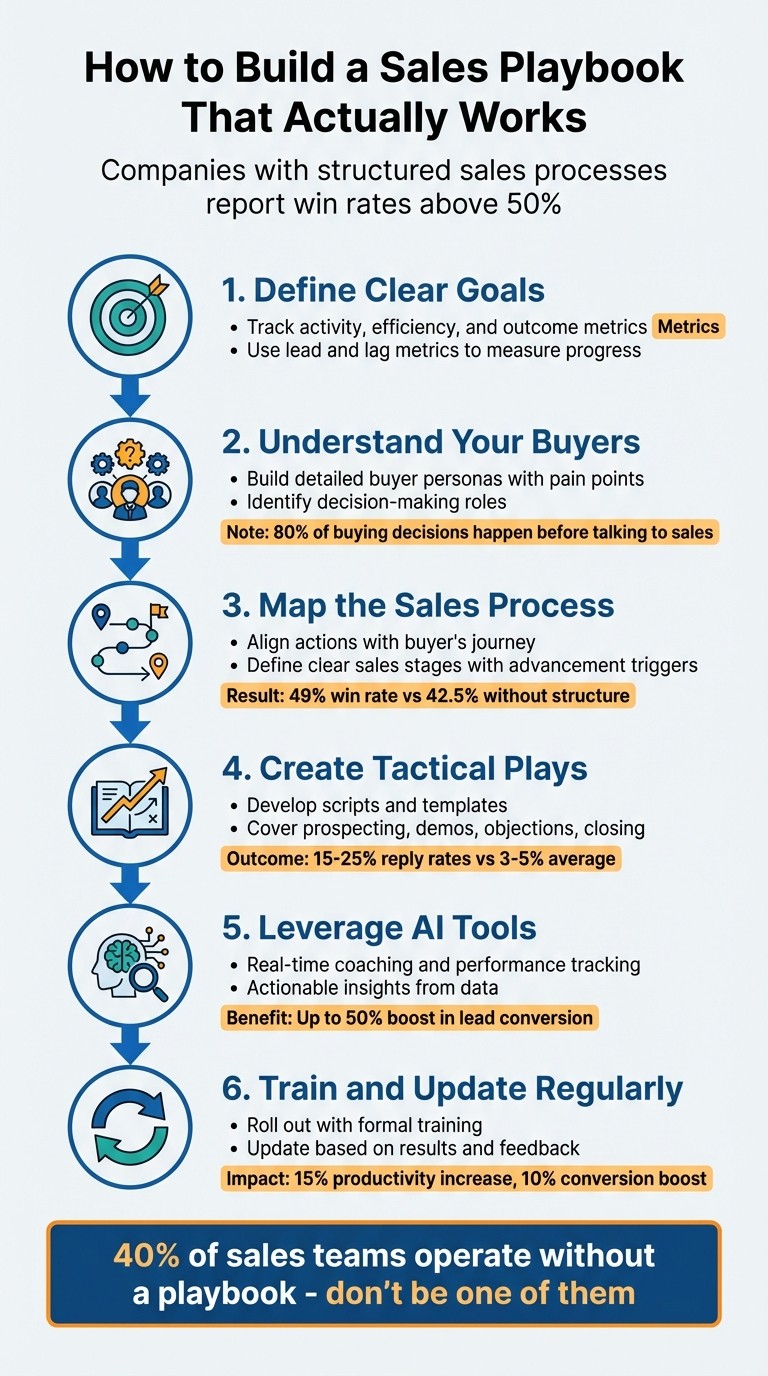
Define clear goals: Use metrics like activity, efficiency, and outcomes to track progress.
Understand your buyers: Build detailed buyer personas, including pain points and decision-making roles.
Map the sales process: Align actions with the buyer's journey and define clear sales stages.
Create tactical plays: Develop scripts, templates, and resources for common scenarios like prospecting and closing.
Leverage AI tools: Use AI sales coaching for real-time feedback, performance tracking, and actionable insights.
Train and update regularly: Roll out the playbook with formal training and keep it updated based on results.
A well-structured sales playbook saves time, boosts productivity, and ensures consistent results. Start by focusing on your buyers' needs and aligning your team's efforts to meet them.
6 Steps to Build an Effective Sales Playbook
How to Create a Sales Playbook (Guide)
Set Sales Goals and Know Your Buyers
Before crafting scripts or designing sales materials, two things are absolutely essential: clear goals and a deep understanding of your buyers. Without these, your sales playbook risks becoming a collection of generic advice that fails to deliver results.
Set Measurable Sales Goals
Start by defining specific, measurable success metrics for your team. Sales leaders should ensure these metrics align closely with overall business objectives. Robert Morton, Team Lead, Sales at Pipedrive, emphasizes this point:
"Your sales goals must align with the business strategy to ensure everybody is working toward the right targets" [2].
Use a mix of lead metrics (activities like calls or meetings) and lag metrics (outcomes such as revenue or closed deals) to track progress [9]. For instance, if your goal is to generate $500,000 in quarterly revenue, applying the sales velocity formula can help pinpoint areas for improvement:
(Number of Leads × Win Rate × Average Deal Size) / Sales Cycle Length [4].
Here’s a breakdown of key metric types:
Metric Type | Examples | Purpose |
|---|---|---|
Activity (Lead) | Calls per day, meetings booked, emails sent | Tracks effort and pipeline-building |
Efficiency | Conversion rates, demo-to-close ratio | Evaluates skill and process effectiveness |
Outcome (Lag) | Total deals closed, average deal size | Measures final results and quota attainment |
Velocity | Sales cycle length, time to close | Tracks how quickly revenue is generated |
To set realistic activity goals, analyze your top performers. For example, if your best sales reps book 15 discovery calls per week, use that as a benchmark [4]. Tailor these goals to specific roles rather than applying a one-size-fits-all approach [8]. Additionally, integrate these metrics into your CRM so reps can easily monitor their progress in real time [8].
Interestingly, 50% of high-performing sales organizations use a "closely monitored, strictly enforced or automated" sales process, which underscores the importance of tracking and accountability [1].
Once your goals are in place, the next step is identifying who drives these results by understanding your buyers.
Create Detailed Buyer Personas
While knowing your numbers is important, understanding your buyers is even more critical. In today’s B2B sales environment, where multiple stakeholders are often involved, a one-dimensional approach simply won’t work [6].
Develop buyer personas that go beyond basic demographics. Include details like firmographics (company size, industry), pain points, and psychographics (motivations, behaviors) [2][6][10][11]. Also, consider the specific decision-making role each persona plays in the buying process [2][8].
This focus matters because up to 80% of a buyer’s decision-making process happens before they even speak to a sales rep [5]. As Mary Flaherty, Vice President of Research and Thought Leadership at RAIN Group, explains:
"Understanding the needs of your customer is the crux of effective selling. You must have a deep understanding of your customers' needs and what's important to them so you can position your solutions effectively" [9].
To dig deeper into buyer motivations, create “pain funnels” - a set of probing questions designed to uncover the real cost of inaction [13]. This approach helps buyers recognize their own need for change, rather than feeling pressured into a decision.
When your sales goals align with the genuine needs of your buyers, you build trust and shift your role from that of a vendor to a trusted consultant [12][13]. Teams that achieve this alignment enjoy an 11 percentage point higher win rate on proposed sales [9].
Map the Customer Journey and Sales Stages
Once you've set clear goals and defined your target buyers, the next step is to map out the buyer's journey and align your team's actions accordingly. Your playbook should include both the buyer's journey and your internal sales stages to keep everyone aligned and working cohesively.
Chart the Customer Journey
Start by outlining the buyer's journey from their perspective. Typically, this journey consists of three main phases: Awareness (realizing a problem exists), Consideration (exploring potential solutions), and Decision (selecting a vendor). For each phase, identify the questions buyers ask, the types of content they engage with, and any potential roadblocks that might slow their progress [2].
To uncover effective strategies, talk to your top-performing sales reps. Find out the key tactics and questions they use to move deals forward and what resources they share at each stage. This process often reveals valuable, undocumented practices that can be standardized. As Cameron MacLean, an Account Development Representative at Highspot, puts it:
"It is no longer the case that sellers get to control the buying process - rather, it's the reverse. In many ways, the role of the salesperson has shifted from being the pitcher in baseball... to the batter, where they now must be ready for anything the prospect decides to throw at them" [5].
Once you've mapped the buyer's journey, align your sales activities with each phase. For example, during the Awareness stage, prioritize discovery calls and identifying pain points rather than pitching a demo. In the Decision phase, tools like ROI calculators or case studies can help overcome final objections [9].
Use these insights to create internal sales stages that guide your team through the process step by step.
Define Sales Stages and Advancement Triggers
With the customer journey mapped out, it's time to define your internal sales stages. These stages act as milestones that track the progress of a deal. Common stages include Prospecting, Discovery, Demo, Proposal, Negotiation, and Closing [15]. To ensure deals move forward effectively, establish clear "advancement triggers" - specific, measurable buyer actions that indicate progress [3].
For instance, a deal shouldn't transition from Discovery to Demo just because a meeting was scheduled. Instead, advancement should depend on concrete buyer actions, such as confirming pain points or agreeing to explore solutions [15]. This approach helps avoid "stage inflation" in your CRM. Chris Orlob, Director of Sales at Gong, emphasizes the importance of clear processes:
"Sales (and factories) tend to get a bit dicey when processes are missing, aren't well-defined, or exist but are not followed rigorously" [3].
Set 2–3 objective criteria for each stage. For example, during the Discovery stage, the requirements might include identifying key decision-makers and confirming a budget range. At the Proposal stage, the criteria could involve receiving a formal request for a quote and reviewing pricing terms. Integrate these stages into your CRM so your reps have clear questions and resources at each step [9]. Companies with structured sales enablement programs report a 49% win rate compared to 42.5% for those without [15].
Sales Stage | Buyer Journey Phase | Advancement Trigger (Buyer Action) |
|---|---|---|
Prospecting | Awareness | Prospect agrees to a discovery call |
Discovery | Consideration | Buyer shares pain points and confirms budget |
Demo | Consideration | Buyer confirms solution fits needs; technical approval |
Proposal | Decision | Buyer requests a formal quote or contract |
Negotiation | Decision | Final terms agreed; verbal commitment from decision-maker |
Closing | Decision | Buyer signs the contract |
Build Sales Plays for Each Stage
Once you’ve defined your goals and mapped out your sales stages, the next step is creating tactical plays for each stage. These plays act as the bridge between your strategy and execution. Think of them as ready-to-use tools - complete with talk tracks, email templates, qualifying questions, and objection-handling guides - that your team can deploy right away.
The best plays aren’t created in isolation. Collaborate with top-performing reps, marketing teams, and product experts to gather proven tactics. Reviewing successful deals is another great way to extract methods that work. These tailored plays ensure your strategic framework translates into effective, day-to-day sales actions.
Write Sales Plays for Common Scenarios
Start by focusing on the scenarios your team encounters most frequently, such as prospecting, lead qualification, product demos, handling objections, and closing deals. Every play should include a clear objective, specific talk tracks, and templates to guide your reps.
For prospecting plays, outline a multi-channel approach that includes LinkedIn, email, and phone outreach. Specify the sequence and timing of touches, and incorporate personalization triggers like recent funding announcements or changes in a prospect’s tech stack. Programs with disciplined playbooks see reply rates of 15–25%, far exceeding the average of just 3–5% [17].
When it comes to product demo plays, use the "inverted pyramid" strategy. Start with the key solution to address the prospect's most pressing issue, rather than diving into a feature-by-feature walkthrough. Include qualifying questions to confirm technical compatibility and add relevant case studies to demonstrate value in the prospect’s industry.
For objection-handling plays, create a searchable library of tested responses to common concerns like pricing, timing, or competitors. Use empathetic rebuttals that tie objections back to value. If leads go silent, provide reps with follow-up templates that focus on understanding and offer easy next steps to re-engage.
Compare Sales Play Strategies
Different scenarios require tailored approaches. Here’s a quick breakdown of key play types, their strategies, and expected outcomes:
Play Type | Primary Strategy | Key Tools/Resources | Expected Outcome |
|---|---|---|---|
Prospecting | Multi-channel outreach (social, email, phone) | LinkedIn templates, cold call scripts, ICP checklists | Discovery meeting scheduled |
Qualification | Needs discovery using SPICED or SPIN questioning | Qualifying question lists, ICP frameworks | Qualified opportunity in CRM |
Product Demo | Solution-first (inverted pyramid) | Demo environments, presentation decks, case studies | Technical/stakeholder buy-in |
Objection Handling | Empathy-led rebuttals with value focus | Battle cards, FAQ documents, ROI calculators | Momentum maintained, barriers removed |
Closing | Create urgency and navigate procurement | Pricing sheets, contract templates, mutual action plans | Signed agreement |
Each play should include clear exit criteria to define when a stage is complete. For instance, a qualification play is successful when the prospect shares their pain points, confirms budget, and agrees to explore solutions.
Organizations that adopt modern sales playbooks see measurable results, including a 15% boost in sales productivity and a 10% increase in conversion rates [16].
Use AI and Technology to Improve Sales Processes
When you integrate AI into your sales playbook, it becomes a tool that works smarter, not harder. AI-driven coaching and analytics embedded in your CRM and communication tools provide real-time guidance, helping sales reps execute strategies exactly when they need them. Organizations that use AI-enhanced playbooks have reported up to a 50% boost in lead conversion rates [16]. Additionally, top-performing teams are 48% more likely to rely on dynamic, tech-enabled playbooks compared to outdated static ones [14].
This approach turns your playbook into a living, learning system that evolves with every interaction. As Steve Rietberg, Senior Director Analyst at Gartner Sales practice, puts it:
"Sellers can no longer exclusively rely on intuition-based selling to push a deal over the finish line. Tomorrow's sellers must learn to use data today to effectively manage their sales cycles" [20].
By leveraging AI to analyze calls, spot skill gaps, and deliver personalized coaching based on real deal data, you can take your sales process to the next level.
Add AI for Real-Time Sales Coaching
AI coaching tools like Coach Pilot are game-changers. These platforms analyze live or recorded sales calls for speech patterns, sentiment, and how objections are handled [18]. The feedback is immediate - sales reps get actionable advice on their tone, word choice, and engagement strategies, enabling them to adjust their approach for future conversations. This shift from occasional reviews to ongoing improvement significantly enhances team performance.
Another standout feature is role-playing simulations. Reps can practice their pitches, negotiation tactics, and objection handling with an AI-simulated buyer, anytime, anywhere. These simulations, powered by CRM data such as deal history and customer pain points, create highly realistic scenarios tailored to specific opportunities [18][19]. The AI identifies strengths and weaknesses across multiple interactions, offering custom development plans that help new hires ramp up faster.
Modern AI tools also handle tasks like reviewing discovery calls, suggesting next steps based on the sales stage, and preparing account summaries that highlight customer history and potential objections [21]. This allows managers to focus on strategic priorities while ensuring consistent, data-driven coaching for every rep.
Track Performance with Analytics
AI-powered analytics turn your sales playbook into a performance optimization engine. Instead of guessing which strategies work, you can track key metrics like content adoption rates, new hire ramp times, and certification completions within the playbook [21]. Heatmaps can reveal which assets are driving deals and which ones need to be retired [14]. Companies that track their sales processes with data are 33% more likely to outperform their competitors [20].
By monitoring CRM behaviors and performance metrics - like win rates by persona, deal velocity, and cycle length - you can refine your strategies in real-time. For example, incorporating video content into your playbook can lead to a 95% information retention rate, compared to just 10% for text-based content [14]. Recording best-practice calls from top performers and embedding them into your platform makes this knowledge easily accessible for the entire team.
AI tools can also provide "guided selling" recommendations, suggesting the next best actions based on the buyer persona and current sales stage [20]. This transforms your playbook from a static document into an active, execution-focused tool that ensures reps are always applying the right strategy at the right moment. With continuous data-driven updates, your sales team stays adaptable, efficient, and results-oriented.
Build, Roll Out, and Update Your Playbook
Once you've outlined your strategies and mapped out the buyer journey, the next step is to create a playbook that your team can rely on daily. A well-crafted playbook isn't just a document - it’s a tool that drives operations and fosters growth. Research shows that companies who streamline their best practices experience a 15% higher growth rate, and sales teams that share these practices grow 2.5 times faster than those that don't [22]. By combining content, training, and feedback, you can create a playbook that truly works.
Organize Your Playbook with Templates and Scripts
Your playbook should be easy to access, searchable, and stored in a central digital location. This saves your team time and ensures they can find the information they need when they need it [7]. To make it even more effective, integrate it with your CRM for real-time updates. Organize the content in a way that aligns with your team’s workflow - whether that’s by sales pipeline stages, buyer personas, or product offerings. A clear table of contents and smart search functionality will help reps quickly locate relevant sections.
Start with a manageable length, around 15–40 pages, and allow it to grow over time. Before creating new content, audit what you already have. Review successful email templates, call recordings, and presentations to include proven materials. Focus on real-world strategies that have worked, rather than untested theories.
Train Your Team on the Playbook
Rolling out a playbook is more than just handing over a document - it’s a chance to create meaningful change. Host formal training sessions when you launch the playbook and whenever you update it. Break these sessions into smaller, focused topics like prospecting, discovery, or negotiation. This approach helps your team build specific skills without feeling overwhelmed.
Start by training sales managers so they can reinforce the playbook’s tactics during one-on-ones and team meetings. Use a mix of formats, such as virtual sessions, self-paced modules, and in-person role-playing. For new hires, incorporate the playbook into their 30-60-90 day onboarding plan, using it for role plays and quizzes.
Statistics back up the importance of training: 71% of top-performing salespeople rate their training as highly effective, compared to just 45% of average performers. Effective training also correlates with an 11% higher win rate on proposed deals [9]. To encourage adoption, tie playbook usage to key incentives like commission structures or performance reviews. Share success stories from team members who’ve closed deals using the playbook to further motivate the team.
Update Based on Results
Your playbook should evolve alongside your business. Use the insights from your AI tools and performance metrics to keep it current. Assign a dedicated owner - such as a sales enablement manager or head of sales development - to oversee updates. As Brad Rosen from Sales Assembly puts it:
"A sales playbook is a fluid document with best practices that your sales team members should live and breathe by, with the flexibility to change as your business changes" [1].
Create a feedback loop that allows reps to suggest updates based on their experiences in the field. Weekly team meetings can be an opportunity to share wins and highlight areas for improvement. Make small monthly updates to scripts or objection-handling guides, and conduct more comprehensive reviews every quarter. Use these reviews to align the playbook with win/loss data and shifts in the market. Monitor which sections of the playbook are being accessed most frequently and adjust or remove content that isn’t delivering results.
Major changes, like new product launches or shifts in strategy, should prompt immediate updates. The data speaks for itself: high-performing sales organizations are nearly twice as likely to monitor and enforce their sales processes (50% vs. 28%), and companies with a documented sales process see up to a 28% boost in revenue compared to those without one [17].
Conclusion
A successful sales playbook hinges on setting clear objectives, understanding your buyers deeply, leveraging modern tools, and committing to constant refinement. Surprisingly, 40% of sales teams operate without a playbook, missing out on the chance to boost quotas and improve conversion rates. In contrast, teams that use one report a 15% increase in productivity and a 10% jump in conversion rates [14][16].
Think of your playbook as a dynamic resource - a tool that evolves in real time to deliver maximum value [14]. This is especially important when you consider that sales reps spend just 28% of their time actively selling [23]. A well-structured and easily accessible playbook ensures they can focus on what matters most instead of wasting time searching for scripts or templates.
The best playbooks capture and standardize effective strategies, making them easy to replicate across the team. As Chris Orlob, Director of Sales, explains:
"Sales (and factories) tend to get a bit dicey when processes are missing, aren't well-defined, or exist but are not followed rigorously" [3].
By documenting specific strategies for common scenarios and incorporating AI-driven coaching, you empower your sales reps with the tools they need to thrive.
However, creating a playbook is just the beginning - adoption is key. Train your managers, embed the playbook into your CRM, tie its usage to incentives, and establish a feedback system so reps can contribute updates and improvements.
Once your team embraces the playbook, ensure it evolves alongside market trends and the future of sales enablement. The companies that succeed treat their playbook as a strategic tool - one that adapts to new product launches and changing customer needs. By focusing on measurable goals, aligning sales stages, and integrating AI-driven insights, you can build a playbook that drives consistent, scalable success. The time to start is now.
FAQs
How can AI tools make your sales playbook more effective?
AI tools can breathe new life into your sales playbook by using data insights, automating tedious tasks, and tailoring recommendations to your prospects. For instance, AI can sift through past sales data to pinpoint the strategies that drive the best results, allowing your team to double down on what actually works. It can also handle repetitive tasks like sending follow-up emails, scoring leads, and managing schedules - freeing up your sales reps to focus on sealing the deal.
On top of that, AI can provide real-time coaching by analyzing conversations and suggesting responses that align with customer behavior. It can even fine-tune sales pitches by leveraging customer data to address specific needs or objections. When you bring AI into the mix, your sales playbook evolves into a smarter, more adaptable tool that helps your team close more deals and work more efficiently.
What are the most important metrics to track when setting sales goals?
When setting sales goals, it’s important to focus on metrics that give a clear picture of how your team is performing and progressing. Start with quota attainment, which tracks how well your team is hitting their sales targets. Another key metric is conversion rates, which reveal how effectively your leads are being turned into paying customers.
You should also keep an eye on deal progression to see how opportunities are advancing through your sales pipeline. Lastly, measure buyer engagement to understand how prospects are interacting with your team and the materials you provide. By keeping tabs on these metrics, you can spot areas of strength, address weak points, and set realistic goals that push your team toward success.
Why is it important to match your sales process with the buyer's journey?
Matching your sales process to the buyer's journey is all about timing and relevance. It ensures your team connects with prospects at the right moment and delivers messages that resonate. Today, many buyers make most of their decisions before they ever interact with a salesperson. By aligning your approach with their decision-making process, you’re better positioned to build trust and close deals more effectively.
When your sales team addresses the specific needs, concerns, and questions buyers have at each stage of their journey, it creates a more tailored and customer-focused experience. Plus, having a sales playbook that maps your sales stages to the buyer's journey ensures consistency across the board. This not only makes your process scalable but also leads to more predictable outcomes - key ingredients for driving revenue growth.
Related Blog Posts

Remove the guesswork from winning more deals.