B2B Sales
How AI Improves Sales Playbook Iteration
Mar 20, 2026
AI turns static sales playbooks into living systems—automating updates, predicting deal risk, personalizing outreach, and cutting update time from 20–30 to 1–3 hours.

AI is transforming sales playbooks from static documents into dynamic tools that adapt to real-time selling conditions. By automating updates and analyzing data, AI reduces the time required to refresh playbooks from 20–30 hours to just 1–3 hours. This shift increases accuracy to 95% and relevance to 90%, helping sales teams close more deals and grow revenue by 3–15%. Key benefits include:
Automated Updates: AI integrates CRM data, call transcripts, and other inputs to keep playbooks current.
Real-Time Insights: AI flags issues like stalled deals or messaging gaps and recommends fixes instantly.
Predictive Analytics: AI forecasts deal risks and suggests the next best actions based on buyer behavior.
Content Personalization: AI generates tailored scripts, email templates, and sales sequences for specific personas.
Performance Tracking: Metrics like win rates and deal velocity are monitored continuously, enabling faster adjustments.
Companies like Salesforce, Snowflake, and Lenovo have already seen significant improvements, including higher win rates, shorter deal cycles, and millions in additional revenue. AI-powered playbooks are no longer optional - they’re essential for staying competitive.
Best Bits: How to 10x Sales Productivity with AI (Agent Playbook Masterclass)
How AI Analyzes Sales Data to Improve Playbooks
AI takes a wide range of data and turns it into actionable updates for sales playbooks by pulling information from various sources. These include CRM notes (covering closed-won and closed-lost deals), call transcripts from platforms like Gong, Fireflies, or Fathom, Slack conversations, and even proposal templates. The result? A "living" playbook that evolves with real-time selling conditions [14]. This process involves three key layers: the Signal Layer, which tracks buyer behavior and rep activity; the Decision Logic Layer, which applies strategic if-then rules; and the Learning Loop, which updates guidance based on win/loss data [2]. Together, these layers transform static sales guides into dynamic, responsive tools.
AI doesn’t just collect data - it connects the dots between market trends, competitive signals, and rep performance to flag when guidance needs a refresh [3]. For instance, AI can analyze call recordings for buyer sentiment, spotting hesitation or curiosity, and then suggest adjustments to the playbook based on historical success rates [9]. This feedback loop identifies critical issues like "messaging drift" (reps straying from approved scripts), "discovery gaps" (missing key questions during calls), and "engagement drop-offs" (like a champion going silent or a 40% drop in interactions) [4] [5]. By combining these diverse data sets, AI sets the stage for precise, actionable insights.
Using CRM Data and Call Analytics
AI dives into CRM data and sales call analytics to uncover patterns that might otherwise take weeks to spot. This allows teams to identify stalled deals early and take corrective action before opportunities are lost. A helpful tip? Export CRM data in JSON format instead of CSV - large language models process JSON more effectively for complex sales data [14]. Thanks to these tools, 80% of sales reps report easier access to customer insights, compared to just 54% without AI assistance [11].
AI also flags common pitfalls, like "demos-to-nowhere", where deals stall due to a lack of executive involvement or missing alignment among stakeholders [4] [5]. By addressing these challenges, teams can focus on what moves the needle.
Finding Trends with Predictive Analytics
Predictive analytics takes it a step further by forecasting customer behavior and potential sales outcomes. This allows playbooks to offer recommendations before problems even arise. AI tracks subtle changes - such as shifts in communication frequency, stakeholder involvement, or product usage - to identify deals at risk [11]. These insights turn playbooks into dynamic tools that suggest the Next Best Action based on live buyer signals [5].
"The difference between a playbook and an NBA [Next Best Action] system is the difference between a map and GPS. A map shows you the roads. GPS tells you which turn to make right now, based on live traffic." – Pingd.io [5]
Salesforce tested this approach between February and May 2025 in an internal pilot. By consolidating fragmented signals into a unified predictive layer, the system delivered 24,000 personalized recommendations over four months. This boosted action completion rates to 38% - a significant jump from the 8% baseline - and contributed $28M to the pipeline, with $9M in closed annual contract value [17]. Predictive engines also monitor external factors, like competitor price shifts, executive social activity, or layoffs, with about 87% accuracy in forecasting potential objections [13]. This proactive strategy helps teams refine their playbooks before small issues snowball into lost deals.
Automating Sales Content Creation and Customization
AI is transforming how sales teams approach content creation and personalization. By automating the development of targeted messaging, conversation guides, and email templates, AI eliminates the need for time-consuming manual script writing. Tools like Gong, Fireflies, and CRM systems analyze call transcripts, notes, and Slack conversations to uncover successful patterns. This allows AI to draft content tailored to specific buyer personas - focusing on ROI and risk for CFOs or operational impact for process-driven buyers [14][15][4].
In May 2025, Trust Insights showcased this capability by using Google Gemini to overhaul their sales playbook. They processed 70 meeting transcripts (around 400,000 words), CRM notes, and Slack conversations to create a 153-page master playbook. Led by Christopher Penn and Katie Robbert, the AI identified 5 Ideal Customer Profiles and 7 buyer personas, generating scripts, voicemail templates, and multi-step sales plays based on proven interactions [10]. Ameya Deshmukh from EverWorker aptly described this as "a capacity problem disguised as a copywriting problem" [19].
The results speak volumes. Companies using AI report 2-3x higher response rates and a 25-30% boost in conversion rates [12]. What used to take 20-30 hours of manual effort to update playbooks now requires just 1-3 hours for guided review [3]. This streamlined approach ensures 95% playbook accuracy and 90% content relevance [3], keeping sales teams equipped with up-to-date, effective messaging.
Building Dynamic Messaging Libraries
AI also revolutionizes messaging libraries, turning static documents into dynamic, ever-evolving resources. These "living playbooks" update automatically, adapting to changes in customer personas or market conditions. By analyzing call recordings, AI identifies trends - like fresh objections or effective talk tracks - and integrates them into the library [6][14].
This adaptability is crucial, as 44% of go-to-market leaders are prioritizing updates to sales messaging to better connect with modern buyers [18]. AI simplifies this process by embedding real-time guidance within CRMs and sales tools. It surfaces specific messaging snippets - like objection counters or talk tracks - based on the deal stage or persona, ensuring sales reps are always prepared [3].
Creating Customized Sales Sequences
AI takes personalization a step further by crafting tailored sales sequences. It researches prospect-specific triggers, such as funding announcements or executive hires, and maps them to relevant value propositions [19]. This approach balances deep personalization for strategic accounts with scalable automation for smaller opportunities [19].
In 2025, the no-code identity platform Bureau implemented AI-driven pre-call checklists and personalized coaching actions via Zime. This resulted in a 30% increase in deal conversion rates, thanks to improved discovery call quality and messaging alignment [18]. Beyond drafting content, AI manages the entire outreach workflow, from research to sequence deployment into engagement platforms [9][19]. To ensure accuracy, teams maintain a centralized library of approved value propositions and competitive insights, while a dedicated QA agent reviews AI-generated sequences for tone and compliance [19]. This meticulous process ensures that automated content aligns with real-world effectiveness, continually refining playbooks to reflect what works in the field.
Tracking Performance and Updating Playbooks in Real Time
AI transforms static playbooks into dynamic tools that adjust instantly to market changes. With AI-driven content creation aligning messaging to current trends, real-time performance tracking ensures these playbooks evolve as fast as market conditions shift. Instead of relying on quarterly reviews, AI continuously monitors performance metrics - like win rates, deal velocity, and conversion rates - at every stage. For instance, if a competitor changes their pricing strategy or new objection patterns appear in call transcripts, the system identifies these changes immediately and flags outdated guidance [3][13].
This real-time adaptability works like a GPS for sales teams. Mary Flaherty, Vice President of Research and Thought Leadership at RAIN Group, highlights the importance of this dynamic approach:
"Modern playbooks evolve daily, not quarterly. If buyer behavior shifts or a competitor changes its messaging, the playbook can reflect it almost immediately" [1].
The results speak volumes - 65% of CSOs and senior sales executives now list advanced analytics and AI as top priorities for sales enablement over the next two years [8]. These insights feed directly into actionable metrics, driving the next wave of AI updates.
Monitoring Key Performance Metrics
AI links key operational signals - such as stage progression, competitive win rates, and A/B-tested messaging - to revenue outcomes. For example, when a competitor is mentioned during a sales call, AI can surface updated battlecards in minutes. Studies show that delivering competitive intelligence within 27 minutes can boost win rates from 32% to 67% [20].
The technology also tracks how specific behaviors impact pipeline health. It can pinpoint whether asking certain discovery questions leads to higher conversion rates and alert teams when those questions are missing in ongoing deals [8][4]. At Versa Networks in 2025, the global sales team used Zime's Pipeline Review tool to combine behavior data with deal data. This approach helped managers identify execution gaps in real time, cutting coaching time in half while maintaining consistency across regions [16].
Making Data-Based Playbook Changes
AI goes beyond identifying problems - it recommends precise playbook updates. For instance, if data reveals a talk track isn't converting or a battlecard is being ignored, the system can draft new content based on successful strategies from recent wins [3][5]. A mid-market SaaS company with $8M in annual recurring revenue tested a real-time AI battlecard system integrated with their CRM. During a 90-day pilot in 2026, their competitive win rates soared from 35% to 68%, and deal cycle times dropped from 94 days to 67 days [13].
This automation slashes manual work. Updates that used to take 20–30 hours now require just 1–3 hours [3]. Teams can redirect this saved time to strategic efforts. To maintain accuracy and compliance, high-performing teams ensure human sign-off for major updates, such as pricing or legal language, while automating low-risk changes like talk tracks and email templates [3][4]. This balance allows playbooks to stay relevant and aligned with real-world needs faster than ever before.
Case Studies: Companies Using AI to Improve Sales Playbooks
These case studies highlight how companies are using AI tools to reshape their sales playbooks, delivering measurable results.
Snowflake integrated Yoodli AI Roleplays in August 2025 to enhance global sales coaching for nearly 3,000 sellers. Spearheaded by Nathan Irby, Principal Technical Platform Enablement Strategist, the initiative freed up 1,215 manager hours per quarter, translating to quarterly savings of about $176,175 - or over $700,000 annually. Sales reps reached pitch proficiency in just 14 minutes on average, with a 94% completion rate [21]. This transformation turned static training into a scalable, adaptive coaching system that continuously improved playbook execution.
Salesforce opted for a different strategy between February and May 2025 by piloting its own Agentforce Sales Coach internally as "Customer Zero." The tool delivered 24,000 tailored recommendations to sellers via Slack, achieving a 38% action completion rate - five times higher than the previous 8% baseline. This contributed to $28 million in generated pipeline and $9 million in closed Annual Contract Value (ACV) in just four months.
"By moving from passive dashboards to active agents, we didn't just predict success, we helped secure it" [17].
Inspired by Salesforce's success, TechVantage, a B2B SaaS firm with 50 sales reps, underwent a six-month AI overhaul from July 2024 to January 2025. Led by VP of Sales Rebecca Martinez, the company implemented Optifai to focus on high-probability opportunities. By analyzing 2,400 past deals to refine its ideal customer profile, TechVantage doubled its win rate from 18% to 36%, shortened deal cycles from 60 days to 47, and generated $3.2 million in additional Annual Recurring Revenue (ARR). This effort also delivered a staggering 1,400% ROI within six months [22]. These results underscore how AI-driven playbooks can help teams prioritize and close the most promising deals.
Lenovo's Digital Workplace Solutions group partnered with Letter AI in Q1 2026 to launch a revenue enablement platform. In its first quarter, the system supported over 2,000 AI roleplay and training sessions, cut client inquiry response times by 90% using real-time knowledge retrieval, and facilitated over $400 million in Total Contract Value through dynamic AI sales rooms. Vijay Gopal, Global Offering Leader, shared:
"The Letter AI sales platform empowers us to address client needs seamlessly, regardless of their location, language, or the complexity of their requirements. This platform has revolutionized our approach to personalization by adapting the sales process to individual seller strengths" [23].
These examples demonstrate how AI-powered playbooks not only reduce manual effort but also speed up deal cycles and improve win rates by turning static guidance into dynamic, real-time systems.
Research-Backed Methods for AI-Powered Playbook Updates
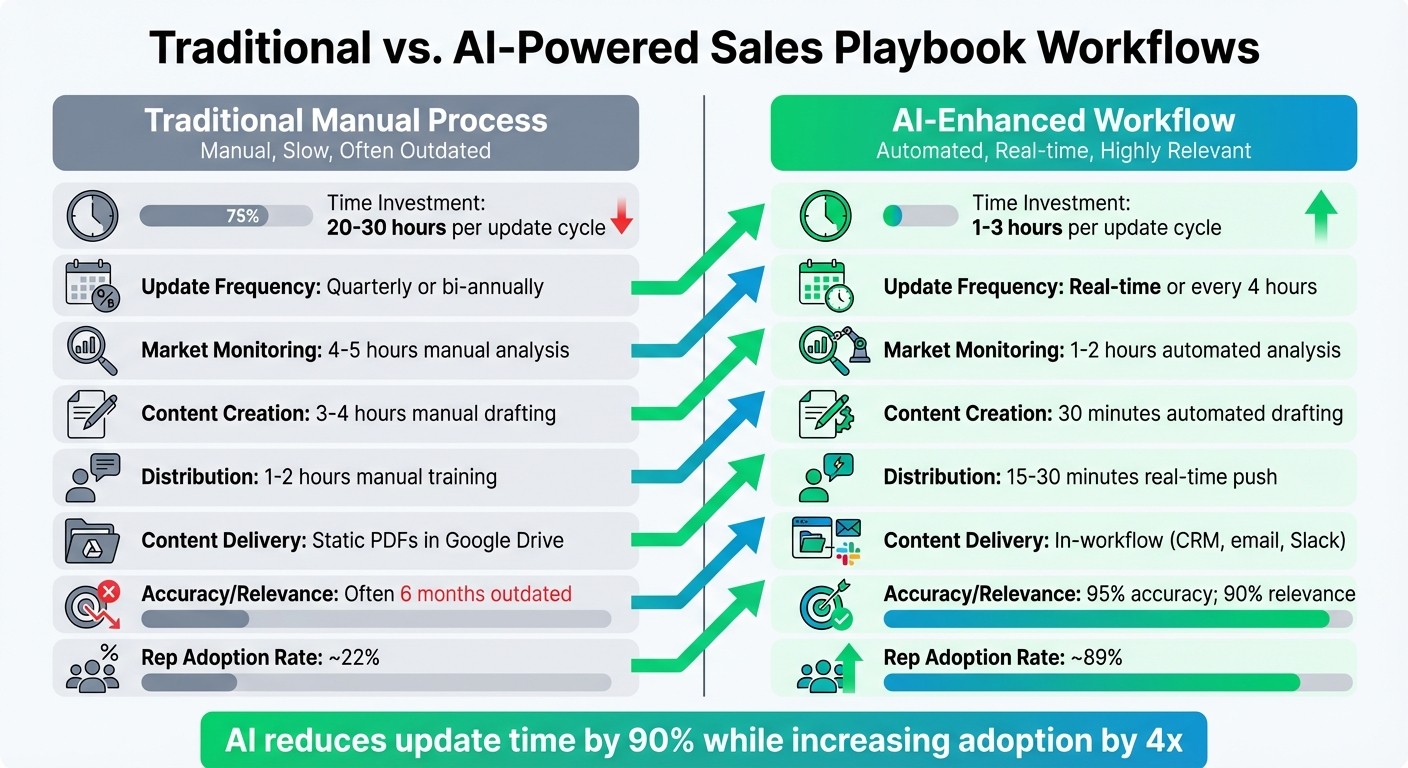
Traditional vs AI-Powered Sales Playbook Workflows Comparison
Studies reveal that AI-driven playbook updates rely on a four-layer architecture:
The Signal Layer gathers inputs from sources like CRM systems and call recordings.
The Decision Logic Layer applies strategic if-then rules.
The Action Layer delivers timely recommendations.
The Learning Loop evaluates which actions lead to successful outcomes [2].
This framework shifts playbooks from static documents into "living intelligence systems" that adapt dynamically based on real-world results.
The transition from manual to AI-assisted workflows has proven to save time and boost efficiency. For example, AI-powered playbook updates require only 1–3 hours of guided review, compared to the 20–30 hours typically spent on manual updates [3]. Companies adopting AI in sales often report revenue growth of 3–15% and a 10–20% improvement in sales ROI [1][7]. Even more compelling, 83% of sales teams using AI experienced revenue growth in 2025, compared to just 66% of teams without it [11].
Speed is a critical factor in achieving these benefits. Research shows that win rates can soar from 32% to 67% when sales reps receive competitive intelligence within 27 minutes of a competitor being mentioned during a call [20]. AI enables this speed by continuously monitoring market changes, analyzing win/loss patterns, and drafting updates automatically for approval [3].
However, the best results come from a balanced approach. Human-in-the-loop governance ensures that while AI handles data processing and drafts updates with ChatGPT, sales leaders retain control over high-stakes decisions like pricing, legal adjustments, or strategic shifts [3][4]. This blend of automation and human judgment ensures that playbooks remain both fast and effective, empowering sales teams to close more deals.
Traditional vs. AI-Powered Workflows: A Comparative Overview
The following table highlights the differences between manual and AI-driven playbook updates:
Feature | Traditional Manual Process | AI-Enhanced Workflow |
|---|---|---|
Time Investment | 20–30 hours per update cycle [3] | 1–3 hours per update cycle [3] |
Update Frequency | ||
Market Monitoring | 4–5 hours manual analysis [3] | 1–2 hours automated analysis [3] |
Content Creation | 3–4 hours manual drafting [3] | 30 minutes automated drafting [3] |
Distribution | 1–2 hours manual training [3] | 15–30 minutes real-time push [3] |
Content Delivery | ||
Accuracy/Relevance | Often 6 months outdated [20] | 95% accuracy; 90% relevance [3] |
Rep Adoption Rate |
Traditional playbooks are essentially static reference tools, while AI-powered playbooks function as dynamic decision systems, triggering actions based on real-time buyer signals [2]. This difference explains why 68% of reps ignore traditional playbooks, while AI-powered alternatives achieve adoption rates as high as 89% [13].
How Coach Pilot Uses AI for Sales Playbook Updates
Coach Pilot bridges the gap between strategy and real-time deal execution by offering AI-driven insights based on patterns from successful deals. This approach aligns with research showing that adaptable playbooks can significantly improve sales performance, reflecting the future of sales enablement. Unlike traditional conversation intelligence tools that focus on past metrics like talk ratios or keyword mentions, Coach Pilot takes it further by providing actionable guidance on what sales reps should do next, all based on proven deal data [24].
The platform offers three key features that make its AI-powered playbook updates stand out:
Custom Playbook Creation: By analyzing the behaviors of top-performing reps, Coach Pilot creates a framework that codifies these winning strategies into a dynamic playbook.
AI-Driven Coaching: The playbook integrates seamlessly into a rep’s daily workflow - whether they’re using a CRM, email, or Microsoft Teams. It offers real-time advice, such as suggesting the best time to call key decision-makers.
Automated Deal Truth Capture: This feature saves reps an average of 19.5 hours per week by handling CRM updates and administrative tasks, ensuring data accuracy without manual effort [24].
These capabilities translate directly into measurable sales improvements. For example, case studies highlight impressive results:
In June 2024, Connor Bell, a Business Development Manager at HubSpot, increased net new opportunities by 50%, secured 12 new deals in 11 weeks, and boosted quarterly sales revenue by 38%.
Similarly, in May 2024, Naum Sekulovski at Food By Us closed 13 new contracts in just 9 weeks, driving a 45% increase in sales revenue.
On average, Coach Pilot customers report a 7.8× pipeline growth within 90 days and a 39% improvement in quota attainment by shifting from generic outreach to messaging aligned with their playbooks [24].
The platform’s "Living Playbook" approach is continuously supported by an AI coach and weekly live coaching calls. Craig Cant, Head of Sales at Industry Best, shared his experience:
"Creating a playbook, the information that has gone into it, and the evolution of the playbook has been hugely insightful beneficial and it's helped me not only make my target but exceed my target."
Conclusion
AI has completely reshaped sales playbooks, turning them from static documents into dynamic systems that integrate with CRM data, automate content, track real-time metrics, and offer instant updates within sales workflows [1][20]. What used to take 20–30 hours of manual maintenance per cycle can now be done in just 1–3 hours, thanks to AI-driven processes [3]. These advancements pave the way for measurable improvements in both revenue and efficiency.
Companies leveraging AI in their sales processes report revenue growth of 3–15% and sales ROI boosts between 10–20% [1]. A striking example: when competitive intelligence reaches a sales rep within 27 minutes of a competitor being mentioned on a call, win rates soar from 32% to 67% [20].
Industry leaders echo this shift. Mary Flaherty, Vice President of Research and Thought Leadership at RAIN Group, highlights:
"The modern sales playbook has shifted from a document to a dynamic system - one that learns, adapts, and guides sellers in real time with the power of AI" [1].
This shift also has a huge impact on productivity. AI can reclaim up to 59% of a sales rep's time typically spent on administrative tasks, freeing them to focus on activities that directly drive revenue [5].
Platforms like Coach Pilot are prime examples of this evolution. By combining custom playbook creation with AI-driven coaching embedded into daily workflows, they help sales teams turn strategy into action. Their approach ensures that playbook guidance remains flexible and actionable, keeping teams competitive in a constantly changing marketplace.
The days of relying on quarterly updates and static battle cards are over. In today’s fast-paced sales environment, embracing AI-powered playbook iteration isn’t optional - it’s the standard that separates top-performing teams from the rest. This isn’t just about adopting new technology; it’s about adapting to a new way of working that empowers sales teams to excel.
FAQs
What data sources should feed an AI sales playbook?
An AI sales playbook pulls together information from various critical data sources to fine-tune sales strategies and boost results. These sources include call transcripts, CRM records, Slack conversations, lead details from platforms like LinkedIn, and existing sales materials. By merging these inputs, the playbook becomes a powerful tool, streamlining processes and driving better sales performance.
How do you keep AI playbook updates accurate and compliant?
To keep AI playbook updates accurate and compliant, focus on using reliable, governed sources of truth. Set up versioning and approval workflows to track changes and ensure consistency. Regularly review content standards to align with current guidelines. Emphasize quality checks, manage permissions carefully, and adhere to regulations to safeguard accuracy, brand integrity, and compliance.
What metrics prove an AI playbook is improving revenue?
Key metrics show impressive results: real-time AI battlecards have led to increased win rates, higher sales conversions, and a 41% rise in deals closed. Additionally, research reveals the creation of a $37 million sales pipeline, showcasing how AI contributes to measurable revenue growth.
Related Blog Posts

Remove the guesswork from winning more deals.