B2B Sales
How AI Reduces Sales Workflow Mistakes
Mar 17, 2026
AI eliminates manual CRM errors, automates follow-ups, and prioritizes leads to save reps time and boost win rates.

Sales teams lose valuable time and revenue due to avoidable workflow mistakes. From manual data entry errors to missed follow-ups, these issues can cripple deal progress. AI is changing the game by automating repetitive tasks, ensuring data accuracy, and improving lead prioritization. Here's what you need to know:
Time Drain: Sales reps spend 72% of their time on admin work, leaving only 28% for selling.
Error-Prone Processes: Manual data entry leads to 25% CRM inaccuracies, hurting forecasts and deal visibility.
Missed Opportunities: Following up more than 30 minutes late reduces conversion chances by 21x.
AI tools like Coach Pilot tackle these challenges by automating CRM updates, scoring leads based on behavior, and triggering timely follow-ups. Companies using AI report up to a 43% boost in win rates and save over 20 hours per week per rep. The result? Sales teams can focus on building relationships and closing high-value deals, while AI handles the tedious tasks.
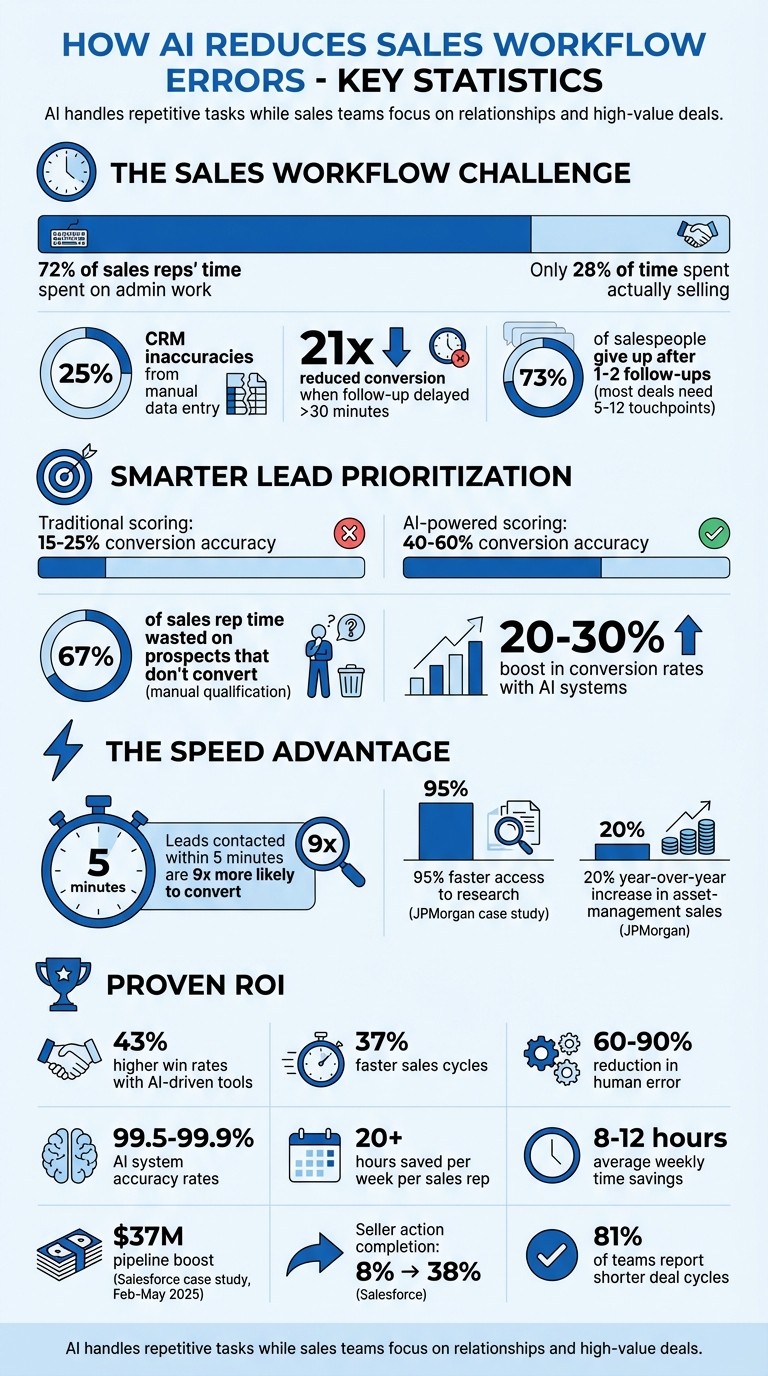
How AI Reduces Sales Workflow Errors: Key Statistics and Impact
How to Boost Your Sales With AI Automation? (Complete Guide, 2025)
Common Sales Workflow Errors AI Can Fix
Handling sales workflows manually often leads to issues like duplicate or incomplete CRM records, which can hurt forecast accuracy. Subjective lead qualification wastes time on prospects who aren’t a good fit. And then there’s the problem of delayed follow-ups: responding more than 30 minutes after a lead reaches out can reduce conversion chances by a staggering 21x [6].
AI steps in to tackle these problems by automating repetitive tasks. Instead of relying on sales reps to manually track every interaction, AI logs communications in real time, identifies missing stakeholders, and triggers follow-ups as soon as a prospect shows interest. As Vito Vishnepolsky, Founder and Director at Martal Group, puts it:
AI isn't replacing our reps. It's removing the noise, so they can spend more time strategizing with clients and closing high-fit leads. [1]
These common errors highlight why your sales process needs to be a living, breathing AI to streamline workflows and boost efficiency.
Manual Task Errors and Oversights
When sales reps are under pressure, manual processes are especially prone to mistakes. Calls might go unlogged, contact details could be entered incorrectly, or CRM updates might fall through the cracks. These oversights can hurt pipeline visibility and make revenue forecasting less reliable. AI eliminates these issues by syncing data automatically, capturing call transcripts, updating contact records, and spotting duplicate entries - all in one seamless process. Gianluca Ferruggia, Managing Director at DesignRush, explains:
It makes clean data the default. And that becomes the foundation for sophisticated forecasting, better prioritization, and smarter revenue operations decisions. [1]
AI can also prevent errors in commission calculations, a common issue when using manual spreadsheets. Mistakes in formulas can lead to disputes over payments, but automation ensures accuracy, providing a solid base for better forecasting and revenue management.
Lead Qualification and Scoring Errors
Traditional lead scoring often relies on intuition or rigid criteria like company size and job title. This approach can miss critical behavioral signals, such as visits to a pricing page or high email engagement. AI, on the other hand, analyzes over 50 data points simultaneously, improving conversion accuracy from around 15–25% to 40–60% [4][5]. It also flags "zombie deals" - prospects that seem active but are unlikely to close - allowing sales teams to focus on higher-value opportunities.
At Rugged Books Inc., Ahmad Nahle implemented an AI assistant to handle early qualification calls, focusing on budget and timelines. This freed up the sales team to spend 40% more time with qualified prospects who were ready to buy [1]. Nahle shared:
Previously, our sales reps spent too much time on early qualification calls, often with prospects who weren't the right fit... Now, the AI handles these initial conversations. [1]
By automating lead qualification, AI allows sales teams to concentrate on nurturing the most promising opportunities.
Delayed Follow-Ups and Missed Opportunities
Timing is everything in sales. Leads contacted within 5 minutes are 9x more likely to convert, yet 73% of salespeople give up after just one or two follow-ups - even though most deals require 5 to 12 touchpoints to close [6]. Waiting more than 30 minutes to follow up can drastically reduce conversion rates [6].
AI addresses this by automating follow-ups. It sends immediate responses when a lead is captured, uses email and SMS for multi-channel outreach, and customizes messages based on previous interactions [1][3]. AI also keeps an eye on deal activity, alerting managers when opportunities go untouched for more than 10 days. This ensures pipelines stay active and opportunities don’t slip through the cracks.
How to Reduce Sales Workflow Errors Using AI
Tackling errors in sales workflows starts with automating repetitive, error-prone tasks like CRM data entry and follow-up management. These tasks are time-consuming but straightforward, making them perfect for automation. By addressing these areas first, you can free up valuable time while reducing mistakes.
Before diving into broader AI integration, it's crucial to establish some ground rules. Define clear customer profiles, value propositions, and objection-handling protocols. These steps ensure your AI tools stay aligned with your messaging and maintain consistency. With these foundations in place, AI can immediately step in to detect and correct errors.
Step 1: Integrate AI for Real-Time Error Detection
The first step is connecting AI tools to your existing CRM system, whether you use Salesforce, HubSpot, or another platform. Once integrated, AI continuously scans your records to spot issues like duplicate entries, outdated data, or conflicting information. This real-time monitoring helps ensure that every interaction is accurately reflected in your CRM, eliminating "mystery leads."
AI also analyzes sales calls and emails, extracting critical details such as decision-makers, pain points, and next steps. These insights are automatically updated in your CRM, keeping your data actionable. Tools like Coach Pilot even embed AI-driven coaching into workflows, helping maintain accuracy while flagging potential revenue leaks. For example, the system can highlight deals that have been inactive for a set period - like 10 days - or those missing key qualification details.
"Within the first 60 days, our client saw a noticeable lift in rep productivity and deal velocity. Follow-ups went out faster, notes were consistent, and managers had visibility into conversations at scale."
Sahan Rao, Founder of LeadAi Solutions[1]
Step 2: Automate Lead Qualification and Prioritization
Did you know that manual lead qualification wastes up to 67% of a sales rep's time on prospects that don't convert [9]? AI can change that. By monitoring buyer behavior - like visits to pricing pages, email engagement, or time spent on specific content - AI automatically scores and prioritizes leads based on intent signals.
The most effective strategy combines AI-driven predictive scoring with hard rules for essential criteria like location, industry, or budget. Beyond assigning a score, AI can trigger automated CRM actions. For instance, high-priority leads could be routed immediately to sales reps with a two-hour follow-up window, while mid-priority leads might enter an automated nurture sequence.
The results speak for themselves. Predictive scoring powered by AI improves lead prioritization accuracy by 40–60%, and companies using these systems report conversion rate boosts of 20–30% [5].
Step 3: Automate Follow-Ups and Task Scheduling
In sales, timing is everything - but staying on top of follow-ups can be a challenge. AI simplifies this by drafting personalized follow-up emails based on previous interactions and managing scheduling tasks like calendar invites and reminders, all without manual input.
AI also keeps an eye on your pipeline, identifying stalled deals and triggering automated alerts or re-engagement campaigns. This is especially valuable given that 73% of salespeople stop following up after one or two attempts, even though most deals require 5 to 12 touchpoints to close [6].
The productivity gains are hard to ignore. By automating non-selling tasks, AI can save sales teams over 20 hours per week [7]. Teams using AI regularly report shorter deal cycles 81% of the time.
"The point isn't the exact percentage - it's that productivity gains only materialize when the work is operationalized into repeatable workflows."
Ameya Deshmukh from EverWorker[8]
Scaling Sales Workflows While Maintaining Accuracy
Growth often presents a tricky question: how do you manage a larger volume of deals without losing the precision that drives success? For many sales teams, the instinctive answer is to hire more people. But AI offers a smarter alternative - scaling your operations while maintaining top-tier execution.
The key lies in embedding your most effective sales strategies directly into daily workflows. Instead of relying on manual processes, AI ensures these strategies are consistently applied. For example, when a sales rep opens a deal, the system can suggest next-best actions based on proven methodologies like MEDDICC qualification or a custom framework. This approach reduces human error and enables consistent scaling. The results speak for themselves: organizations using AI-driven sales tools see 43% higher win rates and 37% faster sales cycles [2]. By integrating AI strategically, companies maintain accuracy while unlocking scalable and impactful performance.
A great example of this is JPMorgan’s wealth management division. They introduced "Coach AI" to help advisors access research 95% faster, which contributed to a 20% year-over-year increase in asset-management sales [11]. Importantly, this tool didn’t replace human expertise - it removed obstacles, allowing advisors to focus on meaningful client interactions.
AI also takes over repetitive tasks, freeing sales reps to concentrate on strategy and relationship building. On average, AI tools can save reps 8 to 12 hours per week [2]. Platforms like Coach Pilot amplify this impact by offering custom sales playbooks and AI-driven coaching. These systems analyze every interaction, identifying skill gaps and spotlighting successful moments. Unlike manual reviews, AI provides 100% coaching coverage, ensuring no opportunity for improvement slips through the cracks [10][1].
Conclusion
Errors in sales workflows can drain resources and hinder progress, but AI addresses these challenges head-on. By automating repetitive tasks, identifying gaps in real time, and ensuring consistent use of proven sales strategies, AI transforms how teams operate.
The results speak for themselves. Companies that integrate AI into their sales processes report massive reductions in human error - between 60% and 90% - while AI systems boast accuracy rates of 99.5% to 99.9%, far surpassing even the best human performance under pressure [11]. For instance, Salesforce's internal team adopted an AI-driven system from February to May 2025 and saw a $37 million boost in pipeline and revenue impact. During this period, seller action completion rates jumped from 8% to 38% [12]. This level of automation ensures a consistent, scalable approach across the board.
AI doesn’t just assist - it autonomously handles tasks like CRM updates, follow-up emails, and identifying at-risk deals. This frees up your team to focus on what truly matters: building meaningful client relationships and closing high-value deals.
Tools like Coach Pilot integrate your sales playbooks directly into daily workflows, ensuring methodologies like MEDDICC or Challenger are consistently applied. With AI embedded at every stage, your team can prioritize strategic activities and maximize their impact.
"AI isn't replacing our reps. It's removing the noise, so they can spend more time strategizing with clients and closing high-fit leads." - Vito Vishnepolsky, Founder and Director, Martal Group [1]
FAQs
Which sales tasks should I automate first with AI?
Automating tasks that are repetitive, time-consuming, and prone to errors can make a huge difference in efficiency and accuracy. Begin with areas like lead scoring, email follow-ups, data entry, and sales forecasting. Automating these processes not only saves time but also cuts down on mistakes and delivers better results - think higher response rates, more accurate forecasts, and more time for sales teams to tackle high-value opportunities. By simplifying these workflows, you set the stage for smoother operations and improved performance.
How do I connect AI to my CRM without breaking processes?
Connecting AI to your CRM can transform how you manage customer relationships, but it requires careful planning. First, ensure your CRM data is clean and standardized. Inconsistent or outdated data can throw a wrench in AI's ability to deliver accurate insights.
Next, define clear goals for how you want to use AI. Are you looking to improve lead qualification, automate follow-ups, or streamline other tasks? Knowing your objectives will help you choose the right tools.
When selecting AI tools, opt for ones that integrate directly with your CRM. This eliminates the need for manual data transfers, saving time and reducing errors. External tools that require frequent importing and exporting of data can disrupt workflows and create inefficiencies.
Finally, keep an eye on key performance indicators (KPIs). Regularly reviewing these metrics ensures your AI integration aligns with your sales goals and maintains smooth operations. Periodic checks can also help you identify areas for improvement and keep everything running seamlessly.
How can AI improve follow-up speed without sounding robotic?
AI improves follow-up efficiency by automating timely, personalized outreach. It analyzes data to pinpoint the ideal moments to connect, ensuring messages feel relevant and genuine. This approach helps increase engagement while maintaining a human touch.
Related Blog Posts

Remove the guesswork from winning more deals.