B2B Sales
How AI Improves Sales Forecast Accuracy
Apr 5, 2026
AI turns fragmented CRM and real-time buyer signals into cleaner, evidence-based forecasts that boost sales accuracy and reduce bias.

Only 15% of companies can forecast revenue within 5% of actuals, and 84% of U.S. businesses missed revenue targets last year. Why? Traditional methods rely on human judgment and static sales playbooks, which are prone to bias and incomplete data. AI changes the game by using data like buyer behavior, email response times, and stakeholder engagement to improve forecast accuracy by 20–35%.
Here’s what AI brings to sales forecasting:
Unified Data: AI consolidates fragmented CRM, email, and call data, reducing errors and blind spots.
Real-Time Updates: AI tracks buyer activity continuously, flagging at-risk deals 2–3 weeks earlier.
Historical Patterns: By analyzing past deals, AI identifies trends that improve predictions.
Automation: AI cleans data, standardizes formats, and eliminates hours of manual work.
Actionable Insights: AI highlights risks and opportunities, helping sales leaders make informed decisions.
AI is not here to replace humans but to give sales teams better tools and insights for accurate, evidence-based forecasting.
Enhancing Sales Forecasting Accuracy with AI and Machine Learning
Using Clean, Unified Data for Better Forecasts
Fragmented data can seriously undermine forecast accuracy, which is the backbone of effective revenue planning. When sales data is incomplete or scattered across multiple systems, even the most advanced AI models struggle to provide reliable predictions. The first step to achieving accurate forecasts is to unify and clean your data.
Why Fragmented Data Hurts Forecasts
Incomplete CRM data is a widespread issue. For instance, 67% of deals are missing key fields like next steps or decision-maker names [4], and 79% of opportunity data is incomplete [9]. Sales data often ends up spread across emails, call recordings, spreadsheets, and unsynced billing systems, creating major blind spots in forecasting.
This fragmentation forces managers to spend over six hours each week auditing data from various sources, while sales reps delay logging essential details [4][9]. The outcome? Only 23% of sales data is deemed accurate and complete [9], and poor data quality costs enterprises between $9.7 million and $15 million annually [9].
AI can help tackle this problem by automatically unifying data sources and reducing manual intervention.
How AI Prepares Your Data
AI simplifies data management by connecting your CRM, email, calendar, and customer success tools into a single, unified system [6][3][8]. It automates data capture from emails, calls, and meetings, filling up to 100 custom qualification fields using frameworks like MEDDIC or BANT [4][7].
With the help of large language models, AI identifies which account or opportunity each interaction belongs to, avoiding duplicate or fragmented records [4]. It also standardizes inconsistent entries - like merging variations such as "Ent Negotiating" and "Enterprise - Negotiation" into a single format - and sends Slack reminders to sales reps to verify incomplete records before updates [6][8][4].
Platforms like Coach Pilot take these capabilities further by integrating AI-driven tools, ensuring your sales team has access to accurate, unified data for better forecasting and the future of sales enablement.
While automation handles a lot, verifying data quality is still essential before diving into forecasts.
Verifying Data Quality Before Forecasting
Before you start forecasting, check your CRM for common issues - referred to as the "Five Horsemen": Ghost Deals (missing amounts), Timeless Wonders (missing close dates), Walking Dead (deals stuck in limbo), Fossil Records (stale opportunities), and Lone Wolves (deals with no recorded activities) [10]. For example, in 2022, Atlassian struggled with a 65% forecast accuracy rate because 20% of its opportunities were missing amounts or close dates. After implementing automated validation, they boosted accuracy to 87% within two quarters and shortened their average sales cycle by 12 days [10].
To prevent these issues, set up CRM rules that require critical fields - like budget confirmation or identifying an economic buyer - before deals can advance stages [4][7]. Automate stale deal alerts by flagging opportunities with no activity for over 15 days [7]. Also, cross-reference internal CRM dates with external milestones, such as aligning "Close Date" with "Quote Expiration Date", to ensure they reflect actual timelines rather than overly optimistic guesses [7]. Companies that introduce structured data quality programs often see forecast accuracy improve by 20% or more in just one quarter [10].
Using Real-Time Signals for Adaptive Forecasting
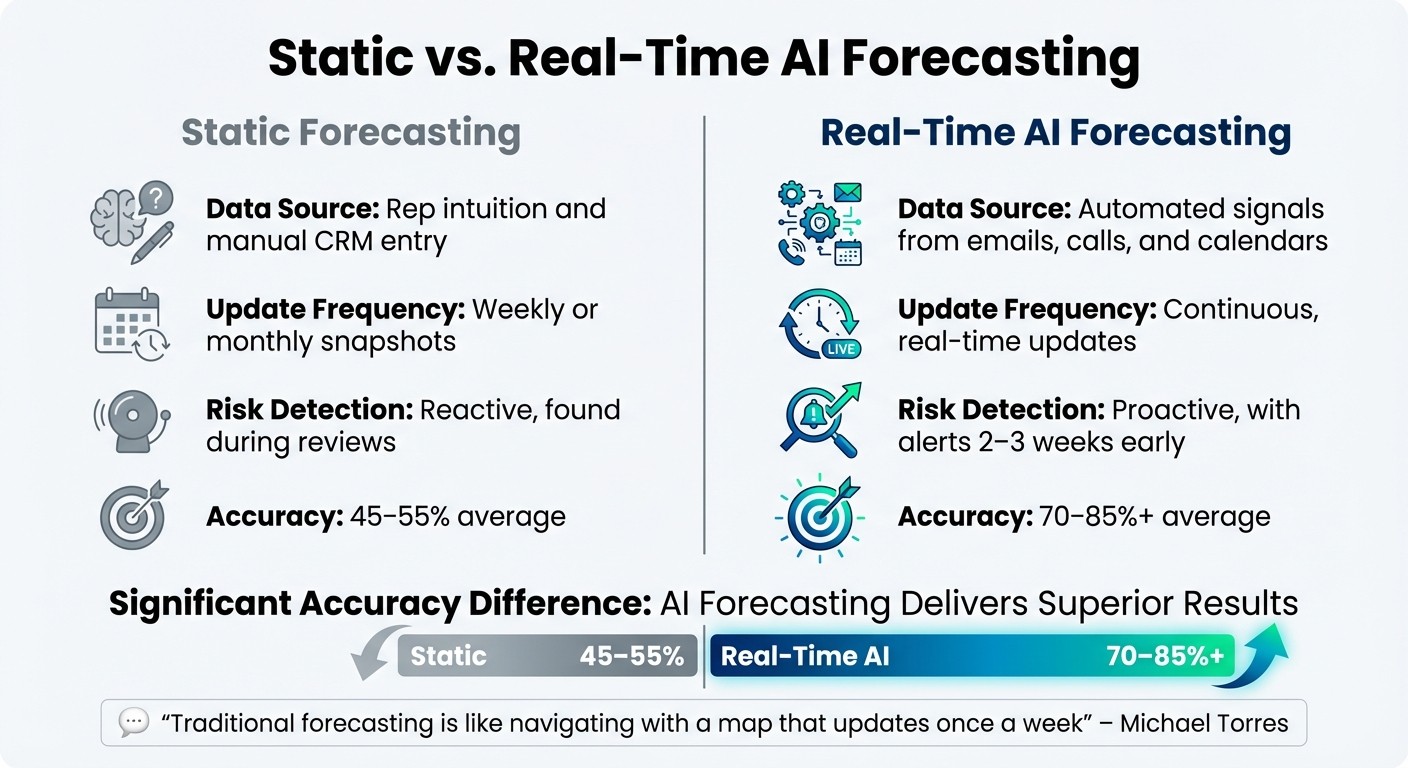
Static vs Real-Time AI Sales Forecasting Comparison
Once your data is clean and unified, the next step is moving from static forecasting to a system that continuously adapts. By leveraging unified data, real-time signals allow forecasts to adjust dynamically as buyer behavior changes. AI-driven forecasting thrives on this process, tracking buyer activity in real time to improve accuracy and responsiveness.
Static vs. Real-Time Forecasts
Static forecasts rely on outdated inputs, often updated weekly, which leaves room for significant blind spots.
"Traditional forecasting is like navigating with a map that updates once a week. You might be headed toward a cliff, but you won't know until your next map refresh" – Michael Torres, Prospectory [1]
AI-driven forecasting, on the other hand, recalculates continuously. Every time a prospect replies to an email, schedules a meeting, or views a proposal, the system updates the forecast instantly [11]. This shift from gut feeling to data-backed evidence is transformative, especially when following a structured B2B sales playbook. Current B2B forecast accuracy averages only 67% [4], with just 7% of sales organizations hitting 90% or higher [11]. AI steps in to improve prediction accuracy by 20–35%, eliminating rep bias and focusing on objective buyer signals [2].
Feature | Static Forecasting | Real-Time AI Forecasting |
|---|---|---|
Data Source | Rep intuition and manual CRM entry | Automated signals from emails, calls, and calendars |
Update Frequency | Weekly or monthly snapshots | Continuous, real-time updates |
Risk Detection | Reactive, found during reviews | Proactive, with alerts 2–3 weeks early |
Accuracy | 45–55% average | 70–85%+ average |
This ability to continuously recalculate enables more precise tracking of key buyer behaviors.
Which Real-Time Signals to Track
Certain real-time indicators provide critical insights into deal momentum. While AI monitors hundreds of signals, a few are particularly predictive:
Engagement velocity: Tracks how quickly prospects respond to emails and how often they initiate meetings. Slower responses can indicate a cooling deal [2].
Stakeholder depth: Measures how many people are involved in the deal. Deals with just one contact are riskier, while those engaging decision-makers like CFOs, IT, or legal teams have a higher likelihood of closing [2][13].
Stage velocity: Compares a deal’s time in its current stage to historical averages. If a deal stays in a stage 1.5 times longer than average, it’s unlikely to close on schedule [4].
Sentiment shifts: Analyzes email and call transcripts for tone changes. For example, transitioning from "let's schedule next steps" to "we'll circle back" can signal trouble [4].
Content engagement: Tracks how prospects interact with proposals or pricing sheets. Multiple views, especially by legal or finance teams, often indicate strong interest [2][13][14].
Acting on Real-Time Data
Real-time signals aren’t just for observation - they demand immediate action. AI can flag at-risk deals 2–3.2 weeks earlier, triggering alerts that allow managers to intervene promptly [2][4]. For example, if a deal lingers in a stage 1.5× longer than average, the system notifies the manager, who can coach the rep on specific actions, such as engaging the economic buyer or addressing a competitor’s influence [4].
This proactive approach slashes forecast preparation time - cutting it from over six hours per week to just two, a 65% reduction [4]. Instead of spending hours on Monday morning status checks, managers can focus on strategic coaching for flagged deals [11][12]. By shifting from reactive oversight to proactive guidance, managers can reduce revenue risks and make faster, data-driven decisions. As Spotlight.ai aptly puts it:
"The pipeline doesn't lie. But it does require someone - or something - that can read it without bias" – Spotlight.ai [11]
Finding Patterns in Historical Sales Data
Real-time signals are great for quick adjustments, but digging into historical sales data can uncover long-term patterns that drive these insights. Historical data shines a light on what makes deals succeed or fail. AI takes this a step further by processing massive amounts of past deal data, spotting patterns that manual reviews would likely miss. This shift - from relying on instinct to using data-backed precision - is crucial. Why? Because the average B2B company’s forecast accuracy is only 47%, meaning forecasts are wrong more often than flipping a coin [2].
Identifying Patterns in Deal Data
AI dives deep into historical records to uncover trends like deal velocity, win rates, and seasonal behaviors. For instance, it can analyze how long successful deals spend in each sales stage or identify which stakeholders are consistently involved in winning negotiations - details that are tough to spot when reviewing deals one by one. Machine learning models like XGBoost and Random Forest come into play here. They analyze dozens of variables simultaneously, such as deal size, sales rep experience, the number of stakeholders involved, email response times, and even shifts in sentiment. These models excel at capturing complex, non-linear relationships. For example, a $50,000 deal doesn’t behave the same way as a $500,000 deal, and AI can easily pick up on these differences.
Once these patterns are identified, AI applies them across thousands of deals, refining predictions and making them even more accurate.
Analyzing Thousands of Deals at Once
AI’s ability to handle massive datasets is a game-changer for predictive accuracy. Take Siemens as an example: in February 2026, the company revamped its global forecasting process, spanning over 4,000 sellers in 190 countries. By standardizing opportunity processes and improving data quality, Siemens pushed forecast submission rates above 70% and gained much clearer insights into deal structures [15].
For AI models to work effectively, they typically need at least 12 months of CRM data and over 200 closed deals [2]. The more data you feed the system, the sharper its predictions become. Companies using AI-powered forecasting have reported accuracy improvements of 20% to 35% compared to traditional manual methods [2].
Detecting Complex Variable Relationships
One of AI’s standout strengths is its ability to uncover complex relationships between variables that traditional methods often miss. For example, it can flag "ghost stakeholders" - like a CFO who’s absent from late-stage meetings - indicating potential deal risks [4]. Advanced models also use natural language processing (NLP) to detect the difference between exploratory language and genuine commitment. This goes beyond simple keyword tracking, allowing AI to interpret intent and sentiment, catching subtle cues that might otherwise go unnoticed.
"The winning combination pairs algorithmic pattern recognition with human judgment about factors that don't appear in CRM fields" – MIT Sloan Management Review [15]
Automating Forecasting Tasks with AI
Sales teams often lose valuable hours sorting through spreadsheets, cleaning up CRM data, and hunting for trends. AI steps in to take over these repetitive tasks, allowing managers and reps to focus on driving deals forward. Even in 2025, 76% of data professionals still rely on spreadsheets for data cleaning [17]. By contrast, organizations using intelligent automation report a 61% improvement in data quality and fewer errors [17]. These numbers underline the need for automated AI solutions in sales processes.
Automating Data Cleaning and Analysis
AI simplifies data cleaning by identifying and addressing inconsistencies without human intervention. It learns from historical data to detect anomalies like duplicate entries or format errors. For example, AI uses techniques like probabilistic matching and fuzzy logic to spot duplicate records across CRM, billing, and support systems. It also standardizes formats to ensure consistency across datasets.
"Clean data is the foundation. When your data's fragmented and inconsistent, your forecasts will be, too." – Nora Pantfoerder, Senior Product Marketing Manager, Outreach [8]
Poor CRM data quality is a significant obstacle, with 63% of Salesforce Einstein forecasting implementations failing due to this issue [18]. AI-driven tools actively monitor incoming data for irregularities, such as outliers, missing values, or unusual patterns. They also filter out noise from sales history, like temporary spikes from promotions or dips caused by stock shortages, to create a reliable baseline for predictions. This clean data foundation enables AI to scale forecasting effectively.
Creating Forecasts at Scale
Once the data is cleaned and unified, AI can generate forecasts across an entire organization in real time. Unlike traditional methods, which require manual adjustments for new products, markets, or seasonal trends, AI adapts automatically to these variables. For instance, when a company introduces a new product line or expands into a new region, AI recalibrates its predictions instantly. While manual forecasting methods typically achieve 60–75% accuracy, AI-driven platforms can reach precision levels of 90–98% [18].
Platforms like Coach Pilot streamline this process by automating forecasting and integrating AI-driven coaching into sales workflows. This approach allows teams to scale their forecasts effortlessly while maintaining high accuracy, even in changing market conditions.
Detecting Anomalies for Quick Corrections
AI doesn’t stop at creating forecasts - it also monitors them continuously for anomalies. It flags unexpected changes in performance metrics, such as a key stakeholder going silent, slower email response times, or a sales rep’s pipeline coverage dropping below the critical 3× to 5× ratio needed to hit quota [4]. AI-native platforms can identify at-risk deals 3.2 weeks earlier than manual methods [4].
For instance, if a sales rep assigns a 90% likelihood to close a deal, but historical data suggests similar deals close at only 45%, AI highlights this discrepancy. Sales reps tend to overestimate close probabilities by 20–30% [4], and AI helps correct this bias with evidence-based insights. Additionally, AI can trigger automated recovery actions, such as sending personalized follow-up emails when engagement stalls or carts are abandoned. Real-time forecasting has been shown to recover up to 18% of lost sales [5].
Blending AI Insights with Sales Experience
AI can process millions of data points in seconds, but it’s human judgment that adds context, making forecasts more precise. Interestingly, 84% of companies missed their revenue forecasts in at least one quarter last year [4]. The root cause wasn’t a lack of data - it was the failure to combine human expertise with AI-driven insights.
"AI is designed to be a decision partner, never a decision maker." – Laura Tortosa Sancho, CPO and Co-founder, Lative [20]
AI is excellent at highlighting what’s happening in your sales pipeline - whether it’s stalled deals, decreasing engagement, or other risk factors. But understanding why these issues arise requires the intuition and experience of sales leaders. For example, if a salesperson is overly optimistic about a deal that contradicts historical patterns, this discrepancy could be a valuable coaching opportunity. By merging AI’s data-driven clarity with human insight, companies can create forecasts that are both accurate and actionable, paving the way for better sales decisions.
Using AI to Support Sales Decisions
For sales leaders, AI should act as a trusted second opinion, offering objective data to confirm or challenge their instincts. Instead of spending hours manually auditing spreadsheets, managers can focus on higher-value tasks like coaching their teams on deals flagged as risky with AI sales coaching. However, adopting AI-based forecasting requires a thoughtful approach. Start by running AI and human forecasts side by side for 5–10 weeks [1]. This comparison helps identify where human judgment and AI predictions diverge, while also building confidence in AI’s measurable benefits.
Beyond validating decisions, AI can also uncover behavioral trends that drive success. These insights allow managers to refine their teams’ strategies and improve overall performance.
Improving Team Performance with AI Insights
AI doesn’t just highlight problems - it also identifies the actions that lead to success. By analyzing thousands of deals, AI can detect patterns among top performers, such as how often they engage stakeholders or the timing of their follow-ups. Managers can use this data to coach underperforming reps and replicate winning habits across the team.
Take Sybit, a B2B tech firm, as an example. In 2025, they implemented AI-driven forecasting and data validation. The AI flagged mismatched deal stages and incomplete customer profiles, reducing forecast errors by nearly 30% within two quarters. Led by CRO Thilo Kerner, this initiative also boosted team productivity by 50% and improved alignment between forecasted and actual revenue. Tools like Coach Pilot take this concept further by embedding AI-driven coaching directly into sales workflows, helping teams apply insights in real time. These continuous insights help refine forecasts and improve sales outcomes.
Improving Forecast Accuracy Over Time
To maximize AI’s potential, it’s essential to refine models based on real-world outcomes. Regular review cycles - monthly evaluations and quarterly recalibrations - are key to ensuring AI adapts to evolving market conditions [19]. A structured weekly schedule can also help teams stay on track. For instance:
Mondays: Review AI-generated commitments.
Thursdays: Analyze pipeline slippage.
Fridays: Finalize intervention strategies [1].
It’s equally important to correct for consistent biases in AI models. If, for example, the AI tends to overestimate close rates, adjustments can be made to align future projections more closely with actual results. This closed-loop system - where AI highlights a signal, leaders take action, and the outcomes are measured - creates a cycle of continuous improvement. Companies using structured forecasting analysis are 28% more likely to hit their quotas [16]. By blending AI insights with strategic human intervention, sales teams can achieve more reliable and actionable forecasts.
Conclusion
AI is reshaping sales forecasting by replacing gut feelings with insights grounded in real buyer behavior. By pulling together scattered data, monitoring real-time signals, and analyzing historical trends on a large scale, AI-driven forecasting achieves a level of accuracy that significantly cuts down on costly mistakes. In fact, companies with precise forecasts are 7.3% more likely to meet their quotas [19].
This approach combines various techniques - like data cleaning, real-time tracking, and historical analysis - to create the foundation for modern forecasting. When paired with the expertise of sales leaders, AI transforms raw data into actionable insights. As Michael Torres, a RevOps expert, explains:
"AI forecasting doesn't replace human judgment. It gives humans better data to judge with" [1].
This collaboration fosters a cycle of continuous improvement, where AI learns from past outcomes, and leaders refine their strategies based on facts rather than intuition.
To get started, try running AI forecasting in "shadow mode" alongside your existing methods for one quarter. This lets you build trust in the system and fine-tune the model. Pay close attention to the differences between AI predictions and the feedback from your sales reps - these gaps often highlight coaching opportunities and potential deal risks that manual processes might overlook [1].
Integrating data-driven insights with strategic coaching can turn your forecasting process into a competitive edge. Tools like Coach Pilot, which weave AI-powered coaching into sales workflows, show how these insights can be applied directly to drive consistent revenue growth. Moving from opinion-based to evidence-based forecasting isn’t just about adopting new technology - it’s about creating a smarter, more reliable way to predict and achieve revenue goals.
FAQs
What data do I need before using AI forecasting?
Before diving into AI for sales forecasting, it's crucial to start with clean, consistent, and trustworthy data. Gather inputs from diverse sources like CRM systems, email exchanges, and recorded conversations. Then, align this foundational data with key planning elements such as territories, quotas, and team capacity. Lastly, double-check that your historical data is both accurate and applicable - this ensures reliable AI-driven predictions and sharper forecast precision.
How do real-time buyer signals change the forecast?
Real-time buyer signals help sales forecasts adapt immediately to changes in buyer behavior. By incorporating live data and regular updates from the sales pipeline, they minimize errors and improve prediction accuracy. This makes sales planning more dependable and better equipped to handle shifts in the market.
How can we trust AI without losing human judgment?
AI can play a reliable role in sales forecasting when its predictions are regularly checked against real-world results, ensuring accuracy over time. High-quality data is essential for this process, as it forms the foundation of trustworthy forecasts. By blending AI insights with human judgment, businesses can interpret results more effectively and make smarter adjustments to their strategies. This partnership takes advantage of AI’s analytical power while keeping human expertise at the center of decision-making.
Related Blog Posts

Remove the guesswork from winning more deals.