B2B Sales
AI vs. Manual Forecasting for Market Trends
Apr 2, 2026
AI vs manual forecasting: AI delivers higher accuracy, real-time insights and scalability; manual adds context—hybrid often works best.
Which forecasting method works best for market trends - AI or manual? Here's the quick answer: AI-driven forecasting is far more accurate, faster, and scalable compared to manual methods. While manual forecasting relies on human judgment and historical data, AI uses machine learning to process vast datasets and adjust predictions in real time.
Key takeaways:
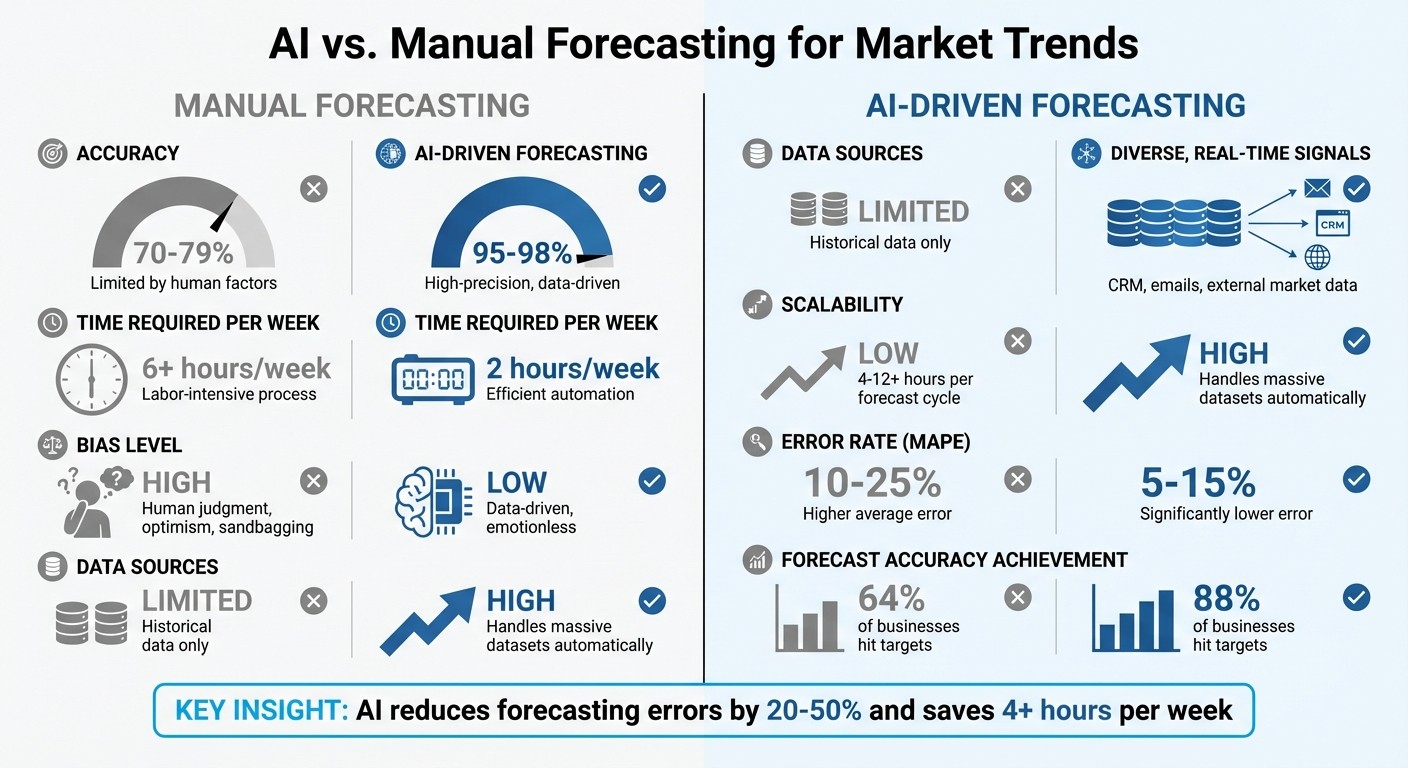
AI achieves up to 96% accuracy, compared to manual methods' 70%-79% accuracy.
AI saves time, cutting forecasting hours from 6+ hours/week to just 2 hours/week.
Manual forecasting is prone to errors (90% of spreadsheets contain mistakes) and bias (optimism or sandbagging).
AI integrates real-time data from diverse sources like CRM systems, emails, and external market signals, giving businesses a better edge in dynamic markets.
Quick Comparison:
Feature | Manual Forecasting | AI-Driven Forecasting |
|---|---|---|
Accuracy | 70%-79% | 95%-98% |
Bias | High (human judgment) | Low (data-driven) |
Data Sources | Limited (historical data) | Diverse, real-time signals |
Time Required | 6+ hours/week | 2 hours/week |
Scalability | Low | High |
For small businesses with stable markets, manual forecasting may suffice. But for growing companies or volatile markets, AI offers clear advantages in precision and efficiency.
AI vs Manual Forecasting: Accuracy, Speed, and Scalability Comparison
Enhancing Sales Forecasting Accuracy with AI and Machine Learning
Key Differences Between AI and Manual Forecasting
AI and manual forecasting differ significantly in how they handle data, their speed, and their ability to recognize patterns - key aspects that influence how businesses respond to shifts in the market. This evolution is a core component of the future of sales enablement, where technology streamlines complex workflows.
Data Processing and Integration
Manual forecasting heavily depends on data manually entered into CRM systems and the subjective judgment of sales managers [2]. Typically, this data comes from weekly meetings and is already outdated by the time it's reviewed. This delay creates what's often called the "Snapshot Problem", where forecasts represent past conditions rather than the current market landscape [2].
AI-driven forecasting takes a completely different approach. It pulls information automatically from a variety of sources, including email response times, sentiment analysis, calendar activity, stakeholder interactions, and even external news like funding announcements or leadership changes [2][1]. Unlike humans, who can only process a limited number of variables at once, AI can analyze thousands of data points spread across the entire revenue cycle [5]. For example, 67% of sales leaders cite forecasting as their biggest challenge, often due to the lack of real-time visibility into the many factors that influence deal outcomes [2].
This ability to integrate and process data more efficiently sets the stage for AI's advantages in speed and scalability.
Speed and Scalability
Manual forecasting is a time-consuming process. Managers typically spend over six hours a week gathering data, adjusting for optimism from sales reps, and consolidating spreadsheets [2]. By the time these forecasts are ready, market conditions might have already shifted. On the other hand, AI systems continuously update forecasts in real time as new data comes in, cutting the time managers spend on forecasting to about two hours per week [2].
"Traditional forecasting is like navigating with a map that updates once a week. You might be headed toward a cliff, but you won't know until your next map refresh." - Michael Torres, Prospectory [2]
This real-time capability not only saves time but also allows AI to scale effortlessly. While a human manager can only review a limited number of deals in detail, AI can evaluate thousands of deals simultaneously, maintaining accuracy regardless of the volume [1].
Pattern Recognition and Response to Change
AI's edge becomes even clearer when it comes to identifying patterns and adapting to change. Manual forecasting often relies on basic statistical models, like moving averages, which struggle to capture complex, non-linear relationships. AI, however, excels at detecting intricate patterns by linking diverse factors such as weather conditions, social media activity, and economic trends to shifts in demand [7]. It also compares current deal signals to historical data from thousands of won and lost deals, providing a more accurate probability of closing [2][1].
For instance, during Q3 of a recent year, a sales team using AI forecasting flagged a $340,000 "commit" deal as high-risk three weeks before the quarter ended. While the sales rep remained confident, the AI identified critical warning signs: the economic buyer had stopped responding to emails, and a competitor's engineer had connected with the prospect's technical leads on LinkedIn. Acting on these insights, the team re-engaged through a different contact and ultimately closed the deal in Q4 [2].
This example underscores how AI's predictions, grounded in data and evidence, outperform manual models that rely on subjective opinions - especially during unpredictable market conditions [6].
Comparison Table: AI vs. Manual Forecasting
When you compare AI-driven forecasting to manual methods, the differences are striking. Manual forecasting depends heavily on human intuition and a limited number of data points, while AI systems analyze massive datasets in real-time, delivering faster and more precise predictions.
Here’s a breakdown of how these approaches measure up across key attributes:
Attribute | Manual Forecasting | AI-Driven Forecasting |
|---|---|---|
Accuracy | ||
Primary Input | Rep intuition and manager adjustments | Objective buyer signals and historical patterns |
Data Processing | Limited to a few variables per deal | Thousands of variables across the entire pipeline |
Speed | Weekly or monthly updates; data often goes stale [6] | Real-time; continuous updates as signals change [2] |
Scalability | Low; requires 4–12+ hours per forecast cycle [3] | High; handles massive datasets automatically via cloud [3] |
Bias | High (optimism, sandbagging, emotion) [2] | Low (evidence-based, emotionless) [6] |
Response to Change | Reactive; relies on the next scheduled meeting | Proactive; flags risks immediately [3] |
Mean Absolute Percentage Error (MAPE) | 10–25% [3] | 5–15% [3] |
AI systems have the ability to slash forecasting errors by as much as 20% to 50%, compared to traditional methods [3]. While manual forecasting often provides static, outdated snapshots, AI recalculates predictions in real time as new data - like a missed meeting or customer response - feeds into the system. This responsiveness allows businesses to pivot quickly, addressing market changes in days rather than weeks. The numbers aren’t just about better accuracy; they emphasize AI's potential to improve revenue execution and decision-making.
Advantages of AI-Driven Forecasting
Improved Accuracy and Pattern Recognition
AI-driven forecasting can cut forecasting errors by 20–50% compared to traditional manual methods [3][4]. While sales professionals often rely on intuition and limited data, machine learning models like XGBoost and Neural Networks analyze thousands of historical transactions to detect patterns that human analysis might miss [3].
What sets AI apart is its focus on actual buyer behavior - tracking details like email response times, stakeholder involvement, and even sentiment from call transcripts [2][6]. This data-driven approach eliminates common biases, such as over-optimism or deliberate underestimation ("sandbagging") [2][6]. Companies using AI-driven forecasting achieve accuracy rates as high as 95–98%, a stark contrast to the industry average of 78% [3][10]. In fact, only 7% of sales teams using traditional methods reach 90% or higher accuracy [3][6].
For example, Walmart implemented machine learning models like Gradient Boosting and Random Forests across its U.S. stores between 2018 and 2020. This resulted in a 3% improvement in domestic forecasting accuracy and a 5% improvement in international markets [4]. Similarly, Animalcare Group introduced a LightGBM algorithm in 2024 to manage 700 product-market combinations, achieving a 19% reduction in forecasting errors compared to their previous methods [4].
Beyond accuracy, AI ensures that forecasts adapt seamlessly to rapidly changing market conditions.
Real-Time Response to Market Changes
Unlike manual forecasting, which is often updated infrequently, AI recalculates forecasts instantly as new data becomes available. Whether it’s a missed meeting, a competitor’s action, or economic fluctuations, AI keeps forecasts up-to-date, enabling businesses to react to market changes in days instead of weeks [2][3].
"Traditional forecasting is like navigating with a map that updates once a week. You might be headed toward a cliff, but you won't know until your next map refresh." - Michael Torres, RevOps Expert, Prospectory [2]
AI also integrates external factors that manual methods struggle to incorporate - economic trends, weather data, social media sentiment, and point-of-sale metrics [4][8]. For example, Heuritech uses AI to analyze millions of social media images every month, identifying 2,000 fashion attributes. This allows brands to achieve 91% forecast accuracy and predict trends up to two years in advance [11].
Scalability for Growing Businesses
AI’s ability to scale is another game-changer, especially for businesses experiencing growth. Manual forecasting can take 4–12+ hours per cycle [3], and as businesses expand, that time commitment grows. In contrast, AI processes vast datasets and thousands of variables automatically, without requiring additional resources [3].
Take Procter & Gamble as an example. By integrating machine learning, the company managed 5,000 products and 22,000 components without the need for the 10+ manual experts previously required for data verification. They also reduced supply chain response times from over two hours to real-time answers [4].
The scalability advantage also extends to maintaining accuracy under pressure. 88% of businesses using AI hit their forecast targets, compared to just 64% for those relying on spreadsheets [4]. AI-powered lead scoring can boost conversion rates by up to 25% and reduce lead qualification time by 30% [3]. Additionally, organizations using AI report a 73% productivity increase from automated insights and recover 18% of lost e-commerce sales through real-time risk detection [10].
Advantages of Manual Forecasting
While AI is known for its automation and ability to analyze real-time data, manual forecasting stands out for its reliance on human judgment and straightforward processes.
Human Expertise and Contextual Insights
One of the strongest points of manual forecasting is its ability to account for qualitative factors that are hard to quantify. For example, in industries like fashion, where trends and brand perception play a huge role, human forecasters can incorporate insights that aren't captured in data. Think of a verbal agreement made during an informal meeting or a private dinner - these kinds of details rarely make it into CRM systems but can heavily influence outcomes.
Before the pandemic, some forward-thinking sales managers used manual judgment to interpret global news and adjust supply chains accordingly, favoring local producers to avoid future disruptions.
"In the realm of intangibles and future predictions, immediate verification of the solution's appropriateness isn't possible... humans have common sense that they use to evaluate intuitive assumptions."
Alexander Gritsay, CEO, Forecast NOW! [12]
This "common sense" approach acts as a safeguard against unrealistic predictions. For instance, if a forecasting model suggests an improbable tenfold increase in demand without clear justification, a human forecaster would likely question and reassess that projection.
Lower Initial Costs
Cost is another key advantage of manual forecasting. It requires little more than time and basic tools like Excel, making it far more affordable upfront compared to AI-based solutions. Cloud-based AI tools can range from $300 to $1,000 per month, while enterprise-level forecasting software can demand initial investments between $10,000 and $50,000 or more[9]. For businesses with a small number of products - say, 10 SKUs - manual methods are often sufficient and far more economical.
It's worth noting that about 70% of organizations still stick to traditional forecasting methods[9]. This is largely because they avoid the hefty expenses tied to building data infrastructure, cleaning up large datasets, and training staff to use advanced technology. For small businesses or those operating in stable markets with consistent sales patterns, these cost savings make manual forecasting a practical choice.
Transparency and Simplicity
Manual forecasting also shines in its simplicity and clarity. With tools like Excel, the logic behind forecasts is easy to understand and modify, making it straightforward to explain projections to stakeholders or board members[6]. On the other hand, AI models - especially complex ones like neural networks - can feel like "black boxes", where the reasoning behind specific results is hard to trace[12].
"Some people simply do not trust complex systems, especially when it's unclear how specific results were derived."
Alexander Gritsay, CEO, Forecast NOW! [12]
This transparency is particularly important when businesses need to justify their forecasts or when team members are hesitant to hand over decision-making to algorithms. For companies with stable sales, limited product ranges, or unstructured data, manual forecasting often proves to be a more effective and reliable approach in maintaining accuracy and trust.
AI vs. Manual: Impact on Revenue Predictability
When it comes to revenue predictability, the contrast between AI-driven and manual forecasting is striking. Traditional methods often fall short in accuracy, while AI models deliver predictions that are far more precise, leading to improved revenue outcomes[5][3].
The key difference lies in how each approach handles market volatility. Manual forecasting depends on static historical data, which quickly becomes outdated when conditions change. A prime example? The COVID-19 pandemic in 2020. Forecasting models based on 2019 data became irrelevant almost overnight[7][5]. On the other hand, AI models adapt rapidly, retraining on fresh data to reflect shifts in consumer behavior within days[7].
This adaptability is especially critical during market upheavals. Take MUFG, a leader in financial services. By leveraging AI to analyze engagement patterns, the company improved pipeline accuracy, boosting conversion rates by 25% and shortening sales cycles by 30%. AI also identified three times more leads than their previous manual methods ever could[3]. Similarly, Lennox Residential applied machine learning to uncover seasonal trends across their product lines. The result? A 16% improvement in service levels and a 25% increase in inventory turnover[3]. These advancements directly contribute to more reliable revenue streams.
AI also streamlines operations by automating data collection, allowing teams to focus on strategic decision-making. Manual forecasting often ties up 60–80% of a finance team’s time in data gathering and basic number crunching[7]. For sales teams, tools like Coach Pilot integrate AI-driven coaching into daily workflows. These platforms enhance forecast accuracy by relying on evidence - such as email response times and stakeholder engagement - instead of subjective optimism. This ensures that sales qualifications are grounded in real buyer behavior, not just gut feelings[6][2].
By eliminating inefficiencies, AI further enhances revenue predictability. It removes the "optimism tax", where overly confident sales reps inflate deal expectations. As Craig Daly, CRO at Nectar, puts it:
"Our forecasting is entirely AI-driven, based on behavioral signals from pipeline activities - pinpointing risks and opportunities accurately."[5]
This shift not only improves forecast accuracy but also ensures that predictions are rooted in actionable insights, making revenue streams more dependable.
When to Choose AI Over Manual Forecasting
Deciding between AI and manual forecasting depends on factors like your business's growth stage, the amount of data you handle, and how unpredictable your market is. For early-stage startups with minimal historical data - typically fewer than 100 closed deals - manual methods are often sufficient. However, once your business grows to managing over 100 opportunities per quarter or involves 5–10+ sales reps, AI becomes a game-changer [13]. At this stage, the need for real-time data integration and automated analysis becomes too significant to ignore.
Market volatility is another critical factor. Manual forecasts often fall short during unpredictable times, while AI thrives. As Spotlight.ai aptly states:
"Evidence doesn't panic. Opinions do." [6]
AI bases its predictions on real-time buyer engagement patterns, such as how quickly emails are answered, the frequency of meetings, and the involvement of decision-makers. This approach eliminates reliance on sales rep sentiment, which can fluctuate wildly, especially in turbulent markets. In complex B2B sales cycles lasting 2–6 months and involving multiple stakeholders, AI provides an edge by tracking engagement across the entire buying committee. This ensures forecasts reflect actual buyer behavior, not just hunches [13].
Platforms like Coach Pilot take this a step further by embedding AI-driven coaching into daily workflows. These tools validate deals using real conversation and email signals instead of relying on gut feelings. This method helps combat the "optimism tax", where overly confident sales reps might inflate forecasts [6].
That said, the effectiveness of AI hinges on the quality of your data. AI relies on structured, accurate CRM data to deliver reliable insights. As Nathan Thompson from Fullcast warns:
"A powerful algorithm fed inputs from a broken GTM plan will only give you a confident, fast, and expensive path to the wrong number." [5]
Before adopting AI, it's essential to audit your data - territories, quotas, and overall CRM hygiene. Poor data quality can lead AI to amplify incorrect assumptions, undermining its potential benefits.
For high-growth teams handling large datasets or managing complex enterprise deals, AI is the clear choice. Meanwhile, manual forecasting might still work for businesses in stable markets where historical trends are consistent and predictable [6][14]. For mid-market teams, AI offers a way to automate data entry and improve forecast accuracy without needing to expand your team [14]. The key is aligning your forecasting approach with your business's scale and the dynamics of your market to improve revenue predictability.
Conclusion
Pick a forecasting method that aligns with your business needs. For early-stage companies with limited historical data and simple sales processes, manual forecasting can be a practical choice. It provides clarity, relies on human expertise, and avoids hefty upfront costs. But as your business grows - handling over 100 deals per quarter or navigating unpredictable market conditions - manual methods often fall short. For instance, traditional forecasting accuracy dropped from 53% in 2021 to just 40% by 2026 [1].
This is where AI-driven forecasting shines. It handles massive datasets in real-time, eliminates biases in deal probabilities [2], and adjusts instantly to market changes. The results speak for themselves: 88% of businesses using machine learning hit their forecast accuracy goals, compared to 64% relying on spreadsheets [4]. AI also reduces forecasting errors by 20-50% [4], offering reliable insights for better resource planning and revenue predictions.
The key takeaway? A hybrid approach often works best. AI provides data-backed probability scores based on buyer engagement metrics - like email response times, meeting frequency, and stakeholder involvement - while human judgment adds a layer of relational context that algorithms might overlook. As Michael Torres from Prospectory puts it:
"The goal isn't to remove humans from forecasting. The goal is to give humans better inputs so they can make better predictions" [2].
For B2B sales teams, AI is becoming indispensable. Tools like Coach Pilot integrate AI-driven insights directly into sales workflows, using real conversation and email data to validate deals. This helps bridge the gap between strategy and execution, boosting both win rates and forecast accuracy. However, no AI model can fix issues like unrealistic quotas, poor CRM hygiene, or misaligned sales territories [1].
FAQs
What data do I need before using AI forecasting?
Before diving into AI forecasting, make sure your groundwork is solid. Start with clean historical sales data - this ensures the AI has reliable information to work with. Add in real-time signals like buyer engagement and behavior to capture current trends. Finally, include planning inputs such as quotas, territories, and team capacity. These pieces are essential for generating precise and actionable AI-driven predictions.
How do I know if AI forecasts are trustworthy?
AI predictions work best when they rely on precise, high-quality data and remain unbiased. Research indicates that AI can cut errors by 20-50% and reach accuracy levels as high as 98%. Additionally, AI models can adjust to real-time market shifts, which boosts their dependability. To maintain confidence in these forecasts, it's important to check the quality of the data, understand how the AI operates, and regularly track the accuracy of its predictions.
Should we use AI, manual, or a hybrid approach?
A hybrid approach works best for predicting market trends. On one hand, AI-driven methods shine when it comes to accuracy, as they can process massive datasets and detect market signals, helping to minimize errors. On the other hand, manual forecasting brings in critical context, strategic judgment, and a layer of validation - especially useful when data quality is questionable. By blending AI's precision with human expertise, you get forecasts that are both more flexible and dependable.
Related Blog Posts

Remove the guesswork from winning more deals.