B2B Sales
Dynamic Coaching for Complex Sales Scenarios
Apr 5, 2026
Real-time AI coaching closes the execution gap by giving sales reps instant, actionable guidance during complex, multi-stakeholder deals.

Sales teams lose deals when feedback comes too late. Imagine missing a key objection on a Friday call and only getting coaching on Tuesday - by then, the deal is gone. That’s where dynamic coaching steps in, offering real-time guidance during live sales calls. It identifies critical moments - like budget signals or competitor mentions - and helps reps address them instantly.
Here’s why it matters:
Improves outcomes: Real-time coaching increases win rates by over 6% and doubles deal closures compared to uncoached calls.
Addresses complexity: It’s ideal for long sales cycles, multiple stakeholders, and industries with strict regulations.
AI-driven insights:AI sales coaching monitors every call, provides immediate feedback, and scales best practices across teams.
Dynamic coaching is transforming sales by replacing delayed feedback with actionable, in-the-moment support. Whether you’re in healthcare, financial services, or enterprise software, this approach ensures reps don’t just learn - they win.
Real-Time AI Coaching & Vibe Selling - Winn.ai
Main Challenges in Complex Sales Scenarios
In complex sales situations, traditional coaching approaches often fall short in three major areas. Over time, these gaps lead to a disconnect between what sales reps know and how they perform during critical conversations.
Inconsistent Sales Methods Across Teams
When managers coach using different approaches, best practices tend to stay confined within individual teams rather than being shared across the organization [3]. For instance, some teams might strictly follow MEDDICC principles, while others completely overlook stakeholder mapping. This lack of standardization means that development depends more on the manager's style than on a unified company methodology. The result? Unreliable forecasts and stalled deals.
Even top performers, who naturally develop effective strategies, can't easily transfer their methods to the rest of the team without a system in place. It's no surprise that 45% of sales reps consider the coaching they receive from managers to be "below average" [4]. Often, this feedback feels subjective and disconnected from actionable, repeatable behaviors.
"There are no bad salespeople, only bad coaches. It's the coach's job to understand what a rep needs in order to be successful - and deliver it."
Mike Montague, Global Head of Content, Sandler Training[4]
This inconsistency creates a significant barrier to scaling effective, personalized coaching across an organization.
Scaling Personalized Coaching
Managers often juggle administrative responsibilities, leaving little time for personalized coaching [3]. At the same time, sellers dedicate just 24% of their week to active selling [1], further limiting opportunities for impactful coaching. Generic advice fails to address the unique challenges each rep faces. For larger teams, providing tailored feedback requires analyzing hundreds of hours of calls - a task no human can manage effectively [3].
One example of overcoming this hurdle comes from Versa Networks. By automating diagnostics with dynamic coaching, the company reduced managers' coaching time by half while achieving greater consistency globally [1].
But even with internal improvements, external factors like market changes add another layer of complexity.
Keeping Up with Market Changes
In industries that evolve rapidly, static playbooks quickly become outdated. For example, a financial services team might master a pitch based on current regulations, only to face a shift in buyer priorities when compliance requirements change overnight.
"The issue is not information scarcity. It is that feedback arrives too late and coaching struggles to keep pace with the velocity of the sales cycle."
Sanchit Garg, Cofounder & CEO, Zime [1]
Traditional quarterly training can't keep up with these shifts. Sales reps need guidance that evolves in real time to match buyers' changing expectations. Organizations that leverage technology and automation in sales report efficiency gains of 10–15% [3], replacing outdated manuals with real-time, adaptive prompts.
These challenges highlight why dynamic, AI-driven coaching is becoming a necessity in complex sales environments. By adapting in real time, dynamic coaching addresses these issues head-on, paving the way for actionable solutions in the next sections.
How AI Powers Dynamic Coaching
AI has revolutionized sales coaching by turning it into a continuous, scalable process. Instead of relying on sporadic and manual reviews of select calls, AI evaluates 100% of sales interactions and provides actionable guidance exactly when sales reps need it most [3].
Real-Time Feedback During Sales Calls
AI listens to live sales calls, transcribes them using advanced speech-to-text technology, and analyzes the conversation’s context, intent, and sentiment in mere milliseconds [5][6]. It identifies key moments - like when a competitor is mentioned, a pricing concern arises, or a prospect shows buying intent by asking about timelines - and sends immediate alerts [2][6]. For instance, if a prospect inquires about integration capabilities, AI can instantly provide relevant internal documentation. This real-time assistance equips reps with the tools and insights they need to respond effectively, creating an opportunity for personalized coaching during the call itself.
Personalized Coaching for Each Team Member
One-size-fits-all advice doesn’t cut it in sales. AI delivers detailed, context-specific feedback, such as pointing out that a rep asked only two open-ended questions during a discovery call. This level of detail allows managers to coach every team member individually, regardless of team size, without adding to their workload. AI also supports established sales frameworks like MEDDPICC or BANT by highlighting missed topics or criteria during calls. This system ensures coaching is both objective and unbiased, fostering trust among team members.
Using Predictive Analytics to Anticipate Problems
AI doesn’t just react - it predicts. By analyzing historical data like win rates, deal velocity, and stage-based metrics, AI can forecast which deals are likely to close and when [7]. Teams using AI are 3.7x more likely to hit their quotas compared to those without it [7]. Additionally, AI can pre-analyze calls and compile the "top three coachable moments" for each rep, streamlining weekly one-on-one sessions [3]. Automated checks against qualification frameworks ensure reps address critical factors like urgency, decision-making processes, and potential impact early in the sales cycle. Reports show that 86% of companies see positive ROI from sales AI within the first year [7].
"AI in sales is about giving you superpowers you didn't have before, so you can do your job better, faster, and with more precision." - LeadIQ [7]
Coach Pilot's Approach to Scenario-Based Coaching
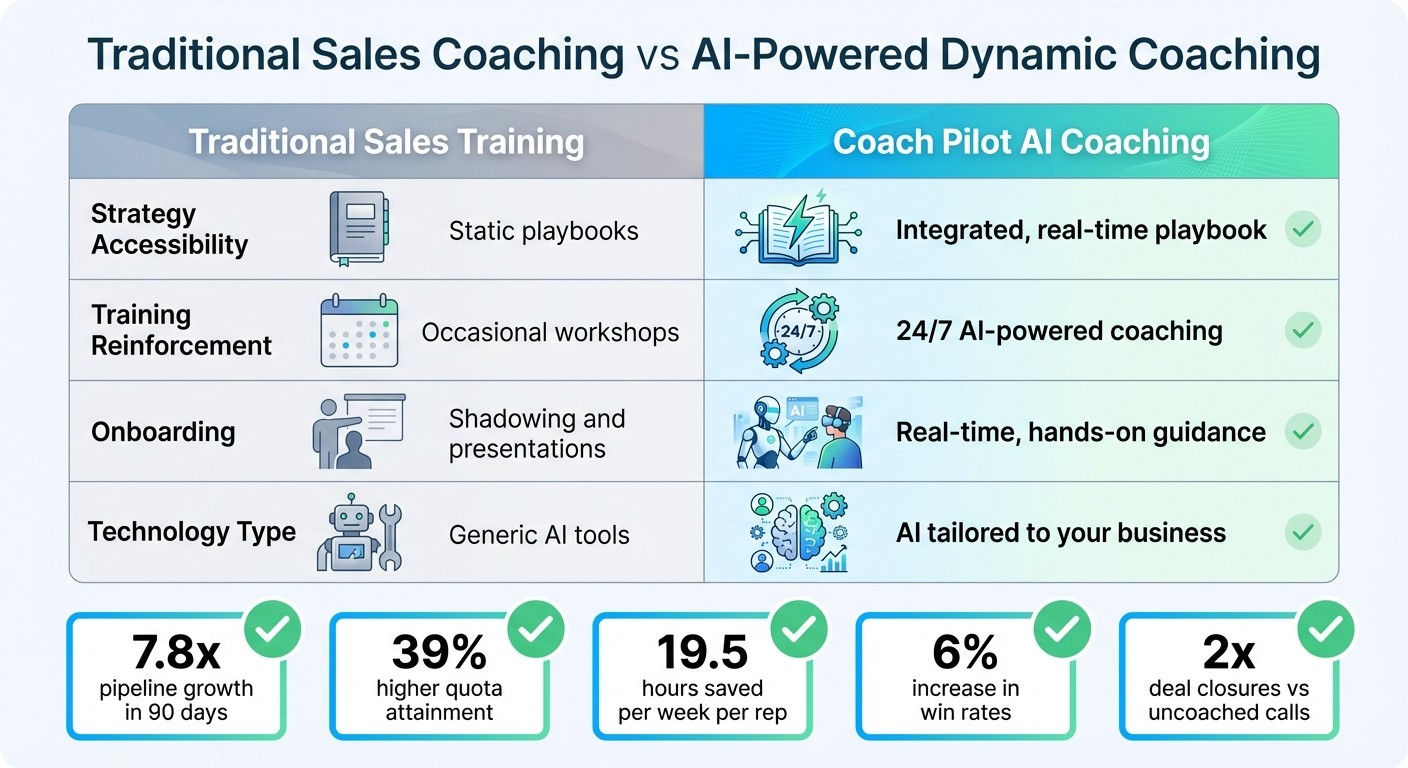
Traditional Sales Coaching vs AI-Powered Dynamic Coaching Comparison
Coach Pilot takes real-time coaching to a new level by turning your company's sales methodology into an interactive, actionable playbook. This approach ensures that reps have access to proven strategies and guidance during live deals - not just in onboarding or training sessions [8].
Custom Playbooks and Training Programs
Coach Pilot captures the instincts of your top performers and turns them into scalable playbooks that everyone on the team can use [8]. These aren't outdated, static documents. Instead, they integrate your unique processes, messaging, deal stages, and objection-handling strategies into a dynamic resource that reps can rely on at every step [8]. The playbooks include searchable battle cards and guided strategies, making them practical tools for real-world sales scenarios [9].
Reps can log their roles, KPIs, and deal opportunities to get instant, context-specific advice [9]. The results speak for themselves: teams using this method see 7.8x pipeline growth in just 90 days and hit 39% higher quotas by shifting from generic outreach to personalized, value-driven messaging [8]. By embedding these tools directly into daily workflows, Coach Pilot ensures strategies are immediately actionable.
AI Coaching Built Into Daily Workflows
Coach Pilot seamlessly integrates with platforms like Microsoft Teams, Microsoft Copilot, and ChatGPT for Teams [8]. This ensures that reps receive real-time coaching during live deals rather than waiting for scheduled one-on-one meetings [8]. The AI also takes over time-consuming tasks like CRM updates and call summaries, saving reps an impressive 19.5 hours per week - time they can reinvest in selling [8].
For managers, a dashboard provides insights into rep activity, stalled deals, and areas requiring extra support [9]. This constant feedback loop moves strategies from the planning stage to practical execution exactly when it’s needed.
Traditional Coaching vs. Coach Pilot's AI Coaching
Factor | Traditional Sales Training | Coach Pilot AI Coaching |
|---|---|---|
Strategy Accessibility | Static playbooks [8] | Integrated, real-time playbook [8] |
Training Reinforcement | Occasional workshops [8] | 24/7 AI-powered coaching [8] |
Onboarding | Shadowing and presentations [9] | Real-time, hands-on guidance [9] |
Technology Type | Generic AI tools [8] | AI tailored to your business [8] |
Coach Pilot’s AI-driven approach bridges the gap between planning and execution, helping sales teams work smarter and achieve better results. With sellers spending just 24% of their time actively selling, AI tools like these recover lost hours and drive revenue growth - organizations using AI are 1.3 times more likely to see measurable gains [1]. This blend of strategy and execution is transforming how businesses approach coaching and sales.
Applying Dynamic Coaching to Specific Industries
Every industry brings its own set of sales challenges, and addressing these effectively requires a tailored approach. AI-powered dynamic coaching steps in to meet these unique needs by helping sales teams navigate regulations, build trust with niche buyers, and handle complex decision-making processes. By customizing AI strategies for each sector, companies can tackle specific obstacles head-on.
Healthcare Sales
In healthcare, sales reps face the dual challenge of demonstrating clinical expertise while staying within strict regulatory boundaries. AI tools come into play by analyzing both verbal and non-verbal cues - like eye contact, tone, and pacing - to gauge how well reps communicate their expertise to medical professionals. These tools can also highlight recurring issues, such as weak questioning techniques or missed regulatory steps. To make the most of AI insights, companies can set clear performance benchmarks, define how managers should interpret AI feedback, and co-create realistic roleplay scenarios alongside sales leaders [10].
Financial Services Sales
Sales teams in financial services must juggle compliance and data security requirements while maintaining client trust. AI tools help by learning approved messaging and flagging potential compliance risks during both practice sessions and live interactions. For example, real-time nudges can ensure reps disclose mandatory fees when required. Fintech teams using these tools have reported impressive results: a 35% faster sales cycle, twice-as-fast security reviews, and a 20% drop in compliance breaches [11]. While traditional audits cover only 1–2% of calls, AI platforms analyze every interaction, creating detailed logs for regulatory inquiries and quarterly reviews. This has led to a 40% improvement in compliance scores [12].
Enterprise Software Sales
Selling enterprise software often means navigating lengthy sales cycles and dealing with buying committees that typically include 7 to 12 stakeholders - on average, about 10 decision-makers [13][14]. AI-driven coaching helps reps handle these complexities by analyzing conversations and stakeholder cues to identify gaps, like a missing Economic Buyer or an underpowered Champion. It also suggests real-time escalation strategies. Roleplay simulations further prepare reps for multi-stakeholder discovery sessions, procurement talks, and executive ROI discussions. Teams leveraging AI coaching have seen 3.3x year-over-year growth in quota attainment, a 56% reduction in sales cycle duration, and a 36% boost in win rates [14]. By focusing on deeper discovery - covering metrics and decision workflows in detail - and practicing scenarios with cautious or skeptical buyers, teams can significantly enhance their performance, especially considering that the average B2B quota attainment rate is just 47% [14].
These examples highlight how industry-specific coaching strategies can drive measurable improvements and set the stage for ongoing refinement of the future of sales enablement through AI-powered tools.
Measuring Results and Improving with AI Analytics
Dynamic coaching has reshaped sales interactions, but its true value comes from tracking results with AI analytics. For coaching programs to succeed, it’s critical to monitor the right metrics. By combining real-time coaching with precise analytics, teams can validate and refine their strategies effectively.
AI analytics evaluate performance using two types of indicators:
Leading indicators: Metrics like Score Improvement Velocity, Coaching Adherence Rate, and Question Quality Scores predict future success [15][17].
Lagging indicators: Metrics such as win rates, sales cycle length, and deal sizes confirm the overall business impact [16][17].
Key Metrics for Coaching Performance
The most insightful metrics focus on behavioral changes, not just outcomes. For example, sales reps who maintain a balanced talk-to-listen ratio can close up to 29% more deals. Similarly, calls scoring above 80% show a 23% increase in close rates. AI tools also ensure 100% coaching coverage, compared to the 1–2% achieved through manual efforts [17][16]. To measure coaching impact effectively, teams should document baseline metrics like current close rates, average deal sizes, and ramp times [16].
Using AI for Continuous Improvement
AI analytics go beyond surface-level insights by spotting patterns across numerous interactions, helping teams identify systemic trends. One key metric, the Coaching Adherence Rate, tracks how well reps apply feedback during subsequent calls, offering a clear measure of coaching effectiveness [15]. Interestingly, delivering feedback within 24 hours of a call boosts skill adoption by 42% [17].
A great example of this in action comes from Versa Networks. In 2025, they introduced a behavior-based pipeline review powered by AI. This approach cut coaching time for managers in half while ensuring consistent practices across their global sales team [1]. Another valuable metric, Score Improvement Velocity, focuses on the rate of improvement over time, helping managers identify which reps respond best to coaching [15]. These insights not only drive ongoing improvements but also highlight successes worth replicating.
Recognizing Wins and Sharing Best Practices
AI analytics can pinpoint which coached behaviors lead to closed-won deals, enabling teams to refine their sales strategies continuously. For example, creating a "coaching queue" at the start of each week - featuring the top three coachable moments for each rep - allows managers to hold focused, data-driven one-on-ones and track team trends [3].
Tracking objection-handling success is another way to identify training opportunities. By categorizing objections (e.g., price, competition, or timing) and measuring resolution rates, teams can uncover specific skill gaps [15]. AI can also highlight standout behaviors, such as asking over 10 discovery questions or managing multi-stakeholder scenarios effectively. These wins can then be shared across the organization, promoting a culture of learning and excellence.
Conclusion
In high-stakes sales environments, relying on static playbooks and occasional training sessions simply doesn’t cut it anymore [18]. The gap between strategy and execution - often referred to as the "execution gap" - has been a persistent challenge for sales teams. This gap arises when teams know what to do but struggle to apply that knowledge effectively in live situations. AI-driven dynamic coaching offers a solution by delivering real-time guidance, turning strategy into actionable steps during critical moments [18].
The numbers speak for themselves: teams using AI coaching report an impressive 83% revenue growth compared to 66% for teams without AI. Companies adopting these systems also see rapid pipeline expansion within months and a 36% boost in win rates [18][19][20]. These results highlight how AI coaching transforms sales execution into a more precise and consistent process.
It’s important to note that AI isn’t here to replace human managers - it’s here to amplify their impact. By handling repetitive tasks like analyzing every call, offering instant feedback, and identifying behavioral trends, AI allows managers to focus on areas where they truly add value, such as deal strategy, emotional intelligence, and mentorship. As Julie Thomas, President and CEO of ValueSelling Associates, puts it:
"AI doesn't replace the manager's role; it enhances it. It handles the repetition, speeds up analysis and provides a consistent baseline."
Dynamic coaching addresses key challenges like inconsistent guidance and the need for scalable, personalized training. Platforms like Coach Pilot integrate AI coaching directly into daily sales workflows. They provide custom playbooks tailored to specific industry challenges, immersive training to build lasting habits, and real-time coaching to ensure consistent execution. Whether dealing with healthcare regulations, financial compliance, or complex software sales, tools like these help teams implement proven strategies with precision.
To implement this effectively, consider adopting the "Analyze, Practice, Perform" cycle. Use AI to pinpoint successful patterns from top performers, develop realistic practice scenarios, and measure live performance against those benchmarks [19]. Ensure your CRM data is accurate, create a robust knowledge base, and start with a small pilot group of 3–5 reps for 60 days before scaling up [5][20]. Moving from reactive training to proactive, real-time coaching isn’t just about adopting new technology - it’s about rethinking how sales teams learn, adapt, and succeed in today’s complex sales landscape.
FAQs
What counts as “dynamic coaching” on a live sales call?
Dynamic coaching during live sales calls leverages real-time AI to evaluate conversations as they unfold. It offers immediate guidance through actionable tips, prompts, or suggestions to help sales reps handle objections more effectively, ask sharper discovery questions, and keep deals moving forward. This approach ensures that reps can adjust on the spot and stick to proven strategies during pivotal moments.
How do you start an AI coaching pilot without disrupting the team?
To keep things running smoothly, it's important to follow a structured plan. Begin by crafting a clear strategy that aligns with your sales objectives. Build a customized playbook featuring effective strategies and messaging that resonate with your team. Conduct live workshops to train your team and help them build lasting habits. Introduce the AI coaching system gradually, integrating it into current workflows to provide real-time guidance. Make sure to communicate the pilot program's goals and advantages clearly, and provide continuous support to ease the transition.
How can AI coaching stay compliant in regulated industries?
AI coaching plays a vital role in regulated industries by helping teams stay compliant with policies and regulations. It relies on tools that review outgoing communications, identifying potential issues like risky language, missing disclosures, or consent problems before messages are sent. This proactive approach minimizes legal risks and keeps businesses prepared for audits.
Related Blog Posts

Remove the guesswork from winning more deals.