B2B Sales
AI-Driven CRM Integration: Key Features to Look For
Mar 5, 2026
How AI-driven CRM integration automates data entry, delivers real-time coaching, prioritizes leads with predictive scoring, and improves forecasting accuracy.
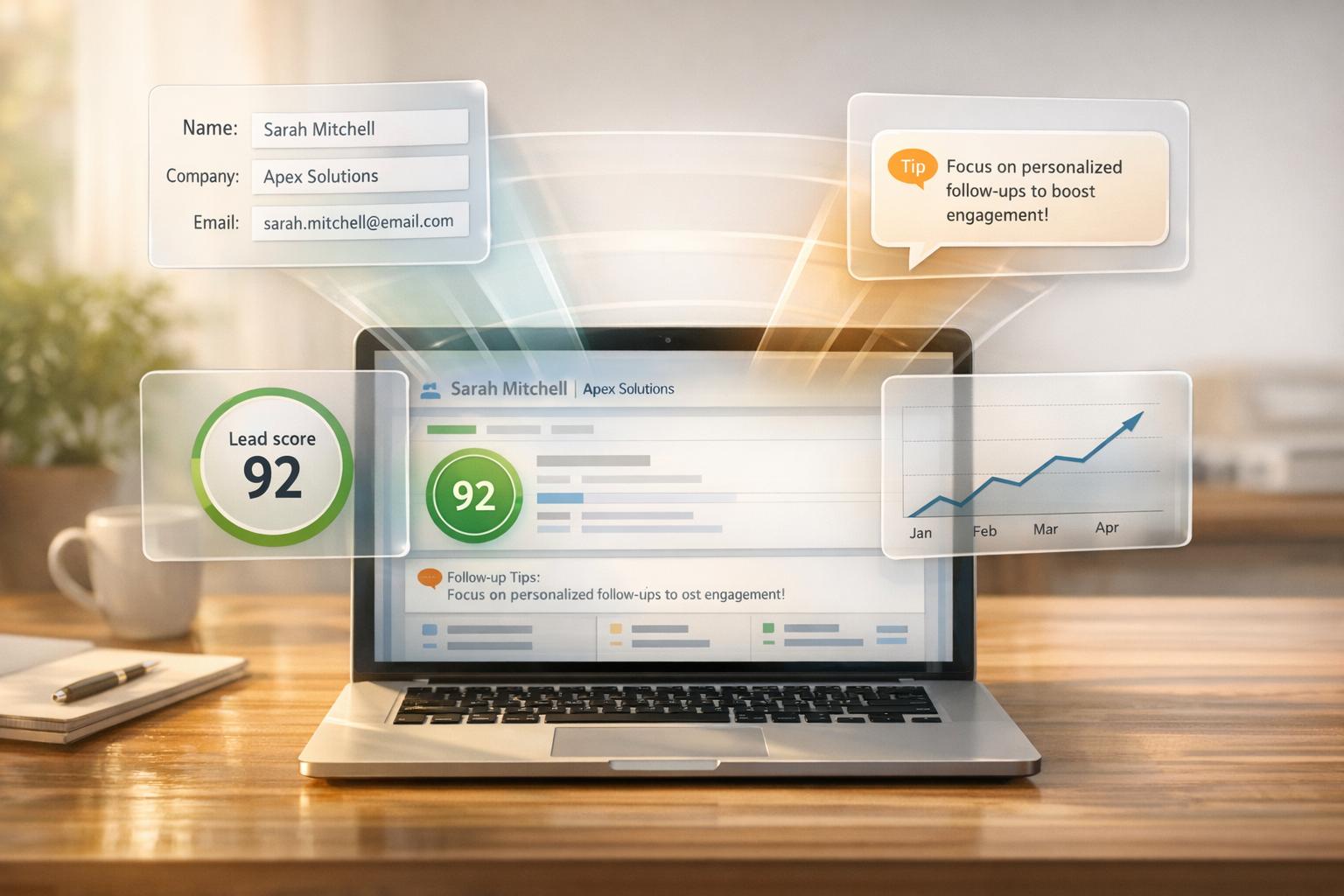
AI-driven CRM integration transforms traditional CRMs into proactive systems that automate workflows, enhance sales performance, and improve forecasting accuracy. By leveraging tools like machine learning and predictive analytics, these platforms save time, increase win rates, and shorten deal cycles.
Key Benefits:
Time Savings: Automates data entry, saving 8–12 hours per week per rep.
Higher Win Rates: Boosts win rates by 30–37%.
Faster Deal Cycles: Reduces sales cycle time by 25–37%.
Improved Forecasting: Enhances forecast accuracy by 20–41%.
Must-Have Features:
Real-Time AI Coaching: Provides instant feedback during sales calls, improving performance on the spot.
Automated Data Entry: Automatically updates CRM records from emails, calls, and meetings.
Predictive Analytics: Prioritizes leads and improves revenue predictions using historical data and buyer signals.
Content Recommendations: Suggests tailored resources like case studies or email templates based on deal context.
Adoption Insights:
65% of businesses already use CRMs with generative AI.
81% plan to adopt these tools by 2025.
Teams using AI-powered CRMs are 83% more likely to exceed sales targets.
The right AI-driven CRM not only automates tasks but actively contributes to revenue growth by aligning with your sales processes and providing actionable insights.
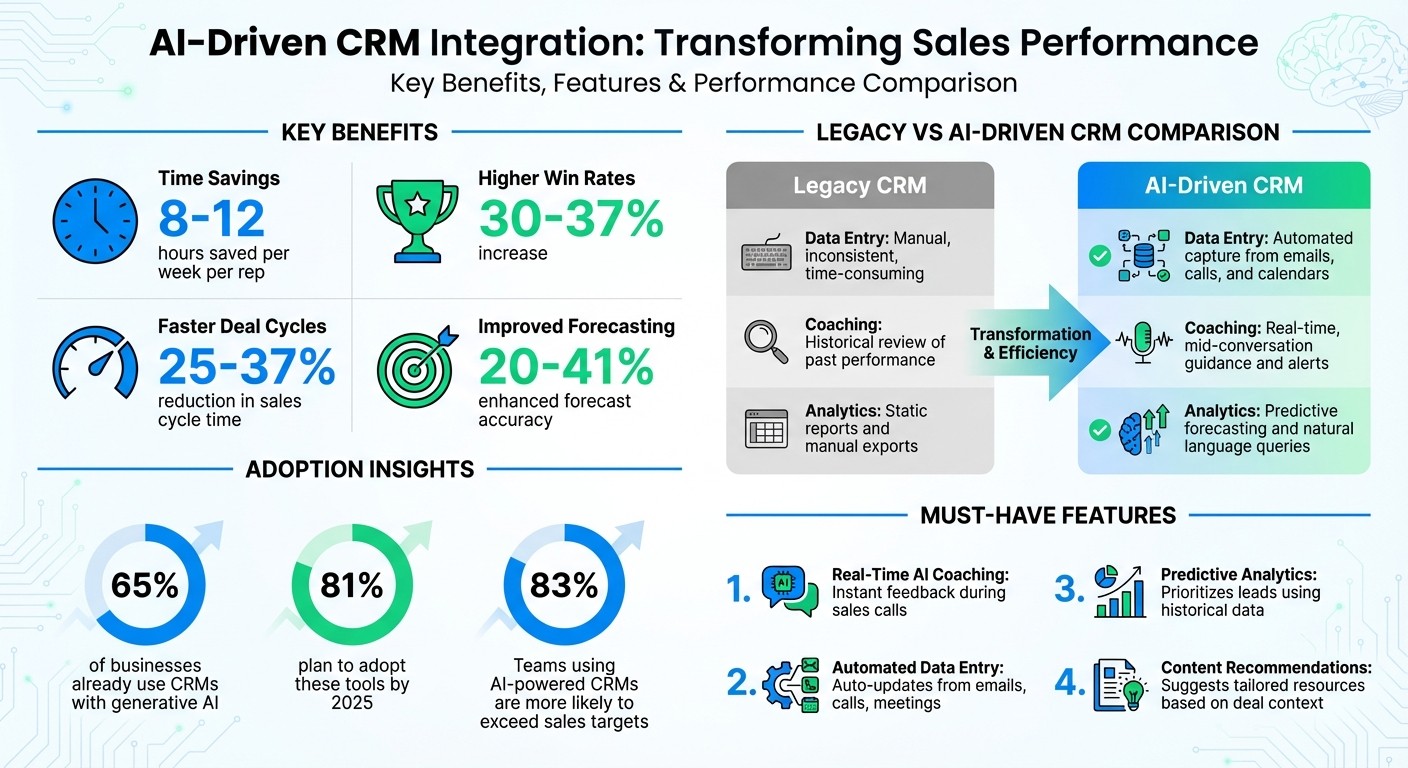
Legacy CRM vs AI-Driven CRM: Key Differences and Performance Metrics
AI in CRM: The Guide to Smarter Customer Relationships
Core Features of AI-Driven CRM Integration
AI-powered CRM tools bring transformative capabilities to sales teams, streamlining data capture, offering actionable guidance, and helping prioritize opportunities. These features drive revenue growth while seamlessly integrating into daily workflows.
Real-Time AI Coaching
AI coaching tools provide instant feedback during live sales conversations, delivering guidance exactly when it’s needed. These systems analyze emotional cues and hesitation in real time, offering prompts like objection-handling scripts or pricing suggestions during natural pauses in the conversation [7]. This immediate support eliminates the need to wait for post-call reviews, enabling representatives to adjust their approach on the fly.
The results speak for themselves: companies using integrated AI coaching and CRM platforms report 37% faster deal cycles and 24% higher win rates [7]. New hires also benefit significantly, with onboarding times reduced by 31% and quota attainment increasing by 22% [7]. Additionally, by flagging deal risks and opportunity signals, AI coaching reduces cognitive load, allowing sales reps to focus on building meaningful customer relationships.
Automated Data Entry and Workflow Sync
In tandem with real-time coaching, AI agents handle the heavy lifting of data entry. They automatically pull information from emails, calendars, and meeting transcripts, updating CRM records without manual intervention [8]. Beyond simple data capture, these systems generate structured call summaries, draft follow-up emails, and log activities in real time. This automation saves sales teams 8–12 hours per week [5][3].
Unlike traditional CRMs, AI-driven systems can process unstructured data such as email threads, call transcripts, and meeting notes. They organize this information into standardized frameworks like BANT (Budget, Authority, Need, Timeline) or MEDDIC, ensuring consistent and actionable qualification data. On average, this reduces administrative tasks by 41% [7], transforming CRMs from passive tools into active contributors to the sales process.
AI also enhances sales precision through predictive analytics, refining targeting and forecasting.
Predictive Analytics for Lead Scoring and Forecasting
Predictive analytics takes CRM integration a step further by analyzing historical data, engagement metrics, and past interactions. This allows the system to identify high-conversion prospects and assign scores to prioritize resources effectively [2][10]. For companies using these tools, sales forecasting accuracy improves by 41%, and they are 83% more likely to exceed sales targets [7][1].
In addition to scoring leads, predictive tools identify at-risk deals and detect pipeline slippage before it impacts revenue [1][7]. By incorporating factors like customer sentiment, email tone, response times, and meeting participation into win-probability calculations, these systems turn forecasting into a precise, data-driven process. Insights are displayed directly on CRM dashboards, making it easier for teams to act quickly and strategically. Together, these analytics capabilities transform CRMs into proactive tools that drive revenue growth.
How AI-Driven CRM Integration Improves Sales Enablement
AI-driven CRM integration is changing the game for sales teams by delivering real-time coaching and content right within their workflow. Instead of spending time hunting through endless libraries, sales reps now get exactly what they need, exactly when they need it - straight from their CRM [11]. This shift from static resources to dynamic, in-the-moment support allows reps to focus more on selling, leading to noticeable improvements in sales performance.
Between February and May 2025, Salesforce rolled out an AI-powered system for its own sales teams, spearheaded by Ali Nahvi and Greg Ardisana. Using Salesforce Data Cloud and Agentforce Sales Coach, they delivered 24,000 personalized recommendations to their reps. The results? Seller engagement skyrocketed - action completion rates jumped from 8% to 38%, driving $28 million in pipeline and $9 million in closed ACV in just four months [17].
"By moving from passive dashboards to active agents, we didn't just predict success, we helped secure it." - Ali Nahvi, Director of Product Innovation, Salesforce [17]
Conversation Intelligence and Performance Insights
AI doesn’t just track sales interactions - it learns from them. Every call, email, and meeting is analyzed to uncover patterns that impact performance. It monitors everything from how objections are handled to competitor mentions, talk-to-listen ratios, and even the sentiment of conversations, all in real time [13]. Unlike traditional coaching, which often relies on delayed feedback and manager intuition, AI delivers actionable insights based on 100% of interactions [18].
These insights fuel automated coaching systems that pinpoint areas for improvement. For example, AI can highlight three key coaching opportunities for each rep every week - whether it’s improving discovery questions, clarifying next steps, or refining stakeholder engagement [18]. While traditional dashboard recommendations see only 8% completion, AI-driven, personalized coaching achieves a 38% action rate [17]. Companies using these tools report efficiency gains of 10–15% [18].
Take Precina, a healthcare company, as an example. They used Agentforce’s AI coaching to train clinicians for patient intake calls. The AI simulated real-world interactions and provided instant feedback on compliance, accuracy, and empathy. This approach sped up skill development for reps while freeing managers to focus on higher-level tasks [12].
"The goal isn't to replace managers. It's to give them leverage - so coaching feels like a system, not a heroic act." - Ameya Deshmukh, Author, EverWorker [18]
But AI doesn’t stop at coaching. It also equips reps with the exact content they need, right when they need it.
Contextual Content Recommendations
AI goes beyond analyzing conversations - it delivers tailored content recommendations in real time. By interpreting CRM signals like deal stage, client persona, industry, and past interactions, AI suggests the perfect case study, pricing sheet, or email template a rep might need [11]. These recommendations integrate seamlessly into CRM records or email composers, ensuring reps always use approved, on-brand messaging.
For instance, in March 2025, Zurich Insurance Group used Microsoft Dynamics 365 Customer Insights to personalize customer journeys with AI. This approach boosted lead quality by over 40% [15]. Similarly, Investec implemented Microsoft 365 Copilot for Sales, automating routine tasks and customizing client interactions. This saved the team around 200 hours annually, allowing them to spend more time building meaningful client relationships [15].
AI also simplifies the creation of sales documents. It drafts personalized emails, business cases, mutual action plans, and follow-up summaries, pulling in live deal data and recent conversation insights [16]. This saves reps from starting from scratch and ensures consistency across all customer interactions. Unsurprisingly, 65% of businesses now use CRMs with generative AI, and teams leveraging these tools are 83% more likely to exceed their sales targets [1].
"AI surfaces the 'right asset + right line' inside email, call prep, CRM, and proposals." - The Pedowitz Group [11]
Platforms like Coach Pilot integrate these features directly into existing sales workflows. By aligning AI with custom sales playbooks and pre-approved messaging, teams ensure every interaction is not only timely but also strategically aligned. This alignment is a core component of a high-performing B2B sales playbook.
Integration and Scalability Requirements
No matter how advanced an AI system is, it’s ineffective if it doesn’t integrate smoothly with your existing tools. With 71% of sales reps already losing time on manual data entry[19], a poorly integrated AI solution can add to the workload instead of reducing it. Technical integration is just as important as the AI's capabilities.
Compatibility with Existing Sales Tools
Your AI-powered CRM should work seamlessly with the tools your team already relies on, avoiding the need for a complete overhaul. Look for bi-directional synchronization at the data layer so information flows automatically between your AI tools and your CRM database[20].
Secure authentication is key. Ensure the system integrates effortlessly with platforms like Google Workspace or Microsoft 365, as well as calendars and communication tools such as Zoom, Teams, or Google Meet[6]. Many companies now use AI as a "companion layer" to enhance their legacy systems rather than replacing them entirely[6].
Before you start integrating, conduct a data health check. This means mapping fields clearly and standardizing definitions (e.g., job titles or lead qualifications)[21]. Currently, only 31% of companies believe their data is AI-ready, and fragmented customer data has already cost one-third of businesses revenue[1]. A pilot test can help validate data accuracy before rolling out the system organization-wide[19].
Security is non-negotiable. Look for compliance with standards like SOC 2 Type 2 and GDPR, and implement role-based access controls to ensure sensitive data is only accessible to the right people[20]. Plan for contingencies, such as API rate limits, network interruptions, or maintenance windows, to avoid data loss during integration[19].
Once the system is securely in place, monitor its performance and make adjustments to optimize its impact.
Analytics and ROI Tracking
Tracking results is essential. AI-powered CRMs should include built-in analytics to measure key metrics like time saved, pipeline velocity, forecast accuracy, and lead response times[21]. Research shows companies using generative AI in their CRMs are 83% more likely to exceed their sales goals[1], but this only happens when the right outcomes are measured.
Start by establishing baseline metrics for administrative tasks, lead response times, and forecast accuracy. AI-CRM integrations have been shown to boost win rates by 15–20% and shorten sales cycles by 10–15%[20]. Set clear goals, such as cutting manual data entry by 30% within six months or increasing lead-to-opportunity conversions by 15%[14], and track progress monthly.
Choose systems with dashboards that provide insights into adoption rates, feature usage, and overall business impact. Make sure your platform can handle growing data volumes without slowing down[20]. With 60% of B2B seller tasks expected to rely on generative-AI conversational interfaces by 2028[1], your analytics infrastructure must be ready for this shift.
Coach Pilot's AI-Driven CRM Integration Capabilities
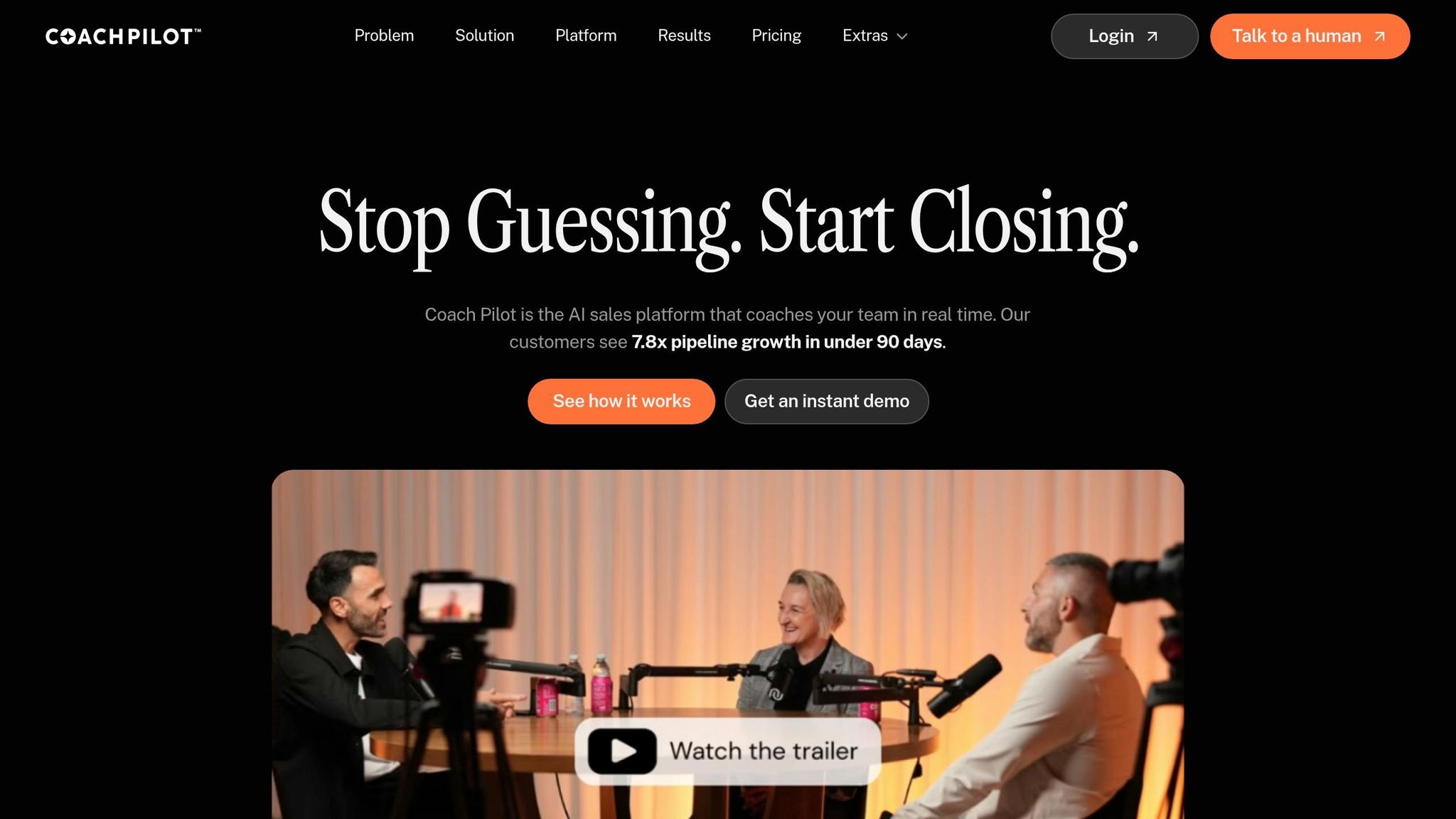
Coach Pilot takes AI integration to the next level by embedding coaching directly into your team’s daily routines. It goes beyond traditional tools that simply analyze what happened during a sales call - like talk ratios or mentions of competitors. Instead, it provides actionable guidance. For example, it might prompt a sales rep to reach out to a specific economic buyer with customized messaging at the ideal time or suggest sending a follow-up email packed with value-driven content to a key stakeholder [22].
One standout feature is its ability to automatically capture and sync accurate deal data - referred to as "deal truth" - with your CRM. This eliminates the need for time-consuming manual data entry, freeing up an average of 19.5 hours per rep each week that would otherwise be spent on CRM updates and admin tasks [22][23]. Not only does this save time, but it ensures your CRM data is always accurate while spreading the expertise of top-performing reps across the team by identifying and leveraging patterns from successful deals [22]. On top of that, the platform supports sales strategy through dynamic, AI-powered playbooks.
Unlike static documents, these custom sales playbooks are constantly updated and reinforced by an AI coach that understands your business goals, methodology, and ideal customer profile. This makes proven strategies easily accessible to every rep, ensuring consistency and alignment across your entire team [22].
The results speak for themselves. Customers have reported a 7.8× boost in pipeline growth within just 90 days of implementing the platform [22][23]. Additionally, sales teams achieve 39% higher quota attainment by replacing generic outreach with targeted, playbook-aligned messaging [22][23]. To round out its capabilities, Coach Pilot also offers immersive training workshops, weekly live coaching calls, and performance analytics, creating a robust sales enablement system that directly ties strategy to measurable outcomes.
Choosing the Right AI-Driven CRM Solution
When selecting an AI-driven CRM tool, focus on systems that prompt action rather than simply presenting data. As SalesHive puts it, "If AI doesn't change what a rep does in the next hour, it's not a sales integration - it's a product tour" [1]. The best platforms go beyond passive dashboards, actively driving follow-ups, routing leads, and updating records automatically.
Key features to look for include real-time coaching, autonomous data entry, and predictive analytics. Tools that transcribe calls, highlight coaching opportunities, and analyze tone can significantly enhance team performance [13][24]. Automated data capture is another must-have, saving time and reducing errors. Additionally, platforms that rank prospects using historical conversion data instead of static rules can boost conversion rates by about 15% within six months [14]. These capabilities lay the groundwork for deeper integration and seamless API connections.
Integration depth is more important than a long list of features. Make sure the CRM solution integrates smoothly with your existing tools - whether that’s Salesforce, HubSpot, or another core platform - through strong API connectivity [2]. Limited integrations often lead to manual workarounds, which undermine the benefits of automation. It’s also crucial to ensure the platform complies with SOC 2 Type 2 and GDPR standards when handling sensitive customer data [3][8].
Before rolling out the system, start with clean data. Eliminate duplicates and fill in missing fields to improve AI accuracy [14][25]. Testing is equally important. Launch a pilot project in a specific territory and measure performance against clear KPIs like meetings booked or deal velocity before scaling across the organization [14][25].
The sales world is evolving. By 2025, 83% of teams using AI reported revenue growth, compared to 66% of teams without it [4]. For example, Coach Pilot integrates coaching directly into workflows and automates data capture, fundamentally changing how teams operate. The right AI-driven CRM isn’t just about organizing data - it’s about transforming the way your team sells.
FAQs
What data should be cleaned before integrating AI into my CRM?
Getting your CRM data ready for AI isn't just about flipping a switch - it's about making sure your data is clean and reliable. Here’s how you can do it:
Eliminate duplicates: Use unique identifiers like email addresses or phone numbers to spot and remove duplicate entries.
Standardize formats: Ensure consistency in how names, addresses, and contact details are entered. For example, decide on a single format for phone numbers or dates.
Remove outdated or incomplete records: Get rid of old leads, test contacts, or any data that’s no longer useful.
Validate contact details: Double-check that emails, phone numbers, and other key information are correct.
Fill in missing information: Add details like company size, industry, or other relevant data that might be incomplete.
By taking these steps, you’ll set the stage for AI to work effectively with your CRM, delivering better insights and results.
How do I measure ROI from AI-driven CRM integration?
To evaluate ROI from integrating AI into your CRM, keep an eye on key performance indicators (KPIs) that highlight improvements in sales processes and outcomes. Pay attention to metrics such as pipeline velocity, time saved on tasks, revenue growth, customer retention rates, and shortened sales cycles. By routinely analyzing these KPIs and comparing them to your objectives, you can gauge how AI and automation are enhancing productivity and overall business performance.
What security and compliance should I require from an AI CRM tool?
When selecting an AI-powered CRM tool, data protection and regulatory compliance should be at the top of your checklist. Make sure the tool offers features like encryption (both at rest and in transit), strong access controls, and certifications such as SOC 2 or ISO 27001. It’s also crucial that the platform complies with regulations like CCPA, GDPR, and HIPAA. To further reduce risks and uphold trust in your sales processes, prioritize tools that conduct regular audits, privacy assessments, and offer secure API integrations.
Related Blog Posts

Remove the guesswork from winning more deals.