B2B Sales
AI in Sales Playbook Adoption
Mar 5, 2026
AI-driven sales playbooks bring real-time coaching, automated CRM updates, faster cycles, higher win rates, and practical fixes for adoption challenges.
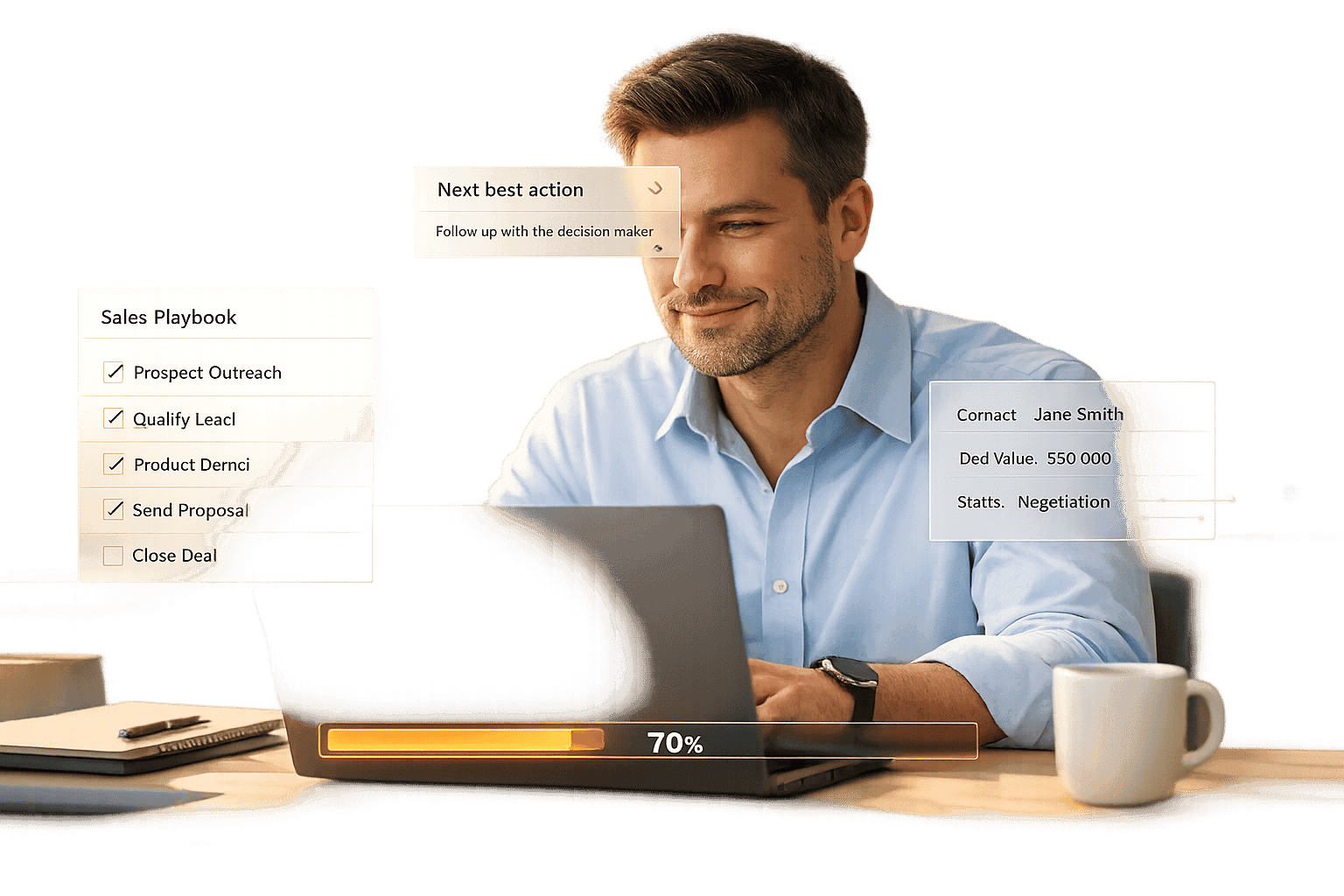
AI-powered sales playbooks are transforming how sales teams operate, moving from static PDFs to dynamic, real-time systems. These tools provide immediate, tailored guidance within CRMs, emails, or video calls, helping sellers respond effectively to challenges like competitor mentions or stalled deals. Companies that adopt AI in sales report measurable benefits, including:
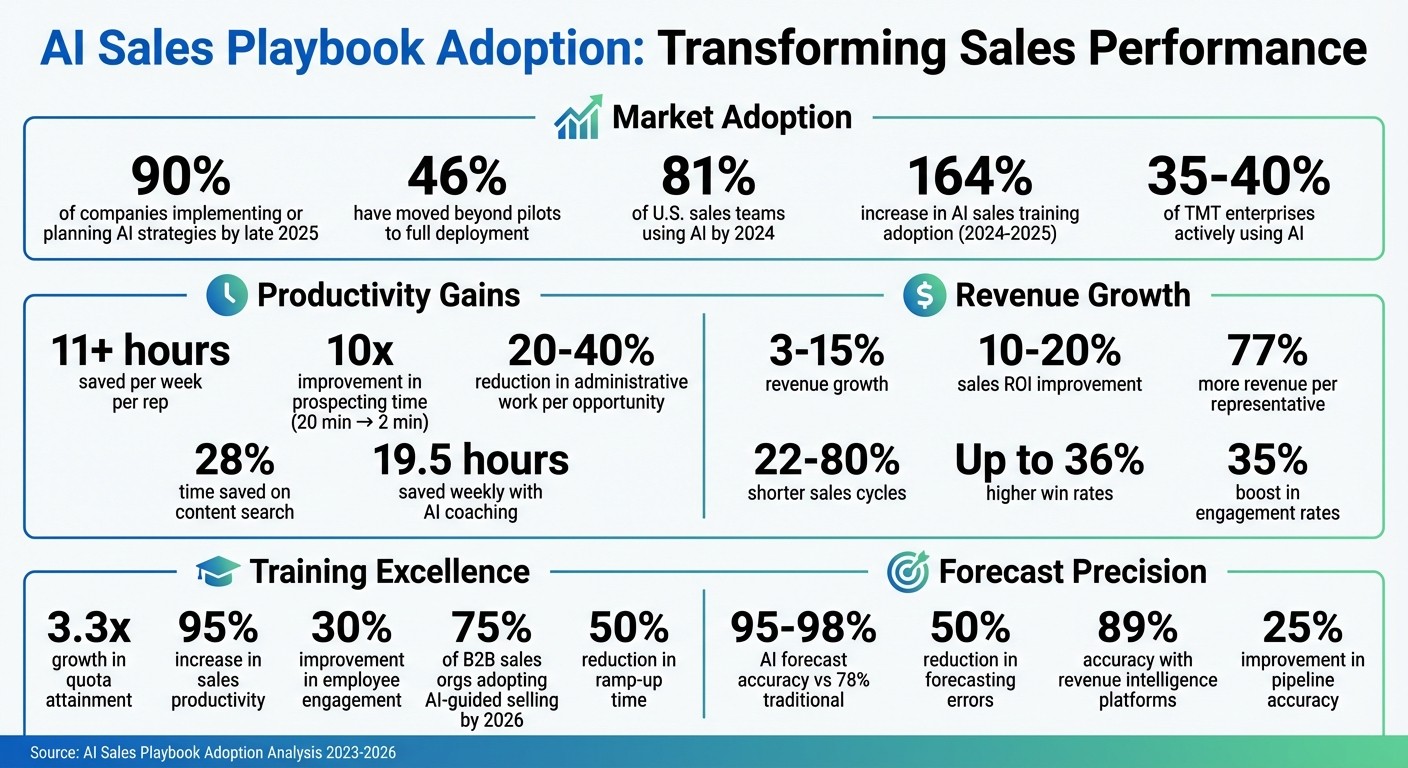
Revenue growth of 3% to 15% and sales ROI improvements of 10% to 20%.
11+ hours saved per week by automating tasks like CRM updates and follow-up emails.
Shorter sales cycles (22%-80% reduction) and higher win rates (up to 36%).
AI playbooks also identify at-risk deals, coach sellers in real time, and update CRM data automatically. Industries like technology and professional services are leading adoption, with 90% of companies implementing or planning AI strategies by late 2025.
Despite these benefits, challenges like resistance to change, integration complexity, and ROI concerns slow adoption. However, tools like Coach Pilot simplify the process by integrating AI into existing workflows, offering tailored playbooks, and saving reps time.
AI isn’t just a tool - it’s reshaping sales processes, making teams more efficient while driving better results.
AI Sales Playbook Adoption: Key Statistics and Performance Metrics 2023-2026
AI Sales Playbook Adoption Trends from 2023-2026
Growth of AI in Sales Enablement
The last three years have seen a dramatic transformation in how sales teams operate. What began as experimental pilots in 2023 has become standard practice by 2026. According to recent findings, 90% of companies have either implemented AI for their go-to-market strategies or plan to do so by the end of 2025 [7]. Even more striking, 46% of organizations have moved beyond pilot stages to fully deploy AI solutions [13].
Between 2024 and 2025, the adoption of AI in sales training programs skyrocketed by 164% [8]. By 2024, 81% of U.S. sales teams had either fully implemented AI or were actively testing it [16].
AI tools have grown from simple assistants to sophisticated systems capable of handling complex workflows. These tools now draft business cases, update account plans, and keep playbooks current in real time [10][11]. On average, sales reps save over 11 hours per week by automating tasks like CRM updates, meeting notes, and follow-up emails [10].
Erik Fowler, Chief Revenue Officer at Allego, summed up the current landscape well:
"The new norm is uncertainty. We still have aggressive growth expectations, we still have economic pressures and budget concerns, and we have AI that we all need to rapidly adopt and figure out how it changes our business." [9]
Certain industries are leading the way. Technology, media, and telecommunications (TMT) companies are at the forefront, with 35–40% of enterprises in these sectors actively using or piloting AI systems [14]. Professional services and information industries, benefiting from their digital expertise and in-house AI capabilities, are also advancing quickly.
These developments highlight the factors driving this rapid AI adoption in sales.
What's Driving AI Adoption in Sales
The shift from static to dynamic sales tools is being driven by a mix of efficiency improvements and leadership directives. In nearly 49% of organizations, executive leadership plays a key role in pushing AI implementation [13]. This top-down push aims to achieve faster training cycles, personalized sales strategies, and scalable solutions - all without requiring proportional increases in staffing.
Several factors are fueling this momentum:
Efficiency gains: LivePerson’s adoption of Outreach’s AI platform in 2025 reduced prospecting time from 20 minutes to just 2 minutes - a 10x improvement. This freed up sellers for strategic tasks and boosted engagement rates by 35%[6].
Performance improvements: AI-powered training and coaching tools have led to measurable results. Teams using these tools are 35% more likely to increase their average deal size and experience a 36% higher win rate[8]. For example, Pushpay achieved a 62% improvement in win rates and exceeded their sales quota by 179% after introducing Outreach’s AI coaching platform [6].
Simplified tech stacks: Companies are reducing the complexity of their technology ecosystems. Instead of juggling 8–12 separate tools, many are consolidating to 4–6 integrated platforms [6]. This streamlining improves data consistency and simplifies training. Currently, 54% of enterprise-level companies have fully implemented AI, compared to just 29% of small businesses[15][16].
The gap between large enterprises and smaller businesses underscores the role of resources in AI adoption. Larger organizations, with access to more capital and technical expertise, are three times more likely to achieve high performance and see significant EBIT impact [15]. While smaller teams are making strides to catch up, the resource disparity remains a key challenge as AI continues to reshape the sales landscape.
From Content to Capability: How to Leverage AI to Accelerate Adoption in Sales Enablement
AI-Driven Sales Playbook Adoption Rates: Key Statistics
AI is reshaping the future of sales enablement, not just by improving training methods but by enhancing the entire sales process.
Training Completion Rates with AI
Did you know that sales reps forget up to 75% of onboarding information within just a few weeks [17]? AI-powered playbooks are tackling this issue head-on by delivering precise, real-time guidance. Instead of overwhelming reps with broad training sessions, AI pinpoints the exact playbook or battlecard a rep needs at the right moment [19].
The results speak for themselves. Companies using AI in their sales training have seen a 3.3x year-over-year growth in quota attainment compared to those using AI without training [20]. On top of that, sales productivity jumps by 95%, while employee engagement improves by 30% when AI is integrated into training and coaching [20].
But here’s the kicker: 77% of sellers still struggle with inefficiency due to information overload [19]. AI-enhanced playbooks address this by filtering out irrelevant data and automating repetitive tasks, cutting administrative work by 20-40% per opportunity [18]. By 2026, 75% of B2B sales organizations are expected to incorporate AI-guided selling into their playbooks [18].
Julie Thomas, CEO of ValueSelling Associates, puts it this way:
"For companies early in their AI and sales coaching journey, the best approach is to explore use cases that align with your business goals - those that boost sales effectiveness and win new opportunities." [20]
These advancements in training are also helping sales teams close deals faster.
How AI Affects Sales Cycle Duration
AI-driven playbooks are making a big impact on sales cycles by offering real-time coaching, automating tasks, and delivering smart content recommendations. The result? 51% of revenue leaders say AI is already speeding up sales cycles and onboarding processes [21].
Sales cycle reductions vary widely, with companies reporting improvements ranging from 22% to 80%. The most dramatic changes come from AI-optimized go-to-market playbooks, which not only shorten cycles but also maintain or even increase deal sizes [12][21][23]. AI-powered content recommendations alone save reps 28% of the time they’d usually spend searching for materials [12]. In a global study projected for 2026, 32% of sales leaders cited shorter sales cycles as a direct benefit of AI adoption [22].
Yuchun Lee, CEO and co-founder of Allego, highlights the competitive edge AI brings:
"Incorporating AI into sales and marketing is now a strategic advantage. The companies pulling ahead are the ones embedding AI into the rhythm of daily work to drive smarter decisions, better coaching, and more meaningful buyer engagement." [21]
How AI Changes Sales Training and Playbook Implementation
AI isn't just reshaping static sales playbooks; it's also revolutionizing how sales teams train and adapt to changing markets. Instead of relying on outdated manuals, AI introduces dynamic, real-time systems tailored to each salesperson's needs and the ever-evolving sales landscape.
AI Tools for Personalized Training
With AI, sales training becomes hyper-personalized. By analyzing call recordings, email communication patterns, and deal outcomes, AI identifies specific skill gaps for each rep. Then, it provides targeted simulations - like practicing discovery questions or handling objections - to address those gaps.
One of the standout benefits is immediate feedback. AI reviews sales calls and delivers coaching tips within minutes through platforms like Slack, email, or the CRM. This rapid feedback is crucial, especially when 82% of B2B buyers feel that sellers often come unprepared for meaningful engagement [17].
Salesforce demonstrated the power of this approach between February and May 2025. Their Customer Zero team integrated AI coaching into their workflow, generating over 24,000 personalized recommendations. The result? A 38% action completion rate - five times higher than the typical 8% achieved through standard dashboard alerts. This contributed to $28 million in generated pipeline and $9 million in closed ACV within just four months [4].
Other companies have also seen impressive results. In early 2026, Bureau improved their discovery process with AI-driven coaching, boosting deal conversions by 30% [26]. Versa Networks, on the other hand, used AI to streamline behavioral analytics, cutting manager coaching time in half while ensuring consistent training across their global teams [26].
Mamta Tainwala, Strategy & Trends Author, summed it up perfectly:
"Sales training is having its Moneyball moment right now." [25]
While personalized training enhances individual performance, AI also ensures that sales strategies stay agile through real-time playbook updates.
Using AI to Update Playbooks in Real Time
Traditional playbooks often become outdated as soon as they're published. AI changes that by continuously analyzing sales calls, win/loss data, and competitor insights to update playbooks in real time. This creates dynamic battlecards that can increase win rates by up to 41% and reduce ramp-up time for new hires by 50% [27][28]. These "living systems" refresh as often as every four hours [1][28].
Instead of requiring extensive manual updates, AI embeds fresh content directly into workflows. It provides stage-specific guidance and persona-focused messaging during live interactions. This shift cuts the time spent on maintaining playbooks from 20–30 hours to just 1–3 hours of guided review [11].
Mary Flaherty, Vice President of Research and Thought Leadership at RAIN Group, highlighted this transformation:
"The modern sales playbook has shifted from a document to a dynamic system - one that learns, adapts, and guides sellers in real time with the power of AI." [1]
These AI-driven playbooks ensure that sales reps always have the right tools - whether it's a perfect objection handler, a discovery question, or tailored messaging - delivered exactly when and where they need it, whether inside the CRM, on a call, or in an email draft [1][2].
Performance Improvements from AI-Enhanced Playbooks
With better training and real-time updates to playbooks, companies are seeing measurable improvements in performance metrics like win rates, forecast accuracy, and team efficiency. These aren’t small changes - AI-driven playbooks are delivering double-digit gains by guiding sales teams through every step of the deal.
Win Rates and Revenue Growth
AI-powered playbooks significantly improve win rates by offering actionable, tailored guidance during live conversations. Instead of generic advice, these systems respond to real-time cues, such as mentions of competitors or the current stage of a deal, nudging reps toward high-impact actions [3].
The results speak for themselves. In September 2025, a mid-sized B2B services company adopted PathfinderAI's Sales Coaching Platform to address inconsistent performance. Within just 60 days, their close rate soared from 17% to 35%, marking a 106% improvement. Weekly performance volatility also stabilized, narrowing from swings of 7–25% to a consistent range of 33–37%, thanks to AI reinforcing specific methodologies on every call [31].
Broadly, companies investing in AI for sales report revenue increases ranging from 3% to 15%, with AI-guided coaching driving win rate improvements of up to 36% [1][5]. These outcomes highlight the transformative potential of AI-driven sales strategies.
Better Forecast Accuracy
AI is revolutionizing sales forecasting, replacing outdated spreadsheets with dynamic systems that analyze vast amounts of data simultaneously. These systems incorporate historical trends, market conditions, buyer sentiment, and communication patterns. Advanced machine learning models, such as XGBoost and neural networks, detect subtle success indicators that human managers often overlook [29][30].
The accuracy gains are striking. AI-powered tools achieve 95% to 98% accuracy, compared to the 78% industry average for traditional forecasting methods [29]. Companies using AI experience a 50% reduction in forecasting errors, and 57% of CFOs report fewer inaccuracies after implementation [29]. Revenue intelligence platforms leveraging AI achieve 89% accuracy, outperforming older systems by 34% [29].
For example, in 2025, a global computing hardware manufacturer adopted C3 AI to manage fluctuating demand. This solution reduced weighted absolute percentage errors (WAPE) by 70–100%, cutting inventory by 7% and saving an estimated $300 million [29]. Similarly, Lennox Residential, an HVAC provider, used AI to identify seasonal trends, boosting service levels by 16% and increasing inventory turns by 25% [29].
AI-enhanced playbooks also keep pipeline data accurate and up-to-date, improving forecast accuracy by 25% [29][4]. Predictive alerts allow managers to spot performance dips 2–3 days before they affect forecasts, with an 84% accuracy rate [30].
Beyond forecasting, AI simplifies daily tasks, freeing up time and improving team efficiency.
Increased Team Efficiency
AI eliminates time-consuming tasks that often bog down sales reps, like updating CRMs, summarizing meetings, or hunting through static playbooks. Instead, reps receive real-time guidance and automated support, allowing them to focus on selling.
Teams using AI-driven recommendations report substantial efficiency gains. Companies see a 50% boost in go-to-market efficiency and a 55% increase in rep confidence with AI systems [5]. Additionally, 32% of sales leaders note shorter sales cycles as a direct result of AI adoption [13].
Sarah Chen, a RevOps Consultant and B2B Strategist at Revenue Velocity Lab, highlighted the financial implications:
"The productivity gap between AI-augmented and traditional reps is $510K/rep/year. For a 20-person sales team, that's $10.2M in annual opportunity cost." [30]
AI also scales coaching by providing personalized feedback after every call. This approach identifies execution gaps without requiring constant manager involvement. Structured coaching programs supported by AI have been linked to a 28% higher win rate [31]. As Ameya Deshmukh from Integrail Corp put it:
"An AI agent changes the game by embedding the playbook into the workflow - so the playbook drives action, not just awareness." [2]
Challenges in AI Sales Playbook Adoption
Even with the promise of better performance, AI adoption in sales teams often stalls at just 15–20% [32]. The roadblock isn’t the technology itself - it’s how it’s implemented. Sales reps often see AI tools as just another way for management to track their activities, rather than tools designed to make their jobs easier [32]. Adding to the challenge, 80% of sales leaders report burnout, stress, or regretted attrition during AI transitions [33]. Michael Ocean, CEO of SellMeThisPen, summed it up well:
"People don't resist change – they resist being changed" [32].
When AI tools feel like extra work or overly complicated systems, it’s no surprise that reps push back. Under pressure, they stick to old habits, especially when the AI playbook isn’t seamlessly integrated into their workflow [2]. These psychological and practical hurdles often lead to deeper resistance.
Resistance to Change
AI tools often prioritize reporting over helping reps succeed. In fact, only 28% of sales leaders say AI is improving revenue-driving performance, despite widespread adoption [33]. This creates a frustrating cycle: leadership questions why adoption is low, while reps feel stuck with tools that don’t solve their daily problems.
To break this cycle, companies can start small, working with 2–3 high-performing, curious reps to pilot AI tools. Sharing their success stories can build momentum. For example, AI can be framed as a solution to common frustrations, like saving 30 minutes on prospect research or automating CRM data entry. Robert Wahbe, CEO of Highspot, emphasized this point:
"The truth is AI only works when it's aligned with people, process, and performance. Otherwise, you're flying blind and burning out your teams in the process" [33].
Leaders must also lead by example. Mastering AI tools themselves before requiring their teams to use them can make a big difference. Creating low-pressure "AI Labs" where teams can experiment and share insights can also ease the transition [32]. But resistance is just one piece of the puzzle - operational challenges add another layer of complexity.
Integration Complexity
67% of businesses struggle to integrate multiple AI solutions into their existing sales workflows [34]. On average, sales teams already juggle 9.4 different tools for tasks like prospecting and lead qualification [34]. Adding AI on top of this can lead to "tool sprawl", where systems don’t work well together. It’s no wonder that 90% of enterprise organizations face significant integration challenges [35].
A phased approach to AI implementation has proven more effective, with companies reporting 63% higher user satisfaction and 41% lower failure rates [34]. Starting with one or two tools that address specific needs - like lead qualification or call preparation - can make the process smoother. Shawn Fontaine, a sales leader at Vention, described how newer reps benefit from AI tools like Salesloft:
"If newer reps aren't sure what to do, they can simply open up Salesloft and use Rhythm to help manage themselves and see what needs to be prioritized" [36].
Choosing AI solutions with built-in CRM integration can also help keep customer data centralized [34][35]. Companies that take a phased approach often see 27% faster time-to-value compared to those that go all-in at once [34]. But even with thoughtful integration, cost and ROI concerns remain a major hurdle.
Cost and ROI Concerns
When resistance and integration challenges slow progress, the expected ROI can take a hit. While 88% of organizations use AI, only 5% have successfully scaled it across their operations [37]. Worse, 95% of AI pilot programs fail to deliver rapid revenue growth [37].
One major issue is poor data quality, which causes 75% of AI failures [37][38]. Before diving into AI, companies should clean up their CRM data. Inaccurate or incomplete data not only derails AI initiatives but can also lead to 40% or higher attrition in sales teams [37][38].
Still, the financial potential of AI is hard to ignore when done right. AI-powered sales training, for example, delivers a 340% higher ROI compared to traditional methods [38]. It can also cut annual training costs per rep by 80%, reducing expenses from $1,500–$3,000 to just $300–$500. A great example is Lumen Technologies, which deployed Microsoft Copilot in 2025. By cutting sales research time from 4 hours to just 15 minutes per account, they projected $50 million in annual savings [37][38]. Similarly, Paycor used Gong's revenue intelligence platform to achieve a 44% increase in win rates through AI-driven insights [37].
To see immediate benefits, companies should focus on applying AI to specific, high-friction tasks first. Establishing an AI Council with members from different departments can help align goals, metrics, and expectations across the organization [39]. Tracking metrics like ROI, time saved, and model precision together provides a more complete picture of AI’s impact [34].
Coach Pilot's Role in AI Sales Playbook Adoption
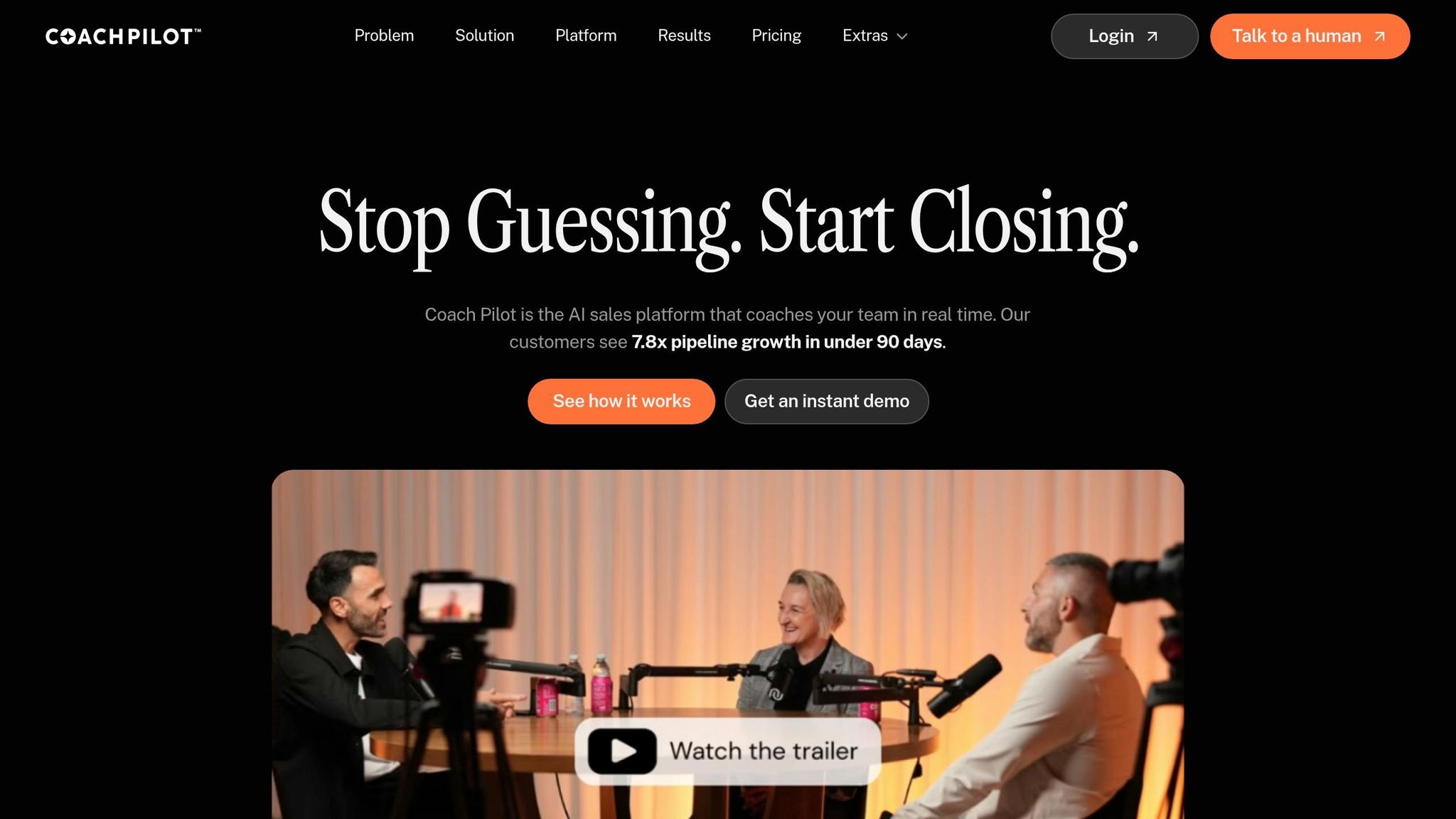
The hurdles of resistance to change, integration difficulties, and ROI skepticism often derail AI implementations. Coach Pilot addresses these issues by turning static sales playbooks into a dynamic, real-time system that integrates seamlessly into existing workflows, giving sales reps actionable guidance while they work.
Custom Sales Playbook Creation
Coach Pilot doesn’t rely on generic templates. Instead, it crafts tailored playbooks by capturing a company’s unique sales processes, messaging, deal stages, objection handling, and key proof points[40]. This approach codifies what works best for the business, leveraging data to uncover the sophisticated tactics top performers use - like knowing the right moment to involve executives or how to navigate procurement complexities - and scales that expertise across the team.
"Coach Pilot identifies those complex patterns in your actual deal data and makes them available to every rep. It doesn't simplify your process. It scales the sophistication your top performers use naturally." - Coach Pilot FAQ[40]
For teams with existing playbooks, the platform enables an audit and refinement process during onboarding, ensuring the AI is trained on the most effective strategies already in place. The results speak volumes, with customers achieving 7.8x pipeline growth in under 90 days and 39% higher quota attainment by shifting from generic outreach to AI-driven, value-focused messaging[40].
From there, Coach Pilot enhances sales performance with immersive training and continuous AI coaching.
Immersive Training and AI Coaching
Coach Pilot goes beyond just creating playbooks. Unlike tools that only analyze calls after they happen, this platform delivers real-time, actionable guidance with tailored talking points and follow-up steps during live interactions[40]. It bridges the gap between strategy and execution through a streamlined four-step process - Build, Train, Deploy, and Scale - complemented by live workshops that help teams develop effective habits[41].
Sales reps also gain access to an AI coach available 24/7, offering guidance directly within their workflow. This coach not only provides real-time support but also automates tedious tasks like CRM updates, saving reps an average of 19.5 hours per week that can be redirected to selling activities[40]. With native integrations into platforms like Microsoft Teams and Microsoft Copilot, the AI coach becomes a central hub for sales operations[41].
Workflow Integration
To tackle the common integration challenges in AI adoption, Coach Pilot embeds its tools into platforms sales teams already use. By integrating into familiar environments like Microsoft Teams, CRM systems, and ChatGPT for Teams, the AI coach delivers guidance where it’s needed most - right in the flow of work[41]. Additionally, the platform adheres to strict security standards, including SOC2 and ISO27001, making it a reliable solution for industries with high compliance requirements, such as finance and healthcare[41].
Conclusion: The Future of AI in Sales Playbook Adoption
Static PDFs are becoming a thing of the past, making room for dynamic, AI-driven playbooks that are reshaping how competitive sales teams operate. The numbers speak for themselves: sales teams leveraging AI see 77% more revenue per representative and are 65% more likely to boost win rates [24].
These adoption rates aren’t just statistics - they translate into real, measurable performance improvements. Companies embedding AI into their go-to-market strategies are seeing dynamic playbooks drive far greater engagement compared to traditional dashboard-based methods. Internal trials at top organizations have shown these tools can generate millions in pipeline and closed revenue in just a few months [4].
"The future of revenue leadership isn't human vs. machine - it's humans empowered by machines." - Hyperbound.ai [42]
For sales leaders, AI-powered platforms are a game-changer. They turn strategies into action and scale the expertise of top performers across entire teams. These modern playbooks adapt in real time, provide instant coaching, and free up representatives from non-selling tasks, which can take up as much as 77% of their day [24].
The results are clear: AI is already reshaping the sales landscape, and early adopters are gaining a competitive edge. For teams ready to embrace these advancements, tools like Coach Pilot offer tailored playbooks and sales insights, hands-on training, and seamless workflow integration - helping bridge the gap between strategy and execution while driving sustainable revenue growth. The future of sales is here, and it’s powered by AI.
FAQs
What is an AI-powered sales playbook?
An AI-powered sales playbook is a smart tool that leverages artificial intelligence to turn static sales strategies into flexible, dynamic workflows. Unlike traditional playbooks that remain fixed, these advanced systems continuously learn from real-time data and customer interactions. They offer personalized recommendations, automate repetitive tasks, and fine-tune sales processes. Key features often include real-time updates, AI-driven coaching, and actionable insights - all designed to help sales teams work more efficiently, close deals faster, and improve their success rates.
How do I measure ROI from AI playbooks?
To evaluate ROI from AI playbooks, keep an eye on key metrics such as revenue growth, cost reductions, and efficiency gains. Pay special attention to areas like pipeline coverage, forecast accuracy, deal velocity, and win rates. By comparing these metrics against your pre-AI baseline data, you can clearly measure the financial and operational impact. Research highlights that AI-powered sales processes can lead to notable revenue increases, better training returns, and shorter onboarding periods.
What’s the fastest way to get reps to adopt AI?
The fastest way to get sales reps on board with AI is to focus on quick wins and make AI a natural part of their daily routines. Start with tools that can build sales playbooks in just minutes or provide personalized training through interactive quizzes. By incorporating real-time coaching and AI-powered playbooks into their workflows, you can show immediate benefits. This approach reduces pushback and makes the transition smoother and more effective.
Related Blog Posts

Remove the guesswork from winning more deals.