B2B Sales
Top 10 Sales Workflow Automation Tools for 2026
Feb 4, 2026
Compare 10 AI-driven sales automation platforms that streamline workflows, improve forecasting, and cut admin time for reps in 2026.

Sales teams spend 65% of their time on non-selling tasks like data entry and scheduling. The solution? Automation tools that save time, improve accuracy, and boost revenue. By 2026, AI-powered platforms are transforming how sales teams operate, handling tasks such as lead scoring, forecasting, and follow-ups. These tools can increase win rates by 15–20%, shorten sales cycles by 20–30%, and free up 8–12 hours per week per rep.
Here’s a quick overview of the top 10 sales automation tools for 2026:
Coach Pilot: AI-powered coaching embedded into workflows.
HubSpot Sales Hub: CRM with AI insights and automated outreach.
Pipedrive: Simple, visual CRM with AI deal predictions.
Close: Focused on reducing admin work with integrated calling and automation.
Apollo.io: Combines a massive contact database with AI-driven outreach.
Zapier: Connects 8,000+ apps to automate complex workflows.
Zoho CRM: Offers AI-driven insights and customizable workflows.
Outreach: AI-powered multi-channel sequences and real-time coaching.
Gong: Revenue intelligence platform with predictive analytics.
Clari: Enterprise-level revenue operations with AI-guided forecasting.
These tools integrate with CRMs, email platforms, and communication tools, making them essential for teams aiming to stay competitive. Whether you're a small business or an enterprise, these platforms can help you focus on selling while automating repetitive tasks.
15+ Best AI Sales and Marketing Tools for 2026
1. Coach Pilot
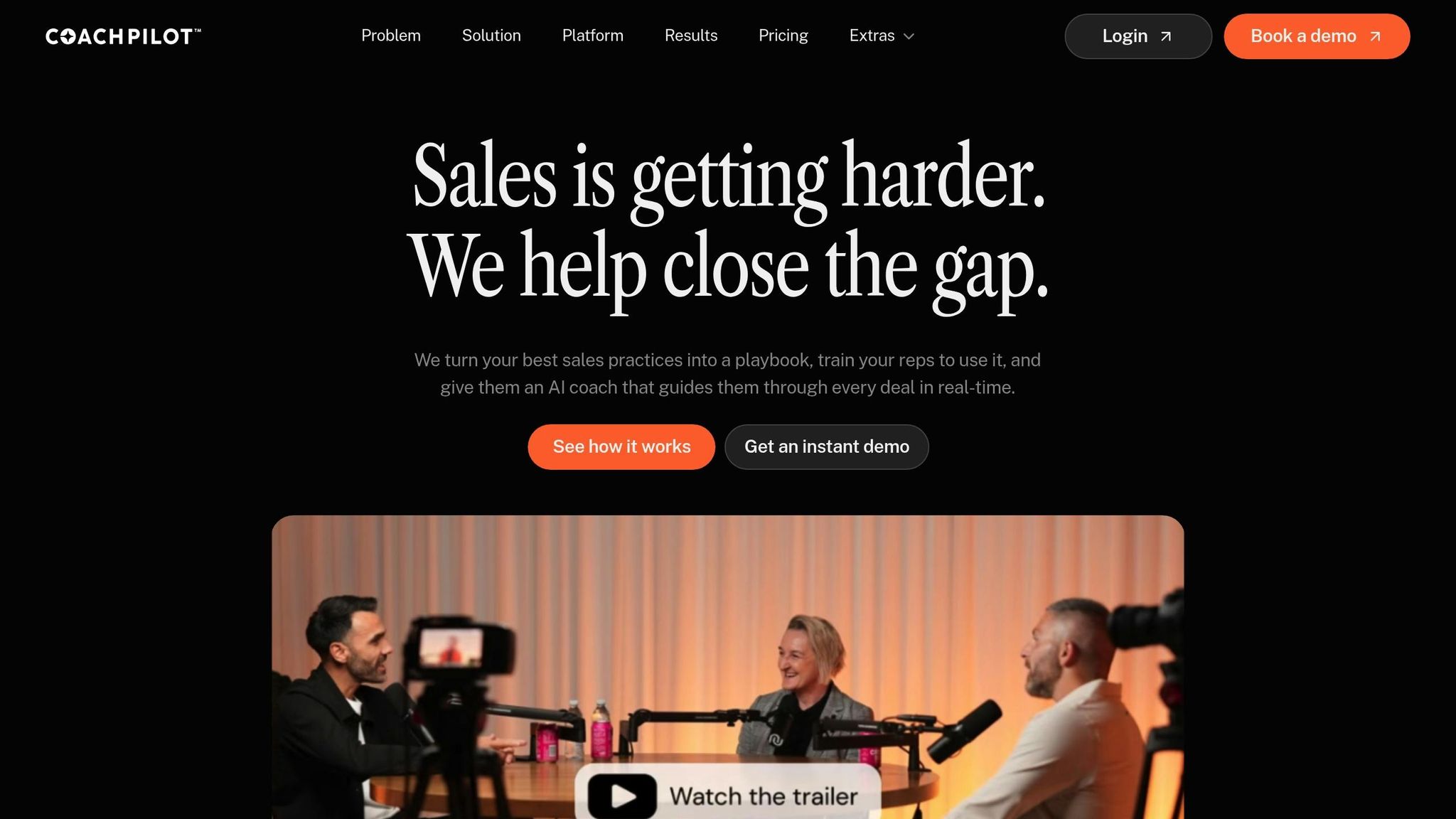
Coach Pilot bridges the gap between sales strategy and everyday execution by embedding AI-powered coaching directly into your team's daily workflows. It combines playbook guidance, real-time insights, and performance analytics within the tools your sales reps already rely on. Let’s dive into how Coach Pilot automates coaching triggers throughout the sales process.
Automation triggers and workflow capabilities
The platform keeps a close eye on sales interactions and automatically initiates playbook-guided coaching whenever reps hit key deal stages or face common objections. This ensures best practices are applied consistently, no matter the customer or situation.
AI-driven features and analytics
Using AI to analyze conversations, Coach Pilot identifies skill gaps by examining factors like talk ratios, customer sentiment, and discussion topics. Dashboards then spotlight key coaching opportunities, helping sales managers focus their efforts where they’ll make the most impact.
Integration with other sales tools
Coach Pilot works seamlessly with your existing CRM, email, and communication tools. Real-time data synchronization ensures your coaching insights stay up-to-date, while bi-directional data flow with your CRM keeps forecasts accurate as deal details evolve.
Pricing and scalability for different team sizes
Coach Pilot offers three flexible options: the Starter Package for basic playbook creation and training, the Advanced Package for more customization, and Enterprise Plans with full analytics and compliance support. Pricing is customized based on your needs.
2. HubSpot Sales Hub

HubSpot Sales Hub combines CRM, automation, and AI-driven insights to help sales teams focus on what they do best - selling. By leveraging automated triggers, it streamlines workflows, whether it’s assigning a new lead to the right salesperson, sending a follow-up email after a prospect visits the pricing page, or creating tasks as deals progress. This approach lays the groundwork for data-informed, efficient selling.
Automation Triggers and Workflow Features
HubSpot Sales Hub tracks high-intent actions like multiple visits to pricing pages, downloads of competitor comparisons, or repeated website sessions within 48 hours. These behaviors trigger timely outreach, ensuring no lead slips through the cracks. Leads are routed automatically based on factors like location, company size, or industry, while round-robin assignments make sure every lead gets attention. Multi-channel sequences adapt to engagement levels and pause once a response is received, avoiding redundant follow-ups.
At Teamwork.com, automated workflows tied to deal stages were introduced by Beau Brooks, VP of Worldwide Sales. These workflows required specific criteria before advancing deals, cutting reps’ manual tasks by 50%. The result? An 18% boost in average selling price and an 11% gain in win rates.
AI Tools and Analytics
HubSpot's Breeze AI takes center stage by analyzing engagement levels, firmographics, and historical data to score leads and prioritize top opportunities. Its conversation intelligence feature transcribes calls, identifying sentiment, objections, and successful patterns that managers can use for coaching. The AI-guided workspace also creates prioritized task queues and daily action summaries, helping reps focus on their next best move.
SANDOW Design Group tapped into Sales Hub’s deal scoring and automated workspaces to pinpoint stalled deals. According to Keith van de Venter, Director of CRM Strategy & Operations, this led to a 62% reduction in sales cycle time for major deals, including closing a $375,000 contract in just three months - down from their usual eight-month timeline.
"Being able to filter within the deal board and select the highest-priority customer needs has reduced our time to close by 50% and doubled our conversion rate." - Chase Le Roux, Chief Revenue Officer, Scrums.com [10]
Integration with Other Sales Tools
Beyond internal workflows, HubSpot Sales Hub integrates seamlessly with over 1,700 applications, including LinkedIn Sales Navigator and specialized AI tools. Its CPQ (Configure, Price, Quote) feature simplifies quote generation by pulling relevant data from deal records, while automated workflows streamline proposal approvals by routing them to legal or management teams - cutting out manual steps.
Pricing and Scalability
Plan | Monthly Cost | Key Features | Onboarding Fee |
|---|---|---|---|
Free | $0 | Basic deal tracking, meeting scheduling, live chat | None |
Starter | $15–$20/seat | Automated outreach, 2 pipelines, task triggers | None |
Professional | $100/seat | 300 workflows, lead rotation, AI forecasting, sequences | $1,500 |
Enterprise | $150/seat | 1,000 workflows, conversation intelligence, predictive scoring | $3,500 |
From solo entrepreneurs to large enterprises, Sales Hub scales to fit teams of all sizes. Companies using the platform have reported a 94% increase in deals closed within six months, along with a 48% reduction in average time to close when leveraging its AI capabilities.
3. Pipedrive
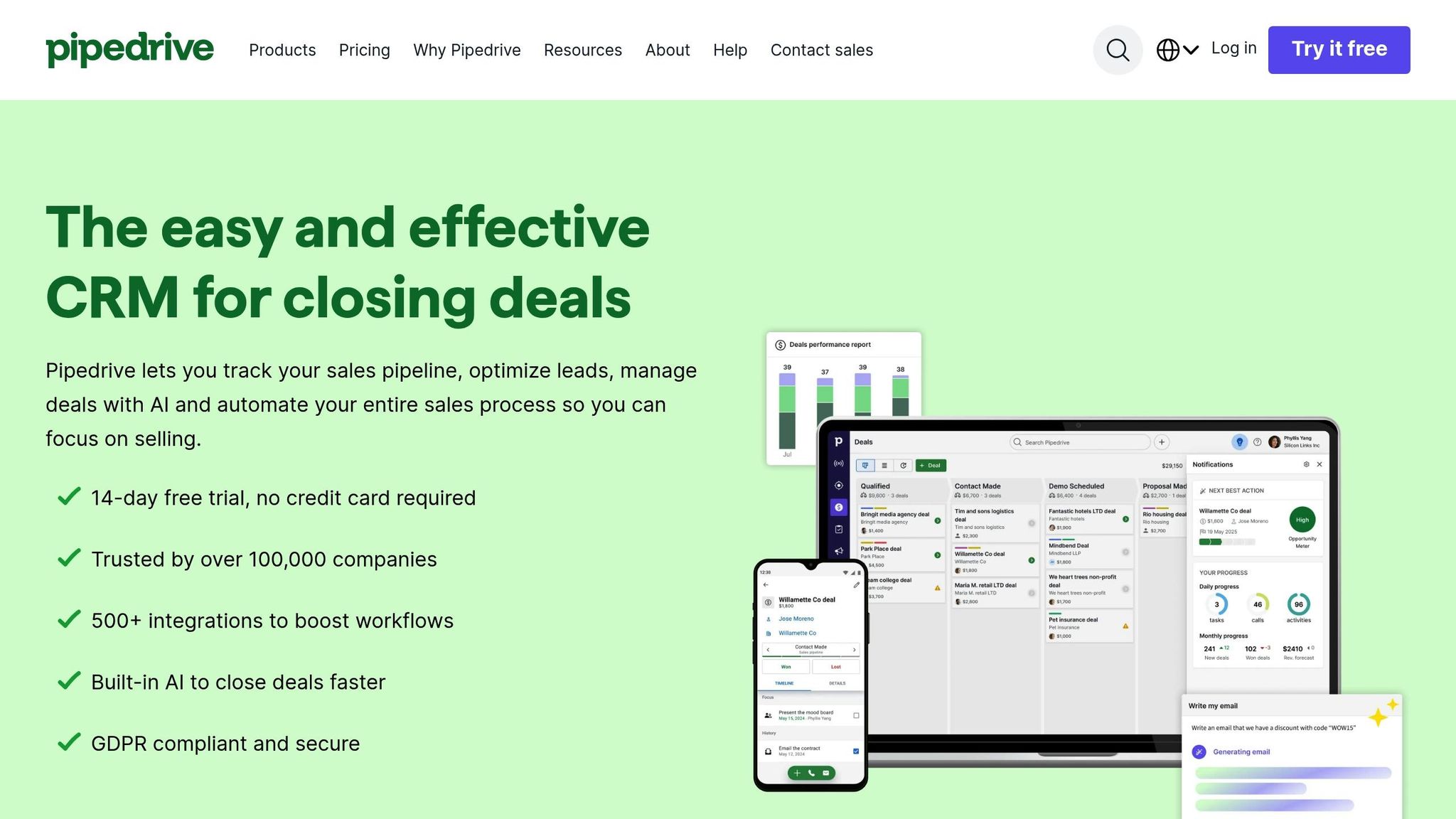
Pipedrive offers a Kanban-style interface designed to automate repetitive sales tasks. This tool stands out for its ability to simplify sales processes using AI, helping businesses work more efficiently and increase revenue. Trusted by over 100,000 companies in 179 countries [11], Pipedrive is user-friendly and doesn't demand technical expertise to operate.
Automation Triggers and Workflow Capabilities
Pipedrive employs two main types of automation triggers: updates to deals or contacts and specific dates like contract renewals or follow-up reminders. These triggers enable the creation of if-then sequences, complete with branching logic for more complex workflows.
For example, Key Search implemented over 100 automations using Pipedrive, speeding up their internal processes by 40% [11].
"I think that without Pipedrive, we would not have grown so fast. We must hire additional consultants now because the system is getting bigger and we need more help!"
– Franziska Palumbo-Seidel, CEO and Founder, Key Search [11]
These triggers form the backbone of Pipedrive's AI-powered features.
AI-Driven Features and Analytics
Pipedrive's AI Sales Assistant is packed with tools to enhance sales performance. It predicts the likelihood of winning deals, highlights stalled opportunities, and assigns lead scores. Additionally, its Forecast View keeps tabs on deals nearing closure, ensuring businesses maintain accurate revenue projections [13][14][11][9].
"As a business owner, my favorite feature in Pipedrive is the statistics and being able to look at the dashboard and use those metrics to help each individual on the team."
– Lisa Coyle, CEO, 360 Payments [11]
The platform’s visual dashboards provide managers with clear insights into individual and team performance, enabling more targeted coaching and decision-making.
Integration with Other Sales Tools
Pipedrive integrates seamlessly with other tools to keep workflows running smoothly. Its Marketplace offers over 500 native integrations, and through Zapier, users can connect to an additional 8,000+ apps [2][16]. Popular integrations include Slack, Microsoft Teams, Asana, Trello, and Surfe, ensuring teams stay updated in real time [11][16].
Plan | Monthly Cost | Key Features | AI Access |
|---|---|---|---|
Essential | $14/user | Basic CRM, email integration, mobile app | No |
Growth | Higher tier | Workflow automation, multiple pipelines | No |
Premium | $49/user | AI Sales Assistant, advanced forecasting | Yes |
Ultimate | Higher tier | Full AI features, unlimited automations | Yes |
Pricing starts at $14 per user per month (annual billing), with automation tools included in Growth plans and AI features available in the Premium and Ultimate tiers. A 14-day free trial is available, and no credit card is required to get started [2][12][13][11][9].
4. Close
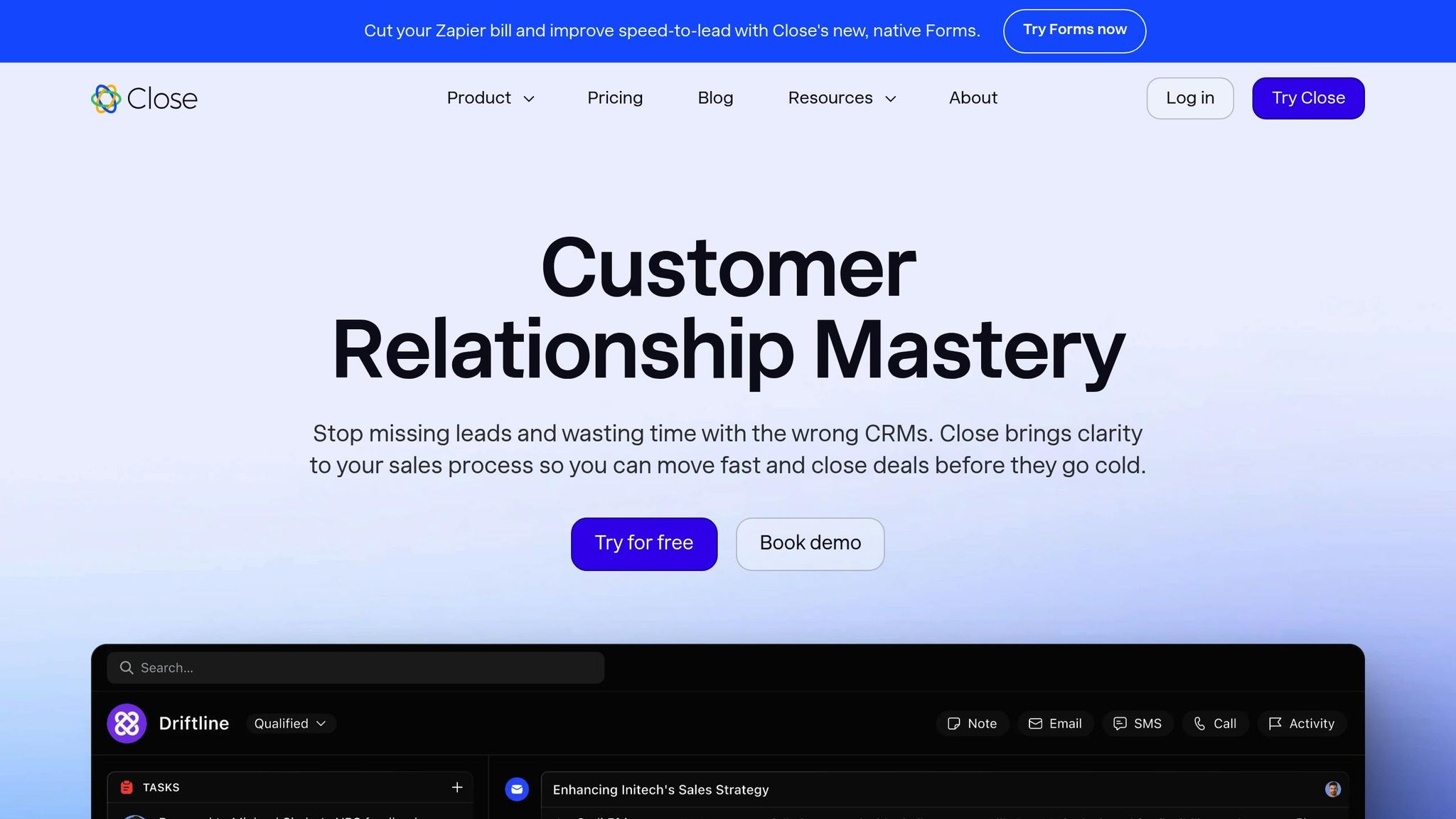
Close is designed to help sales teams cut down on admin work and focus on what matters most: closing deals. By combining integrated calling, workflow automation, and AI-driven tools, Close ensures reps spend more time in conversations and less time on data entry. It's no surprise that 98% of users report saving at least 3 hours of manual work each week with Close [17].
Automation Triggers and Workflow Capabilities
Close's automation features kick in based on specific events, such as when a new lead is created, an opportunity's status changes, or a call concludes. Users can fine-tune these triggers - for example, by filtering based on opportunity value or call duration - to automatically perform actions like sending emails, updating lead fields, or creating tasks. Features like "Communication Windows" ensure outreach happens only during business hours, while "Blackout Dates" prevent contact on holidays [33,37].
One standout tool is the "Goal" function, which pauses automated sequences the moment a prospect takes action, such as replying to an email or scheduling a meeting. This prevents unnecessary follow-ups and keeps interactions relevant. For teams managing inbound leads, Close also supports ultra-fast responses to website submissions, with delays measured in mere minutes [18].
"Whether it's capturing, nurturing, or following up with leads, Close adapts flexibly to our unique processes and helps us streamline our workflow to a level that few other CRMs can match."
– Damian Golunski, Managing Director, Dago Express [17]
These automation tools lay the groundwork for Close's advanced AI features.
AI-Driven Features and Analytics
Close takes automation a step further with AI tools designed to streamline sales operations. For instance, the AI Notetaker transcribes and summarizes sales meetings, logging key action items directly into the CRM [37,38,40]. AI Enrich quickly updates lead records by pulling fresh data from sources like LinkedIn, while AI Summaries give sales reps a quick overview of past interactions before their next call [37,38].
Another key feature, Pipeline Guidance, uses AI to highlight stalled deals and suggest actionable next steps. Additionally, Close's MCP Server connects directly to advanced AI models like Claude and ChatGPT, offering deeper analysis and insights [37,38].
Integration with Other Sales Tools
Close integrates seamlessly with popular tools like Zapier, Slack, Gmail, and WhatsApp, making it easy to connect your sales stack [17]. The platform also introduces native Close Forms, allowing users to capture website leads directly into the CRM - eliminating the need for third-party form builders. A Calendly integration further simplifies scheduling by automatically creating contacts, detecting duplicates, and supporting round-robin scheduling [18].
Pricing and Scalability for Different Team Sizes
Plan | Monthly Cost | Workflows | Power Dialer | AI Features |
|---|---|---|---|---|
Solo | $9/user | Not Included | Not Included | AI Summaries only |
Essentials | $49/user | Not Included | Not Included | AI Summaries only |
Growth | $99/user | Included | Included | Usage-based AI Enrich |
Scale | $139/user | Included | Predictive Dialer | Full AI access |
Close's pricing starts at $9 per user per month (billed annually), with workflow automation available starting at the Growth plan for $99 per user per month. For teams looking to supercharge their sales efforts, the AI Call Assistant is available as an add-on at $50 per month per organization, plus $0.02 per minute [19]. All plans are billed annually.
5. Apollo.io
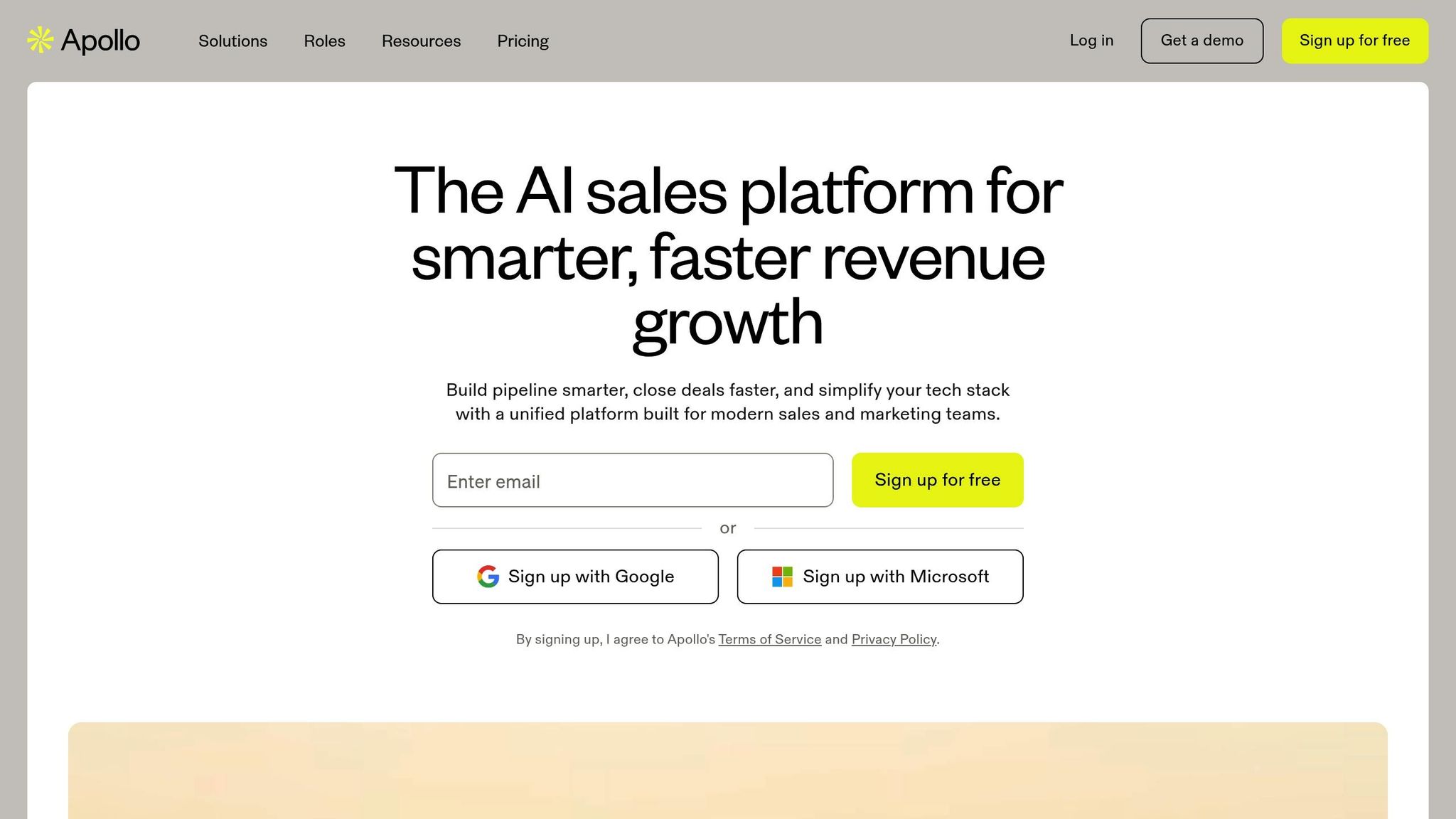
Apollo.io is reshaping sales workflow automation by combining AI-powered tools with a massive contact database to simplify prospecting and outreach. With access to over 275 million contacts and a 96% email accuracy rate, sales teams can cut research time dramatically while automating multi-channel outreach across email, phone, and LinkedIn. The platform's goal is simple: help teams book more meetings without the hassle of juggling multiple tools [23].
Automation Triggers and Workflow Capabilities
Apollo's workflow engine stands out with its visual, drag-and-drop interface, allowing teams to design complex sales processes with ease. Using multi-branch and conditional logic, workflows can be triggered automatically by factors like buyer intent signals, headcount growth, website visits, or custom CRM fields. To make things even easier, Apollo offers a library of over 21 pre-built workflow templates, giving teams a head start with proven strategies [44,46].
The platform handles multi-channel sequences across email, phone, and LinkedIn, using round-robin scheduling to distribute meetings efficiently. Deliverability guardrails, such as automated email warm-up and volume limits, ensure a strong sender reputation. These features have helped teams book 2.5x more meetings compared to manual efforts [20].
"Apollo Workflows save my team a ton of time. There's less steps to creating a workflow which makes it easy to train our employees. And they can build an entire campaign in one workflow." – Chris Cozzolino, CEO & Founder, Uptown Creation [41,44]
This automation backbone is further strengthened by its advanced AI tools.
AI-Driven Features and Analytics
Apollo's AI Research Assistant uses custom prompts to uncover prospect pain points and company priorities, creating enriched data fields for better filtering and targeting [22]. The AI writing assistant then drafts personalized emails for entire contact lists, while sentiment analysis helps fine-tune follow-up messages [44,46].
For example, Alexander Theodorou, CEO of Neurofit, reported saving over 100 hours of manual research for his team of three BDRs by leveraging Apollo's AI Research Assistant. This effort resulted in a 39% email open rate [22]. On top of that, the platform's conversation intelligence provides AI-driven call summaries and real-time coaching suggestions, enabling managers to boost team performance [43,48].
Integration with Other Sales Tools
Apollo.io ensures seamless integration with other tools in your sales tech stack. Its bi-directional syncing with CRMs like Salesforce, HubSpot, and Pipedrive keeps data consistent and up-to-date. Additionally, it connects with specialized tools like Orum and Nooks to sync call tasks, notes, and recordings automatically. Slack integration adds another layer of convenience by delivering instant alerts when leads show buyer intent or other critical signals [46,49].
Sylvain Giuliani, Head of Growth at Census, replaced his company’s entire tech stack with Apollo, gaining access to 4x more contact data while cutting platform costs by 64% [21]. Similarly, Collin Stewart, CEO of Predictable Revenue, achieved 50% cost savings, doubled email open rates, and halved meeting setup time after consolidating onto Apollo [43,46].
Pricing and Scalability for Different Team Sizes
Apollo offers a free plan for basic needs, with paid plans starting at $50–$100 per user per month. Teams looking for advanced AI features can opt for enterprise plans, which typically range from $100 to $300+ per user monthly. This all-in-one pricing structure often reduces total tech stack expenses by 50% to 64%, as it eliminates the need for separate tools like data providers, dialers, and enrichment services [23].
6. Zapier
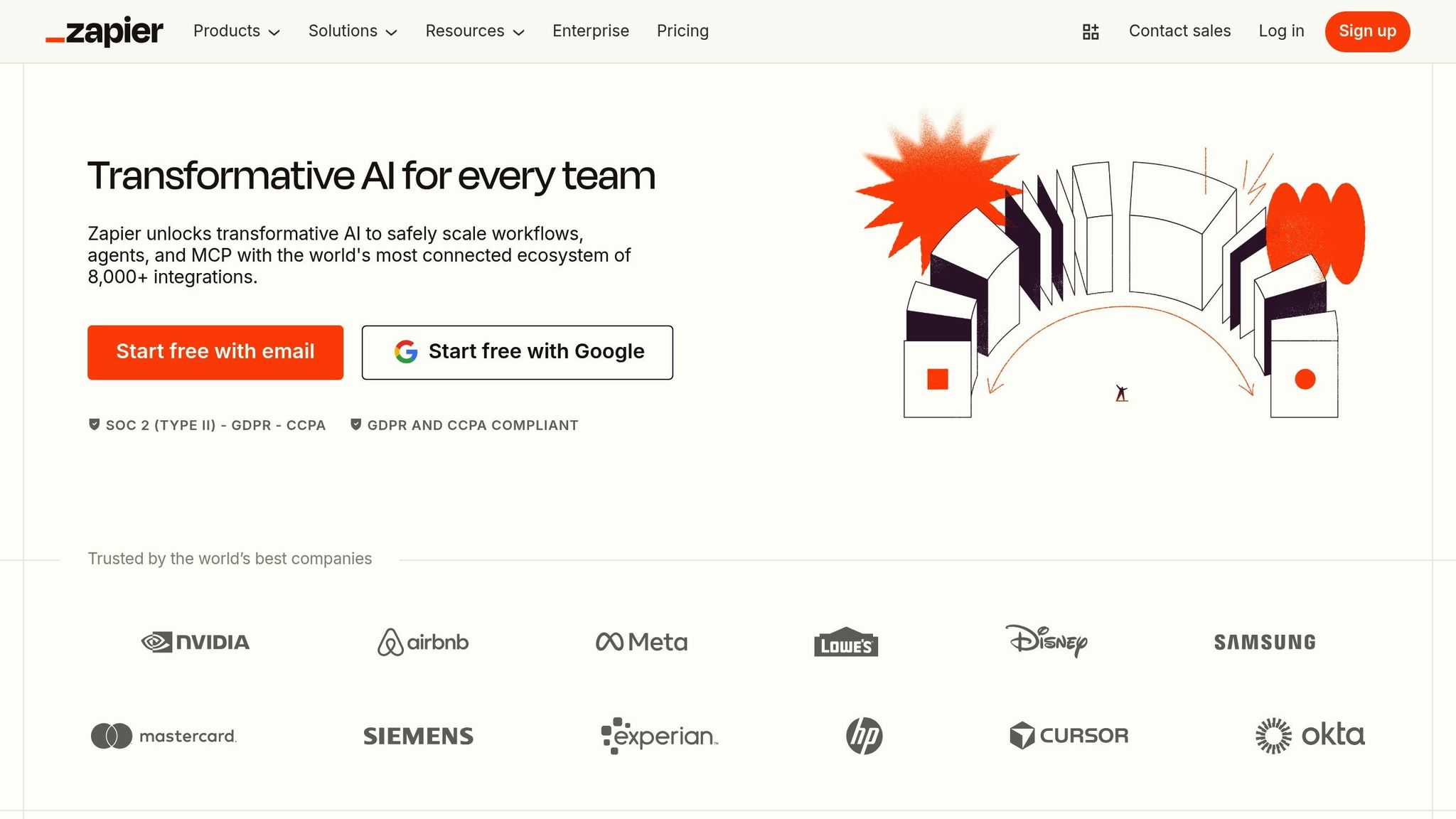
Zapier serves as a powerful connector, linking over 8,000 apps to create a seamless automation experience. By integrating various tools, Zapier transforms isolated sales processes into a cohesive system. It's no surprise that more than 3.4 million companies trust Zapier to manage repetitive tasks, with over 100 million tasks handled by AI through the platform [26]. This integration drives advanced, trigger-based workflows that simplify complex operations.
Automation Triggers and Workflow Capabilities
Zapier eliminates the need for technical expertise when automating intricate, multi-step sales processes. Its Paths feature uses if/then logic to direct leads based on factors like region or deal size, while Filters ensure workflows activate only under specific conditions. These tools deliver measurable benefits. For instance, Jacob Sirrs from Vendasta shared that Zapier automation saved his team 282 days of manual work annually and generated $1 million in potential revenue [25].
Another success story comes from Smart Charge America. According to Vice President David Laderberg, Zapier saves each estimator 75 minutes daily. The company operates 77 automated workflows, or "Zaps", that handle over 18,000 tasks weekly, enabling them to function with just 50 employees instead of 100 [26].
AI-Driven Features and Analytics
Zapier goes beyond basic automation with its AI-driven features. Its AI Agents can carry out multi-step sales tasks using simple natural language commands, such as conducting pre-call research or enriching lead data. The Copilot feature allows users to build complex workflows by simply describing their goals in plain English, enabling first-time users to set up automations in under six minutes [26].
Popl provides a great example of Zapier's AI in action. By integrating Zapier with OpenAI, the sales team automated the triage of hundreds of daily demo requests, routing leads based on company size and region. This workflow saves the company $20,000 annually [27].
Integration with Other Sales Tools and Pricing
Zapier works effortlessly with leading CRMs like Salesforce, HubSpot, and Pipedrive, as well as communication tools like Slack and Gmail. This connectivity ensures smooth transitions from lead capture to CRM updates and team notifications. The platform offers a free plan for basic two-step workflows, with paid plans starting at $19.99 per month (billed annually) for the Professional tier. Team plans are available at $69 per month for up to 25 users, while Enterprise plans provide custom pricing, enhanced security, and a 99.9% uptime guarantee [2].
7. Zoho CRM
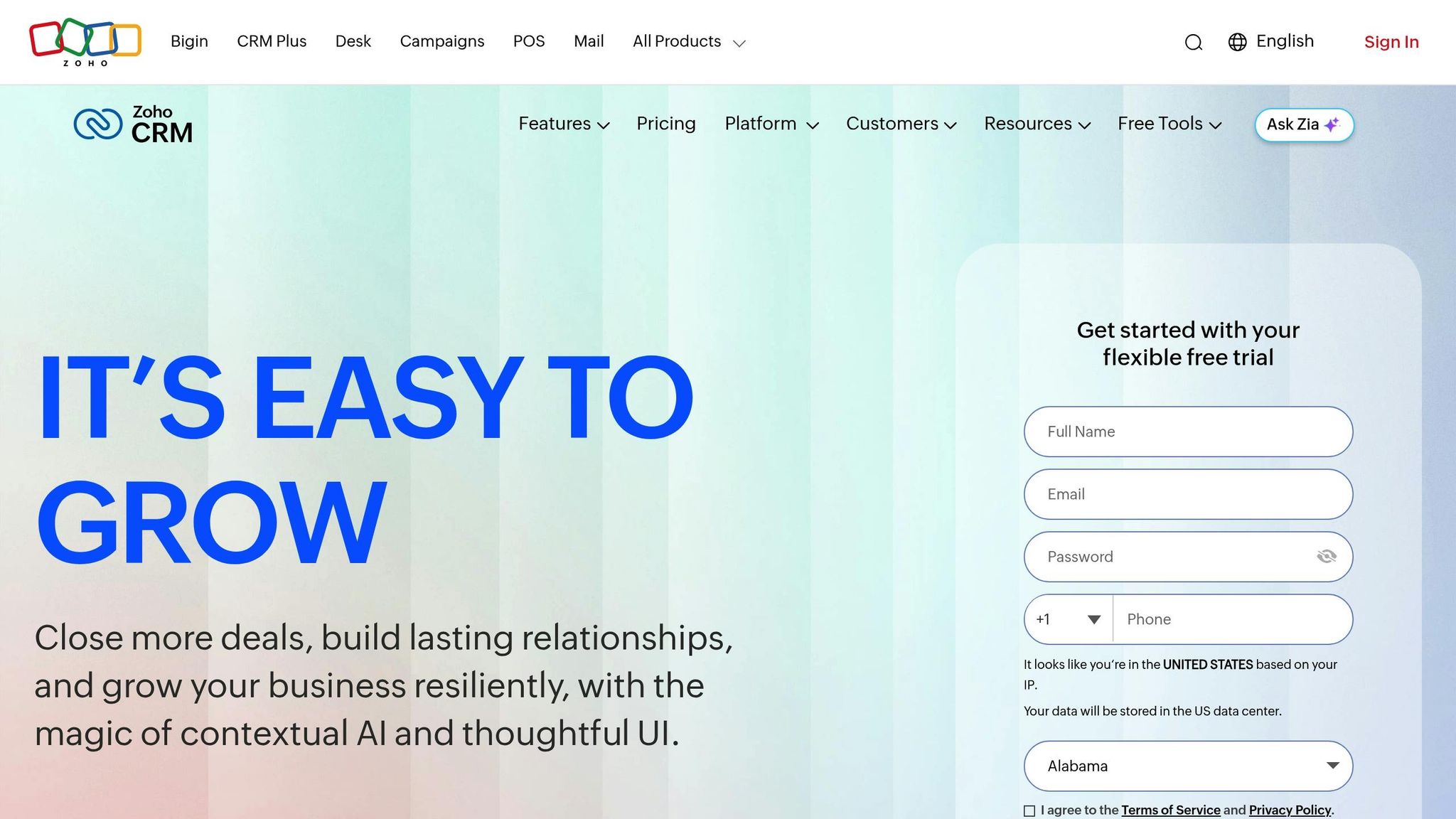
Zoho CRM continues to push the boundaries of AI-powered sales automation, showcasing how customized workflows and intelligent tools can amplify results. With over 300,000 users worldwide, Zoho CRM delivers impressive outcomes: a 300% increase in lead conversion, 41% more revenue per salesperson, and 24% faster sales cycles [31]. Let’s dive into its standout features in automation, AI, and integrations.
Automation Triggers and Workflow Capabilities
Zoho CRM excels in workflow automation with its versatile triggers. These include record actions (like creating, editing, or deleting records), date and time fields (such as deal closing dates with recurring reminders), scoring rules (adjusting based on record scores), and AI-driven recommendations from Zia, Zoho's built-in assistant. The platform handles up to 5,000 records every 10 minutes for date-based workflows [32].
Key tools like Blueprint guide sales teams through structured processes, while Cadences ensure consistent follow-ups. The Canvas design studio allows users to create intuitive, code-free interfaces, and Client Script enables advanced UI customizations for technical users [28]. Zoho CRM also integrates with external systems using webhooks and custom functions, making it highly adaptable [29].
AI-Driven Features and Analytics
Zoho’s AI assistant, Zia, adds a layer of intelligence to sales processes. Through voice or chat commands, Zia can retrieve data, predict win probabilities, detect anomalies, and provide actionable recommendations. It analyzes touchpoints to suggest the best products for each pitch and assigns records to the most suitable sales reps based on past performance.
Zia’s Best Time to Contact feature analyzes historical patterns to recommend the optimal outreach times, while its sentiment analysis tool helps prioritize emails by identifying customer intent - distinguishing complaints from general inquiries [30]. Additionally, Zia’s workflow intelligence suggests custom automations for repetitive tasks and evaluates existing workflows to prevent errors like duplicate email templates [29][30].
Integration with Other Sales Tools
Zoho CRM integrates seamlessly with tools like Slack, Zoho Cliq, and Cisco Webex, enabling instant notifications triggered by workflow rules [32]. Its OpenAI ChatGPT integration allows sales reps to draft and refine emails directly within the CRM [31]. Beyond native integrations, it connects with over 8,000 third-party apps via webhooks, custom functions, and Zapier [2][26].
The CRM for Everyone (CRM4E) feature promotes cross-department collaboration, automates lead enrichment using data from social media and company websites, streamlines quote-to-cash processes, and even provides Competitor Alerts by flagging mentions of competitors in integrated communications [28][31][32].
Pricing and Scalability for Different Team Sizes
Zoho CRM offers a 15-day free trial and a free basic version [28][29]. Paid plans include Standard, Professional, Enterprise, and Ultimate tiers. Enterprise and Ultimate tiers allow up to 10 conditions per workflow rule, while Standard and Professional support up to 5 conditions. Automated record creation is available starting with the Professional tier [32].
The Portals feature enhances scalability by creating dedicated spaces for customers, partners, and vendors to interact with CRM data. This makes Zoho CRM a great fit for growing teams and businesses [28].
8. Outreach
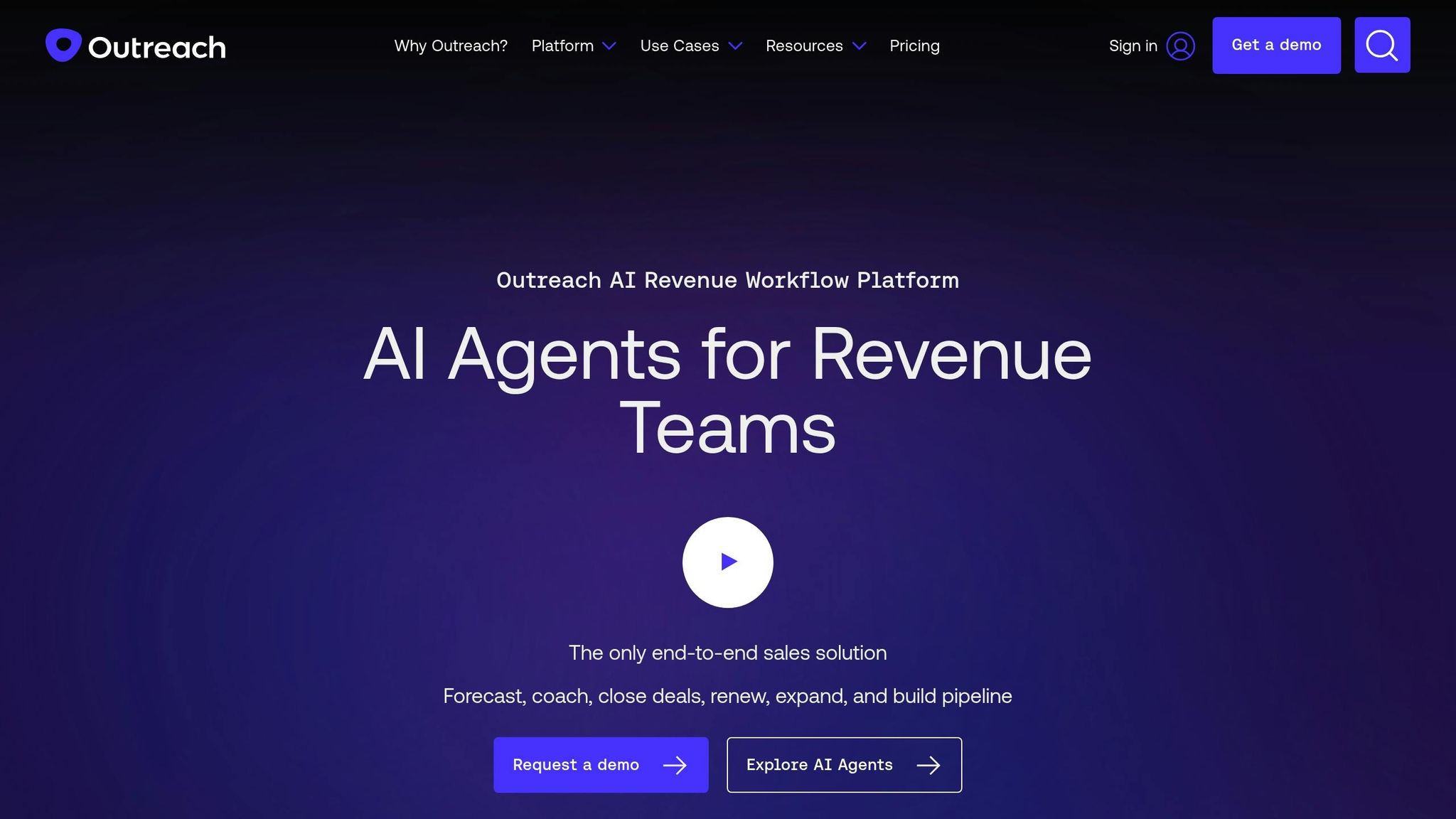
Outreach is a revenue workflow platform powered by AI, processing over 33 million action-outcome pairings every week to refine its machine learning models [36]. Users of the platform report a 60% increase in seller productivity [24], and its conversation intelligence features help close deals an average of 11 days faster [37].
Automation Triggers and Workflow Capabilities
Outreach’s automation is driven by four AI Agents that identify opportunities and initiate multi-channel sequences, including email, LinkedIn, SMS, and phone calls [34]. The system is smart enough to pause these sequences automatically when prospects respond, schedule meetings, or fill out forms, ensuring no redundant communication occurs [33].
Behavior-based triggers allow the platform to react in real time to prospect actions. For instance, it flags high-intent visitors who view pricing pages three or more times, creates deal records when prospects book demos, and highlights at-risk deals if engagement drops for more than seven days [33]. Lead routing ensures that high-value prospects - scored based on engagement and demographics - are assigned to the right sales representatives [33].
These features enable Outreach to deliver actionable insights powered by AI.
AI-Driven Features and Analytics
The platform utilizes Predictive AI for forecasting outcomes and Generative AI to draft personalized emails [36]. Its conversation intelligence tool, Outreach Kaia, provides real-time transcription, sentiment analysis, and action-item detection [34][36]. With AI-powered forecasting, the platform achieves accuracy rates of up to 98%, with some sales leaders reporting 99% accuracy in deal predictions [36][37].
"The goal was always simplicity. Reps are finding it much easier than Salesforce. And now we're getting easier, deeper insights into the structure in a way we've never had before."
Thorsten Reichenberger, Head of Revenue Operations, Siemens [24]
In 2025, Siemens collaborated with Outreach to overhaul its global forecasting processes for 4,000 sellers across 190 countries. Using the Seller Action Hub to unify opportunity workflows, Siemens increased forecast submissions to over 70% [38]. Similarly, LivePerson leveraged AI prospecting tools to cut research time from 20 minutes to just 2 minutes per prospect, boosting engagement rates by 35% [37].
Integration with Other Sales Tools
Outreach’s advanced automation and AI capabilities extend through its seamless integration with other sales tools. Supporting over 90 integrations, the platform offers bi-directional synchronization with Salesforce, automatically logs calls, and identifies lead-to-contact conversions [35]. The Outreach Data Cloud combines first-party engagement signals, CRM data, data warehouse connections, and third-party intelligence into a unified system through its four-layer architecture [34].
For example, Omniplex Learning’s CRO, Tom Hammond, implemented real-time pipeline visibility using Outreach, eliminating manual spreadsheet reviews and tightening forecast accuracy to within 5% [38].
Pricing and Scalability for Different Team Sizes
Outreach caters to mid-market and enterprise clients with custom pricing tailored to specific features [24]. According to Forrester, businesses using unified revenue platforms like Outreach see an average 299% ROI over three years [38]. The platform has earned recognition as a "Leader" in Forrester's Wave: Revenue Orchestration Platforms (Q3 2024) and IDC MarketScape’s 2024 Revenue Intelligence Platforms assessment [38].
9. Gong
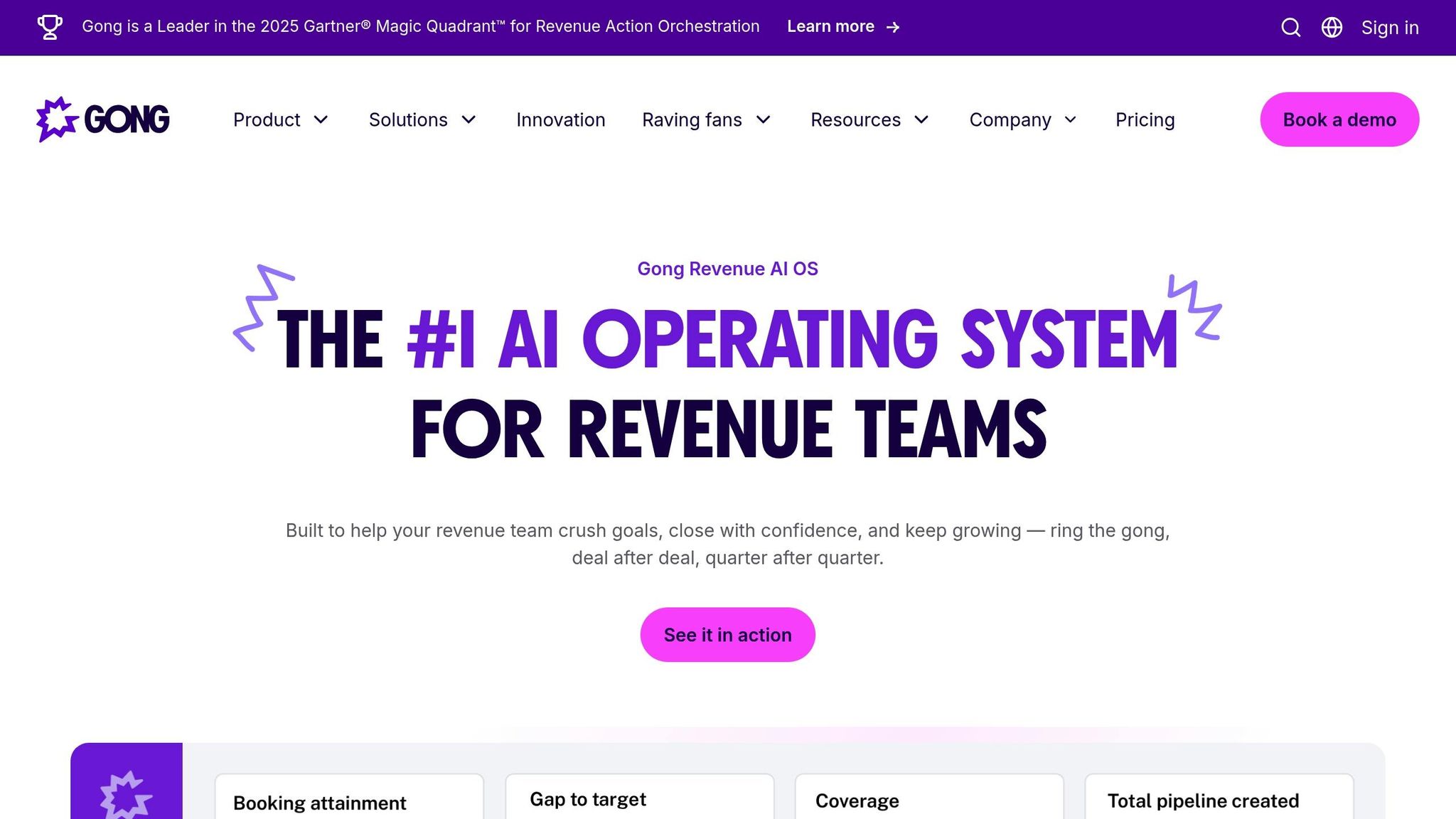
Gong operates as a Revenue AI OS, capturing nearly all customer interactions - calls, emails, and meetings - to provide actionable insights for sales teams [42]. Trusted by over 5,000 customers, including 40% of the Fortune 10, Gong boasts an impressive 4.7/5 rating on G2 from more than 6,200 reviews [39]. In 2025, it was recognized as a Leader in the Gartner Magic Quadrant for Revenue Action Orchestration, earning top marks for "Ability to Execute" [39]. Let’s dive into how Gong’s automation and AI tools help sales teams streamline their efforts and achieve better results.
Automation Triggers and Workflow Capabilities
Gong employs AI agents to handle follow-ups, update pipelines, and refine forecasts [39]. Its AI Tasker prioritizes actions by analyzing deal context and buyer signals [42]. For instance, when deals show risk indicators - like stalled conversations or reduced engagement - the system flags them and suggests next steps. A real-world example? Uber for Business saved 6,700 hours on call prep, follow-ups, and CRM updates in 2025. By using Gong’s AI Tracker agent to pinpoint effective value propositions, they also boosted buyer response rates by 32% [39]. This proactive automation ensures sales teams can address potential issues before they escalate.
AI-Driven Features and Analytics
Gong’s Revenue Graph consolidates all customer interactions into a single source of truth [39]. Its Predictive Intelligence evaluates over 300 signals to forecast deal outcomes, while tools like the AI Call Reviewer and Trainer analyze calls to highlight best practices and address skill gaps [40][42]. Upwork, for example, achieved 95% forecast accuracy within three quarters of adopting Gong. Drew Korab, Upwork’s Director of RevOps, noted a 60% increase in rep capacity due to a significant reduction in administrative work [42]. Another success story: SpotOn saw a 30% rise in top-of-funnel opportunities and converted 20% more of them into revenue using Gong Engage’s automation features [44].
"Gong allows our leaders to coach more effectively. They don't have to ask reps what happened last week. Instead, they use Gong's deals board and AI-generated call summaries to immediately be ready for a productive conversation."
Christine Talcott, Sr. Division Vice President Enablement & Global Events, ADP [42]
Gong’s AI Composer takes personalization to the next level by drafting outreach emails based on past customer interactions, leading to an average 34% increase in response rates [44]. Additionally, its advanced analytics identify deal risks, complex concepts, and emerging trends, providing sales teams with a competitive edge [40].
Integration with Other Sales Tools
Gong integrates seamlessly with over 250 tools, including Salesforce, Microsoft Teams, Zoom, Slack, and Okta [41][45]. Its bi-directional sync with Salesforce automatically updates CRM records with real-time interaction data [45]. Slack integration delivers automated notifications, while Microsoft 365 Copilot helps teams act on insights within their usual workflows [45]. For example, Frontify’s Head of Revenue Operations, Naya Tsoukala, reported a 30% increase in lead conversion by centralizing pipeline management and forecasting through Gong [45]. Gong’s Agent Studio also empowers admins to configure AI agents without IT support, offering support in over 70 global languages via its AI Translator [46].
Pricing and Scalability for Different Team Sizes
Gong doesn’t offer fixed pricing tiers. Instead, potential customers are encouraged to book a demo to receive a tailored enterprise pricing plan based on their team size and needs [39][43]. The platform scales effortlessly, catering to both mid-market teams and large enterprises with robust security and compliance standards [45][43]. Canva’s use of Gong for sales messaging led to a 60% increase in rep capacity and a 6% boost in overall revenue [46]. Similarly, Pitchbook saw a 10× improvement in efficiency through automated follow-ups and training [39].
10. Clari
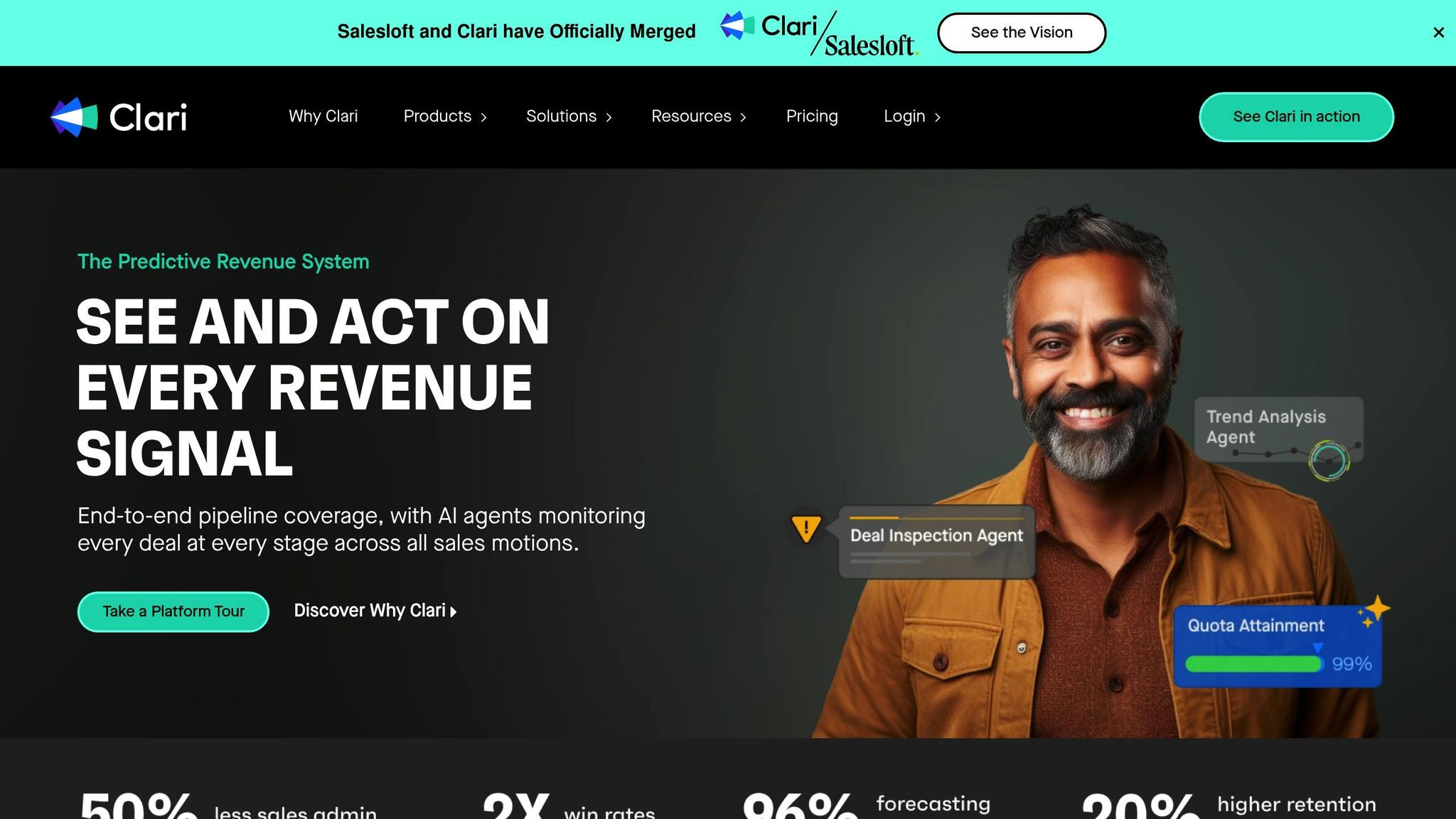
Clari is an enterprise-level platform designed to streamline revenue operations by automating sales workflows with AI-powered tools and seamless integrations. It’s reported to deliver an impressive 398% ROI, making it a go-to solution for businesses aiming to optimize their revenue processes[47]. A standout feature, Revenue Context, pulls data from CRM, ERP, and email systems, giving Clari’s AI a clear understanding of how your business operates[47].
Automation Triggers and Workflow Capabilities
Clari transforms sales strategies into actionable, repeatable processes through its Revenue Cadences. With 24/7 AI Agents and the Clari Guide, the platform monitors pipelines, updates deal stages based on CRM activity and communication signals, and suggests the next best steps[48][8]. For example, BirchStreet Systems experienced a 70% year-over-year increase in bookings after adopting Clari. Chief Revenue Officer David Schloss highlighted how forecast accuracy improved dramatically, consistently landing within 3–4% of actual results every quarter[47].
"Clari has really become the revenue operating system here in Alight. When we think about forecast improvement and accuracy, we now have one version of the truth."
Ally Bean, SVP of Revenue Operations and Demand, Alight[48]
Clari’s automation features are complemented by its AI capabilities, which take deal management to the next level.
AI-Driven Features and Analytics
Clari employs AI to analyze conversation data, sales activities, and CRM signals, offering precise predictions about deal outcomes[49]. Its Smart Deal Summaries compile emails, call transcripts, and notes, cutting down deal review time by 30 minutes per deal[49]. Over six months leading up to March 2025, usage of these summaries surged by 572%[49].
The Clari Omnibar provides sales reps with guided, prioritized tasks directly within their workflows, saving up to 2 hours daily[49]. Meanwhile, Ask Clari acts as an AI-powered assistant, delivering quick answers to deal and account management questions, along with actionable recommendations. Features like Advanced Opportunity Scores highlight stalled deals or hidden opportunities, helping managers make data-driven decisions instead of relying on gut instincts[50][51]. Many enterprise users report closing new logo deals 20% faster and achieving forecast accuracy rates exceeding 95%[49][6].
"Clari's AI and predictive capabilities have been a game-changer. Our CEO and top executives rely on Clari to predict outcomes, while our field teams focus and execute with greater confidence."
Paty Hanna, VP of Field Strategy and Operations, Okta[47]
Integration with Other Sales Tools
Clari integrates seamlessly with popular CRMs like Salesforce and HubSpot, email platforms such as Gmail and Outlook, and sales enablement tools like Highspot. This integration highlights the future of sales enablement where AI-driven insights unify disparate data sources. These connections create a unified, real-time view of revenue operations[8]. Additionally, Clari’s conversational intelligence features analyze call and meeting transcripts to identify verbal cues and emotional signals, enabling AI Agents to recommend actionable next steps[8][48]. All of this data feeds into the Revenue Context system, solidifying Clari’s position as a key player in revenue orchestration[48].
Pricing and Scalability for Different Team Sizes
Clari operates on a custom pricing model tailored to mid-market and enterprise clients. It can scale to accommodate teams of over 5,000 users, as seen with organizations like Adobe and Workday[47][48][49][6]. Prospective customers need to schedule a demo and receive a personalized quote based on their unique requirements[47][48].
Feature Comparison Table
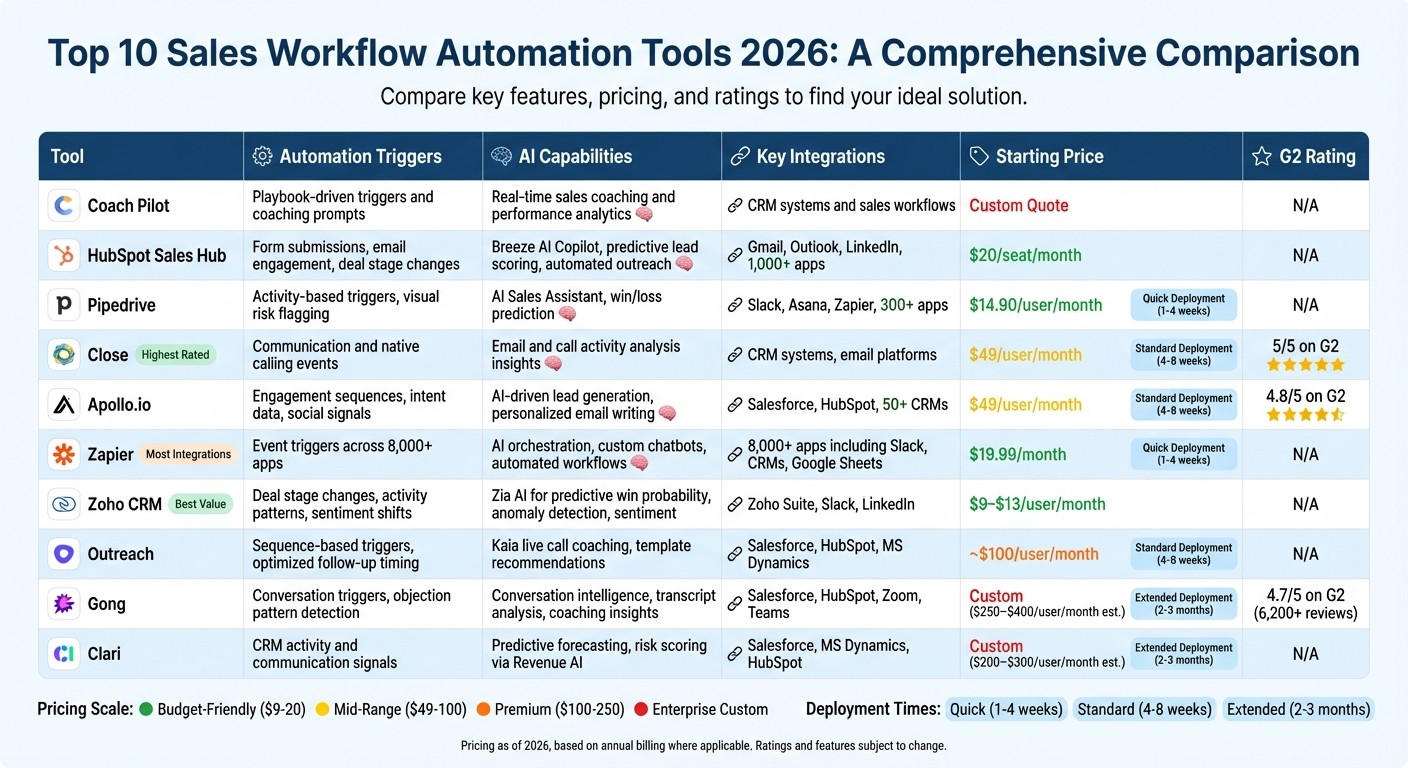
Sales Workflow Automation Tools Comparison 2026: Features, Pricing & AI Capabilities
Here's a quick breakdown of the core features offered by each tool, covering automation triggers, AI functionalities, integrations, and pricing. This comparison is designed to help you make an informed decision efficiently.
Tool | Automation Triggers | AI Capabilities | Key Integrations | Starting Price |
|---|---|---|---|---|
Coach Pilot | Playbook-driven triggers and coaching prompts embedded in workflows | AI-powered real-time sales coaching and performance analytics | Works with existing sales workflows and CRM systems | Custom Quote |
HubSpot Sales Hub | Triggers based on form submissions, email engagement, and deal stage changes | Breeze AI Copilot, predictive lead scoring, and automated outreach drafting [2][15] | Gmail, Outlook, LinkedIn, and 1,000+ apps [3] | $20/seat/month [15] |
Pipedrive | Activity-based triggers and visual risk flagging | AI Sales Assistant for neglected deals and win/loss prediction [15] | Slack, Asana, Zapier, and 300+ apps [3] | $14.90/user/month [15] |
Close | Triggers centered on communication and native calling events | Insights from email and call activity analysis | CRM systems and email platforms | $49/user/month [15] |
Apollo.io | Engagement sequences, intent data, and social signals | AI-driven lead generation and scalable personalized email writing [15][4] | Salesforce, HubSpot, and 50+ CRMs [7] | $49/user/month [15] |
Zapier | Event triggers across 8,000+ apps | AI orchestration, custom chatbots, and automated workflows [2] | Over 8,000 apps, including Slack, CRMs, and Google Sheets [1] | $19.99/month [2] |
Zoho CRM | Triggers based on deal stage changes, activity patterns, and sentiment shifts | Zia AI for predictive win probability, anomaly detection, and sentiment analysis [15] | Zoho Suite, Slack, and LinkedIn [3] | $9–$13/user/month [15] |
Outreach | Sequence-based triggers with optimized follow-up timing | Kaia live call coaching and template recommendations [4] | Salesforce, HubSpot, and MS Dynamics [6] | ~$100/user/month [4] |
Gong | Conversation triggers and objection pattern detection | Conversation intelligence with transcript analysis and coaching insights [4] | Salesforce, HubSpot, Zoom, and Teams [3] | Custom pricing (est. $250–$400/user/month) [3] |
Clari | CRM activity and communication signals | Predictive forecasting and risk scoring via Revenue AI | Custom enterprise pricing (est. $200–$300/user/month) [3] |
For additional context, user ratings and deployment timelines can further refine your decision. For instance, Apollo.io scored 4.8/5 on G2, praised for its massive 275+ million contact database, though some users report data accuracy issues outside North America [1]. Meanwhile, Close earned a perfect 5/5 on G2, appreciated for its communication-focused design and native calling features [15].
If you're looking for budget-friendly options, Zoho CRM ($9–$13/user/month) and Pipedrive ($14.90/user/month) are worth considering. For enterprise-grade solutions, Gong and Clari offer advanced capabilities but require custom pricing. Deployment times vary - expect 1–4 weeks for tools like Pipedrive and HubSpot, while larger platforms like Gong and Clari may take 2–3 months [3].
Conclusion
Sales workflow automation in 2026 is reshaping how teams operate. By automating tasks, sales reps can reclaim nearly 65% of the time they currently spend on administrative work [5]. This shift allows them to focus more on high-value selling activities. When used effectively, these tools can lead to measurable gains, such as 15–20% higher win rates, 20–30% shorter sales cycles, and an 18–22% improvement in meeting quotas [1]. These advancements set the stage for a seamless move toward autonomous sales operations.
Today, autonomous digital tools manage tasks like prospect research, personalized outreach, and meeting scheduling. They even provide real-time coaching during live calls, enabling sales teams to work smarter.
"The purpose of sales automation tools isn't to get rid of human talent. It's to give human workers more space for using their skills instead of spending hours on tedious administrative tasks." - Zendesk [52]
To get started, identify the most time-intensive tasks in your workflow and automate them step by step [52]. Choose platforms with native, bi-directional CRM integration to avoid data silos, and ensure the software aligns with your team’s daily routines by conducting hands-on testing [7][52]. For enterprise-level teams, confirm that your chosen solution complies with SOC 2, GDPR, and CCPA standards [1].
Whether you’re considering a cost-effective option like Zoho CRM with its competitive pricing or advanced tools like Gong and Clari for enterprise needs, the ideal solution should align with your revenue goals, team size, and integration requirements. Clearly define your priorities, involve your sales team in the decision-making process, and select a platform that grows with your business. By adopting these tools, your team can unlock new levels of efficiency and drive revenue growth like never before.
FAQs
How do sales workflow automation tools help close deals faster and improve success rates?
Sales workflow automation tools are a game-changer for teams aiming to close deals faster. These tools take over repetitive tasks like data entry, follow-ups, and pipeline updates, freeing up sales professionals to focus on what truly matters - building relationships with prospects and addressing their specific needs. By cutting down on manual work and reducing errors, they help smooth out the sales process and eliminate unnecessary delays.
Many of these tools come equipped with AI-driven features like predictive analytics and lead prioritization. These capabilities help identify high-potential opportunities, ensuring that sales teams target the right prospects at the right time. The result? More effective outreach and a higher chance of sealing the deal.
On top of that, real-time insights and integrated workflows give teams instant access to essential buyer information. This enables personalized, timely interactions that not only shorten the sales cycle but also significantly improve win rates.
What AI features should you prioritize in sales automation tools for 2026?
When selecting sales automation tools for 2026, focus on AI-powered features that simplify workflows and boost efficiency. The right tools can handle tasks like researching prospects, crafting tailored outreach, and managing communication across multiple channels. This means less time spent on repetitive tasks and more time for meaningful engagement.
Look for tools that offer real-time data analysis, predictive insights, and adaptive sequencing. These capabilities can fine-tune lead generation, streamline follow-ups, and close deals faster. Features such as next-best action suggestions, smart account insights, and systems that learn continuously from sales interactions are particularly valuable for improving both accuracy and speed in sales processes.
Additionally, it’s crucial to choose tools that align with evolving privacy and data security standards. Protecting sensitive information while maintaining operational efficiency is non-negotiable. By leveraging these advanced AI features, businesses can enhance revenue growth and empower their sales teams to perform at their best in 2026.
How do sales automation tools work with CRMs and communication platforms?
Sales automation tools are designed to work hand-in-hand with CRMs and communication platforms, making workflows smoother and boosting productivity. They often integrate with well-known CRMs like Salesforce or HubSpot, automating tasks such as updating contact records, managing sales pipelines, and logging interactions - all directly within the CRM. These integrations rely on APIs or built-in connectors to ensure data flows seamlessly and stays updated in real-time.
Beyond CRMs, these tools also connect with communication platforms like email and messaging apps. This enables features like automated follow-ups, personalized outreach, and activity logging - all without requiring manual input. Many platforms even provide no-code or low-code customization, so sales teams can design workflows that fit their specific needs. By reducing repetitive tasks and keeping processes unified, these integrations help businesses work more efficiently and stay focused on growing revenue.
Related Blog Posts

Remove the guesswork from winning more deals.