B2B Sales
5 Problems Real-Time Coaching Solves for Sales Teams
Apr 7, 2026
Real-time coaching gives reps instant, AI-guided prompts during live calls to catch missed signals and close more deals.

Real-time coaching solves five key challenges for sales teams by delivering instant, actionable guidance during live calls. Unlike traditional coaching methods that rely on delayed feedback, real-time coaching empowers reps to improve performance in the moment. Here's what it addresses:
Delayed Feedback: Traditional coaching often arrives too late to save a deal. Real-time coaching provides immediate insights, helping reps adjust during calls.
Inconsistent Performance: High achievers thrive while others struggle. Real-time tools ensure every rep gets tailored, on-the-spot guidance to close the performance gap.
Overwhelmed Managers: Managers often lack time for effective coaching. AI-driven systems automate performance analysis, freeing managers to focus on impactful coaching moments.
Missed Opportunities: Critical buying signals can be fleeting. Real-time coaching helps reps catch and act on these signals instantly.
Hidden Skill Gaps: Traditional methods fail to pinpoint specific weaknesses. Real-time systems analyze live calls to uncover and address gaps in real-time.
Quick Stats:
Calls with real-time coaching close at 2.3x the rate of uncoached calls.
Teams using AI tools achieve up to 91% quota attainment.
Real-time coaching cuts new hire ramp time by 60%.
Real-time coaching doesn’t just analyze past mistakes - it helps sales reps win deals as they happen. By integrating AI tools into workflows, teams can boost revenue, improve skills, and close more deals with confidence.
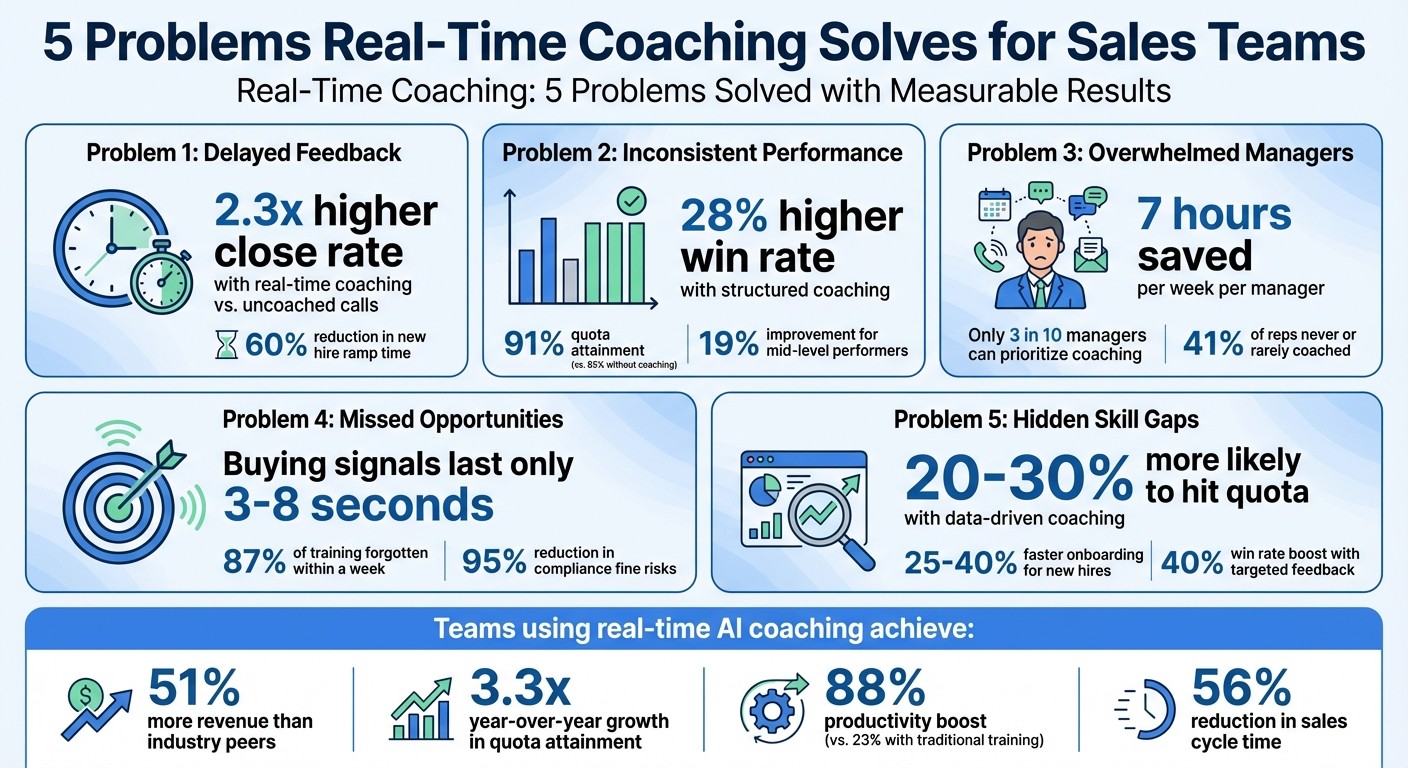
Real-Time Coaching Impact on Sales Performance: Key Statistics
Problem 1: Delayed Feedback Slows Down Skill Development
Traditional sales coaching often operates on a frustrating timeline. Reps typically receive feedback days after a call, making it hard to recall specifics like when a prospect mentioned their budget cycle or raised concerns about implementation timelines. By the time feedback arrives, its relevance diminishes, and the opportunity to adjust in real time is lost. This delay not only reinforces mistakes but also slows the progress of new sales reps. After all, improving on the next call doesn’t help salvage the current deal. For instance, if a manager points out a missed buying signal after the fact, the prospect may have already moved on. While post-call analysis can shed light on what went wrong, it rarely helps in the moment when it matters most.
Real-time coaching changes the game by offering immediate corrections during the call itself.
How Real-Time Coaching Provides Immediate Feedback
Delayed feedback hampers performance, but real-time coaching solves this problem by delivering actionable insights right when they’re needed.
Take tools like Coach Pilot, for example. These systems transcribe audio in real time and provide instant, actionable suggestions. Imagine a prospect mentions a competitor during a call - within seconds, the system surfaces a battle card highlighting key competitive advantages. Or, if the buyer’s tone and pacing suggest they’re nearing a decision, an alert prompts the rep to seize the moment. This kind of immediate intervention prevents errors before they happen and accelerates the learning curve, helping reps quickly identify patterns and buyer signals that might otherwise take years to master.
Business Benefits of Instant Feedback
The impact of instant feedback is undeniable. Calls with real-time coaching boast deal close rates that are 2.3 times higher than those without coaching [2]. High-performing sales teams are nearly twice as likely to adopt AI tools, which not only shorten the learning curve but also reinforce effective habits on the spot. For managers, this means less time spent on exhaustive review sessions and more time focusing on strategy. Meanwhile, teams develop skills faster, close more deals, and generate more revenue. By improving on-call performance, real-time coaching doesn’t just boost current outcomes - it lays the foundation for long-term success.
Feature | Traditional Post-Call Coaching | Real-Time Coaching |
|---|---|---|
Timing | Delayed (often days later) | Instant (during the call) |
Impact | Helps improve future calls | Helps win the current deal |
Retention | Memory lapses | Reinforces habits in context |
Outcome | Explains why a deal was lost | Prevents mistakes before they occur |
Problem 2: Inconsistent Performance Across the Sales Team
Step onto most sales floors, and you'll see a familiar pattern: a few sales reps consistently crush their quotas, while many others struggle to hit their targets. This isn’t about a lack of talent - it’s about inconsistency. Managers often provide conflicting advice, which only widens the performance gap. Shockingly, just 19% of sales teams stick to a regular coaching schedule, and a staggering 81% of reps say they don’t receive coaching tailored to their individual needs[3]. On top of that, managers overseeing 8–12 reps typically review only 2–3 calls per rep each month - a sample size too small to draw meaningful conclusions[4].
"The average frontline sales manager has 8-12 direct reports. Even if they're disciplined about coaching, they might listen to 2-3 calls per rep per month. That's a sample size so small it's statistically meaningless."
– Taylor Galbraith, Co-Founder, Parlay[4]
Top performers’ success is often attributed to innate talent rather than repeatable strategies. Meanwhile, the middle 70% of the team - the group with the most potential for improvement - is frequently overlooked. Without proper guidance, many reps are left to figure things out on their own. Real-time coaching offers a solution by providing consistent, actionable feedback on every call.
Personalized Coaching at Scale
Real-time coaching tools analyze every call and deliver feedback tailored to each rep’s unique challenges. Instead of vague advice like "ask better questions", the system identifies specific behaviors, such as interrupting customers or hesitating during pricing discussions. It then provides relevant prompts and resources, like battle cards, to address these issues on the spot. Platforms like Coach Pilot seamlessly integrate these features into sales workflows, ensuring every rep gets immediate, customized insights.
In 2025, Paycor adopted AI-powered coaching to train their new sales team on core skills. This approach allowed every rep to practice in identical scenarios and receive objective feedback. The results? A 22% jump in deal size, 15% higher win rates, and a 23% boost in quota attainment[5]. Similarly, Visa used AI-driven coaching to train its global sales team for product launches. Reps were able to refine their pitches in just 30 minutes, ensuring a consistent and polished delivery across the board[5].
Building Consistency Across the Team
This kind of personalized, real-time feedback not only speeds up learning but also levels the playing field across the team. Real-time coaching enforces uniformity by ensuring every rep follows the same playbook. Using data from thousands of successful calls, the system establishes a proven standard for handling objections, discussing pricing, and other critical skills. This eliminates the variability caused by differing managerial styles and helps replicate the behaviors of top performers.
The results speak for themselves. Teams with structured coaching processes see a 28% higher win rate and achieve 91% quota attainment compared to 85% for teams without such systems[3]. Quality coaching can improve mid-level performers’ quota attainment by up to 19%[3] and cut new hire ramp time by 60%[3]. By shifting from occasional coaching to a continuous, data-driven approach, reps can apply what they learn immediately, avoiding the common pitfall where 80% to 90% of training content is forgotten within 90 days[4].
Problem 3: Sales Managers Have Too Much on Their Plate to Coach Effectively
Sales managers often find themselves buried under a mountain of responsibilities, leaving little room for effective coaching. In fact, only about 3 in 10 managers are able to prioritize coaching for their teams [8]. Tasks like pipeline stress testing, forecast accuracy reporting, territory planning, and CRM upkeep consume their time. Many end up spending hours updating outdated spreadsheets instead of focusing on their team's development. To make matters worse, managers who still carry their own sales quotas face an even steeper challenge [8] [9].
This creates a reactive work environment. Managers are constantly putting out fires, stepping in to save deals that are going off track, rather than proactively coaching their teams [8]. The result? A staggering 41% of sales reps report that they are never or rarely coached [10]. This lack of coaching directly impacts performance, with fewer reps achieving their quotas.
AI-driven systems are changing the game by taking over performance diagnostics, freeing up managers to focus on what truly matters.
Automating Performance Insights
AI-powered coaching tools are reshaping the way managers approach their roles. Instead of manually reviewing a small sample of calls, these systems analyze every call and email, identifying specific skill gaps and key coaching opportunities [11]. They score behaviors against proven methodologies, creating a "coaching queue" that prioritizes the most impactful moments for each rep.
"Sales coaching is one of the highest-leverage activities in revenue leadership - and one of the hardest to scale."
– Ameya Deshmukh, EverWorker [11]
By automating this process, managers save an average of 7 hours per week [7]. Platforms like Coach Pilot streamline performance insights and integrate them directly into sales workflows. These tools provide objective scorecards and pre-built agendas for 1:1 coaching sessions, enabling managers to spend less time figuring out what to coach and more time on effective coaching.
Focusing on High-Impact Coaching Moments
With performance diagnostics handled by AI, managers can concentrate on what matters most: improving their team's skills. Top-performing managers dedicate 25–40% of their time to coaching, compared to just 12–15% for average managers [10]. The difference is striking - teams that receive weekly coaching achieve 76% quota attainment, while those coached quarterly or less hit only 47% [10].
Real-time systems allow managers to spend 80% of their 1:1 sessions on skill development rather than revisiting past deals [10]. By eliminating the need to rehash old calls, managers can focus on helping their reps grow and succeed in the moment.
"Stop being the hero who closes deals. Start being the coach who develops people who close deals."
– Bret Larsen, Sales Coaching Expert, Chief [10]
Problem 4: Missed Opportunities During Critical Sales Moments
Sales calls move fast - buying signals, often lasting just 3–8 seconds, can disappear before reps even register them [2]. These signals, like mentions of a timeline or budget, are easy to miss, and traditional coaching methods can't keep up. By the time a post-call review highlights the mistake, the deal is often already lost. The issue lies in relying on post-call coaching, which assumes improving the next call is just as important as closing the current one [2]. Adding to the challenge, 87% of sales training is forgotten within a week [12], leaving reps ill-equipped to handle key moments when they arise.
This leads to common missteps: reps stumble over technical questions, promising to "circle back", which gives competitors an opening. They might miss critical mentions of competitors, fail to handle objections effectively, or dominate the conversation when they should be listening. Addressing these gaps requires a solution that doesn’t just prepare reps ahead of time but actively supports them in the moment.
Real-Time Guidance for Critical Decisions
Real-time coaching tools are reshaping how sales teams operate by delivering instant, actionable support during live calls. For example, when a prospect brings up a competitor, battle cards automatically pop up on-screen, so reps don’t waste time searching for information [2][12]. If a technical question arises, the system pulls answers from integrated knowledge bases in under 700 milliseconds [1], allowing the rep to respond seamlessly without breaking the flow of the conversation.
These systems also track metrics like talk-to-listen ratios, sending alerts if a rep is monopolizing the discussion or exceeding the optimal 65% talk threshold [2][12]. They highlight buying signals - such as mentions of budgets, timelines, or decision-makers - that might otherwise go unnoticed [2]. Tools like Coach Pilot integrate directly into sales workflows, ensuring reps get real-time guidance exactly when it’s needed.
To avoid disrupting the conversation, modern platforms use subtle, private overlays to deliver quick, digestible cues without distracting the rep or alerting the prospect [1][2]. This instant feedback helps reps stay on track, catch key details, and respond more effectively in high-pressure situations.
Impact on Sales Outcomes
Real-time coaching has a measurable impact on sales success. Deals supported by these systems close at 2.3x the rate, and top-performing teams are nearly twice as likely to leverage AI tools [2]. By eliminating "let me get back to you" moments and providing instant answers, these systems help reps maintain confidence and keep the conversation moving.
Beyond boosting sales, real-time tools also help mitigate compliance risks. For example, AI-driven reminders can reduce compliance fine risks by up to 95% by prompting reps to include required phrases during critical moments [12]. Perhaps most importantly, these systems help reps identify the precise moment a buyer is ready to commit, avoiding the dreaded "send me more information" stall.
"Post-call analysis helps you understand what happened. Real-time intelligence helps you win."
– Nilansh Gupta, Co-founder & CEO, Nimitai [2]
Problem 5: Difficulty Identifying and Fixing Skill Gaps
Sales teams often face a major hurdle: figuring out exactly where their reps are falling short. Traditional methods rely heavily on self-assessments, where sellers tend to overestimate their abilities. This results in data that reflects how they think they're performing rather than their actual effectiveness [13]. Manager evaluations aren’t much better - they’re often influenced by personal biases and varying standards, leading to inconsistent feedback [13].
Here’s a telling statistic: while 85% of sellers rate themselves as strong in prospecting, only 44% of managers agree that their reps are effective at advancing deals and identifying risks [14]. Even more concerning, 56% of sales managers report that their reps overlook critical risks that ultimately derail deals [14]. To make matters worse, 37% of sellers admit they rarely or never receive personalized feedback, even though 94% of managers claim coaching is part of their process [14].
"The real culprit? You're measuring confidence, not competence."
– Madeline Cunningham, Content Marketing Manager, Corporate Visions [13]
The root of the problem lies in how skills are evaluated. Traditional training measures what reps know - like product details or sales techniques - but often ignores whether they can apply that knowledge in real-world situations. Quizzes and tests don’t reveal if a rep can handle objections on the spot or identify when a prospect is ready to commit. This disconnect leads to generic training that doesn’t address specific behavioral gaps.
Data-Driven Skill Analysis
Real-time coaching systems are changing the game by focusing on actual sales conversations to pinpoint skill deficiencies. AI tools analyze live audio and transcripts, picking up on key triggers like competitor mentions, pricing objections, and missed buying signals. These insights reveal exactly where a rep needs improvement [1][2]. For example, the system might flag how often a seller says, "I'll get back to you", or struggles with technical questions, uncovering knowledge gaps as they happen [1].
These platforms also allow for team-wide benchmarking, comparing individual performance against top sellers to highlight specific areas for improvement [15]. By relying on hard data instead of subjective opinions, managers can see which behaviors directly drive revenue. Standardized scenarios - where all reps face the same buyer context - help isolate true skill levels, eliminating factors like personal charm or sheer luck [13]. This level of detail lays the groundwork for coaching that addresses each rep's unique challenges.
Targeted Coaching for Measurable Results
Armed with precise data, targeted coaching focuses on specific, actionable improvements. Reps who receive coaching based on actual call data are 20-30% more likely to hit their quotas compared to those who don’t [15]. For new hires, this approach can speed up onboarding by 25-40%, thanks to real-call analysis and tailored feedback [15].
Instead of overwhelming reps with a laundry list of weaknesses, it’s more effective to focus on one or two high-impact behaviors at a time [15]. Tools like Coach Pilot integrate AI-driven coaching into daily workflows, offering guidance tailored to each rep’s performance patterns. In fact, sellers who receive direct buyer feedback from just three deals can boost their win rates by up to 40% [13]. This proves that targeted, precise coaching delivers far better results than generalized approaches.
How Real-Time Coaching Systems Work
Real-time coaching systems rely on advanced technology to deliver actionable insights during live sales conversations, making them a game-changer for sales teams.
These platforms work by capturing audio from microphones and video conferencing tools. Using dual-stream transcription, they separate the rep's audio from the prospect's, ensuring each speaker is accurately identified. This setup also allows for precise analysis of metrics like talk-to-listen ratios [1].
Once the audio is captured, streaming transcription converts speech into text almost instantly. From there, natural language processing (NLP) dives deeper, analyzing the context, intent, and even the emotional tone of the conversation. The system flags specific events - like mentions of competitors, pricing concerns, or implementation questions - and uses sentiment analysis to pick up on shifts in the prospect's attitude or potential buying signals, all in real time [1].
One standout feature is knowledge base integration, which links live conversations to internal resources such as product documentation, battlecards, and CRM data. For example, if a prospect raises a technical objection, the system taps into Retrieval-Augmented Generation (RAG) to pull up the exact information needed. Coaching prompts are then displayed as subtle overlays visible only to the rep. Even during screen sharing, the prospect remains unaware that the rep is receiving assistance [1].
Technology Component | Role in Real-Time Coaching |
|---|---|
Streaming Transcription | Converts speech to text almost instantly for real-time use. |
NLP & Sentiment Analysis | Identifies buyer intent, objections, and emotional shifts. |
Knowledge Retrieval | Provides relevant documents or battlecards on the spot. |
Behavioral Analytics | Tracks metrics like speaking pace and filler word usage. |
By embedding these tools directly into sales workflows, platforms like Coach Pilot deliver tailored guidance during calls. The impact is striking - sales calls with real-time coaching are 2.3× more likely to close compared to uncoached calls [2].
"Post-call analysis helps you understand what happened. Real-time intelligence helps you win."
– Nilansh Gupta, Co-founder & CEO, Nimitai [2]
Measurable Impact of Real-Time Coaching on Sales Teams
The impact of real-time coaching on sales teams is nothing short of transformative when you look at the numbers.
Sales teams that adopt structured coaching programs see a 28% higher win rate compared to those without formal coaching systems [17]. Even organizations that focus on continuous, adaptive coaching enjoy win rates climbing by over 6 percentage points [6].
When coaching is tailored to specific deals and delivered in real time, annual revenue can increase by 8% [17]. Beyond that, companies with a strong coaching culture generate 51% more revenue than their industry counterparts [17]. And here’s an eye-opener: businesses that combine AI with structured sales coaching achieve 3.3× year-over-year growth in quota attainment compared to those using AI without a coaching framework [16].
Real-time coaching also tackles inefficiencies head-on by slashing delays. For example, sales teams using AI-enhanced training and coaching reduce their sales cycle time by 56% [16]. The ability to provide instant answers during live calls eliminates the dreaded "I'll get back to you", speeding up deal progression significantly. In terms of productivity, real-time coaching delivers an 88% boost, far outpacing the 23% improvement seen with traditional training methods [17].
One of the most compelling benefits is how real-time coaching impacts the middle 60% of performers, boosting their quota attainment by up to 19% [17]. This group often represents the backbone of a sales team - solid contributors who just need that extra push to reach their potential. Real-time guidance gives them the tools and confidence to close more deals.
Platforms like Coach Pilot make these results possible by embedding AI-driven coaching directly into sales workflows. This approach doesn’t just prepare teams for future opportunities - it helps them win the deal at hand. The ROI speaks for itself: real-time coaching bridges the gap between strategy and execution in a way that’s both immediate and measurable.
Conclusion
Real-time coaching is reshaping sales by tackling common hurdles like delayed feedback, inconsistent performance, overwhelmed managers, missed opportunities, and unaddressed skill gaps.
Instead of waiting to address issues after the fact, real-time coaching steps in to fix mistakes as they happen, giving your team the edge to win deals in the moment. As Nilansh Gupta puts it, "real-time intelligence secures wins in the critical moments" [2].
The results speak volumes: calls with real-time coaching interventions close at 2.3 times the rate of uncoached calls, and high-performing sales teams are nearly twice as likely to integrate AI into their processes [2].
If your team struggles with these challenges, consider solutions that align strategy with execution. Coach Pilot integrates AI-powered coaching directly into your sales workflows. By combining living playbooks, immersive training, and real-time guidance, it empowers reps to close deals on the spot - not just prepare for the next opportunity. This ensures your team is ready to win when it matters most.
Real-time coaching doesn’t replace managers or disrupt your workflow - it delivers timely insights that make all the difference.
FAQs
How do real-time coaching prompts stay private during a live call?
Real-time coaching prompts work by analyzing audio in just milliseconds and offering suggestions directly to the sales rep. This ensures the conversation stays completely private - nothing is shared or transmitted externally. The result? Discreet, instant guidance right when it’s needed.
What data is needed to set up real-time coaching playbooks and battle cards?
To build real-time coaching playbooks and battle cards, you’ll need key data such as sales scripts, objection-handling strategies, product knowledge, customer personas, and sales process guidelines. These elements allow AI tools to offer context-specific suggestions during sales calls, ensuring your team is both prepared and effective in their approach.
How can managers measure ROI from real-time coaching in the first 30 days?
Managers can start seeing measurable ROI within the first 30 days by keeping an eye on crucial sales metrics. These include higher conversion rates, shorter deal cycles, and pipeline expansion. On top of that, benefits like faster onboarding and lower employee turnover - both driven by consistent, hands-on coaching - serve as clear signs of progress.
Related Blog Posts

Remove the guesswork from winning more deals.