B2B Sales
AI-Driven Collaboration Tools: 2026 Trends
Apr 2, 2026
AI agents, unified data, and embedded coaching shorten sales cycles, boost win rates, and automate routine sales tasks.

AI tools are transforming sales teams in 2026 by automating tasks, boosting efficiency, and improving collaboration. Here's what you need to know:
87% of sales organizations use AI, with tools now acting as autonomous agents managing workflows.
Sales reps spend 72% of their time on non-selling tasks like data entry and research. AI reduces this dramatically, saving 7–8 hours weekly.
Generative AI creates personalized content, increasing response rates by 18% and conversions by 40%.
AI agents qualify leads for $15 each, compared to $50 manually, and can handle 130,000 leads in 4 months, as Salesforce demonstrated.
Real-time dashboards and AI coaching help teams close deals 17% faster and hit 107% of quotas.
Unified platforms solve inefficiencies, cutting context-switching time and improving task completion rates from 8% to 38%.
Sales teams using AI report shorter sales cycles, higher win rates, and revenue growth. To succeed, focus on integrating AI into workflows and maintaining clean, unified data systems.
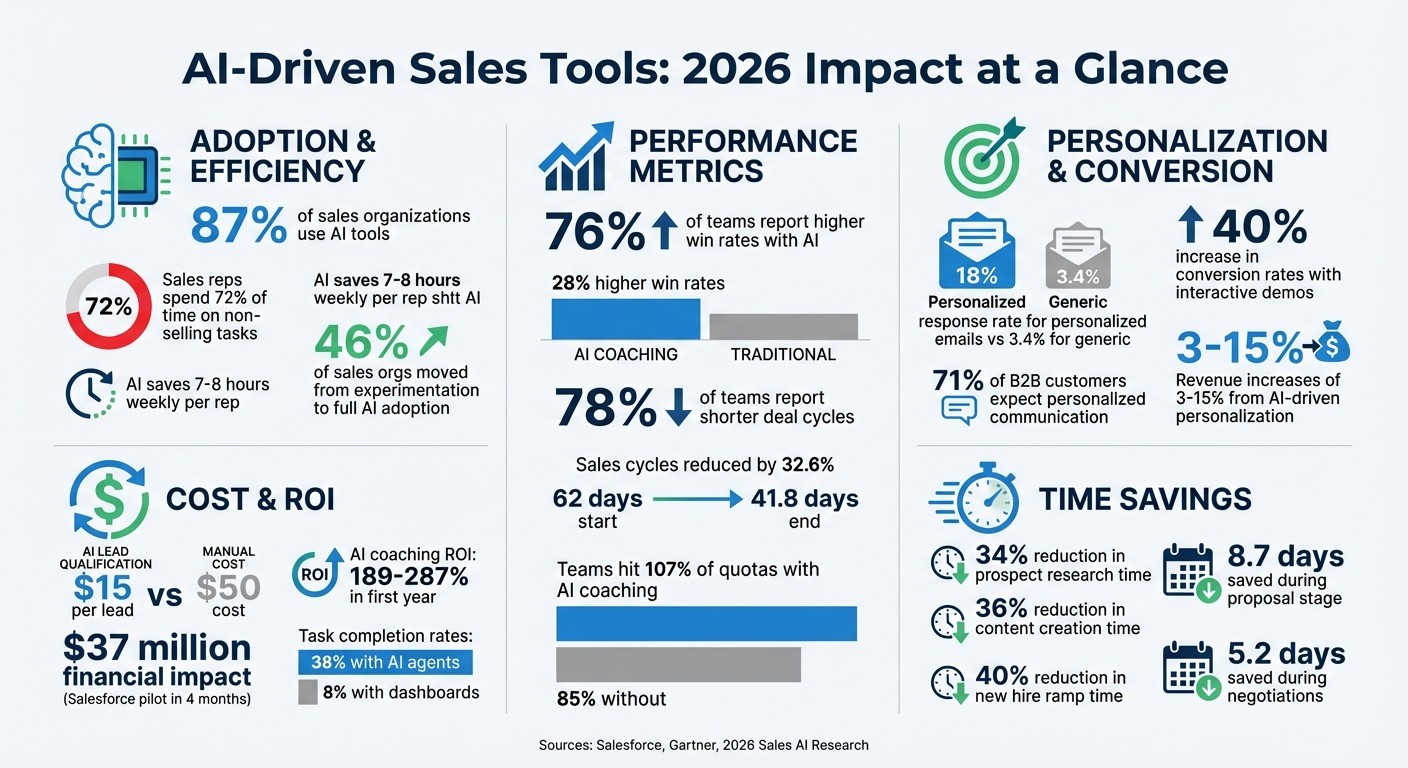
AI-Driven Sales Tools Impact: Key Statistics and ROI Metrics for 2026
Major Trends in AI-Driven Sales Collaboration Tools
By 2026, AI is fundamentally reshaping how sales teams work together, with 46% of sales organizations moving from experimentation to fully embracing AI tools [10]. Five key trends are driving this transformation.
Real-Time Collaboration and Shared Dashboards
Gone are the days of disconnected systems. Sales teams now rely on unified data, addressing a major pain point for 51% of sales leaders who identify siloed systems as a top challenge [2]. Shared dashboards provide live updates, offering instant context for deals and accounts. This is especially critical in an environment where 70% of B2B interactions occur virtually [9]. The results? Virtual deals close 17% faster, and AI-powered teams can respond to buying signals 87% faster, cutting response times down to under 15 minutes compared to the 4–6 hours typical of older systems [7]. This streamlined approach also sets the stage for automating routine tasks with AI agents.
AI Agents for Routine Task Automation
AI agents have advanced to manage entire workflows, freeing sales reps from time-consuming tasks like data entry and research. Considering that reps spend just 28% of their time selling, this shift is game-changing [1]. These agents cut prospect research time by 34% and reduce content creation time by 36% [2][5]. High-performing teams are 1.7 times more likely to adopt these tools [2][5]. For example, Analytic Partners has shown how AI agents can speed up account research, fueling pipeline growth [3].
AI-powered SDRs (Sales Development Representatives) can qualify leads at $15 per lead - far cheaper than the $50 cost of manual efforts. This automation also saves reps 7–8 hours each week and boosts meeting bookings by 40% within 24 hours of inbound follow-ups [3][8].
Generative AI for Personalized Content
Generic outreach no longer cuts it. By 2026, 71% of B2B customers expect personalized communication, and 67% are frustrated by generic approaches [1]. Generative AI steps in to create tailored proposals, email campaigns, and demo experiences by analyzing company data, industry trends, and real-time buying signals [13][14]. The impact is clear: personalized emails achieve an 18% response rate, compared to only 3.4% for generic ones [13]. Interactive demos tailored to individual prospects can boost conversion rates by 40% [12]. A great example comes from Cacheflow, which integrated AI into its CRM to eliminate manual research, achieving full platform utilization within just 24 hours [14]. Companies using AI-driven personalization report revenue increases ranging from 3% to 15% [15][14].
Conversation Intelligence for Coaching and Feedback
Conversation intelligence tools now analyze every sales call, a massive leap from the days when managers reviewed just 9% of calls [9]. This comprehensive analysis enables weekly coaching sessions, helping reps reach 107% of their quotas compared to 85% for those without regular coaching [9]. Implementing a structured B2B sales playbook ensures these coaching sessions align with buyer needs. While AI handles routine tasks, 88% of leaders agree that building executive relationships should still be led by humans [10]. These tools are also evolving to offer real-time coaching directly within sales platforms.
AI-Driven Coaching Built Into Daily Tools
The most transformative trend in 2026 is the integration of AI coaching directly into CRM and sales tools. These systems provide real-time guidance during interactions, offering context-specific advice based on account history, buyer profiles, and deal stages [13]. This embedded coaching ensures that sales reps receive actionable insights exactly when they need them. Additionally, 74% of sales professionals prioritize data cleansing to fully leverage AI, with high performers being 1.7 times more dedicated to maintaining clean data [2]. Adam Alfano, EVP of Sales at Salesforce, sums it up perfectly:
"The secret sauce for sales AI agents is unified data. Stand-alone agents without comprehensive customer context tend to fail."
Adam Alfano, EVP of Sales, Salesforce [2]
How Coach Pilot Aligns with 2026 Trends
Coach Pilot connects strategy with execution by embedding AI coaching into day-to-day workflows, keeping pace with 2026 trends. Below, we’ll explore how it improves playbook accuracy, provides real-time coaching, and integrates seamlessly into sales workflows.
Custom Sales Playbooks for Strategy Execution
Coach Pilot tackles one of the biggest challenges with sales playbooks: ensuring they reflect real-world success rather than theoretical strategies. By analyzing thousands of actual sales calls, the platform pinpoints winning behaviors and identifies skill gaps [16][19]. This ensures that playbooks are based on what truly works in the field.
The platform also automates the creation of scorecards tailored to popular methodologies like MEDDPICC, SPIN, and Challenger [18][19]. AI tools draft objection-handling guides and email templates, allowing enablement managers to focus on refining strategies instead of spending time on manual tasks [21]. Additionally, teams can build custom AI-powered roleplay libraries designed around their products, customer personas, and common objections [16]. This aligns with the growing emphasis on skills-based performance systems, which map competencies to specific territories, customer segments, and product complexities [20].
The results speak for themselves: companies with structured coaching programs report a 10% increase in win rates [16]. Meanwhile, AI-driven enablement tools have reduced new hire ramp times by 40% in B2B tech firms [17].
Training and Real-Time Coaching
There’s a disconnect in sales coaching: while 90% of sales leaders believe they provide regular coaching, 38% of reps say they "rarely or never" receive it [19]. With managers now overseeing an average of 12.1 direct reports, traditional one-on-one coaching simply isn’t feasible [19]. This is where AI steps in.
Coach Pilot's AI Sales Roleplays, also called "Batting Cages", offer reps a 24/7 practice environment. Here, they can engage with AI buyer personas that simulate realistic objections and personality types. During live calls, AI provides real-time prompts and tips for handling objections. Automated scorecards offer immediate, unbiased feedback based on specific methodologies. This approach not only improves coaching quality but also addresses inefficiencies, as reps often lose valuable selling time to administrative tasks [20].
The impact of high-quality coaching is undeniable: reps who receive it are 50% more likely to hit or exceed their targets [19]. Teams leveraging AI tools report faster revenue growth (83%) compared to those without AI (66%) [19].
Integration with Sales Workflows
Coach Pilot eliminates the inefficiencies caused by switching between tools, streamlining the sales process. By embedding AI coaching into CRMs, email platforms, and meeting tools, the platform ensures that sellers can respond quickly and cohesively.
AI copilots offer real-time support during discovery calls and demos, prompting reps to ask key questions and providing live objection-handling tips [22][23]. The platform also automates tasks like scheduling meetings, entering data, drafting follow-up emails, and generating contracts [22][20]. Additionally, intelligent content delivery ensures that case studies, ROI calculators, and battlecards are readily available when needed [20]. This is a game-changer, considering sales teams spend around 440 hours per year - roughly 11 work weeks per person - searching for or creating content [20].
AI-powered content recommendations improve content relevance by 41% while cutting search time by 28% [20]. As one VP of Sales at a Fortune 500 SaaS company put it:
"AI-driven intent detection has been a game changer for our pipeline velocity. We now catch and act on buying signals within minutes, not days." [23]
Research-Backed Performance Impacts of AI Tools
By 2026, AI-powered collaboration tools are driving measurable improvements across sales teams, boosting win rates, shortening sales cycles, enhancing forecast accuracy, and increasing overall efficiency.
Improved Win Rates and Shorter Sales Cycles
The numbers speak for themselves: 76% of sales teams report higher win rates after integrating AI into their sales strategies [25]. AI-driven coaching programs, in particular, lead to 28% higher win rates compared to traditional methods [25]. Early adopters of AI-enabled platforms have seen win rate increases surpassing 30% [1].
A 2026 study highlighted that sales reps receiving AI-driven coaching achieved 19.7% higher conversion rates than those relying solely on human coaching [24]. Additionally, teams leveraging AI are 2.8 times more likely to exceed their quotas compared to those without AI tools [9].
Speed is another area where AI shines. When sales teams act on AI recommendations within 24 hours, sales cycles are cut by an average of 32.6%, shrinking from 62.0 days to 41.8 days [24]. Across the board, 78% of sales teams report shorter deal cycles after adopting AI tools [25]. Specific stages of the sales process also benefit significantly: AI tools save an average of 8.7 days during the proposal stage and 5.2 days during negotiations by identifying bottlenecks like stakeholder gaps or stalled legal reviews [24].
One standout example comes from Salesforce's internal "Customer Zero" pilot, conducted between February and May 2025. Led by Adam Alfano, EVP of Sales, and Brian Barry, VP of Global Field Readiness, the initiative utilized Agentforce Sales Coach and Data Cloud. Over four months, the system generated more than 24,000 personalized recommendations, resulting in a financial impact of $37 million - including $28 million in pipeline and $9 million in closed annual contract value [5][26].
"Our goal is to allow our teams to focus on what truly moves sales forward: building relationships and growing success. AI agents make this possible." - Adam Alfano, EVP of Sales, Salesforce [5]
The most effective sales strategies combine AI with human oversight. A 2026 study comparing different approaches found that "Hybrid Models" - where AI handles routine tasks and data analysis while human managers focus on complex negotiations - yield the best results. AI-only groups achieved 29.2% conversion rates, human-only groups managed 24.4%, but hybrid teams delivered 27.9% conversion rates combined with the highest satisfaction scores, averaging 8.4 out of 10 [24].
"AI doesn't replace human managers - it augments them. The Hybrid Group achieved the best overall outcomes." - Sarina Chen, RevOps Consultant & B2B Strategist [24]
These advancements pave the way for the future of sales enablement, including more precise forecasting and streamlined daily operations.
Better Forecast Accuracy and Team Efficiency
AI tools replace guesswork with actionable insights. By analyzing win rates, customer behavior, and historical sales data, these systems provide real-time updates on pipeline health, significantly improving forecast accuracy [1]. However, only 28% of sales teams currently use AI for forecasting and pipeline analysis, leaving room for broader adoption [27].
The efficiency gains are hard to ignore. Sales professionals report saving 7–8 hours per week through AI automation [8]. Tasks like prospect research and email/content creation see time reductions of 34% and 36%, respectively [5]. This is especially impactful when you consider that the average sales rep spends 72% of their day on non-selling activities, such as 25% on data entry, 22% on manual research, and 25% on administrative tasks [1].
AI tools also enhance coaching effectiveness. Unlike human managers, who typically review only 9% of sales calls, AI systems analyze 100% of calls, providing more comprehensive feedback [9]. This automation allows sales managers to cut their direct coaching time by 43.4%, freeing up time to focus 256% more on complex deal strategies [24].
The shift from static dashboards to proactive AI agents has been transformative. Action completion rates for sales tasks jump from 8% with traditional dashboards to 38% when tasks are delivered via AI agents [26]. Salesforce's internal pilot demonstrated the impact of this shift, contributing directly to the $37 million financial gain achieved in just four months [26].
"By moving from passive dashboards to active agents, we didn't just predict success, we helped secure it." - Ali Nahvi, Director of Product Innovation, Salesforce [26]
AI coaching also helps sales reps hit 107% of their quota on average, compared to 85% for those without regular coaching [9]. With an average cost of $49 per representative per month, AI coaching platforms deliver a first-year ROI ranging from 189% to 287% [24].
Future Outlook: The Evolution of AI-Driven Collaboration Tools
AI-powered tools are moving beyond simple automation to systems capable of working independently. This shift is allowing sales teams to focus more on building relationships and handling complex negotiations. According to Gartner, by 2028, at least 15% of work-related decisions will be made autonomously by AI agents [28].
The Rise of Autonomous AI in Sales Collaboration
The future of AI in sales is about autonomy. Unlike current systems that execute commands, these advanced tools will independently plan, strategize, and act [28]. By 2026, AI copilots are expected to feature in nearly 80% of enterprise applications, and by 2028, AI agents could outnumber human salespeople 10-to-1 [3]. The market for AI agents is forecasted to grow at an annual rate of 46.3%, reaching $52.62 billion by 2030 [28].
One exciting development is the rise of multi-agent systems. Instead of relying on a single AI tool, companies are building networks of specialized agents - each designed for tasks like research, signal analysis, and outreach - that work together, much like a human team [28][3].
"Instead of single, monolithic entities, agentic architecture will consist of teams of specialized agents designed to work on specific tasks while also collaborating and sharing data." - Bernard Marr, AI Strategist [28]
Ambient intelligence is another trend to watch. These systems continuously monitor and provide real-time suggestions, automatically prioritizing next steps [29]. Looking further ahead, we may even see AI agents negotiating directly with one another, handling terms and verifying trust between organizations [29].
Real-world examples highlight the potential. Andrew Giordano of Analytic Partners noted that AI agents helped reps complete 80% to 90% of their research in just 15 minutes [3]. Similarly, Frontify quadrupled its self-sourced pipeline by replacing manual research with signal-driven intelligence agents [3].
Before these autonomous agents see widespread use, they must undergo rigorous testing and certification through simulations [29].
Unified Platforms for Better Collaboration
As AI systems become more independent, integrating tools into a unified platform is becoming critical. Sales teams are working to consolidate their tech stacks to avoid "AI agent fatigue", where switching between multiple tools can cost reps over three hours a day [30][6]. Unified platforms that combine data, enrichment, sequencing, and CRM updates in one interface are proving to be the answer. They not only improve efficiency but also shorten sales cycles.
Fragmented systems create blind spots by restricting AI access to about 19% of critical enterprise data. This lack of access can block signals like usage telemetry or renewal risks [11]. Unified systems solve this by combining data from various sources - usage stats, support tickets, contract terms - allowing AI agents to deliver highly tailored outreach [11].
The numbers back this trend. Over 80% of sales teams plan to consolidate their tech stacks by 2026 [30]. High-performing teams are 1.3 times more likely to use unified platforms, and 90% of sales teams are either using or planning to adopt AI agents within two years [11].
"Stand-alone agents without comprehensive customer context tend to fail. To get accurate results, agents need the full picture. Otherwise, you get garbage outputs." - Adam Alfano, EVP of Sales, Salesforce [2]
Unified platforms are tackling fragmentation by embedding insights directly into tools like Slack, instead of requiring reps to search across multiple dashboards. This shift from passive data to proactive insights has already shown improvements in task completion rates.
However, consolidation has its challenges. More than half of sales leaders cite disconnected systems and tech silos as the main obstacles to AI initiatives [11]. Clean, reliable data is also essential - high-performing teams are 1.5 times more likely to invest in regular data cleansing [11]. Security remains a concern, with privacy and data lineage issues delaying AI projects for over 50% of sales teams [11].
To address these hurdles, organizations should treat data management as seriously as their sales pipeline. Weekly reviews of data health dashboards and public tracking can help. Starting with a single high-value workflow, like lead qualification or renewals, can provide a roadmap for broader consolidation [11]. The ultimate goal is to minimize the number of tools reps need to use, whether through Slack-native agents or CRM-embedded solutions [30][6].
As Silvio Savarese of Salesforce AI Research explains:
"The next evolution adds orchestrator agents: intermediaries that coordinate fleets of specialists, acting as personal AI assistants aligned to your preferences and business goals." - Silvio Savarese, Salesforce AI Research [29]
These orchestrator agents are expected to bring together diverse tools - CRM, email, forecasting - creating a seamless experience across the entire sales process [31].
Conclusion: Key Takeaways for Sales Teams in 2026
By 2026, AI is no longer a novelty - it's the backbone of sales efficiency. High-performing teams are 1.7x more likely to use AI agents, and sales reps leveraging AI are 3.7x more likely to hit their quotas [2][5][6]. The key? Unified data. Adam Alfano, EVP of Sales at Salesforce, puts it perfectly:
"The secret sauce for sales AI agents is unified data. Stand-alone agents without comprehensive customer context tend to fail" [2].
To get started, focus on one impactful AI application, like AI-driven lead scoring or automated follow-ups. Many organizations also find success by integrating ChatGPT for Teams to streamline internal communication and drafting. This approach builds momentum for broader adoption [4].
AI also reshapes how time is spent. By automating 60–72% of non-selling tasks, sales reps gain an extra 12 hours per week to focus on selling. Companies integrating generative AI into their CRMs are 83% more likely to exceed sales targets [1][2][4].
Another game-changer? Integrated platforms. The average enterprise juggles 7–12 disconnected AI tools, leading to over three hours lost daily in context switching [6]. Unified platforms that embed AI directly into CRMs and tools like Slack eliminate these inefficiencies. Teams using AI-native workflows are 3x more likely to hit $1 million ARR within six months [6].
FAQs
Where should we start with AI in our sales workflow?
To start incorporating AI into your sales process in 2026, look for tools that offer real-time coaching, automation, and insights you can act on. AI copilots can assist sales teams by delivering instant suggestions during conversations and analyzing performance metrics. Meanwhile, autonomous AI agents can take care of tasks like prospecting and outreach, giving your team more time to focus on strategic activities. Begin with tools that naturally fit into your existing workflow and take the time to integrate them properly for optimal outcomes.
What data needs to be unified for AI agents to work well?
To help AI agents work efficiently, it's crucial to bring together data from various systems such as CRM tools (like Salesforce), email platforms (like Gmail), and messaging apps (like Slack). By integrating and standardizing this information, businesses can provide a complete and accurate view of customer interactions. This process strengthens the AI's ability to deliver valuable support to sales teams.
How do we keep human judgment in the loop with autonomous AI?
Building strong partnerships between humans and AI is key to keeping human judgment at the forefront. AI should function as a supportive "copilot", providing insights and recommendations that people can evaluate and refine. By treating AI as "digital colleagues", organizations can establish governance frameworks that guide its use and focus its efforts on handling repetitive tasks.
This approach ensures that humans stay in control, make critical decisions, and maintain accountability while upholding ethical standards. At the same time, leveraging AI's strengths can significantly boost productivity, creating a balance where technology supports, rather than replaces, human expertise.
Related Blog Posts

Remove the guesswork from winning more deals.