B2B Sales
AI in CRM: Transforming Sales Content Management
Mar 16, 2026
AI-powered CRMs automate admin, personalize sales content, boost lead scoring and forecasting, and offer real-time coaching to accelerate deals.

AI-powered CRMs are reshaping sales by automating manual tasks, predicting outcomes, and delivering actionable insights. Here's what you need to know:
Time Saved: Sales reps reclaim up to 15 hours weekly by automating data entry, call logging, and follow-up scheduling.
Higher Sales Targets: Teams using AI in CRM are 83% more likely to exceed goals.
Improved Lead Scoring: AI analyzes engagement patterns and customer data to prioritize leads and boost conversions.
Personalized Content: AI generates tailored emails, proposals, and updates based on customer behavior and industry trends.
Pipeline Optimization: AI flags risks, forecasts revenue, and suggests next steps to keep deals on track.
Real-Time Coaching: AI tools provide live guidance during calls and meetings, helping reps close deals faster.
Companies integrating these tools report faster sales cycles, better win rates, and significant revenue growth. AI transforms CRMs from static databases into active sales assistants, enabling teams to focus on building relationships and closing deals.
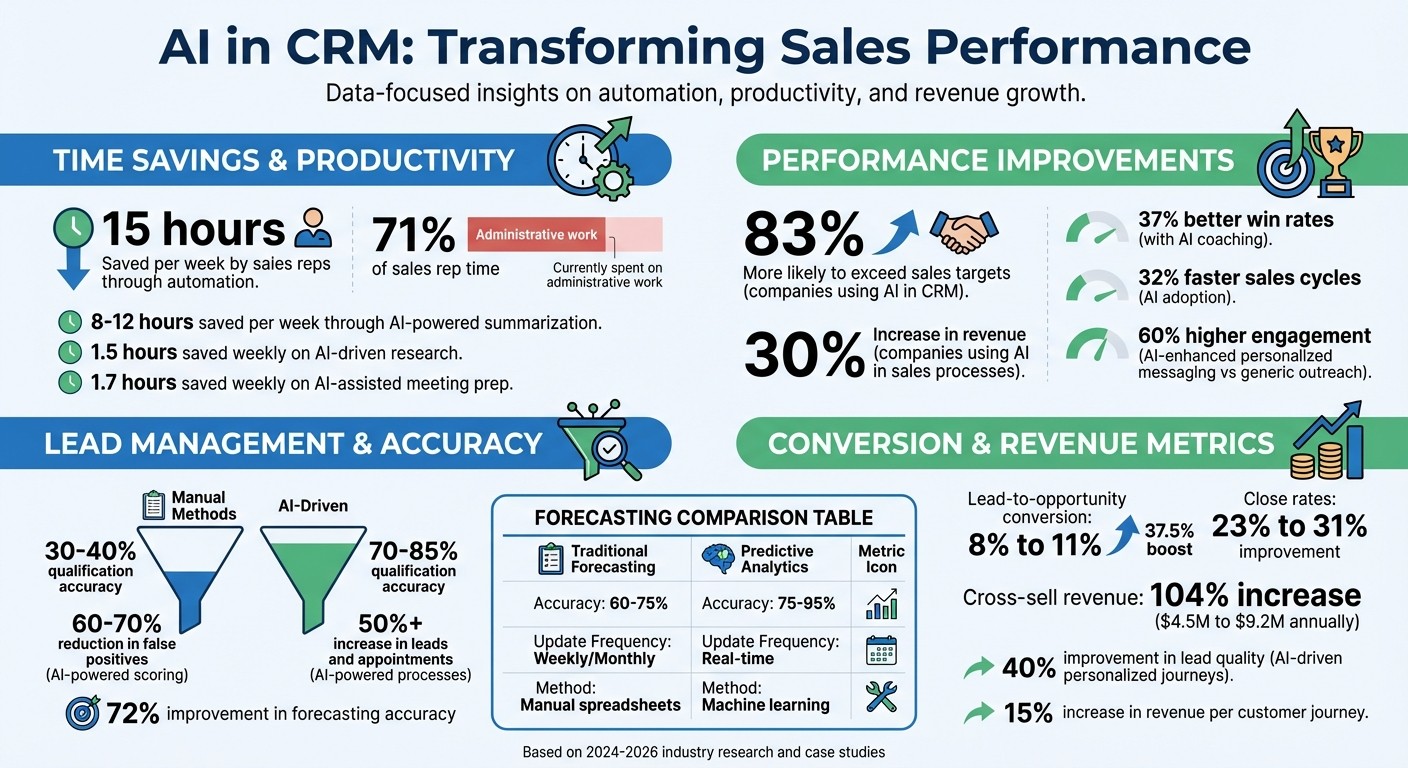
AI in CRM: Key Performance Metrics and Business Impact Statistics
How AI Transforms Sales CRM Workflows
How AI is Changing CRM Systems
AI is reshaping CRM platforms. No longer just static repositories for customer data, modern CRMs now actively manage workflows, predict outcomes, and minimize manual tasks. As Recombine AI aptly states:
"The most overlooked value in today's CRM isn't the dashboard. It's the dialogue." [1]
This shift addresses some of the biggest challenges sales teams face: time-consuming manual tasks, limited insights, and missed opportunities in customer communication. AI tackles these pain points by automating processes, predicting customer behavior, and analyzing the emotional tone of interactions.
Automating Repetitive CRM Tasks
Sales reps spend over 15 hours a week on manual data entry [9]. Tasks like inputting contact details, recording call notes, updating deal stages, and cleaning up duplicate records eat into time that could be spent selling. AI is stepping in to take over.
For instance, automated data capture pulls contact details straight from email signatures, LinkedIn profiles, or documents, filling CRM fields without human effort [9][6]. AI can also join calls and meetings to take notes, summarize discussions, and update CRM records, eliminating the need for post-meeting data entry [11][12].
Dynamic lead scoring is another game-changer. When a prospect repeatedly opens an email, visits a pricing page, or downloads a case study, AI adjusts their score in real time and assigns them to the most suitable sales rep based on expertise and bandwidth [9][2].
AI also ensures data accuracy by merging duplicate records, validating email addresses, and enriching profiles with updates like recent company funding or leadership changes [9][3]. This is critical because poor data quality, not flawed models, accounts for 72% of forecasting errors [2].
Take Salesforce’s internal pilot as an example. Between February and May 2025, they used their Data Cloud and Agentforce platform to deliver over 24,000 personalized recommendations to their sales team. The results? A 38% action completion rate (compared to 8% for traditional dashboard alerts), $28 million in new pipeline, and $9 million in closed revenue during just four months [4].
Beyond automation, AI-powered predictive analytics is turning historical data into actionable insights.
Using Predictive Analytics for Customer Insights
Predictive analytics takes CRM data beyond historical records, using it to forecast outcomes and guide decisions.
AI can prioritize leads by analyzing engagement patterns, company fit, and conversion likelihood. It also flags at-risk opportunities by monitoring signals like declining email responses or prolonged deal stages. For instance, a mid-market SaaS company improved its lead-to-opportunity conversion rate from 8% to 11% - a 37.5% boost - after implementing predictive lead scoring. Their close rates also increased from 23% to 31% [13]. Similarly, an industrial equipment distributor used churn prediction to identify at-risk customers 4.3 months in advance, cutting churn from 12% to 7% and saving $1 million annually [13].
Modern CRMs are evolving from predictive to prescriptive systems. Instead of just forecasting outcomes, they suggest actionable next steps. For example, a wealth management firm using Salesforce Einstein AI identified cross-sell opportunities, leading to a 104% increase in cross-sell revenue - from $4.5 million to $9.2 million annually [13].
Here’s how predictive analytics compares to traditional forecasting:
Aspect | Traditional Forecasting | Predictive Analytics |
|---|---|---|
Data Sources | Sales rep estimates, historical revenue | CRM data, engagement patterns, external factors [13] |
Analysis Method | Manual spreadsheets, gut feelings | Machine learning processing thousands of variables [13] |
Accuracy | 60–75% (often off by 10%+) | 75–95% when implemented correctly [13] |
Update Frequency | Weekly or monthly | Real-time, continuous learning [13] |
As CRM expert Vadim Volnitskyi explains:
"A CRM saturated with data is only valuable if it provides clear, actionable foresight rather than retrospective guesswork." [13]
Analyzing Customer Sentiment in Communications
AI, powered by Natural Language Processing (NLP), can interpret the tone, urgency, and emotional cues in customer interactions. By analyzing emails, chat messages, and call transcripts, it moves beyond simple record-keeping to deliver actionable insights [3].
This is especially valuable for understanding customer intent. Sentiment analysis can adjust lead scores based on subtle expressions of enthusiasm or hesitation. It also acts as an early warning system: if AI detects frustration or confusion in a support ticket or email, it alerts account managers to intervene before the situation escalates [3][9]. Companies using AI-driven sentiment analysis are 83% more likely to exceed their sales targets [5].
AI also identifies positive buying signals and recommends the best timing for upsell opportunities. By converting unstructured data - like messy email threads or call notes - into structured insights, AI equips sales teams with actionable information. Studies show AI models can achieve a median sensitivity of 0.88 when extracting insights from unstructured text [9].
Here’s how AI changes the game for CRM systems:
Feature | Traditional CRM | AI-Powered CRM |
|---|---|---|
Data Role | Passive archive of contact history [3] | Active source of intelligence and sentiment [3] |
Communication | Manual recording of notes [3] | Automated NLP analysis of tone and intent [3] |
Response Style | Reactive (responding to events as they occur) | Predictive (anticipating needs based on tone) [3] |
As Nikolaus Kimla, CEO of Pipeliner CRM, aptly states:
"AI transforms CRM from organizational tools to strategic growth engines." [2]
AI Features That Improve Sales Content Management
AI is reshaping sales content management by complementing CRM automation with tools that streamline content creation, updates, and personalization. These advancements allow sales teams to focus less on administrative tasks and more on building relationships and closing deals.
Sales reps currently spend 71% of their time on administrative work [6]. AI is changing this by automating repetitive tasks like content creation, real-time updates, and communication summaries, freeing up time for higher-value activities.
AI-Generated Sales Content
AI tools analyze customer interactions and successful sales strategies to generate customized email templates, social media posts, and sales materials [16][18]. These drafts incorporate proven tactics from top-performing reps, ensuring consistency and effectiveness.
Platforms like Cirrus Insight and Creatio take this a step further by automatically drafting proposals and quotes based on opportunity data [15][18]. AI also tailors content to specific prospects by analyzing factors like industry, role, and pain points. For instance, a manufacturing prospect might receive a completely different use case or battle card than a SaaS buyer [16].
This level of customization is delivering measurable results. Companies using AI in their sales processes have reported a 30% increase in revenue [14]. By analyzing emails and call transcripts from top performers, AI workflows replicate winning strategies across teams, creating a consistent approach to success [16].
The result? Dynamic updates and hyper-personalized content that resonates with prospects.
Automated Content Updates and Personalization
AI doesn't just create content - it keeps it relevant. By monitoring external signals like funding announcements, executive changes, and company news, AI dynamically updates sales materials and outreach strategies [19][20]. This adaptability drives real results. For example, Zurich Insurance Group used AI-driven insights to craft personalized customer journeys, leading to a 40% improvement in lead quality [21]. Similarly, Investec saved 200 hours annually by leveraging Microsoft 365 Copilot to automate routine tasks, allowing their team to focus on creating personalized customer experiences [21].
Personalization is another game-changer. AI-enhanced messaging tailored to specific challenges and industries boosts engagement by 60% compared to generic outreach [10]. Early adopters have also seen reply rates increase by 15–20% [19]. By combining real-time customer data with generative AI, teams can deliver prospecting-optimized content for Business Development Reps and closing-focused materials for Account Executives [10]. AI even creates personalized visuals and demos, further enhancing engagement [10].
On top of that, AI-powered summarization ensures no detail is overlooked, making follow-ups more effective.
AI-Powered Summarization of Sales Communications
Modern AI tools now act as virtual assistants, handling post-call workflows [17][11]. After a discovery call, AI transcribes and summarizes the conversation, capturing critical details like customer goals, objections, and next steps [17]. Advanced systems can even extract data from these summaries to update CRM fields automatically - whether it's MEDDICC, BANT, or another framework - ensuring accurate pipeline management without manual input. Tools like Coffee and Salesflare streamline this process by connecting directly to emails, calendars, and meeting transcripts, turning CRMs into proactive systems of action [6][22].
These tools can save each sales rep 8 to 12 hours per week by automating data capture [6]. Ameya Deshmukh of EverWorker highlights the value of this approach:
"Sales leaders don't have a 'note-taking problem.' You have a revenue consistency problem - because the truth of the deal lives in a rep's head... instead of your systems." [17]
AI also prepares reps for upcoming meetings by delivering pre-meeting summaries and talking points, drawn from attendee insights and account history, directly to their inbox [15]. This preparation can save reps over 2 hours per day, ensuring they show up fully equipped for every conversation [15].
For teams looking to incorporate AI-driven coaching, platforms like Coach Pilot integrate real-time guidance into sales workflows. This helps teams consistently apply best practices, unifying sales content management with CRM insights for a seamless process.
AI for Lead Management and Pipeline Optimization
AI is reshaping how sales teams handle leads and manage their pipelines, turning data into actionable insights. Instead of relying on outdated scoring methods, AI evaluates hundreds of signals - like website activity, company details, funding news, and executive changes - to pinpoint the leads most likely to convert [24][27].
The results are impressive. AI-driven lead generation achieves 70–85% qualification accuracy, compared to the 30–40% seen with manual methods [29]. Businesses using AI in their sales processes can boost leads and appointments by over 50% [27], while AI-powered scoring cuts false positives by 60–70% [29]. Let’s dive into how AI enhances lead scoring, monitors pipeline health, and offers actionable advice.
Lead Scoring and Qualification with AI
AI has taken lead scoring to a whole new level. Instead of focusing on basic metrics like email clicks, it evaluates deeper account-level signals - things like new funding rounds, leadership changes, or regulatory updates - that reflect genuine buying intent [25]. For example, if a prospect visits a pricing page or downloads a case study, AI updates their score in real time, helping sales teams engage at the perfect moment [27][28].
Using machine learning, AI examines past successful deals to uncover patterns that predict conversions for a specific business [24][25]. It even explains its scoring decisions, highlighting factors like "Matched ICP + high pricing intent" [26][30].
"Something I would spend hours researching manually, now it's automated" [25]
Derek Rosen, Director of Strategic Accounts at Guild Education, captures the efficiency AI brings.
AI also scales effortlessly. It can process 5,000 leads without adding to staff costs [24]. Leads are automatically routed into tiers - like Tier A for immediate follow-up or Tier D for nurturing - and alerts ensure no lead gets overlooked. This is crucial because responding to leads within an hour makes sales teams 7× more likely to have meaningful conversations with decision-makers [27].
Monitoring Pipeline Health and Forecasting Revenue
AI doesn’t just track pipelines; it actively flags risks. It identifies deals in trouble by spotting signs like reduced engagement, missing key decision-makers, stalled deal stages, or a lack of executive involvement [31][32][35]. Real-time monitoring means sales leaders can step in before deals fall through.
Traditional forecasting often relies on gut feelings or optimism. AI replaces this with accurate, data-driven predictions based on buyer engagement - like meeting attendance, response tone, and progress through qualification steps [32][35].
"The pipeline doesn't lie. But it does require someone - or something - that can read it without bias" [32]
This quote from Spotlight.ai underscores the objectivity AI brings to forecasting.
The numbers back it up. AI-powered pipeline insights can improve forecast accuracy by 25–30% and increase win rates by 15–25% [34][28]. Deals identified as well-qualified by AI are 6.3× more likely to close compared to poorly qualified ones [35]. Yet, only 7% of sales teams achieve forecast accuracy above 90%, with most hovering between 70% and 79% [32].
AI also eliminates outdated data by automatically logging interactions - emails, calls, meetings - into CRM systems in real time [31][33][28]. This ensures forecasts rely on live information, not stale manual updates.
"Measuring activity produces a misleading view of pipeline health, while true deal scoring measures progress toward a close" [35]
Rob Stanger from The Go-to-Market Podcast highlights the importance of accurate deal scoring.
AI Recommendations for Next Steps in Deals
AI doesn’t just highlight issues in the pipeline - it offers solutions. By analyzing buyer intent signals like engagement frequency, stakeholder involvement, and response tone, AI suggests specific actions. For instance, it might recommend scheduling a call with an executive sponsor or sending a tailored ROI case study [36][32]. If key decision-makers haven’t been engaged, AI flags this and proposes re-engagement strategies [28][32].
A Salesforce pilot demonstrated how AI-driven recommendations significantly improve action completion rates and contribute to pipeline growth and closed deals [4].
AI even fine-tunes follow-ups, suggesting the best timing, messaging, and communication channels. It can draft personalized emails based on past interactions, saving time and increasing effectiveness [28][37].
"Traditional CRMs store data. AI deal flow management interprets that data and tells you what to do next" [28]
As monday.com explains, this makes CRMs proactive tools rather than static databases.
For teams aiming to integrate AI-driven coaching into their processes, tools like Coach Pilot help sales reps act on these insights, bridging the gap between AI recommendations and execution.
Adding AI Tools to CRM Workflows
Integrating AI into CRM workflows is reshaping how sales teams operate daily. By combining tasks like prospect research, email drafting, and note-taking into a single, seamless workflow, AI reduces the need to jump between multiple platforms. Early trials have already shown notable improvements in task completion and pipeline growth.
This shift addresses a key challenge: sales reps spend only 25% of their time actually selling, with the rest consumed by administrative tasks such as data entry, meeting prep, and pipeline updates [40]. By automating these repetitive activities, AI frees up time for reps to focus on what truly matters - engaging with customers. AI assistants, in particular, are proving to be game-changers for streamlining everyday sales processes.
AI Assistants for Daily Sales Tasks
Conversational AI assistants, often referred to as "copilots", are designed to handle time-consuming tasks like converting emails, calls, and meetings into structured CRM updates - no manual effort required. Tools like Salesforce Einstein Activity Capture and Copper automatically log emails and calendar events [39]. Meanwhile, AI agents can research prospects before meetings, ensuring reps are well-prepared [40].
The impact is clear: AI-driven research saves sales reps an average of 1.5 hours per week [40], while AI-assisted meeting prep cuts another 1.7 hours weekly [43]. Early adopters have reported a more than 30% increase in win rates [40]. Additionally, 56% of sales professionals now use AI daily, making them twice as likely to exceed their targets [40].
"With the Agentforce Sales app in ChatGPT, our reps can prioritize deals, plan accounts, and update Salesforce directly from the conversation. It will change how our sales team works and boost productivity."
– Brandon Metcalf, CEO and Founder, Asymbl [42]
To implement AI effectively, businesses should establish safeguards. Recommendations include using allowlists to control which fields AI can modify and requiring human approval for critical updates like deal stage changes [23]. A phased rollout - starting with one team - helps identify and resolve issues before expanding organization-wide [23].
Platforms like Coach Pilot integrate AI guidance directly into sales workflows, helping reps act on insights in real time. Beyond individual tasks, AI also connects efforts across sales, marketing, and service teams.
Connecting Sales, Marketing, and Service with AI
As CRM systems evolve, AI is bridging the gaps between departments by creating a unified intelligence layer. Traditional CRMs often silo data - sales tracks deals, marketing monitors campaigns, and service handles tickets. AI-native systems, on the other hand, analyze signals from all three areas to provide actionable insights [38].
For example, if a customer shows high satisfaction in service interactions and engages heavily with marketing content, AI can prompt sales to explore an upsell opportunity [4]. HubSpot demonstrated this approach in 2025 when they implemented AI agents to handle routine support inquiries. By late 2025, these agents were autonomously resolving 35% of support tickets, with a goal of surpassing 50% in 2026 [7].
"AI-native CRM behaves less like a System of Record (SoR) and more like a decision engine."
– Everest Group [38]
The benefits of integration are hard to ignore. Companies embedding generative AI into sales and service workflows report productivity boosts of 8–12% [7], and businesses using AI in CRM are 83% more likely to exceed sales targets [5]. One mid-market B2B team saw a dramatic shift after implementing a CRM-voice AI stack: reps went from making 12 manual calls per day to having 4 qualified conversations automatically booked. This resulted in a 28% increase in conversion rates without adding staff [1].
These tools not only improve efficiency but also enhance strategic AI-driven sales coaching and pipeline management, creating a system that supports success across the customer lifecycle.
Before rolling out AI tools, start by auditing your workflows to identify repetitive tasks and establish baseline metrics like response times and lead conversion rates [41]. Clean and organize your data to ensure AI has high-quality inputs [41]. Then, begin with straightforward use cases - like automated prospecting or data enrichment - measure the results, and expand gradually [41].
New Trends in AI-Powered Sales Enablement
The integration of AI tools into CRM workflows is evolving fast, moving from simple automation to systems capable of autonomous sales enablement. By March 2026, nearly half of sales organizations (46%) will have fully committed to AI deployment, and by 2027, almost 90% are expected to adopt autonomous AI agents [48][8]. These advancements are transforming how sales teams create content, engage with customers, and receive coaching - all seamlessly embedded into their daily workflows.
Advanced Personalization with Autonomous AI
CRMs are no longer just databases; they’re becoming intelligent systems that provide real-time, personalized guidance. Instead of sales reps searching for the right materials, AI now delivers tailored content at the exact moment it’s needed [4]. This shift has produced tangible results: AI-driven recommendations have a 38% action completion rate, compared to only 8% for traditional dashboard-based tools [4].
One standout feature is Content Remixing, where AI takes a successful case study and reimagines it into multiple, highly customized emails addressing specific buyer pain points [22]. Another is the ability to perform "research waterfalls", where AI analyzes diverse sources like LinkedIn posts, financial reports, and even podcast appearances to craft personalized outreach hooks [22].
Salesforce’s internal trials highlight the effectiveness of these tools. Their use of autonomous AI personalization not only boosted pipeline growth and revenue but also cut research and content creation time by 33% [4][8].
"We aren't letting an LLM hallucinate a sales strategy, we are enforcing strict guardrails defined by leadership... ensuring the agent operates as an extension of the enablement organization."
– Ali Nahvi, Director of Product Innovation, Salesforce [4]
AI Across Multiple Customer Channels
AI is breaking down barriers between communication channels, creating unified customer journeys that span email, SMS, social media, and voice agents. This cohesive approach ensures customers receive consistent, personalized experiences at every touchpoint [21]. The benefits are clear: companies implementing AI-powered customer journeys report a 15% increase in revenue per journey and save 75% of the time typically spent developing these journeys [21].
For example, Zurich Insurance Group used Microsoft Dynamics 365 Customer Insights in 2024/2025 to manage personalized interactions across various platforms. This AI-driven strategy improved lead quality by over 40% [21]. Modern platforms now even support messaging apps like WhatsApp, WeChat, and Line, ensuring every interaction is captured within the CRM system [49].
Voice AI agents are proving especially effective for initial outreach. Companies using voice AI have seen lead response times double and no-show rates for demos drop by 35% [1]. As these technologies streamline customer interactions, the next step is integrating real-time coaching into these engagements.
AI Sales Coaching Built into Daily Workflows
One of the most game-changing developments in sales enablement is embedding AI coaching directly into everyday workflows. Instead of analyzing past calls, AI now provides in-the-moment guidance during live interactions or immediately afterward [44][45]. This approach shifts coaching from a retrospective task to actionable, real-time support.
In 2025, Bureau implemented AI coaching for structured discovery and automated signal capture, reducing documentation time and achieving a 30% increase in deal conversions [44][47]. Versa Networks took a similar approach, using AI to anchor pipeline reviews on behavioral signals. This cut coaching time for managers in half while improving team performance consistency [44][47].
"AI sales coaching, when executed well, delivers three outcomes: Time recovered, behavior reinforced, and outcomes measured."
– Sanchit Garg, Cofounder & CEO, Zime [44]
Platforms like Coach Pilot bring AI-driven coaching directly into sales workflows. Features like autonomous roleplay and pitch practice allow reps to refine their skills 24/7, using CRM data to simulate real customer objections [46]. Organizations that embrace dynamic, ongoing coaching report win rate improvements of over 6 percentage points [44].
The numbers speak volumes: 37% of sales leaders have seen better win rates, and 32% report shorter sales cycles thanks to AI adoption [48].
Conclusion
Organizations leveraging AI-powered CRM systems are seeing a massive boost in performance, with an 83% higher likelihood of exceeding sales targets [5]. AI-driven forecasting alone has enhanced accuracy by 72% [2]. These advancements are saving valuable time, improving win rates, and shortening sales cycles - clearly demonstrating the game-changing role of AI in sales operations.
The numbers speak for themselves. Sales reps who used to lose over three hours each week to administrative tasks [2] are now able to focus that time on selling. Companies using AI coaching have reported 37% better win rates and 32% faster sales cycles [48]. Meanwhile, just-in-time recommendations are driving 60% more engagement compared to generic content [10]. The move from manual data entry to automated processes, from static training to real-time coaching, and from one-size-fits-all messaging to hyper-personalized outreach has become essential for staying competitive.
Platforms like Coach Pilot are at the forefront of this shift. By combining custom sales playbooks, immersive training, and AI-driven coaching, they provide teams with the tools to automate tasks, leverage predictive analytics, and receive real-time guidance. This approach empowers sales teams to move beyond simply knowing what to do - it helps them execute efficiently at scale, improve forecast accuracy, and close deals faster.
The message is clear: adopting AI is no longer optional. Organizations that embrace these technologies now will position themselves to thrive in a future where AI moves from being a helpful tool to a critical driver of success.
FAQs
What data is needed before adding AI to a CRM?
To make the most of AI in your CRM, start by ensuring your data is accurate, complete, and well-organized. This means keeping contact details, lead profiles, and activity records up to date. If your data is messy or outdated, it can seriously hurt how well the AI performs - and ultimately affect your return on investment. Prioritizing clean, reliable data is essential for getting the best results from your AI-powered CRM.
How do we keep AI-generated CRM updates accurate and safe?
To keep AI-generated CRM updates accurate and secure, focus on maintaining a reliable "golden record" through continuous data deduplication and verification. Automating tasks like note-taking and interaction updates helps minimize manual errors, streamlining the process. Additionally, regular data enrichment and validation ensure your records stay accurate and up-to-date over time. By using AI to link internal insights with external data sources, you can further protect data integrity and improve the precision of your forecasts.
Which AI CRM use case delivers ROI the fastest?
AI sales assistants integrated into CRM workflows offer the quickest return on investment in AI-powered CRM systems. These tools help simplify processes and can cut the average time to close deals by as much as 48%, driving both efficiency and revenue growth.
Related Blog Posts

Remove the guesswork from winning more deals.